If you are an Indian student wrapping up your Master’s degree in Germany, you are standing at the edge of a massive opportunity. You have survived the German lectures, navigated the semester tickets, and perhaps mastered the art of cooking dal in a shared apartment (WG).
But now comes the tricky part: How do you stay?
You have likely heard about the “Germany Job Seeker Visa.” However, there is a massive confusion between the 6-month visa you apply for from India and the 18-month residence permit you apply for inside Germany. If you are already here as a student, the 6-month rule doesn’t apply to you. In this comprehensive topic, you will learn everything about the Germany Job Seeker Visa for Indian Students in 2026, including eligibility criteria, costs, processing times, required documents, success rates, and the complete application process.
Germany Job Seeker Visa at a Glance
| Particulars | Details |
| Visa Type | National Long-Term Visa (D Visa) / Opportunity Card (Chancenkarte) |
| Purpose | Search for employment in Germany |
| Validity | Up to 12 months (or 18 months for in-country German university graduates) |
| Work Permission | Part-time work up to 20 hours/week plus unlimited 2-week trial jobs (Unrestricted work for German graduates) |
| Extension Possible | Generally No (though Chancenkarte may allow follow-up permits upon finding work) |
| Conversion to Work Permit | Yes, after securing a qualified employment contract |
| Processing Time | Usually 4 – 12 weeks |
| Financial Requirement | Proof of sufficient funds via Blocked Account (€1,091/month for Chancenkarte; €992/month for students/grads) |
| Health Insurance Required | Yes, mandatory for the entire duration of the stay |
| Minimum Qualification | Recognized Degree (Bachelor’s/Master’s) OR a state-recognized 2-year Vocational Qualification |
| Target Applicants | Skilled professionals, international graduates, and qualified point-based candidates |
Immigration Framework
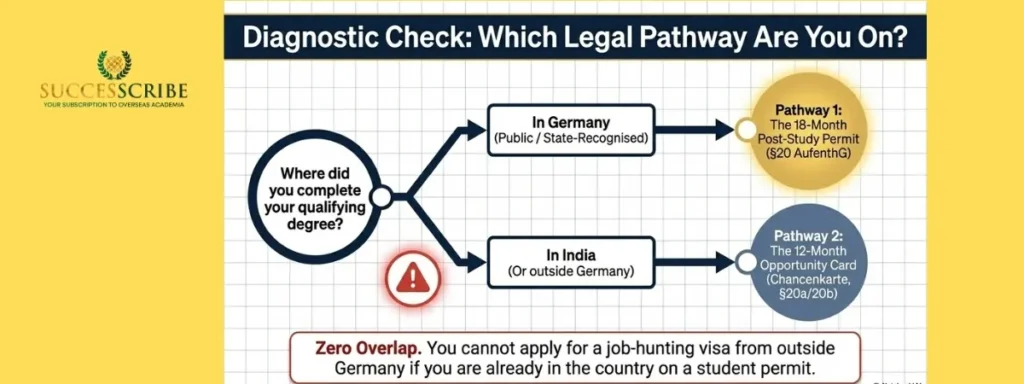
For Indian students and young professionals planning to establish a career in Europe’s largest economy, navigating the immigration pathway requires a clear understanding of the options available. The updated 2026 immigration regulations split into two main pathways, fundamentally changing how the traditional Germany job seeker visa for indian students operates depending on where you graduated.
- The 18-Month Post-Study Job Seeker Visa (§20 AufenthG): A specialized, highly flexible route exclusively reserved for international students who have successfully graduated from a public or state-recognized private university within Germany.
- The 12-Month Opportunity Card (Chancenkarte, §20a/20b AufenthG): A points-based legal framework that allows individuals holding degrees or vocational certificates completed outside Germany (such as from Indian universities) to enter the country to secure qualified employment.
Understanding the subtle operational differences, financial thresholds, and regulatory criteria of these two distinct paths is essential for launching a successful career in Germany.
Pathway 1: The German University Graduate Route (§20 AufenthG)
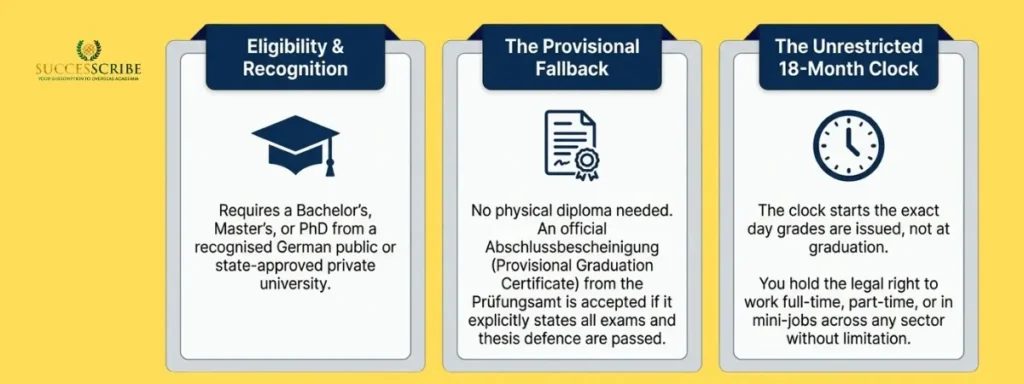
For those who completed their degrees locally, the 18-month residence permit functions as the highly advantageous, in-country version of the Germany job seeker visa for indian students. It serves as a regulatory bridge designed to keep German-trained talent within the domestic workforce.
Eligibility & Institutional Recognition
To transition from your student visa (Aufenthaltstitel zu Studienzwecken) to the official 18-month post-study search permit, you must meet specific graduation benchmarks:
| Requirement Category | Compliance Rule & Details |
| Academic Scope | Must hold a completed Bachelor’s, Master’s, or PhD degree. |
| Institutional Status | Degree must be from a public German university (Universität or Fachhochschule) OR a state-approved private university. |
| Critical Document | Your official Degree Certificate. |
| Provisional Fallback | If the physical diploma is delayed, you can submit a Provisional Graduation Certificate (Abschlussbescheinigung) from your university’s examination office (Prüfungsamt). |
Crucial Check for the Provisional Certificate: The Abschlussbescheinigung cannot just be a grade sheet. It must explicitly state that you have officially passed all examinations and successfully completed your thesis defense.
Rights, Privileges, and Employment Flexibility
The German graduate pathway offers highly favorable legal privileges compared to candidates applying for a job seeker visa from abroad:
- The 18-Month Clock: You receive an uninterrupted window of 18 months to look for a job.
Note: The clock starts the exact day your final grades or provisional certificate are issued by the university, not on the day of your formal graduation ceremony.
- Unrestricted Work Allowance: To financially support yourself while looking for your dream corporate role, you can work as much as you want. There are no labor market tests, no hour limits, and no industry caps.
| Employment Type | Allowed during the 18 Months? | Conditions |
| Full-Time Job (Any field) | Yes | Can be in retail, hospitality, customer service, etc. |
| Part-Time / Mini-Job | Yes | No restriction on the number of hours or employers. |
| Academic Internships | Yes | Can be within or completely outside your major. |
Transitioning to an EU Blue Card (Blaue Karte EU)
Your ultimate goal during these 18 months is to secure a permanent, qualified employment contract that matches your academic background. Once you have a job offer, you can convert your status directly at your local immigration office (Ausländerbehörde) without leaving Germany.
The premier route for young professionals is the EU Blue Card. The German Federal Ministry of the Interior has updated the official gross salary thresholds for 2026.
| Occupational Category | 2026 Gross Annual Minimum | 2026 Gross Monthly Minimum | Target Group & Qualifying Fields |
| Standard Occupations | €50,700 | €4,225.00 | Business, law, management, humanities, marketing, and all other non-shortage fields. |
| Shortage Occupations & Career Starters | €45,934.20 | €3,827.85 | 1. High-Demand Fields: IT, engineering, mathematics, natural sciences, architecture, and medicine. 2. Recent Grads: Anyone who graduated from university within the last 3 years (applies to any field). |
The 3-Year Graduate Advantage: Because you are a recent graduate from a German university, you automatically qualify for the lower salary threshold (€45,934.20) for the first three years after finishing your studies, no matter what field your job offer is in!
Pathway 2: The Opportunity Card (Chancenkarte) for Indian Graduates
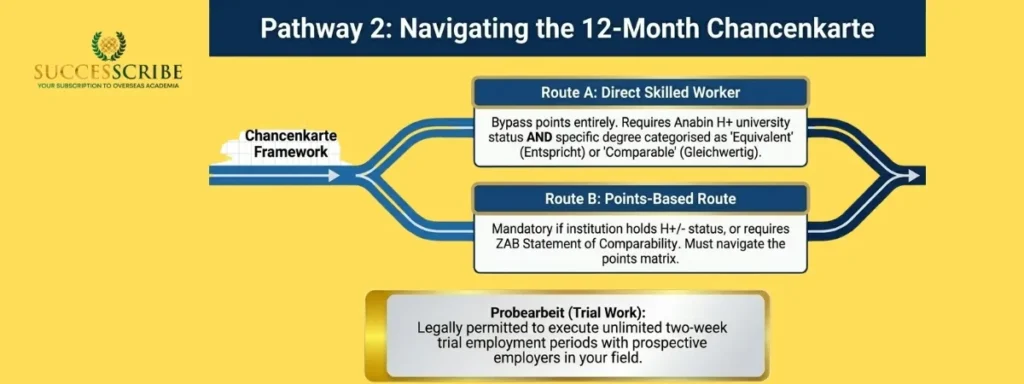
For Indian students who have completed their degrees at universities within India (e.g., IITs, NITs, Delhi University, or any UGC-recognized institution) and want to enter Germany to find a job, the old 6-month Job Seeker Visa has been fundamentally replaced by the Opportunity Card (Chancenkarte). This framework functions via two distinct legal pathways.
Pathway A: The Direct Skilled Worker Route
If your Indian university holds an H+ status on Anabin, you can bypass the points system entirely under the direct route of the Germany job seeker visa for indian students. This is known as qualifying directly as a “Skilled Worker” (Fachkraft).
To verify this, your degree must pass the dual check on the Central Office for Foreign Education (Anabin) database:
- Your university must be classified with an H+ status.
- Your specific degree title must be listed under that university and categorized as Equivalent (Entspricht) or Comparable (Gleichwertig).
If your degree meets these criteria, you automatically qualify for the Chancenkarte without calculating a points score, provided you meet the fundamental financial and language baselines.
Pathway B: The Points-Based Route
If your Indian degree is from an institution with an H+/- status, or if your specific program requires an individual Statement of Comparability from the ZAB (Zentralstelle für ausländisches Bildungswesen) and is only partially recognized, you must navigate the points-based selection system.
To enter the points pool, you must first clear the mandatory baseline requirements:
- Education: A foreign university degree or a state-recognized vocational qualification requiring at least 2 years of institutional study.
- Language: Verified A1 level German proficiency (via Goethe-Institut, ÖSD, Telc, or ECL) OR a verified B2 level English proficiency (via IELTS Academic/General with a minimum band score of 5.5–6.5, or TOEFL iBT).
Once these baseline criteria are met, you must score a minimum of 6 points from the official German Federal Ministry distribution matrix detailed below:
| Criterion Category | Specific Condition | Points Allocated |
| Qualification Equivalence | Partial recognition of foreign qualification (via formal ZAB assessment showing gaps) | 4 Points |
| Shortage Occupation | Job profile falls under a “Mangelberuf” (Engineering, IT, Healthcare, Architecture) | 1 Point |
| Professional Experience (Must match field) | Minimum 5 years within the last 7 years; minimum 2 years within the last 5 years | 3 Points2 Points |
| German Language Skills (Only highest counts) | B2 Level (CEFR)B1 Level (CEFR)A2 Level (CEFR) | 3 Points2 Points1 Point |
| English Language Skills | C1 Level (CEFR) | 1 Point |
| Age Demographics | Age ≤ 35 years oldAge 36 to 40 years old | 2 Points1 Point |
| Prior German Ties | Continuous legal stay of 6+ months within the last 5 years (Excludes tourist stays) | 1 Point |
| Accompanying Spouse | Spouse applies concurrently and meets Chancenkarte basic eligibility criteria | 1 Point |
Rights and Trial Employment Parameters under Chancenkarte
The Chancenkarte offers structural flexibilities that did not exist under legacy job-hunting models:
- 12-Month Base Validity: It provides an initial one-year window to find a qualified position.
- Part-Time Secondary Employment: You are legally allowed to work up to 20 hours per week in any economic sector to offset your living expenses while interviews are ongoing.
- Trial Work Parameters (Probearbeit): You are permitted to execute an unlimited number of two-week trial employment periods with prospective employers for roles that match your qualification profile. This enables companies to assess your technical capabilities before committing to a full-time contract or sponsorship.
Germany Job Seeker Visa / Chancenkarte Requirements (India)
Satisfying the core pillars of language proficiency, academic recognition, and age brackets is crucial to securing an approval for the Germany job seeker visa for indian students. To apply from India, you must satisfy basic eligibility pillars under either the traditional Job Seeker provisions or the points-based Opportunity Card (Chancenkarte) framework.
| Requirement Pillar | Specific 2026 Criteria for Indian Applicants |
| Academic & Training | Hold an Indian Bachelor’s or Master’s degree recognized via Anabin (H+) or supported by a ZAB Statement of Comparability. |
| Work Experience | A preferred minimum of 1–2 years for standard tracks, or up to 2–5 years to secure points under the Chancenkarte system. |
| Language Baseline | English B2 (e.g., IELTS minimum 5.5–6.5) OR German A1 is required to enter the Chancenkarte point pool. |
| Financial Sufficiency | Must prove you can self-sustain without relying on German social welfare. Must be verified through a registered Blocked Account (Sperrkonto). |
| Age Limitations | No official cap for the standard path (applicants 45+ must show pension plans). Chancenkarte awards extra points if you are under 35 or between 36 and 40. |
Germany Job Seeker Visa Processing Time
The implementation of the Consular Services Portal (CSP) at digital.diplo.de allows Indian applicants to fill forms and upload documents online before scheduling biometrics at VFS Global.
| Processing Stage | Expected Timeline (2026) | Variable Factors |
| Digital Pre-Check (via CSP) | 1 – 2 Weeks | Time taken by consulates to digitally vet pre-uploaded documents. |
| VFS India Document Forwarding | 1 – 6 Working Days | Logistical transit of passport/biometrics to the regional German Consulate. |
| Standard Consular Processing | 4 – 8 Weeks | Regular turnaround time for the National Visa sticker to be issued. |
| Peak Season Processing | 8 – 12 Weeks | High volume periods (typically March–June and September–December). |
Germany Job Seeker Visa Success Rate
The success rate for Indian applicants hovers around 80% to 85%. Rejections are typically not due to quote limits, but stem from document inconsistencies.
Leading Denial Triggers vs. Success Factors
- The “Template” Refusal: Using AI-generated or generic cover letters that lack actual job search evidence (such as list of target companies, job IDs, or open applications). Success Tip: Attach copies of active email correspondences or interviews with German recruiters.
- Anabin Mismatches: Presenting an Indian degree from an H+/- university without a corresponding ZAB certificate.
- Incomplete Points Claims: Miscalculating Chancenkarte points – such as trying to count work experience gained before your graduation date.
Germany Job Seeker Visa Documents Checklist
Assembling two identical physical document sets alongside your digital uploads is a non-negotiable step when preparing your portfolio for the Germany job seeker visa for indian students. When attending your VFS Global appointment in India, you must arrange two identical sets of physical A4 copies alongside your original documents:
- Passport: Must be issued within the last 10 years, with at least 2 entirely blank pages, and valid for at least 12 months.
- Application & Section 54 Declarations: Printed, completed, and signed copies from the portal.
- Biometric Photos: Two identical, recent passport-sized photos matching strict ICAO standards.
- Cover Letter / Motivation Letter: A signed statement mapping out your planned arrival date, your target professions, and why you are targeting Germany over other EU nations.
- Tabular Curriculum Vitae (CV): Written in English or German, reflecting your exact professional timeline.
- Proof of Qualification Recognition: Printed Anabin database sheets (showing your university’s H+ status and degree equivalence) OR an official ZAB Statement of Comparability.
- Official Language Certificate: Standardized score reports from recognized providers (e.g., IELTS, TOEFL, or Goethe-Institut).
- Sperrkonto (Blocked Account) Confirmation: Official PDF confirmation from a provider showing the mandatory 2026 funds balance.
- Travel Health Insurance: A valid initial policy offering a minimum of €30,000 in coverage with no deductible higher than €300.
- Proof of Accommodation: Initial hotel, hostel, or host apartment rental confirmations listing a valid physical address in Germany.
Germany Job Seeker Visa from India Cost
Calculating your total upfront budget – including visa fees, translation costs, and blocked account allocations – is essential before launching your application for the Germany job seeker visa for indian students.
| Cost Component | Pricing in EUR (€) | Pricing in INR (₹ Approx.) | Operational Scope |
| National Visa Base Fee | €75 | ₹6,800 | Non-refundable administrative processing fee. |
| VFS Global Logistics Fee | €20 – €40 | ₹1,000 – ₹1,900 | Standard biometric collection and document shipping fee. |
| Mandatory Monthly Funds | €1,091 / month | ₹98,500 / month | Minimum required to be held in a blocked account. |
| Opportunity Card (12 Mos) | €13,092 | ₹11,85,000 | Total 1-year financial proof needed for the Chancenkarte. |
| Traditional Job Seeker (6 Mos) | €6,546 | ₹5,92,000 | Total 6-month financial proof needed for legacy tracks. |
| Document Verification/Translation | Varies by region | ₹15,000 – ₹40,000 | Costs for MEA apostilles, regional verification, and certified translations. |
| Incoming Health Insurance | €30 – €50 / month | ₹2,700 – ₹4,500 / month | Initial coverage valid for the duration of travel and job search. |
Strategic Optimization Blueprint for Indian Applicants
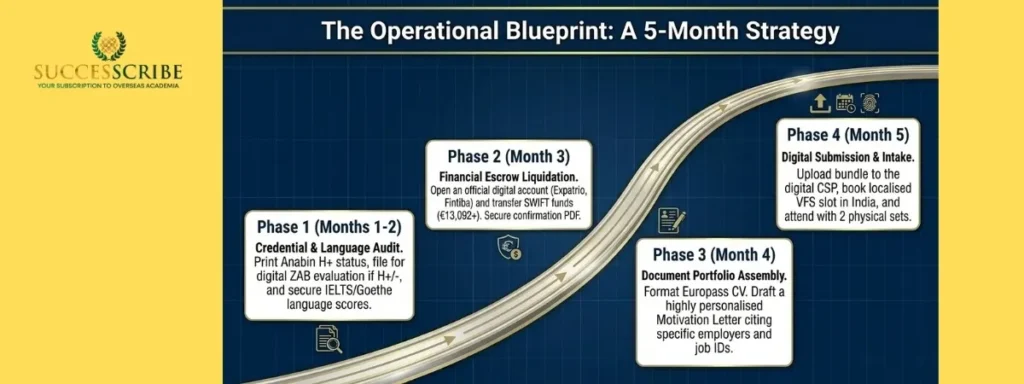
Successfully securing your visa and launching a career in Germany requires moving away from manual, unorganized steps. Indian applicants who follow a strict, phased preparation schedule experience significantly higher approval rates and avoid common bureaucratic delays. Following a meticulous, phased four-month preparation roadmap maximizes your approval odds and guarantees success throughout the entire journey of obtaining a German job seeker visa for indian students. Use this operational phase map to guide your strategy:
| Phase & Timeline | Action Items & Steps | Pro-Tip / Success Factor |
| Phase 1: Credential & Language Audit (Months 1 – 2) | [ ] Print your Indian university’s H+ status from the Anabin database.[ ] File for a digital Statement of Comparability via the ZAB portal if your program is missing or rated H+/- Take an official language test to secure your score (IELTS B2 or Goethe A1-B2). | If your Chancenkarte score falls short of the required 6 points, completing a quick German A1 or A2 certification is the fastest way to bridge a 1- or 2-point deficit. |
| Phase 2: Financial Escrow Liquidation (Month 3) | [ ] Open a digital account with an officially recognized German provider (Expatrio, Fintiba, Coracle).[ ] Transfer your required funds via SWIFT or integrated payment gateway: • Chancenkarte (12 Mos): €13,092 (₹11.85 Lakhs) • Legacy Job Seeker (6 Mos): €6,546 (~₹5.92 Lakhs)[ ] Download your official Blocked Amount Confirmation PDF. | Always add an extra €100 to €150 to your initial transfer to shield your final balance from intermediate bank routing fees and sudden currency fluctuations. |
| Phase 3: Document Portfolio Assembly (Month 4) | [ ] Reformat your entire professional history into a chronological, clean Europass tabular CV.[ ] Draft a highly personalized Motivation Letter listing target cities, 5–10 specific employers, and active job IDs.[ ] Purchase a Schengen-compliant travel health insurance policy (minimum €30,000 coverage, zero deductible). | Avoid generic AI templates that simply state you “want to experience German culture.” Consulates heavily reject applications that lack concrete evidence of an active job search. |
| Phase 4: Digital Submission & VFS Intake (Month 5) | [ ] Scan and upload your complete document bundle to the digital Consular Services Portal (CSP) at digital.diplo.de.[ ] Book your localized biometric appointment slot at VFS Global India.[ ] Attend your VFS slot with two identical physical sets of your complete application package. | Keep a digital copy of your entire submitted portfolio on your phone. Consular officers occasionally call applicants for a brief phone interview during the 4–8 week vetting window. |
Conclusion
Navigating the transition from university to the professional world can feel overwhelming, but Germany has built robust pathways to retain global talent. Whether you are transitioning directly from a campus in Berlin or planning your move from New Delhi, understanding your options is the ultimate key to success. By aligning your credentials, securing your finances, and carefully mapping out your application steps, turning your professional aspirations into a European reality becomes an entirely achievable milestone.
For a smooth transition into Europe’s largest economy, executing the right strategy for the Germany job seeker visa for indian students will ensure you bypass common bureaucratic hurdles and secure your future.
FAQs
Ouestion 1. Can I bring my dependent spouse and children with me to Germany on a Job Seeker Visa or Chancenkarte?
Answer. Under standard immigration rules, family reunification (Ehegattennachzug) is typically restricted while holding a temporary job seeker status. However, the Chancenkarte framework provides a dedicated pathway for this.
You can apply for concurrent entry for your spouse if you meet two conditions:
1. You can demonstrate sufficient joint financial resources (which requires a larger blocked account balance or additional income to support multiple people).
2. Your spouse scores at least 1 point on the Chancenkarte matrix, allowing you to submit a joint family application.
Ouestion 2. How do I handle a situation where my Indian university is listed as H+ on Anabin, but my specific degree program is not listed?
Answer. If your university is clearly rated as H+ but your specific degree program is missing from the database, you cannot claim automatic recognition. In this scenario, you have two procedural options:
The Points Route: Apply for the Chancenkarte via the points-based track by presenting your baseline documents and language scores to achieve the 6-point requirement.
Formal ZAB Evaluation: Prior to your visa application, apply for an individual Statement of Comparability (Zeugnisbewertung) directly through the digital ZAB portal. This independent evaluation takes roughly 3 months and provides a definitive assessment of your degree’s German equivalence.
Ouestion 3. What happens if I find a full-time job in Germany that does not match my university degree?
If you are on the 18-Month Post-Study Job Seeker Visa, you can work any job temporarily. However, to convert that visa into a long-term Work Permit or an EU Blue Card, German law requires the position to be classified as “qualified employment” that aligns with your academic specialization.
Ouestion 4. Can I start working immediately while holding the 18-Month Post-Study Permit?
Answe. Yes, completely. This is one of the biggest advantages of graduating within Germany. Unlike the legacy 6-month visa or the 20-hour limit on the Opportunity Card, the 18-month post-study permit gives you unrestricted work rights. You can work full-time in retail, hospitality, or internships to fund your lifestyle while hunting for your primary corporate role.
Ouestion 5. What happens if the 18 months or 12 months pass and I haven’t found a qualified job?
Answer. Neither permit can be extended beyond its statutory limit (18 months for local grads, 12 months for the Opportunity Card). If the time runs out without a qualified job offer matching your university degree, you must return to India or switch to an alternative visa category (such as a student visa for a different program or an language learning track) to stay legally.
Related Post
MBA Scholarship in Germany
One year masters in Germany
Best courses to study in Germany
Minimum wage in Germany