Germany has solidified its position as the undisputed epicenter of European biotechnology. The strategic importance of pursuing a Masters in Biotechnology in Germany lies in the unique convergence of high-precision engineering and advanced molecular biology – a synergy currently driving the “Bio-Revolution.” Germany’s approach to the life sciences is no longer purely academic; it is an industrial mandate. With the proliferation of “Pharma 4.0” and the digitalization of bioprocess engineering, the German education system has evolved to produce specialists who are as proficient in bioinformatics and data modeling as they are in genetic sequencing. For the international student, particularly those from emerging markets, this represents a unique entry point into an ecosystem where innovation is backed by the world’s most robust manufacturing infrastructure and a relentless commitment to R&D.
Key Highlights: Masters in Biotechnology in Germany
- Why Pursue a Master’s in Biotechnology in Germany
- Top Universities for Master’s in Biotechnology in Germany
- Analyzing Specialization Pathways: From Molecular Design to Bioprocess Engineering
- Comprehensive Semester Curriculum Structure
- Technical Entry Requirements and Eligibility Benchmarks
- Career Prospects and Post-Study Work Visa (The ROI)
- Tuition Fees and Living Cost for a Master’s in Biotechnology in Germany
- Scholarships for International Students
- Applicant’s Actionable Roadmap for a Master’s in Biotechnology in Germany
- Student Life, Culture, and the “Hidden” Challenges
- Conclusion
- FAQs
Why Pursue Masters in Biotechnology in Germany
Germany’s innovation landscape is defined by its resilience and its strategic focus on bridging the gap between bench-top research and industrial production. Pursuing a Masters in Biotechnology in Germany places students at the heart of this dual-layered economic powerhouse.
- Global Innovation Hub: Germany is a world leader in biotech, hosting elite institutions like TU Munich and Heidelberg University that drive global breakthroughs in healthcare and sustainability.
- Unrivalled Affordability: Most public universities offer tuition-free education, providing a world-class degree without the burden of international student debt.
- Industry Synergy: Direct collaboration with giants like Bayer, Merck, and BASF ensures your training is deeply practical and at the forefront of the “Bioeconomy”
- Elite Career Runway: Graduates command high starting salaries (€45,000–€60,000) and benefit from an 18-month post-study visa to launch their careers in a booming job market.
This degree is a powerful passport to global scientific leadership, blending rigorous research with a high return on investment
Core Strategic Benefits
- Pharma 4.0 Curricula Integration: Unlike many global programs, German M.Sc. tracks now mandate modules in bioinformatics and digitized production. This prepares graduates for the smart factories of Bayer and Merck, where data-driven genetic analysis is the standard.
- The “No Tuition” vs. Specialized Private Choice: The public system offers a virtually tuition-free pathway, provided students can meet the rigorous “Numerus Clausus” (restricted admission) standards. Conversely, private institutions like Fresenius provide high-specialization management tracks for those aiming for “Life Science Consulting” or “Regulatory Affairs” rather than laboratory research.
- Strategic Innovation Clusters: Students situated in the Upper Rhine Valley (Freiburg, Strasbourg, Basel) benefit from a tri-national innovation cluster. This region is a global hub for Evolva, Roche, and Novartis, offering a multicultural professional environment that is second to none in Europe.
- Eastern European Pathways: A notable strategic detail exists for students from Eastern Europe; institutions like Offenburg University provide English-taught programs that incorporate German and Polish language contexts, serving as a gateway for those looking to bridge the gap between Eastern European markets and the German industrial core.
- Post-Study Workforce Integration: Germany’s economic stability is paired with an 18-month post-study work visa, specifically designed to retain high-skilled biotech talent in sectors ranging from precision fermentation to mRNA vaccine development.
This academic pathway is fundamentally an investment in the German labor market’s demand for specialized talent, providing a secure trajectory in a global economy characterized by rapid biotechnological disruption.
Suggested Post: Masters in Management in Germany
Top Universities for Masters in Biotechnology in Germany
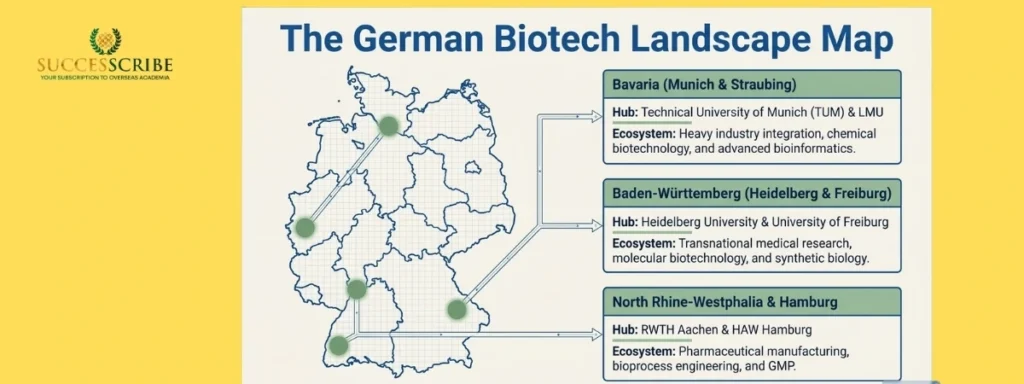
Institutional reputation in Germany is often tied to the distinction between Technical Universities (TU) and Universities of Applied Sciences (UAS). While TUs like TUM and RWTH Aachen offer traditional research depth, UAS institutions like HAW Hamburg and TH Mannheim focus on the “Applied” nature of the science, often resulting in faster entry into the workforce.
| University Name | Specific Program Title | Duration/ECTS | Language | Strategic Asset |
| Technical University of Munich (TUM) | M.Sc. Molecular Biotechnology | 4 Sem. / 120 ECTS | English/German | Global Rank #16; access to Freising/Garching hubs. |
| Heidelberg University | M.Sc. Molecular Biotechnology | 4 Sem. / 120 ECTS | English/German | Substance Research focus; partner with EMBL/Merck. |
| University of Freiburg | M.Sc. Biology (Biotech Spec.) | 4 Sem. / 120 ECTS | English | Trinational Program: Collaboration with Basel & Strasbourg. |
| KIT (Karlsruhe Institute of Technology) | Chemical Biology, Industrial Biotechnology | 4 Sem. / 120 ECTS | English | #42 in Engineering & Tech (QS 2026); emphasis on engineering principles. |
| Offenburg University of Applied Sciences | Master of Science in Biotechnology (MBT) | 3 Sem. / 90 ECTS | English | Joint program with UWM in Poland; focus on Bioeconomy and Industrial Biotechnology. |
| RWTH Aachen University | M.Sc. Biomedical Engineering | 4 Sem. / 120 ECTS | Primarily German | Heavy engineering focus; Strategic Warning: B2/C1 German needed. |
| HAW Hamburg | M.Sc. Pharm. Biotechnology | 3 Sem. / 90 ECTS | English | 3-semester speed; requires A2 German at application. |
| TH Mannheim | M.Sc. Biotechnology | 3 Sem. / 90 ECTS | English | Includes Biostatistics & Process Automation modules. |
| University of Hohenheim | M.Sc. Biotechnology | 4 Sem. / 120 ECTS | English | Block Module System: Intensive 4-week deep-dives. |
| BTU Cottbus-Senftenberg | M.Sc. Biotechnology | 3-4 Semesters | English | Offers 3-semester entry for 210 ECTS Bachelors. |
| Fresenius University | M.Sc. Med. & Pharm. Biotech | 4 Sem. / 120 ECTS | English | Private sector focus; specialized in GMP & Regulatory Affairs. |
Analyzing Specialization Pathways: From Molecular Design to Bioprocess Engineering
Choosing a specialization in 2026 requires an understanding of where the “Value Chain” of biotechnology is heading. The market now rewards professionals who can navigate both the “wet lab” and the “dry lab” (computational analysis).
The Five Pillars of German Biotechnology
- Molecular Biotechnology: The focus here is on the production and design of natural and artificial biomolecules. This is the cornerstone of “Red Biotechnology.” Professional applications involve protein engineering and synthetic biology, where you manipulate genetic features to optimize biosynthetic performance.
- Industrial Biotechnology (White Biotechnology): This pillar is the engine of the sustainable bioeconomy. It utilizes microbial systems for industrial production. Key skills in high demand include metabolic engineering and precision fermentation.
- Medical Biotechnology: Heavily clinical, this pathway covers the development of mRNA vaccines, diagnostic tools, and regenerative medicine. You will apply pharmacology and molecular diagnostics to identify new healing opportunities for chronic diseases like Multiple Sclerosis or cancer.
- Environmental Biotechnology: Strategic for those interested in climate change mitigation. It focuses on bioremediation, biohydrogen production, and sustainable resource management, using biological processes to solve ecological crises.
- Bioinformatics and Computational Biology: This is the “Data Science” of life sciences. With modules like Biostatistics and Genomics, professionals manage large-scale NGS data, utilizing AI and mathematical modeling to predict protein structure or simulate drug interactions.
Suggested Post: MS in Cloud Computing in Germany
Comprehensive Semester Curriculum Structure
A standard masters in biotechnology in germany spans 4 semesters (2 full academic years) and totals 120 ECTS credits. The course structure balances classroom theory with immersive lab modules, culminating in a dedicated semester of research.
- Semester 1 (Core Foundations): Advanced Molecular Genetics, Systems Biology, Metabolic Engineering, and Bioprocess Kinetics.
- Semester 2 (Specialization Electives): Students choose their concentration tracks. Options include downstream industrial processing, clinical diagnostics, pharmaceutical development, or computational bioinformatics.
- Semester 3 (Advanced Practical Lab Modules): This semester emphasizes independent project planning. Students spend weeks inside advanced laboratory facilities learning modern techniques like CRISPR gene editing, high-performance liquid chromatography (HPLC), mass spectrometry, and bioreactor scale-up operations.
- Semester 4 (Master’s Thesis): A full six months dedicated to a research project. This thesis can be executed within university laboratories, affiliated research entities (like the Fraunhofer or Max Planck Institutes), or directly on-site at an industrial pharmaceutical or biotech company.
Technical Entry Requirements and Eligibility Benchmarks
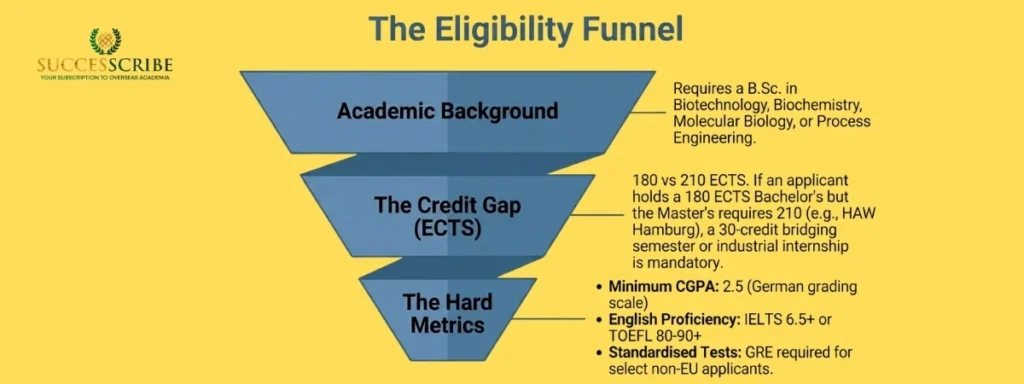
The barrier to entry for a Masters in Biotechnology in Germany is not just academic excellence but technical alignment. German faculties are rigid regarding credit distribution.
Mandatory Academic Requirements
- Undergraduate Degree: A relevant Bachelor’s degree (Biotechnology, Biochemistry, or Bioengineering) with at least 180–210 ECTS credits. Indian applicants should aim for 70%–75%+ to be competitive.
- ECTS Distribution: You typically need at least 180 to 210 ECTS from a relevant Bachelor’s (Biotechnology, Biology, Biochemistry, or Pharmacy). Many programs, such as BTU Cottbus-Senftenberg, require a specific minimum of 70 ECTS in biological, biomedical, or biochemical subjects.
- The ECTS “Bridge” Rule: If you hold a 180 ECTS degree (3-year Bachelor), but apply for a 3-semester (90 ECTS) Master like at HAW Hamburg, you will likely be required to “make up” 30 ECTS through a bridge semester or additional modules to reach the 300 ECTS total required for a Master’s degree in Europe.
- Laboratory Proof: Most top-tier programs require proof of at least 18 weeks of practical laboratory work, often satisfied by the undergraduate thesis project.
Vital Rule: The GPA Threshold Admission is often governed by a “German Grade” threshold. While some universities allow up to a 2.9, the strategic benchmark for competitive admission is a 2.5 or better. Applications with a GPA lower than this are frequently filtered out during the Preliminary Review (VPD) stage.
Language Standards
- English: B2/C1 is the standard. Most universities require an IELTS of 6.5+ or TOEFL 90+.
- German (The Application Barrier): Do not assume “English-taught” means “No German.” HAW Hamburg explicitly requires an A2 German certificate at the time of application. Furthermore, many laboratories in Germany operate in German for safety and administrative reasons.
- GRE/GATE: Applicants from non-EU countries, particularly India, may be required to submit GRE scores or, in the case of TUM, GATE scores to prove technical aptitude in Engineering/Biology.
The APS Certificate (Mandatory): For Indian applicants, the APS Certificate is a bold prerequisite. It is not just for the university; it is required for your Visa Interview. The process can take several weeks, so apply for APS as soon as you have your final transcripts.
Documentation Checklist
- Academic Transcripts: Complete semester-wise marks.
- SOP (Motivation Letter): Must emphasize your specific research interests and industrial goals.
- LORs: Typically two from academic professors.
- Standardized Tests: GRE is required by some (e.g., HAW Hamburg for non-EU applicants), while others like TUM use an internal Aptitude Assessment.
Career Prospects and Post-Study Work Visa (The ROI)
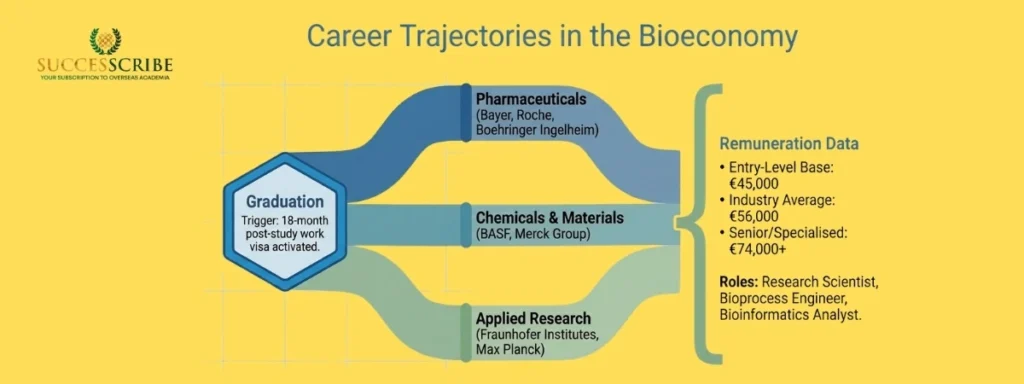
The return on investment (ROI) is exceptionally high. Germany’s aging population and “Pharmaceutical 4.0” initiative have created a vacuum for biotech talent.
Career Outcomes & Average Salaries in German Biotechnology
| Job Role | Entry-Level Salary (EUR) | Entry-Level Salary (INR) | Top Employers |
| Research Scientist | €50,000 – €60,000 | ₹45L – ₹54L | Roche, Merck Group |
| Bioprocess Engineer | €55,000 – €68,000 | ₹49.5L – ₹61.2L | BASF, Sartorius |
| Bioinformatics Analyst | €52,000 – €62,000 | ₹46.8L – ₹55.8L | Qiagen, SAP |
| Quality Control (GMP) | €48,000 – €58,000 | ₹43.2L – ₹52.2L | Boehringer Ingelheim |
The 18-Month Visa & Blue Card: After your MSc in Biotechnology in Germany, you receive an 18-month post-study work permit. Because the salaries for biotech roles typically exceed the EU Blue Card threshold (€50k+), Indian graduates have a direct, accelerated path to permanent residency.
Tuition Fees and Living Cost for a Master’s in Biotechnology in Germany
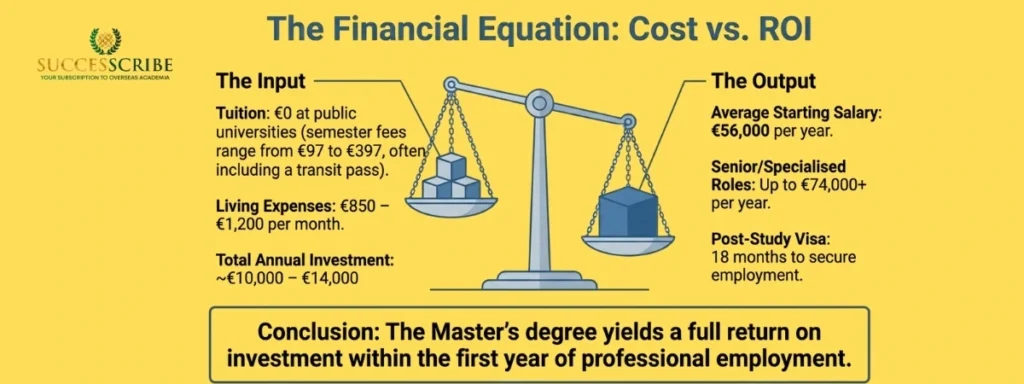
While many public universities remain tuition-free, there is a clear shift toward charging non-EU students at certain institutions or within specific states (such as Baden-Württemberg)
| Fee Category | Estimated Cost (EUR) | Estimated Cost (INR) | Details |
| Public University Tuition (Non-EU) | €0 – €4,000 | ₹0 – ₹3.6L | Per semester. While many are free, TUM now charges €4,000 and universities in Baden-Württemberg charge €1,500 |
| Semester Contribution | €100 – €400 | ₹9k – ₹36k | Per semester. Mandatory for all students; covers admin and often a transit pass |
| Private University Tuition | €880 / month | ₹80k / month | Example: Fresenius University. Annual costs can reach €10,000 – €40,000 |
Monthly Living Expenses
With the total monthly budget for an international student now estimated between
INR 1 – 2 Lakhs:
| Expense Category | Monthly Cost (EUR) | Monthly Cost (INR) |
| Accommodation (Rent & Utilities) | €350 – €600 | ₹63k – ₹1.1L |
| Food & Groceries | €150 – €250 | ₹22k – ₹40k |
| Health Insurance | €100 – €120 | ₹7k – ₹11.5k |
| Transportation (Monthly Pass) | €50 – €80 | ₹4.5k – ₹6.5k |
| Utilities (Electricity, Heating, Water) | Included in rent or €150 | ₹18.7k – ₹46k |
| Leisure & Miscellaneous | €100 – €150 | ₹4.4k – ₹9.7k |
| Total Monthly Budget | €850 – €1,200 | ₹1.24L – ₹2.42L |
Suggested Post: Masters in Data Science in Germany
Scholarships for International Students
Scholarships are the most effective way to reduce the overall biotechnology germany fees for indian students, effectively subsidizing the cost of living.
- DAAD Scholarships: The gold standard, providing €934 – €1,200 monthly plus travel allowances.
- Deutschlandstipendium: A merit-based award of €300 per month, open to all nationalities.
- Heinrich Böll Foundation: Focuses on students with academic excellence and social engagement.
- Bayer Foundation Fellowships: Specifically targeted at life science students for international research placements.
Applicant’s Actionable Roadmap for Masters in Biotechnology in Germany
Success in the 2026 intake requires precision timing. Most German programs are “Numerus Clausus,” meaning when seats are full, admission stops, regardless of your qualifications.
Step-by-Step Strategic Checklist
- VPD via Uni-Assist: Start this 3 months before the university deadline. This document converts your grades to the German system and is a major bottleneck in the process.
- APS Certificate (Mandatory): If you are applying from India, China, or Vietnam, you MUST obtain the APS certificate. This can take several months and is required for both the university application and the visa.
- Hohenheim “Pro-Tip” on Deadlines: While many winter deadlines are July 15, the University of Hohenheim recommends applying by May 15 due to the time-consuming nature of visa procedures. Applying late June often results in missing the October start date because of visa delays.
- Motivation Letter (SOP): German professors value technical precision over personal anecdotes. Focus your SOP on your lab experience, specific modules like Enzyme Technology or Metabolic Engineering, and how you will contribute to the university’s research focuses (e.g., sustainable food systems or bioinformatics).
- Blocked Account Setup: Use providers like Expatrio or Fintiba to set up your €11,904 deposit immediately upon receiving your admission letter.
Student Life, Culture, and the “Hidden” Challenges
The transition to a Masters in Biotechnology in Germany requires a shift in mindset. German universities emphasize “Lernfreiheit” (freedom to learn), which translates to high independence and less “hand-holding” than in the UK or US.
| Pros | Challanges |
| Safety & Stability: High public security. | Bureaucracy: Rigorous visa and APS timelines. |
| Schengen Access: Unrestricted travel in Europe. | Language Barrier: German is needed for social life. |
| Industrial Proximity: Direct access to R&D labs. | Weather: Dark winters require mental adjustment. |
Conclusion
The decision to pursue a Masters in Biotechnology in Germany is a move toward professional stability and scientific leadership. The German life sciences ecosystem – characterized by the “Triple Helix” of academia, industry, and the prestigious Fraunhofer Institutes – provides a launchpad that is both financially accessible and technically elite.
However, success requires meticulous planning. Students must account for the biotechnology germany fees for indian students by securing a Blocked Account early and must heed the “Engineering Credit” warnings for specific programs. We recommend applying by May 15 for winter intakes to accommodate the time-consuming visa and APS certificate procedures. For those willing to bridge the language and technical gaps, Germany offers more than just a degree; it offers a central role in the future of global healthcare and sustainability.
FAQs
Is a Master’s in Biotechnology in Germany free for international students?
Most public universities in Germany do not charge tuition fees, even for international students. However, some specific exceptions apply:
Baden-Württemberg state fees: Universities in this state (e.g., Hohenheim, Heidelberg, Stuttgart) charge €1,500 per semester for non-EU students
TU Munich (TUM): Recently introduced fees of €4,000 per semester for non-EU applicants
Semester Contributions: All students must pay a mandatory “Semester Fee” (approx. €100–€400), which often includes a public transport pass.
Can I study Biotechnology in Germany entirely in English?
Yes, there are numerous English-taught programs specifically designed for international students, including those at TU Munich, University of Hohenheim, TH Mannheim, and BTU Cottbus-Senftenberg. While daily life and some laboratory environments may use German, the primary instruction and examinations for these programs are in English.
How long does the Master’s in Biotechnology program take to complete in Germany?
Most Biotechnology Master’s programs in Germany are 2 years (4 semesters) long, consisting of 120 ECTS credits. Some Universities of Applied Sciences (UAS) offer intensified 3-semester programs (90 ECTS) for those who already have a 210-ECTS Bachelor’s degree.
Is a 3-year Bachelor’s degree accepted for the Master’s?
Generally, German universities require 210 ECTS (4 years). If you have a 180 ECTS degree, you will likely be asked to complete a “bridge” semester of 30 ECTS before starting the core Master’s curriculum.
Is GRE required for Biotechnology in Germany?
It varies. HAW Hamburg requires it for non-EU applicants, while RWTH Aachen and TUM often prioritize academic GPA and their own internal aptitude assessments.
Related Post
Masters in food technology in Germany
Highest paying jobs in Germany for engineers
Indian food and culture in Germany
Health insurance for students in Germany