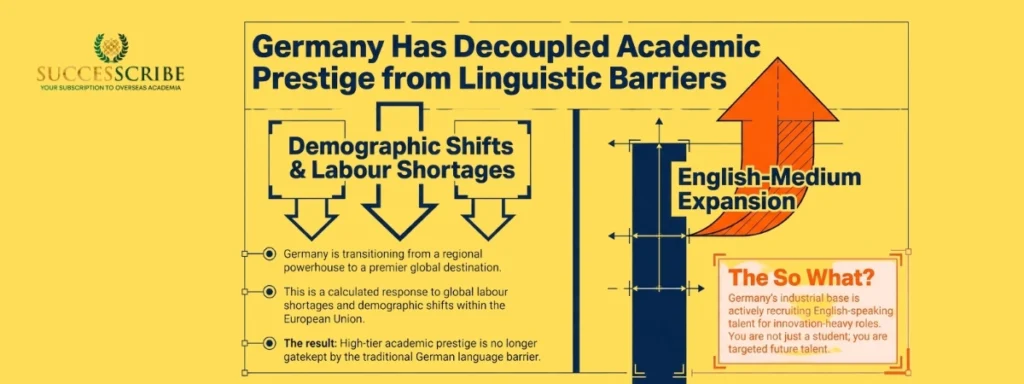
Germany has finalized its transition from a regional powerhouse to a premier global destination for international students. This evolution is not incidental; it is a calculated response to global labor shortages and demographic shifts within the European Union. By strategically expanding English-medium instruction, Germany has successfully decoupled high-tier academic prestige from the traditional linguistic barrier. For the international applicant, particularly those targeting the STEM and management sectors, the decision to study in Germany in English represents a high-yield investment. The combination of negligible tuition at public institutions and a robust 18-month post-study work window makes Germany a formidable competitor to traditional Anglophone destinations.
Why International Students Choose Germany
The primary driver for the current influx of talent is the “Value-to-Investment” ratio. Unlike the escalating debt-driven models found in the United States or the United Kingdom, Germany offers a service-oriented education model.
- Academic Prestige: Direct access to “TU9” technical excellence and specialized Universities of Applied Sciences (Fachhochschulen).
- Economic Stability: A resilient industrial base that actively recruits English-speaking talent for innovation-heavy roles.
- Strategic Entry: Students can focus immediately on core academic competencies in English while acquiring German proficiency at a manageable pace for social integration.
Understanding English-Taught Education in Germany
Many students assume that studying in Germany automatically requires German language proficiency. While German remains the primary language of instruction for many undergraduate programs, the situation has changed considerably over the last two decades.
German universities have expanded their international offerings to attract talented students from around the world. As a result, thousands of programs are now delivered entirely in English.
English-taught education is particularly common in:
- Master’s degrees
- MBA programs
- Engineering courses
- Data Science programs
- Artificial Intelligence courses
- Business and Management studies
- Economics
- International Relations
- Computer Science
- Sustainability and Environmental Studies
This means that students can often complete their entire degree without attending classes in German.
Nevertheless, living in Germany remains different from studying in English. Everyday interactions such as shopping, housing, government appointments, healthcare visits, and local transportation may still involve German language usage.
Therefore, while it is possible to Study in Germany in English, learning basic German can significantly improve the overall experience.
Can You Study in Germany Completely in English?
One of the most common questions among prospective students is whether they can complete an entire degree in English.
The answer is yes.
Thousands of students successfully Study in Germany in English without advanced German language skills.
However, the answer depends on three factors:
| Area | English Possible? | Notes |
| Classroom Teaching | Yes | Many programs fully English-taught |
| Exams | Yes | Conducted in English |
| Assignments | Yes | Submitted in English |
| Research Work | Yes | Depending on program |
| Internships | Sometimes | German may be preferred |
| Daily Life | Partially | German Helpful |
| Job Search | Depends on Industry | German often advantageous |
While academic requirements can often be fulfilled entirely in English, knowledge of German improves integration and employability.
The “So What” Factor?
Relying exclusively on English creates a “glass ceiling” for your career. While you will graduate with a world-class degree, your ability to secure high-value internships or local permanent employment is significantly diminished without at least A2 or B1 German proficiency. The most successful students in 2026 are those who view English as the vehicle for education and German as the vehicle for career longevity.
Types of English-Taught Programs Available in Germany
Germany offers English-language programs across multiple educational levels.
Bachelor’s Degrees
While growing, English-taught Bachelor’s degrees remain competitive and relatively scarce compared to graduate options. They are most prevalent in International Business and foundational STEM fields.
Popular fields include:
- International Business
- Computer Science
- Software Engineering
- Economics
- Digital Media
- Mechanical Engineering
- Artificial Intelligence
However, bachelor’s programs remain less common than master’s programs.
Master’s Degrees
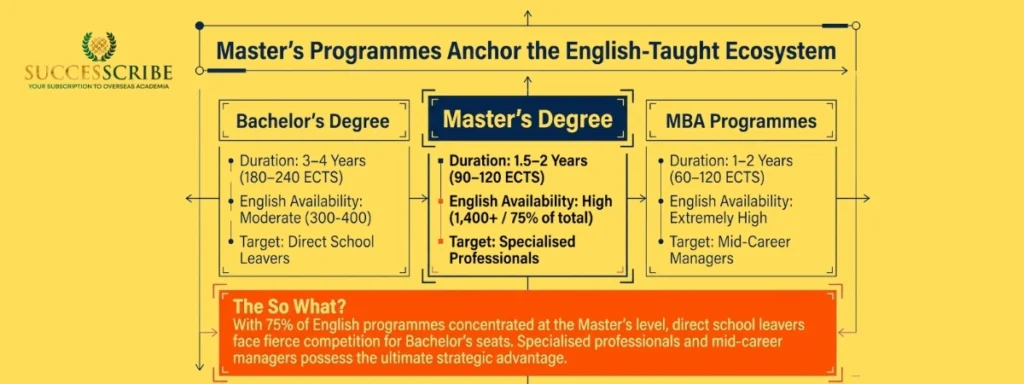
This is the flagship of German internationalization. Approximately 75% of all English-taught programs are at the Master’s level, driven by the need for global research collaboration.
Popular master’s fields include:
- Data Science
- Robotics
- Computer Engineering
- Renewable Energy
- Finance
- Supply Chain Management
- Business Analytics
- Public Policy
Most international students who Study in Germany in English enroll in master’s programs.
MBA (Master’s in Business Administration)
Almost exclusively market-driven and taught in English. These programs focus on international corporate leadership and carry higher tuition fees than standard Master’s programs.
MBA programs typically focus on:
- Leadership
- International Business
- Entrepreneurship
- Strategic Management
- Finance
Many MBA programs are specifically designed for international students and are taught entirely in English.
| Feature | Bachelor’s Degree | Master’s Degree | MBA Programs |
| Typical Duration | 3–4 Years (6–8 Semesters) | 1.5–2 Years (3–4 Semesters) | 1–2 Years |
| Credit Requirements | 180–240 ECTS | 90–120 ECTS | 60–120 ECTS |
| English Availability | Moderate (approx. 300-400) | High (approx. 1,400+) | Extremely High |
| Primary Target | Direct School Leavers | Specialized Professionals | Mid-career Managers |
Students planning to Study in Germany in English from India often find master’s programs easier to locate because universities offer a much wider selection at the postgraduate level.
English Language Requirements to Study in Germany in English
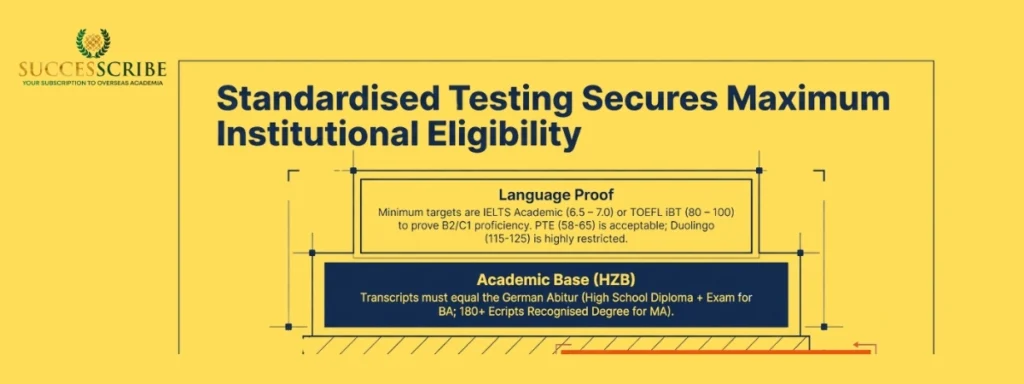
While many institutions accept a “Medium of Instruction” (MOI) letter if your previous degree was 100% in English, this is no longer a universal guarantee in 2026.
High-ranking TU9 universities and elite business schools are increasingly rejecting MOI letters in favor of standardized scores (IELTS/TOEFL) to maintain their positions in global rankings. Students should prioritize a standardized test to ensure maximum university eligibility.
| Test | Minimum Score Range | Proficiency Level |
| IELTS Academic | 6.5 – 7.0 | B2 / C1 |
| TOEFL (iBT) | 80 – 100 | B2 / C1 |
| PTE Academic | 58 – 65 | B2 / C1 |
| Duolingo | 115 – 125 | Selective Acceptance Only |
Admission Requirements and Academic Eligibility
The foundational requirement for all students is the Hochschulzugangsberechtigung (HZB). For international students, this means their school or university transcripts must be equivalent to the German Abitur.
| Requirement | Bachelor’s Level | Master’s Level |
| Academic Credential | High School Diploma + Entrance Exam | Recognized Bachelor’s (180+ ECTS) |
| Language Proof | IELTS 6.5 / TOEFL 80+ | IELTS 6.5-7.0 / TOEFL 90+ |
| Standardized Tests | Not usually (TestAS recommended) | GMAT/GRE (Business/Econ focus) |
| Portfolio/Experience | Rare | Mandatory for MBA/Arts |
| APS Certificate | Mandatory | Mandatory |
The APS Certificate for Indian Students
For those seeking to study in Germany in English from India, the APS (Akademische Prüfstelle) certificate is the most critical administrative hurdle. It is a mandatory verification of Indian academic credentials before a visa can be issued.
The “So What?” Factor: In 2026, the APS bottleneck remains significant. Applicants must utilize the “DigiLocker” verification system to expedite the process. Without this “first domino,” the entire application and visa timeline will collapse.
Public vs. Private Universities
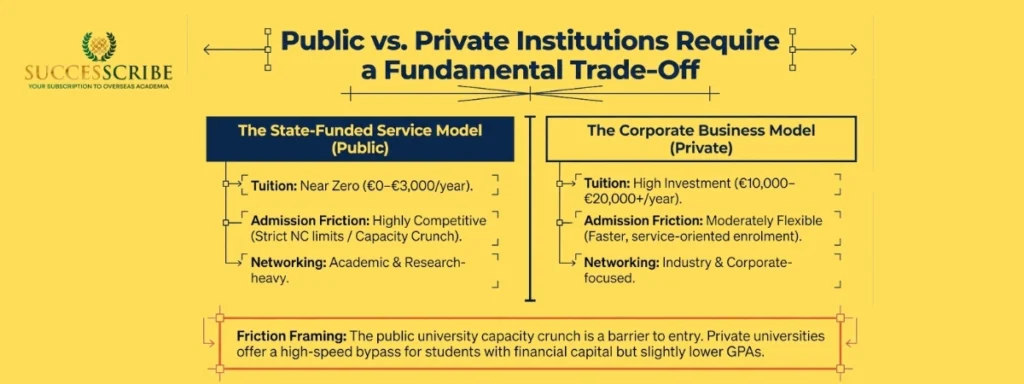
The choice between public and private institutions involves a fundamental trade-off between cost and administrative ease. Public universities operate on a “Service Model” funded by the state, whereas private universities utilize a “Business Model” designed to fill the gaps in English-taught availability.
Public universities are currently facing a “capacity crunch” due to high demand. Private universities provide a strategic alternative for students who may not meet the extremely high GPA requirements of public institutions but possess the financial capital to invest in a faster, more service-oriented enrollment process.
| Feature | Public Universities | Private Universities |
| Tuition Fees | Near Zero (€0–€3,000/year) | High (€10,000–€20,000+/year) |
| Admission Ease | Highly Competitive (NC limits) | Moderately Flexible |
| Networking | Academic & Research-heavy | Industry & Corporate-focused |
| English Volume | Growing in STEM/Econ | Dominant across all subjects |
Top Universities Offering English-Taught Programs
Whether you are interested in Engineering, Computer Science, Business, Economics, Artificial Intelligence, Data Science, or Natural Sciences, there are numerous institutions where you can successfully Study in Germany in English without requiring advanced German language skills. Several German universities are internationally recognized for their English-language offerings.
Examples include:
| University Type | Known for |
| Technical Universities | Engineering and Technology |
| Research Universities | Science and Innovation |
| Applied Sciences Universities | Practical Learning |
| Business Schools | Management and MBA Programs |
Leading German Universities with English-Taught Programs
| University | City | Popular English Taught Fields |
| Technical University of Munich (TUM) | Munich | Engineering, AI, Data Science, Management |
| Ludwig Maximilian University Munich (LMU) | Munich | Natural Sciences, Economics, Social Sciences |
| Heidelberg University | Heidelberg | Life Science, Data Science |
| RWTH Aachen University | Aachen | Mechanical Engineering, Electrical Engineering, Computer Science |
| Karlsruhe Institute of Technology | Karlsruhe | Engineering, Information Technology, Energy Systems |
| Humboldt University of Berlin | Berlin | Economics, Social Sciences, International Studies |
| Free University of Berlin | Berlin | Political Science, International Relations, Business |
| University of Freiburg | Freiburg | Environmental Sciences, Sustainability, Engineering |
| University of Stuttgart | Stuttgart | Automotive Engineering, Aerospace Engineering |
| University of Mannheim | Mannheim | Business Administration, Economics, Finance |
| Technical University of Berlin | Berlin | Computer Science, Engineering, Urban Development |
| University of Hamburg | Hamburg | Business, Economics, Data Analytics |
Top Universities for Engineering
Germany is globally recognized for engineering education, particularly in automotive, mechanical, electrical, and industrial engineering.
| University | Specialization Strengths |
| RWTH Aachen University | Mechanical, Automotive, Industrial Engineering |
| Technical University of Munich (TUM) | Engineering, Robotics, AI |
| Karlsruhe Institute of Technology (KIT) | Mechanical and Electrical Engineering |
| University of Stuttgart | Automotive and Aerospace Engineering |
| Technical University of Berlin | Civil, Mechanical, and Computer Engineering |
These universities maintain strong partnerships with major German industries, providing valuable research and internship opportunities.
Top Universities for Computer Science and Artificial Intelligence
As technology sectors continue to grow, Germany has become a popular destination for students interested in Computer Science, Artificial Intelligence, Data Analytics, and Software Engineering.
| University | Popular Programs |
| Saarland University | Computer Science, Cybersecurity |
| Technical University of Munich | Artificial Intelligence, Data Engineering |
| Technical University of Berlin | AI, Computer Engineering |
| Karlsruhe Institute of Technology | Data Science, Information Systems |
| RWTH Aachen University | Computer Science, Software Systems |
For students aiming to Study in Germany in English, technology-related programs offer some of the largest selections of English-taught courses.
Top Universities for Business and Management
Germany is not only an engineering powerhouse but also a strong destination for business education.
| University | Strengthen Areas |
| University of Mannheim | Business, Economics, Finance |
| Technical University of Munich | Management and Technology |
| WHU – Otto Beisheim School of Management | Business Administration |
| Frankfurt School of Finance and Management | Finance, Banking |
| ESMT Berlin | MBA and Executive Education |
The “Hidden” German Requirement
One of the most common questions I get is: “What scores do I actually need?” For most English-taught programs, universities look for a TOEFL score of at least 80 or an IELTS score of 6.5. However, what most students don’t know is that if your previous education was entirely in English, you can often bypass these exams entirely with a simple “Letter of English Proficiency” from your previous institution.
However, “English-taught” does not always mean “Zero German.” Some universities use basic German as a bridge for your survival in the country. For example, the Applied Artificial Intelligence program at TH Rosenheim requires A2 German just to get in, while TH Deggendorf allows you to study in English but requires you to reach A2 proficiency by the time you graduate.
English Gets You In, German Gets You a Job
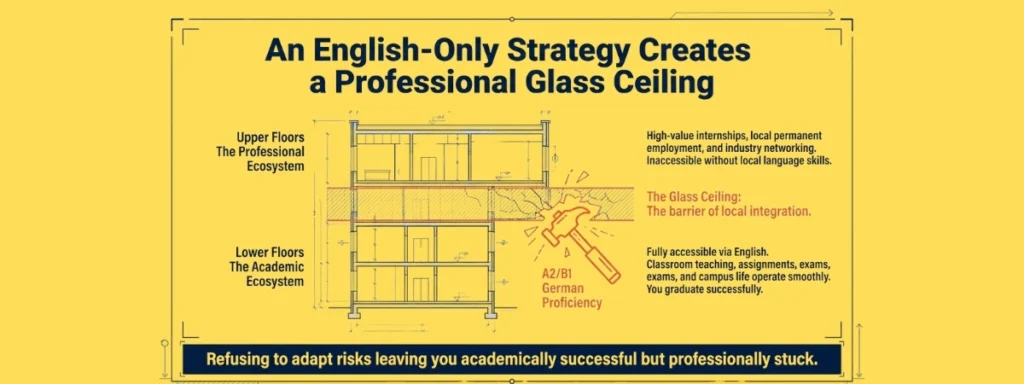
We always give our students a reality check: English is your key to the classroom, but German is your key to the country. While you can complete your degree in English, you will eventually need the local language to land internships, network effectively, and secure a long-term career.
If you refuse to adapt to the local language, you risk becoming “academically successful but professionally stuck.” Use the time during your English-taught degree to build your German skills. It is the single best investment you can make for your future self.
Conclusion
For those looking to study in Germany in English from India, the path requires a high degree of administrative foresight, specifically regarding the APS certificate and Blocked Account funding. If your goal is a low-cost, high-tier technical or business education and you are willing to embrace a bilingual lifestyle, Germany is your best strategic choice. However, if you are seeking a pure “English-only” social and professional ecosystem, the cultural and administrative friction of Germany may outweigh the financial savings. The strategic student uses English to open the door and German to secure the future.
FAQs
Is it true that Master’s degrees are more likely to be in English?
Yes, many Master’s programs, especially in research-oriented fields or economics, are taught completely in English.
Which subjects have the most English-taught options?
Engineering is a top choice for international students due to the high volume of English programs. Other common fields include Natural Sciences (Biology, Chemistry, Physics) and Economics/MBA programs.
Can I study Medicine or Law in English in Germany?
These fields are traditionally taught in German due to clinical training and the local nature of the law. While “International Law” programs exist, a standard law degree for practicing in Germany will be in German. Some private universities offer English medical programs, but they are rare and expensive.
Is it worth learning German if my degree is in English?
Highly recommended. While English gets you through your studies, learning German is essential for landing internships, finding a job after graduation, and building a professional network within the country. Basic proficiency (A1/A2) is often enough to “survive” daily life and can be learned in a few months.
Related Post
Benefits of doing masters in Germany
Germany university entrance Exam
Masters in physiotherapy in Germany
Germany student visa rejection reasons