Germany has emerged as one of the most preferred destinations for international students seeking quality higher education at an affordable cost. While the country is globally recognized for engineering, automotive technology, and business studies, it has also established itself as a leading hub for media, journalism, digital communication, and creative industries. Today, thousands of international students choose Masters in Media and Communication in Germany because of its internationally recognized universities, industry-focused curriculum, affordable tuition fees, and strong career prospects.
Whether your goal is to become a journalist, media strategist, communication consultant, public relations specialist, digital marketer, or media manager, pursuing a Master’s in Media and Communication in Germany can open doors to exciting global career opportunities.
Key Highlights: Master’s in Media and Communication in Germany
- Why Choose a Master’s in Media and Communication in Germany?
- What is a Master’s in Media and Communication in Germany?
- Best Media Studies Germany Universities
- Admission Requirements for a Master’s in Media and Communication in Germany
- Tuition Fees and Living Costs
- Scholarships for Master’s in Media and Communication in Germany
- Career Opportunities After a Master’s in Media and Communication in Germany
- Conclusion
- FAQs
Why Choose Masters in Media and Communication in Germany?
Choosing Masters in Media and Communication in Germany is not only about earning a prestigious degree but also about developing practical skills required in today’s fast-changing media landscape.
Germany’s higher education system is internationally respected for combining academic excellence with practical industry experience. Many universities collaborate with media organizations, publishing houses, broadcasters, technology companies, and communication agencies to provide students with real-world exposure through internships, research projects, and industry collaborations.
Some key reasons why international students prefer Germany include:
- Affordable education at public universities
- Globally recognized master’s degrees
- Modern digital media laboratories
- Strong focus on research and innovation
- English-taught postgraduate programmes
- Access to Europe’s largest economy
- Excellent public transportation
- High standard of living
- Safe and multicultural environment
- Attractive post-study work opportunities
Germany is also home to one of Europe’s largest media industries, with thousands of companies operating across broadcasting, journalism, digital media, advertising, publishing, gaming, public relations, and corporate communication.
Suggested Post: Masters in Data Science in Germany
What is a Master’s in Media and Communication in Germany?
A Masters in Media and Communication in Germany is a postgraduate degree designed to help students understand how communication shapes businesses, governments, media organizations, and society in the digital age.
The programme combines theoretical knowledge with practical skills in areas such as:
- Media Studies
- Journalism
- Corporate Communication
- Public Relations
- Digital Communication
- Social Media Strategy
- Media Management
- Political Communication
- Communication Research
- Intercultural Communication
- Strategic Communication
- Digital Marketing
- Media Economics
- Broadcasting
Most master’s programmes emphasize research, critical thinking, analytical skills, storytelling, audience behaviour, media ethics, and emerging communication technologies.
Students often complete:
- Research projects
- Industry internships
- Media production assignments
- Group projects
- Presentations
- Master’s thesis
Many programmes also incorporate AI-powered media analysis, digital storytelling, multimedia journalism, and communication analytics, reflecting current industry trends.
Skills You Develop
During your Masters in Media and Communication in Germany, students develop both technical and professional competencies.
These include:
- Communication Strategy
- Public Speaking
- Research Methodology
- Digital Storytelling
- Content Creation
- Media Planning
- Journalism Ethics
- Crisis Communication
- Social Media Analytics
- Brand Communication
- Video Production
- Cross-cultural Communication
- Audience Research
- Leadership
- Data Interpretation
These transferable skills prepare graduates for careers across multiple industries, not just traditional media organizations.
Best Media Studies Germany Universities
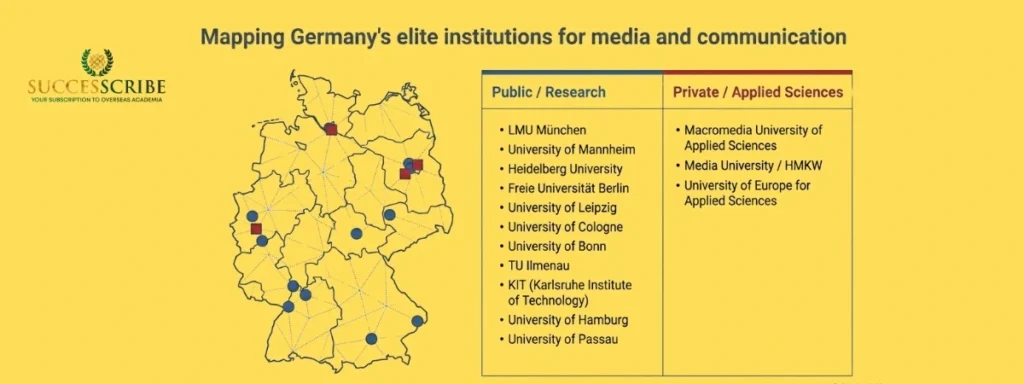
Germany offers numerous universities that specialize in communication, journalism, media studies, and digital media. These media studies Germany universities are known for their academic quality, research excellence, and industry collaborations.
Top Universities for Media and Communication Master’s in Germany
| University Name | Location | Notable Master’s Programme |
| LMU München | Munich | Media and Communication |
| University of Mannheim | Mannheim | Media and Communication Studies: Digital Communication |
| Heidelberg University | Heidelberg | Communication, Literature and Media in Modern South Asian Languages |
| Freie Universität Berlin | Berlin | Media Policy, Journalism, Political Analysis |
| University of Leipzig | Leipzig | Communication and Media Studies (KMW) |
| University of Cologne | Cologne | Media Studies (Combined with Management, Informatics, or Law) |
| University of Bonn | Bonn | Media Studies |
| TU Ilmenau | Ilmenau | Media and Communication Science |
| KIT (Karlsruhe Institute of Technology) | Karlsruhe | Science – Media – Communication |
| Macromedia University of Applied Sciences | Berlin, Munich | Media and Communication Management |
| University of Hamburg | Hamburg | Communication and Journalism Research for a Sustainable Society |
| Media University (formerly HMKW) | Berlin | Visual and Media Anthropology; International Marketing and Media Management |
| University of Passau | Passau | MS in Media |
| University of Europe for Applied Sciences | Berlin | Innovation Design Management |
Suggested Post: Entrance exam for masters in Germany
Admission Requirements for a Master’s in Media and Communication in Germany
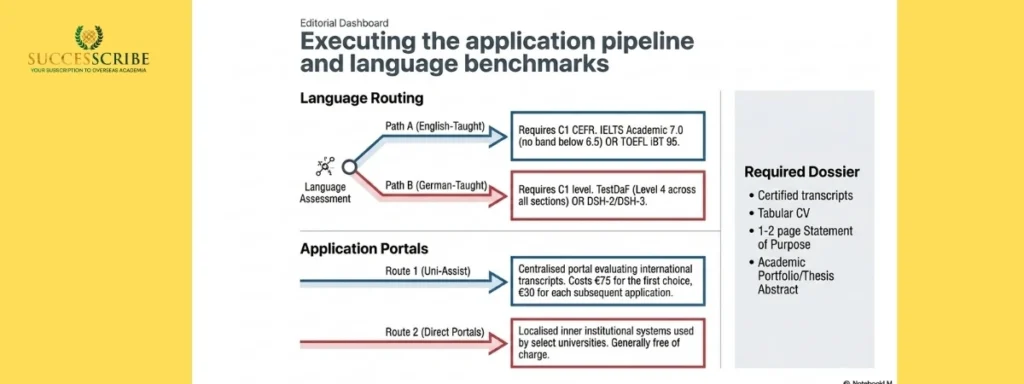
Securing a seat for a masters in media and communication in germany requires meeting strict, uncompromising academic and administrative profiles. Because most public German universities operate under an admission restriction called Numerus Clausus (NC), applications are evaluated using a rigid, merit-based point system.
To successfully apply to media studies germany universities, your application dossier must fulfill the following mandatory criteria:
| Criteria | Public Research Track | Private/Applied Science Track |
| Minimum GPA Requirement | Strict (Typically 2.5 or better on the German scale) | Flexible (Focuses more on interview performance) |
| Research Methodology Credits | High (Requires 15–30 ECTS in statistics/theory) | Low or None (Prioritizes practical portfolios) |
| English Language Benchmark | IELTS 7.0 / TOEFL 95 | IELTS 6.0 – 6.5 / TOEFL 80 |
| Primary Submission Channel | Uni-Assist or Direct Portal | Direct Portal or Institutional Interview |
Academic Qualifications & ECTS Prerequisites
- Relevant Bachelor’s Degree: You must hold a completed undergraduate degree (or equivalent to at least 180 to 210 ECTS credits) from a recognized university. The degree must be in a related field such as Media Studies, Communication Science, Journalism, Digital Media, Sociology, or Business Marketing.
- Credit Distribution Restrictions: Public research tracks often demand a specific credit breakdown from your undergraduate transcripts. It is common to see requirements demanding at least 20–30 ECTS credits explicitly earned in quantitative research methods, empirical social sciences, or communication theory. If your background is purely creative or practical, you may face rejection from highly theoretical programs.
- Grade Point Average (NC Requirement): Top-tier public institutions frequently require a minimum equivalent German grade of 2.5 or better (where 1.0 is perfect and 4.0 is the minimum passing grade).
Language Proficiency Metrics
Depending on whether you choose a German-taught track or seek out a journalism masters germany in english, you must provide official, standardized language certificates.
For English-Taught Programs: A verified minimum level of C1 (CEFR) is the standard benchmark. The following minimum scores are widely accepted across most departments:
- IELTS Academic: Minimum overall band score of 7.0 (with no individual module below 6.5)
- TOEFL iBT: Minimum score of 95 (with strong sub-scores in writing and speaking)
For German-Taught Programs: If a program is entirely or partially taught in German, you must present advanced proficiency certificates at the C1 level, typically fulfilled by passing:
- TestDaF: Level 4 or higher across all four sub-sections
- DSH: DSH-2 or DSH-3 certificate
Mandatory Application Documents
When submitting an application to universities specializing in media management germany universities, your digital dossier must typically include:
- Certified Transcripts and Degrees: Officially translated copies of your academic records (in English or German) bearing the stamp of an authorized notary or embassy.
- Tabular Curriculum Vitae (CV): A comprehensive, chronological summary of your education, internships, published work, and relevant technical skills.
- Statement of Purpose (Letter of Motivation): A highly focused, 1-to-2-page academic essay detailing your specific research interests, career goals, and why you selected that specific German university.
- Academic Portfolios or Thesis Abstract: Programs that emphasize journalism masters germany in english often require a portfolio of published articles, multimedia clips, or a detailed copy of your undergraduate thesis abstract to gauge your research capabilities.
Suggested Post: Masters in Cyber Security in Germany
Application Portals and Processing Fees
Navigating the application process requires understanding the administrative system governing communication studies germany fees and admissions. Applications are routed through two main channels:
Uni-Assist: This is a centralized governance portal utilized by the majority of public German universities to process, evaluate, and convert international transcripts into the German grading system.
- Fee Structure: Uni-Assist charges a processing fee of €75 for your first university choice and €30 for each subsequent application within the same semester window.
Direct University Portals: A select number of universities operate their own independent, localized application portals. Submitting through these inner institutional systems is generally free of charge.
Tuition Fees and Living Costs
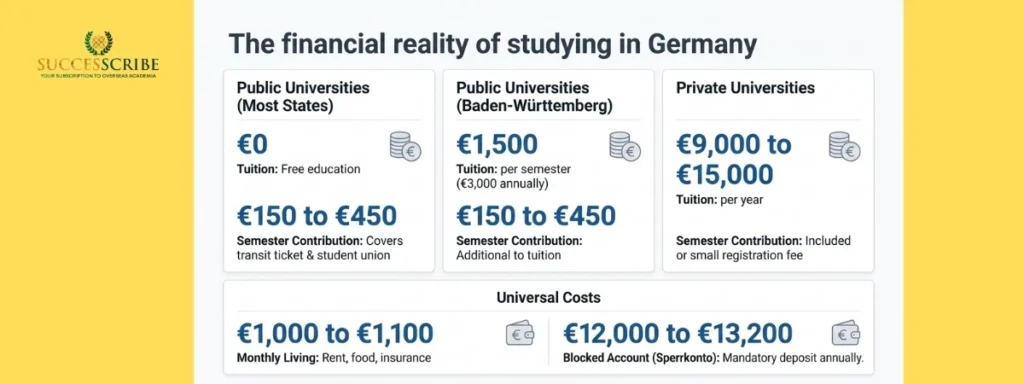
One of the biggest advantages of pursuing a Masters in Media and Communication in Germany is its affordability. When calculating communication studies germany fees, Indian students must account for the specific policies of different German states. Unlike many popular study destinations, Germany’s public universities generally do not charge tuition fees for most master’s programmes. Instead, students pay a semester contribution that covers administrative costs and, at many universities, a public transportation pass.
| Expense Category | Public Universities (Most States) | Public Universities (Baden-Württemberg) | Private Universities |
| Tuition Fees | €0 (Free education for all students) | €1,500 per semester (€3,000 per academic year) | €9,000 to €15,000 per year (Variable by school) |
| Semester Contribution (Semesterbeitrag) | €150 to €450 per semester (Covers transit ticket & student union) | €150 to €450 per semester (In addition to the tuition fee) | Included or charged as a small separate registration fee |
| Monthly Living Expenses | €1,000 to €1,100 (Rent, food, health insurance, materials) | €1,000 to €1,100 (Rent, food, health insurance, materials) | €1,000 to €1,100 (Rent, food, health insurance, materials) |
| Visa Blocked Account Requirement (Sperrkonto) | Mandatory: Approx. €12,000 to €13,200 deposited annually | Mandatory: Approx. €12,000 to €13,200 deposited annually | Mandatory: Approx. €12,000 to €13,200 deposited annually |
Scholarships for Master’s in Media and Communication in Germany
While many public media studies germany universities do not charge tuition fees, managing your monthly living expenses or financing private university tuition can still be challenging. To offset these costs, international students can apply for a variety of government-funded, merit-based, and institutional financial aid options.
The comprehensive table below details the top funding options available for students pursuing a masters in media and communication in germany:
Major Scholarship Programs for Media & Communication Students
| Scholarship Program | Funding Body | Target Audience | Coverage & Financial Benefits | Key Requirements |
| DAAD EPOS / Development-Related Scholarships | German Academic Exchange Service (Government) | International students from emerging and developing nations | €992 per month, full waiver of communication studies germany fees, travel allowance, and health insurance | Minimum 2 years of professional media/journalism experience; applies to specific courses like the MA in International Media Studies (DW Akademie) |
| Deutschlandstipendium (National Scholarship) | Federal Government & Private Sponsors | High-achieving students of all nationalities enrolled at public German universities | €300 per month for a minimum of two semesters | Exceptional academic transcripts, strong civic engagement, or overcoming social hurdles |
| Heinrich Böll Foundation Scholarships | Heinrich Böll Foundation (Affiliated with the Green Party) | International students with a strong social and political background | Up to €812 + €300 study allowance per month (Varies by country of origin) | Excellent academic record, strict alignment with values of sustainability, democracy, and human rights |
| Friedrich Ebert Foundation Scholarships | Friedrich Ebert Foundation (Affiliated with the SPD) | International students showing strong sociopolitical commitment | Base stipend up to €861 per month plus contribution to health insurance | Enrollment in a German university, proven social/political volunteer work, and proficiency in the German language |
| Erasmus+ Master Loans & Grants | European Union | EU and select partner-country students moving to Germany for their studies | Variable stipends ranging from €400 to €600 per month to cover baseline living costs | Must be moving via an official university partnership exchange or enrolled in an eligible Erasmus Mundus joint media master track |
| Institutional Merit Scholarships | Private/Applied Universities (e.g., Macromedia University) | Highly talented students applying to private media management germany universities | Partial tuition waivers ranging from 10% to 50% off total tuition fees | High undergraduate GPA, stellar professional portfolio, and a successful admissions interview performance |
Career Opportunities After Master’s in Media and Communication in Germany
One of the strongest reasons for pursuing a Masters in Media and Communication in Germany is the wide range of career opportunities available across industries. Modern organizations require professionals who can manage digital communication, build brand reputation, create compelling content, analyze audience behavior, and develop communication strategies in an increasingly digital world.
Industries That Hire Media and Communication Graduates
A master’s degree in media and communication opens doors to multiple industries.
| Industry | Typical Roles |
| Television & Broadcasting | Producer, News Editor, Broadcast Journalist |
| Newspapers & Digital News | Reporter, Multimedia Journalist |
| Public Relations | PR Executive, PR Manager |
| Corporate Communications | Communication Manager, Internal Communications Specialist |
| Advertising | Account Manager, Creative Strategist |
| Digital Marketing | Digital Marketing Manager, SEO Specialist |
| Social Media | Social Media Manager, Community Manager |
| Publishing | Content Editor, Publishing Executive |
| Film & Entertainment | Production Coordinator, Media Planner |
| Technology Companies | Content Strategist, Communications Consultant |
| Government & Public Sector | Public Information Officer |
| NGOs & International Organizations | Communications Officer |
| Consulting Firms | Brand Consultant, Communication Consultant |
| Educational Institutions | Researcher, Lecturer |
Graduates from media management Germany universities often pursue leadership and management roles that combine business strategy with media expertise.
Suggested Post: Masters in Public Health in Germany
Most In-Demand Job Roles
The communication industry has evolved significantly due to artificial intelligence, digital transformation, and changing consumer behavior.
Some of the fastest-growing career options include:
- Communication Manager
- Media Manager
- Public Relations Manager
- Digital Marketing Manager
- Brand Manager
- Corporate Communications Specialist
- Content Strategist
- Multimedia Journalist
- Social Media Manager
- Media Analyst
- Advertising Consultant
- Digital Content Producer
- Communications Consultant
- Marketing Communications Manager
- Internal Communications Specialist
Students graduating from journalism masters Germany in English are increasingly finding opportunities in international media organizations, digital publications, podcasts, and multimedia journalism.
Average Salary After Graduation
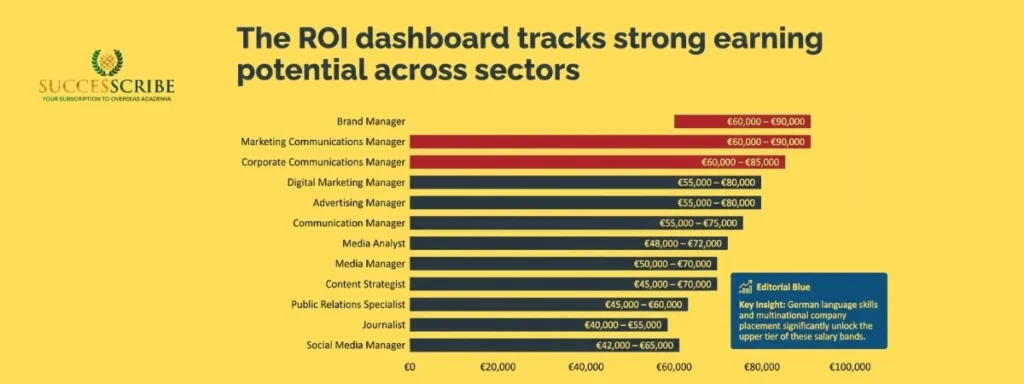
Salary depends on factors such as experience, employer, location, language proficiency, and specialization. Professionals with German language skills often have access to a broader range of positions.
| Job Role | Average Annual Salary (€) |
| Journalist | 40,000–55,000 |
| Public Relations Specialist | 45,000–60,000 |
| Communication Manager | 55,000–75,000 |
| Corporate Communications Manager | 60,000–85,000 |
| Media Manager | 50,000–70,000 |
| Digital Marketing Manager | 55,000–80,000 |
| Brand Manager | 60,000–90,000 |
| Content Strategist | 45,000–70,000 |
| Social Media Manager | 42,000–65,000 |
| Media Analyst | 48,000–72,000 |
| Advertising Manager | 55,000–80,000 |
| Marketing Communications Manager | 60,000–90,000 |
Senior professionals with several years of experience may earn significantly higher salaries, particularly in multinational companies and leadership positions.
Conclusion
Choosing a Masters in Media and Communication in Germany is an excellent option for students seeking a globally recognized education, practical industry experience, and strong career opportunities in one of Europe’s most dynamic economies. From affordable education and innovative teaching methods to internationally respected universities and access to a thriving media sector, Germany offers an environment where students can develop the skills needed to succeed in today’s evolving communication landscape.
FAQs
Is a Master’s (MS) in Media in Germany worth it?
Yes. After completing a Master’s in media, your employability increases significantly, and you gain access to a broader range of job roles in an ever-flourishing sector.
Can I pursue a Masters in Media and Communication in Germany in English?
Yes. Many universities offer journalism masters Germany in English and other English-taught programmes in media, communication, and related fields. Admission requirements vary by institution.
What careers can I pursue after graduating from media management germany universities?
Graduates from these strategic management tracks are highly sought after in the digital economy. Typical career paths include:
1. Digital Project Manager
2. Global Brand Strategist
3. Social Media & Campaign Director
4. Corporate Communications Specialist
5. Media Distribution Manager for streaming and entertainment networks
How long can international students stay in Germany after graduation to look for a job?
Once you complete your masters in media and communication in germany, non-EU students are legally granted an 18-month post-study work visa. This allows you ample time to secure a full-time position that matches your academic qualifications.
Do I need a background in statistics to apply for a communication science master’s?
For theoretical and empirical programs at public research universities, yes. Many universities require a specific allocation of undergraduate credits (often 15 to 30 ECTS) in quantitative research methods, empirical social sciences, or statistics. If your Bachelor’s degree was entirely practical, you might find a better fit at private universities or Universities of Applied Sciences (Fachhochschulen), which prioritize portfolios over statistical prerequisites.
Related Post
Masters in biotechnology in Germany
Masters in food technology in Germany
Highest paying jobs in Germany for engineers
Transportation in Germany for students