Moving from the sensory kaleidoscope of India to the meticulously ordered landscape of Germany is a transition that humbles the spirit and sharpens the analytical eye. In this first year of residency – that “golden window” before integration numbs one to the local quirks – the contrasts are not merely visible; they are felt. One moment you are immersed in the pungent, heavy scents of Old Delhi’s Parathe Wali Galli, surrounded by the lemon-golden hue of turmeric and the steam of sweet lassi; the next, you are breathing the crisp, structured air of a German city where the silence is as intentional as the architecture.
Today, Indian Food and Culture in Germany is not limited to the Indian diaspora alone. German citizens and international residents increasingly enjoy Indian cuisine, yoga, Bollywood entertainment, and Indian festivals. This cultural exchange has strengthened people-to-people connections between the two countries and contributed to a more inclusive society.
Key Highlights: Indian Food and Culture in Germany
- Overview of the Indian Presence in Germany
- Indian Food and Culture in Germany: The Culinary Landscape
- Indian Restaurants in German Cities
- Festivals Celebrated by Indians in Germany
- Indian Grocery Stores in Germany
- Conclusion
- FAQs
Overview of the Indian Presence in Germany
Germany’s strong economy, world-class universities, excellent research opportunities, and increasing demand for skilled workers have made it an attractive destination for Indians. The country has particularly seen rising numbers of professionals in information technology, engineering, healthcare, finance, and scientific research.
Major Cities with Significant Indian Population
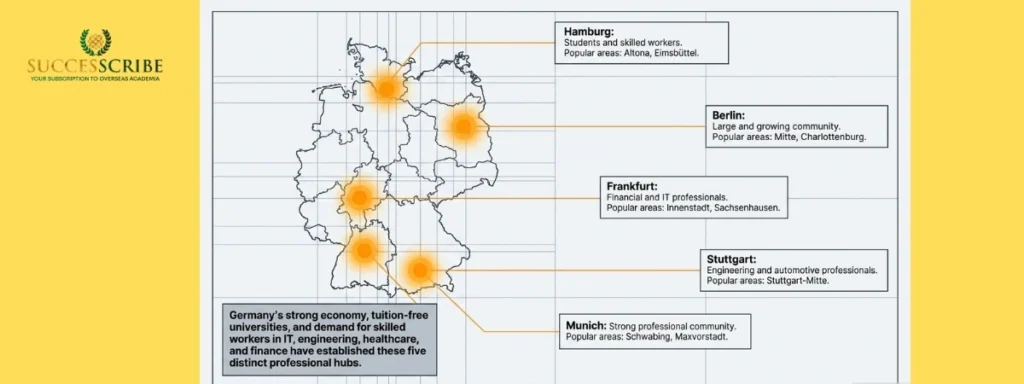
| City | Estimate Indian Presence | Popular Areas |
| Berlin | Large and Growing | Mitte, Charlottenburg |
| Munich | Strong professional community | Schwabing, Maxvorstadt |
| Frankfurt | Financial and IT professionals | Innenstadt, Sachsenhausen |
| Hamburg | Students and skilled workers | Altona, Eimsbüttel |
| Stuttgart | Engineering and automotive professionals | Stuttgart-Mitte |
The expanding indian community in germany has contributed greatly to the growth of cultural events, educational associations, and business networks. Many Indian students arriving in Germany quickly find support through university organizations and local community groups.
As the population grows, the demand for authentic cuisine has also increased, leading to the rise of numerous indian restaurants in germany cities. Likewise, access to familiar ingredients through indian grocery stores in germany has become easier than ever before.
The continued growth of the Indian diaspora ensures that Indian Food and Culture in Germany remains vibrant, visible, and influential across the country.
Suggested Post: Germany student visa rejection reasons
Indian Food and Culture in Germany: The Culinary Landscape
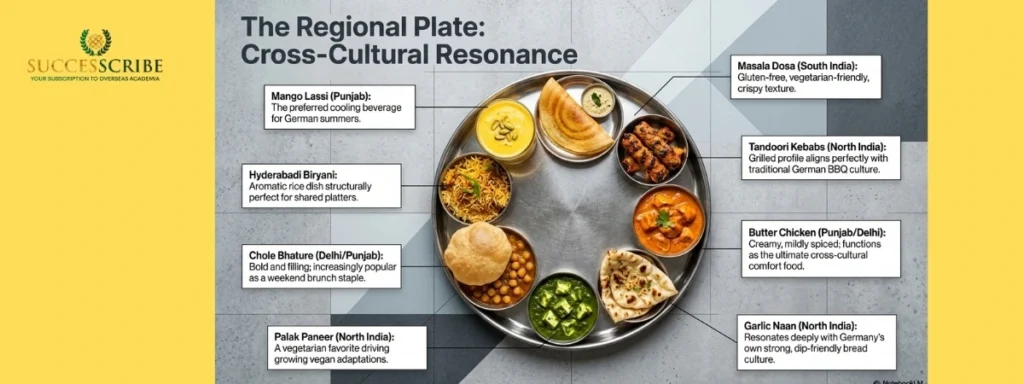
Berlin had over 34 listed Indian restaurants on platforms like Quandoo alone – and the city’s broader South Asian food scene is far larger when you include informal dhabas, takeaways, and cloud kitchen brands. Indian food in Germany in 2026 is not just curry and naan. It encompasses South Indian dosas and idlis, Hyderabadi biryani, Delhi-style street food like chole bhature, Punjabi dal makhani, Kerala fish curry, and Gujarati thalis – reflecting the regional diversity of the Indian subcontinent itself.
Most Popular Indian Dishes in Germany
| Dish | Origin | Why Germans Love It |
| Butter Chicken | Punjab / Delhi | Creamy, mildly spiced; comfort food equivalent |
| Biryani (Hyderabadi style) | Hyderabad | Aromatic rice dish; perfect for sharing platters |
| Masala Dosa | South India (Tamil Nadu / Karnataka) | Gluten-free, vegetarian-friendly, crispy texture |
| Chole Bhature | Delhi / Punjab | Bold, filling; popular as a weekend brunch |
| Tandoori Kebabs | North India | Grilled dishes align with German BBQ culture |
| Palak Paneer | North India | Vegetarian favourite; growing vegan adaptation |
| Garlic Naan | North India | Bread culture resonates; dip-friendly |
| Mango Lassi | Punjab | Popular in summer as a cooling beverage |
Indian Restaurants in German Cities
Finding good Indian restaurants in Germany cities has never been easier. The growth of the Indian community in Germany has driven up both the number of establishments and their quality.
Indian Restaurants in Berlin
Berlin has the richest and most diverse Indian restaurant scene in Germany. The city’s multicultural character has made it a testing ground for every regional Indian cuisine, from Kerala seafood to Rajasthani thali.
| Restaurant Name | Cuisine Focus | Area | Must-Try Dish |
| India Club | North Indian classics | Behrenstraße, Mitte | Dal Makhani (rated 4.5/5) |
| Delhi 6 | Street food & tandoor | Bergmannstraße, Kreuzberg | Tandoori Kebabs, Naan |
| AmmAmma | South Indian / Tamil | Urbanstraße, Kreuzberg | Masala Dosa, Idly, Sambar |
| Amrit | Pan-Indian with contemporary twist | Kreuzberg | Butter Chicken, Biryani |
| Bombay Palace | North Indian, family-style | Bergmannstraße | Lamb, Banana Beer, Naan |
Indian Restaurants in Munich
| Restaurant Name | Cuisine Focus | Known For |
| Maharaja Palace | North Indian, upscale | Regal dining experience, Rogan Josh, Biryani |
| Saravana Bhavan (Munich) | South Indian vegetarian | Masala Dosa, Filter Coffee, Idli |
| Indian Grocery Store Café | Home-style | Daily specials, regional dishes |
Indian Restaurants in Frankfurt
| Restaurant Name | Area | Must-Try |
| Jewel of India | Wilhelm-Hauff-Straße, Westend | Palak Paneer, Gulab Jamun (rated 4.2/5) |
| Indian Curry House | Goldsteinstraße, Niederrad | Non-Veg Thali, Prawn Curry, Palak Gosht |
| Namaste India | Jordanstraße | Yellow Dal Tadka, Dal Makhani (rated 4.4/5) |
| Saravana Bhavan (Frankfurt) | Kaiserstraße | Full South Indian vegetarian menu |
| Bombay Palace Frankfurt | City Centre | Authentic Punjabi menu across multiple outlets |
Indian Restaurants in Hamburg & Other Cities
| City | Restaurant | Specialty |
| Hamburg | Spice Garden | Fresh local ingredients, Indian classics |
| Hamburg | Ashoka | Authentic dining, Bollywood ambiance |
| Hamburg | Molaga South Indian Restaurant (Grindelallee) | Kerala Sadhya, South Indian breakfasts |
| Düsseldorf | Saffron | South Indian vegetarian, Dosa, Uttapam |
| Cologne | Ginger | Contemporary Indian with German fusion |
| Dusseldorf | India Bazaar (Oberbilk) | North Indian staples, Halal options |
Saravana Bhavan – the iconic South Indian vegetarian chain – now operates outlets in Frankfurt, Berlin, Cologne, Munich, and Hamburg, making it one of the few Indian restaurant brands with a pan-Germany presence.
Suggested Post: Daad scholarship for Indian students
Festivals Celebrated by Indians in Germany

Festivals are the heartbeat of Indian culture, and the Indian community in Germany carries this tradition with pride and enthusiasm. From private home celebrations to large public melas attended by thousands, festivals celebrated by Indians in Germany have become vibrant events that attract local German residents as well.
Major Festivals Celebrated by Indians in Germany
| Festival | How It Is Celebrated in Germany |
| Diwali (Festival of Lights) | Community melas, cultural shows, food stalls, Bollywood parties; major events in Berlin, Munich, Frankfurt, Hamburg, Bonn, Stuttgart |
| Holi (Festival of Colours) | Outdoor colour-play events with Bollywood music, Indian food stalls, community gatherings in parks across German cities |
| Navratri & Garba Nights | Garba dance nights with live dhol, traditional attire, community halls in Munich, Frankfurt, and Berlin |
| Onam (Kerala harvest festival) | Kerala Samajam Munich hosts Grand Onam; Sadhya (feast on banana leaves) in restaurants & community halls |
| Pongal (Tamil harvest festival) | Tamil community gatherings; traditional rice cooking ritual, cultural performances |
| Durga Puja / Navratri | Pandals (temporary shrines), cultural programmes, traditional Bengali cuisine |
| Eid al-Fitr / Eid al-Adha | Indian Muslim community celebrations with biryani feasts, mosque prayers, and community iftars |
| Baisakhi | Punjabi community events, bhangra performances, langar (community meals) |
| Republic Day / Independence Day | Consulate events, flag-hoisting, cultural programmes organised by the Indian Embassy Berlin |
Of all the festivals celebrated by Indians in Germany, Diwali is the largest and most widely observed. Private fireworks are only legal on New Year’s Eve (Silvester) in Germany. During Diwali, use LED diyas, electric candles, or battery-operated fairy lights. Organising public fireworks requires a special permit from local authorities.
Indian Grocery Stores in Germany
One of the biggest concerns for any Indian moving to or visiting Germany is access to authentic ingredients – from hing and curry leaves to proper basmati rice and chakki atta. The good news is that Indian grocery stores in Germany have expanded significantly over the past five years, both in physical locations and online delivery.
Physical Indian Grocery Stores in Germany
| City | Store / Location | Specialty |
| Berlin (Kreuzberg) | Asia Mekong (Wrangelkiez) | Fresh curry leaves, green chillies, drumstick, bitter gourd |
| Berlin (Neukölln) | Indian Spices & Foods | MTR, Aachi, MDH, Eastern masalas; good frozen section |
| Berlin (Turmstraße) | Punjab Grocery | Bulk dals, atta brands, achaar |
| Berlin (Mitte) | Asia Pavillon | Indian basics + strong South Indian section; central location |
| Munich (Schwanthalerstraße) | Indian Grocery Store | One of the oldest Indian stores in Munich; North Indian staples |
| Frankfurt (Hanauer Landstraße) | Indian Food Store | All major dal varieties, multiple atta brands, spice wall |
| Frankfurt (Bornheim) | Spice Garden | South Indian staples, ready-to-cook pastes |
| Hamburg (Altona) | Bombay Palace Supermarket | MTR & Kitchens of India; fresh methi, karela, tinda |
| Düsseldorf (Oberbilk) | India Bazaar | North Indian staples, pickles, frozen items |
| Düsseldorf (Flingern) | Indus Supermarkt | South Indian focus; rice varieties, idli rava, sambar powder |
| Cologne (Ehrenfeld) | Indian & Pakistani Grocery | Halal meat, atta, spices; wide overlap selection |
Suggested Post: Sample SOP for German student visa
Top Online Indian Grocery Stores in Germany
For Indians living outside major cities – or those who prefer the convenience of home delivery – several excellent online Indian grocery stores in Germany ship nationwide. Most offer free delivery above a threshold of €33 to €59.
| Online Store | Base Location | Products | Free Delivery Threshold | Delivery Time |
| Jamoona | Germany-wide | Basmati rice, toor dal, ghee, MDH/Everest/Shan spices, pickles, ready-to-cook | Competitive threshold | 2-4 days |
| Annachi Supermarket | Europe-wide (ships to Germany) | 3,000+ products from 200+ brands (Aachi, MTR, Haldirams, GRB) | €45 | 1-3 business days |
| Dookan (eu.dookan.com) | Germany-wide | 10,000+ products, 250+ brands, fresh produce available | Membership discounts available | 2-4 days |
| Anant Supermarkt (Berlin) | Berlin + nationwide | Groceries + Pooja items + Bollywood products; fresh + frozen | €59 | Same-day in Berlin; 2-3 days elsewhere |
| Desigros | Friedrichsdorf (near Frankfurt) | Kerala specialties, Onam Sadhya kits, fresh vegetables | €33.33 | Same-day local; next-day nationwide |
| Grocera | Munich + nationwide | 10 kg basmati rice, fresh green chilli, frozen grated coconut | Available | Same-day Munich; 2-3 days Germany |
| Indira Indian Foods | Germany-wide | 1,300+ authentic products from masalas to fresh mangoes | Standard | Standard shipping |
Most Indian grocery stores in Germany are concentrated in Frankfurt, Berlin, Munich, and Hamburg. If you live in a smaller city like Wolfsburg or Erfurt, your nearest physical desi store may be 60 to 90 kilometres away – making online delivery the most practical option. Platforms like Dookan and Jamoona carry hundreds of SKUs unavailable in general Asian or Turkish supermarkets, including hing, specific regional pickle brands, and specialty flours.
Conclusion
The story of Indian food and culture in Germany is one of remarkable growth, resilience, and cultural pride. The Indian community in Germany has built an ecosystem that allows residents to live deeply connected to their roots – cooking at home with fresh ingredients from Indian grocery stores in Germany, dining out at the growing number of Indian restaurants in Germany cities, and gathering to celebrate the festivals celebrated by Indians in Germany with the same warmth and fervour as they would back home.
From the Kerala nurse who first arrived in Frankfurt in the 1970s to the Bangalore software engineer who relocated to Munich in 2024 via an EU Blue Card, every Indian in Germany has contributed to weaving India’s vibrant cultural fabric into the tapestry of German life. And with a projected population of over 400,000 Indians in Germany by 2030, this story is still just beginning.
Whether you are planning a move to Germany, already settled there, or simply curious about Indian food and culture in Germany, this guide is your starting point. Explore the restaurants, visit the festivals, shop from the grocery stores, and connect with the Indian community in Germany – because India, it turns out, is not as far from Germany as the map suggests.
FAQs
Question 1. Is Germany a friendly place for vegetarians?
Answer: Yes, it is notably better than many European neighbors. Every German restaurant is mandated to have a vegetarian dish, and the Indian diaspora has expanded those options to include staples like Bhindi Masala and Chana.
Question 2. How does the “nearly free” education system benefit Indians?
Answer: The German government provides high-quality education with no tuition fees at public universities, plus financial support for families. The pedagogy is “hands-on,” which helps Indians transition from theoretical knowledge to practical career success.
Question 3. Can I find Indian holy sites in Germany?
Answer: Yes, major cities like Cologne have established “mandirs” (holy sites), and the community organizes public Hindu god rallies and festivals.
Question 4. What are the main differences in family life?
Answer: Germany traditionally has a fragmented, nuclear family system prioritizing individual freedom. India relies on a “joint family” system with high inter-generational dependency.
Question 5. How can I avoid discrimination in Germany?
Answer: While rare, subtle discrimination occurs. Learning the German language is the most effective way to integrate, gain respect from the elderly population, and navigate the bureaucracy.
Related Post
Student accommodation options in Germany
German spouse visa for Indian students
Germany Work Permit After Study
Study in Germany in English