Germany has firmly established itself as Europe’s premier destination for international higher education and post-graduation career building. With more than 400,000 international students enrolled across its public and private institutions, the German federal government has structured immigration laws to act as a seamless pipeline converting academic talent into high-skilled economic contributors.
Navigating the transition from an international student to a full-time professional requires a precise understanding of the Germany work permit after study framework. Following the multi-phase implementation of the modernized Skilled Immigration Act (Fachkräfteeinwanderungsgesetz), the avenues for staying, working, and settling permanently in Germany have become more flexible, accessible, and faster than ever before.
Key Highlights: Germany Work Permits after Study
- The Legal Framework: Student to Professional
- Phase 1: The 18-Month Job Search Visa
- Phase 2: Converting Your Student Status to a Full Work Permit
- The EU Blue Card Route (For Master’s Graduates)
- Application Process and Document Checklist
- Staying Long-Term: Permanent Residence & Citizenship
- Conclusion
- FAQs
The Legal Framework: Student to Professional
When you graduate from a recognized German university, your legal status under immigration law changes immediately. Even if your student residence permit (Aufenthaltserlaubnis zu Studienzwecken) has a physical expiration date printed on the card that lasts for several more months, it loses its primary validity the moment your final grades are officially published or your thesis defense is completed.
Your legal status changes the moment your final grades are officially published, meaning you must immediately transition to the Germany Work permit after Study regulations rather than relying on your physical student card’s expiration date. German immigration law divides this process into two core phases:
- The Search Phase: A dedicated buffer period allowing you to live in Germany without a binding full-time job offer while you apply for positions matching your academic qualifications.
- The Employment Phase: The transition to a long-term residence title dedicated to qualified employment, driven either by standard skilled worker pathways or the premium EU Blue Card framework.
The entire system is governed by the German Residence Act (Aufenthaltsgesetz — AufenthG). The structural differences between the post-graduation pathways in force for 2026 are outlined below:
| Residence Title | Governing Law (AufenthG) | Maximum Initial Duration | 2026 Salary / Financial Requirements | Permitted Work Scope | Fast-Track Permanent Residence |
| Post-Study Job Seeker Permit | Section 20 (3) Nr. 1 | Up to 18 months | €1,091 per month (€13,092 total) via Blocked Account or employment | Completely unrestricted (any job, unlimited hours) | No (Time counts toward citizenship/PR, but must switch first) |
| EU Blue Card (Standard) | Section 18g (1) | Up to 4 years (or contract length + 3 months) | €50,700 gross annual salary | Qualified employment matching university level | 21 months (with B1 German) or 27 months (with A1 German) |
| EU Blue Card (Shortage / Grads) | Section 18g (1) Nr. 2 | Up to 4 years (or contract length + 3 months) | €45,934.20 gross annual salary | Qualified employment matching university level | 21 months (with B1 German) or 27 months (with A1 German) |
| Skilled Worker Permit | Section 18b | Flexible (Usually 2–4 years) | Local standard wage matching position; no fixed national floor | Qualified employment matching qualification scale | 24 months (2 years) for German university graduates |
Phase 1: The 18-Month Job Search Visa
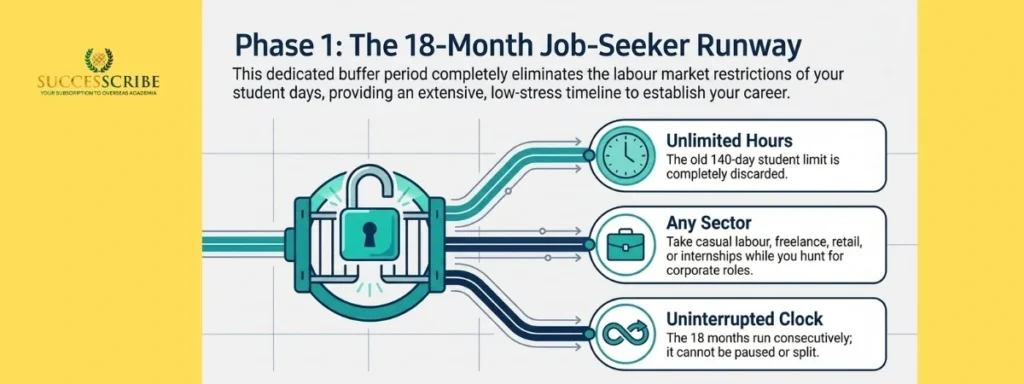
The initial 18-month job seeker visa acts as an excellent cushion, providing an unrestricted runway under the Germany Work permit after Study legal structure to live and work anywhere while interviewing for corporate roles. The foundational step for the vast majority of international graduates is the post study work visa germany 18 months permit. Officially classified under Section 20 (3) Nr. 1 of the Residence Act, this residence title gives you an extensive, low-stress timeline to establish your career within the largest economy in the European Union.
Crucial Timing and Dead lines
The 18-month clock does not start when you walk across the graduation stage or attend your commencement ceremony. It begins the precise day you receive official, written confirmation of your final graduation results (such as a formal transcript of records or a certificate of completion from your university’s examination office, known as the Prüfungsamt).
Critical Warning: Do not wait for your formal, decorative degree certificate (Urkunde) to arrive by mail, as this can take up to three months at some public universities. You must apply for your post-study job seeker permit using your official final graduation transcript as soon as it is issued to prevent any lapse in your legal residency.
Unrestricted Rights to Work Any Job
One of the most competitive advantages of the German post-study framework compared to other global study destinations is the complete elimination of labor market restrictions during the 18-month search phase. While you hold the Section 20 job-seeking permit, you are legally allowed to work:
- Unlimited hours per week (the old student limitation of 140 full days or 280 half days is completely discarded).
- In any economic sector or position, including casual labor, retail, hospitality, internship roles, or freelance projects.
Meeting the 2026 Financial Requirements
To secure your 18-month post-study permit, you must prove to your local immigration office (Ausländerbehörde) that you can cover your daily living costs without relying on German social welfare assistance.
For 2026, the Federal Ministry of the Interior has maintained the baseline subsistence requirement at €1,091 per month. This means that when applying for the full 18-month permit, you must show total financial liquidity of €13,092.
Graduates can satisfy these germany work permit requirements for graduates through three primary methods:
- A Blocked Account (Sperrkonto): Depositing the full €13,092 into a specialized provider (such as Expatrio, Fintiba, or Coracle), which releases exactly €1,091 back to you each month.
- Part-Time Employment Income: Presenting an active employment contract from a part-time job or working student role that explicitly shows a net monthly income of at least €1,091.
- Formal Declaration of Commitment (Verpflichtungserklärung): A legally binding document signed by a sponsor residing inside Germany who guarantees to cover all your living expenses.
Phase 2: Converting Your Student Status to a Full Work Permit
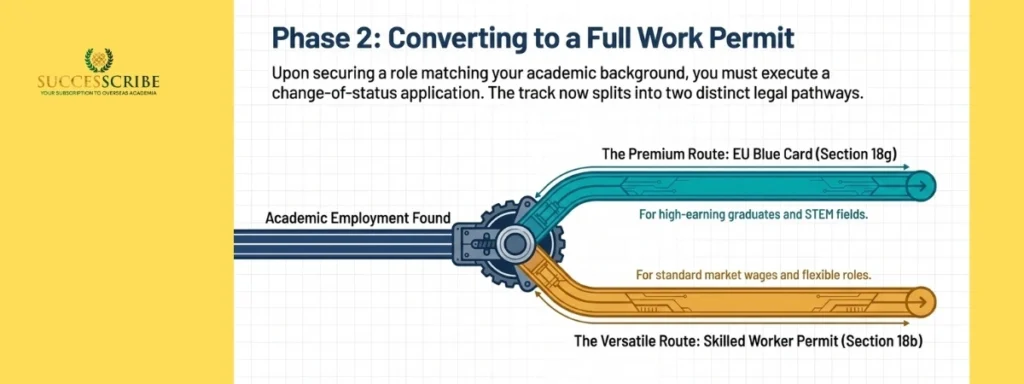
Once you secure a full-time position that matches your academic background, you can formally lock in your long-term Germany Work permit after Study status by applying for a change of residence title at the immigration office. At this point, you must actively execute the protocol of how to convert student visa to work permit germany by filing a change-of-status application with the Ausländerbehörde.
Blue Card vs. Skilled Worker Permit
| Evaluation Criteria | EU Blue Card (Section 18g) | Skilled Worker Permit (Section 18b) |
| Primary Target Audience | High-earning graduates, STEM professionals, and management profiles. | Graduates with starting salaries below the premium Blue Card floor (e.g., non-profits, small startups). |
| 2026 Salary Requirements | • Standard: €50,700 gross/year • Shortage/Recent Grads: €45,934.20 gross/year | No fixed national minimum floor; must match the local industry standard (Ortsübliche Vergleichsmiete/Vergütung). |
| Recent Graduate Provision | Applies the lower threshold (€45,934.20) to any graduate who finished their degree within the last 3 years. | Standard market salary matching is applied based on the job description, regardless of graduation date. |
| Job Scope Flexibility | The job must utilize the high-level intellectual/analytical skills of an academic degree. | The job must be considered “qualified employment” requiring a degree or advanced technical training. |
| Federal Employment Agency (BA) Check | Exempt if meeting the standard salary floor. Automated checks apply for the lower graduate/STEM threshold. | Mandatory. The local agency must explicitly confirm your salary isn’t lower than a German peer’s salary. |
| Fast-Track Permanent Residency (PR) | • 21 Months (with B1 German) • 27 Months (with basic A1 German) | • 24 Months for anyone holding a degree from a state-recognized German university + B1 German. |
| Changing Employers (First 24 Months) | Requires formal approval from the Ausländerbehörde before transitioning. | Requires formal approval and an updated Erklärung zum Beschäftigungsverhältnis form. |
The EU Blue Card Route (For Master’s Graduates)
For ambitious individuals who complete postgraduate studies, securing an blue card germany after masters is the gold standard for long-term integration. The EU Blue Card (regulated under Section 18g AufenthG) provides unmatched statutory advantages, including highly accelerated permanent settlement timelines and simplified family reunification protocols. High-earning graduates can bypass standard waiting times and tap into the premium tier of the Germany Work permit after Study pathway by securing an EU Blue Card with its lower salary thresholds for recent alumni.
2026 Salary Threshold Breakdown
The salary thresholds for the EU Blue Card are updated dynamically every year by the Federal Ministry of the Interior, directly tied to the national pension insurance contribution assessment ceiling (Beitragsbemessungsgrenze). For the year 2026, the income thresholds reflect a 5% baseline adjustment over previous years, split into two specific categories:
Standard Occupations Threshold
For general professions – including business management, finance, marketing, legal services, logistics, and humanities fields – the minimum required gross annual salary for 2026 is €50,700 (approximately €4,225 gross per month).
Shortage Occupations & Recent Graduates (Reduced Threshold)
To directly counteract severe domestic labor shortages, Germany offers a heavily reduced salary threshold of €45,934.20 gross per year (approximately €3,828 gross per month). This lower line applies to two major groups of applicants:
- MINT/STEM Professionals: Individuals working in mathematics, computer science, natural sciences, engineering, and medical fields.
- Recent University Graduates: Any international graduate who completed their university degree less than three years prior to the date of filing the Blue Card application, completely regardless of their specific industry or field of study.
| Professional Category | Example Job Titles | 2026 Gross Annual Salary Requirement | Federal Employment Agency (BA) Approval Required? |
| Standard Blue Card Tier | Marketing Director, Financial Analyst, HR Manager, Corporate Lawyer | €50,700 or higher | Generally Exempt (No check required) |
| MINT Shortage Tier | Software Engineer, Data Scientist, Civil Engineer, Industrial Architect | €45,934.20 to €50,699 | Yes (Automated verification of working conditions) |
| Young Graduate Tier | Entry-Level Consultant, Business Developer, Junior Project Manager | €45,934.20 to €50,699 | Yes (Automated check to prevent local wage dumping) |
| Experienced IT Track (No Degree) | Senior DevOps Engineer, Cybersecurity Architect | €45,934.20 or higher | Yes (Requires proof of 3+ years of expert tech experience) |
The Power of the Fast-Track Permanent Residence
The single most attractive feature of obtaining an EU Blue Card after graduation is the unmatched speed with which you can secure a lifetime Permanent Settlement Permit (Niederlassungserlaubnis).
While standard global visa holders must wait 3 to 5 years, Blue Card holders can fast-track their permanent settlement according to their language proficiency:
Fast-Track Settlement Timeline for Blue Card Holders:
- 21 Months: If you achieve B1 level proficiency in the German language according to the Common European Framework of Reference for Languages (CEFR).
- 27 Months: If you maintain basic A1 level conversational German proficiency.
This means a student graduating with a Master’s degree can become a permanent resident of Germany less than two years after starting their first full-time job.
Application Process and Document Checklist
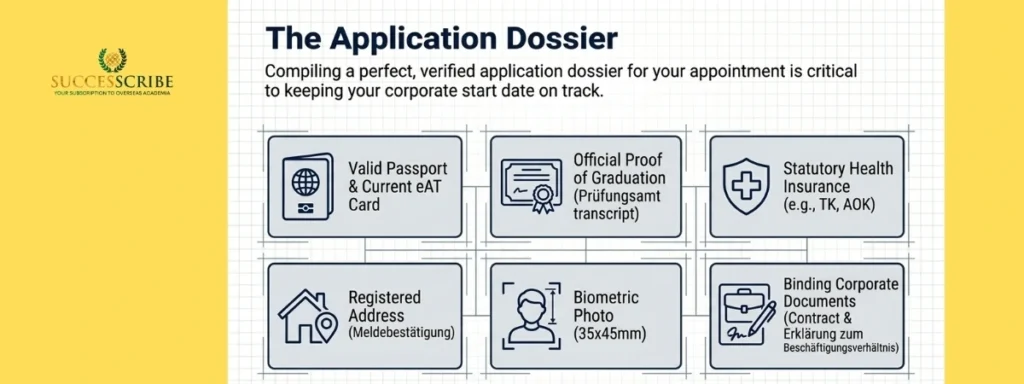
Avoiding administrative delays requires you to gather all necessary paperwork, as compiling a perfect application dossier for your Germany Work permit after Study is critical to keeping your corporate start date on track.
Core Document Checklist for Post-Study Work Permits
When preparing to apply for either the 18-month job seeker visa or your first full work permit at your local Ausländerbehörde, assemble the following verified dossier:
- Valid International Passport: Must be valid for the entire planned duration of the residence permit.
- Current Residence Permit Card: Your active or expiring plastic Electronic Residence Title (elektronischer Aufenthaltstitel – eAT).
- Official Proof of Graduation: Your final university transcript of records, or an official graduation certificate issued by your department’s Prüfungsamt.
- Comprehensive Health Insurance Cover: Proof of continuity of care. You must transition from student health insurance (Studentische Krankenversicherung) to statutory public health insurance (Gesetzliche Krankenversicherung via providers like TK, AOK, or Barmer) or an equivalent private policy immediately upon starting employment.
- Proof of Registered Address (Meldebestätigung): Your active housing registration document, alongside a signed landlord confirmation form (Wohnungsgeberbestätigung).
- Biometric Passport Photo: Taken within the last three months in accordance with German biometric specifications (35mm x 45mm, neutral expression).
- Completed Application Forms: Form Antrag auf Erteilung eines Aufenthaltstitels.
- Binding Employment Documents (For Work Permit/Blue Card): Your signed corporate employment contract and the fully completed Federal Employment Agency form: Erklärung zum Beschäftigungsverhältnis (Declaration of Employment Relationship), filled out and signed by your HR department.
Staying Long-Term: Permanent Residence & Citizenship
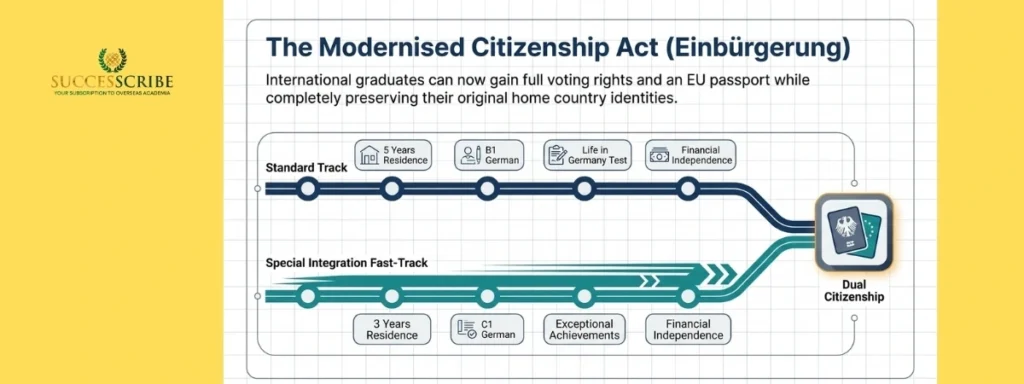
Local university degrees unlock accelerated pathways to a permanent settlement permit, meaning that time spent under a Germany Work permit after Study fast-tracks your journey toward dual citizenship and a lifelong European home.
Phase 1: Getting Permanent Residence (PR) (Niederlassungserlaubnis)
A permanent residence permit allows you to live and work in Germany indefinitely without visa renewals. As a graduate of a state-recognized German university, you bypass the standard 5-year waiting period required for other foreign nationals.
| Qualifying Path | Required Months of Employment & Pension | Required German Language Level | Key Prerequisites & Rules |
| German University Graduate Fast-Track (Section 18b) | 24 Months (2 years) | B1 Level | Must hold a qualified skilled worker permit and have paid 24 months of statutory pension contributions (Rentenversicherung). |
| EU Blue Card Fast-Track (Section 18g – Option A) | 21 Months (Under 2 years) | B1 Level | Available to any Blue Card holder who achieves independent intermediate language proficiency. |
| EU Blue Card Fast-Track (Section 18g – Option B) | 27 Months (2.25 years) | A1 Level | Designed for fast-earning professionals who only possess basic conversational German. |
Phase 2: German Citizenship (Einbürgerung)
The German Nationality Act completely modernizes the naturalization pipeline. International graduates can maintain their original identities while gaining full voting rights and an EU passport.
| Naturalization Track | Required Residence Timeline | Language & Integration Requirements | Dual Citizenship Rules |
| Standard Naturalization | 5 Years (Reduced from the old 8-year rule) | • B1 German • Pass the “Life in Germany” test • Complete financial independence | Fully Allowed. You are no longer legally required to give up your original home country passport. |
| Special Integration Fast-Track | 3 Years | • C1 German • Exceptional academic/professional achievements • Complete financial independence | Fully Allowed. Dual citizenship is fully preserved even on the 3-year accelerated track. |
Conclusion
The transition from a student inside a German lecture hall to a professional driving Europe’s largest economy is backed by one of the most progressive immigration structures in the world. By aligning the 18-month post-study runway with the modernized pathways of the Skilled Immigration Act, Germany makes it incredibly attractive to stay long-term.
Whether you cross the line via the premium EU Blue Card at the 2026 threshold or build your career through the versatile Skilled Worker Permit, the path forward is direct. Navigating this transition successfully comes down to meticulous document preparation, acting immediately upon receiving your final grades, and keeping a close eye on your language skills to unlock rapid permanent residency and dual citizenship. Building a thriving professional life in Europe’s largest economy is highly achievable if you execute your Germany Work permit after Study strategy immediately after finishing your exams and keep improving your German language skills.
FAQs
Question. Does my student visa automatically stay valid until its printed expiration date after I graduate?
Answer. No. This is one of the most common pitfalls for international graduates. Your student residence permit (Aufenthaltserlaubnis zu Studienzwecken) legally loses its primary purpose the moment your final examination results are officially published or your thesis defense is confirmed by the Prüfungsamt. You must apply to transition to the 18-month job seeker permit or a full work permit immediately to maintain continuous legal residency.
Question. Can I travel outside of Germany or the EU while holding the 18-month Post-Study Job Seeker Permit?
Answer. Yes. The post-study job seeker permit is a standard residence title (Aufenthaltserlaubnis). It allows you to travel freely throughout the Schengen Area for up to 90 days within any 180-day period, and you can exit and re-enter Germany as long as your passport and permit remain valid.
Question. Can I split the 18-month job seeker visa? For example, use 6 months, go home for a year, and return for the remaining 12 months?
Answer. No, the 18-month post-study permit is issued as a continuous, non-extendable runway. The clock runs consecutively from the date your graduation results are certified. If you leave Germany without transitioning to a specialized overseas job seeker visa, you forfeit the remaining time on this specific local graduate permit.
Question. Am I limited to working a certain number of hours while on the 18-month job-seeking permit?
Answer. Not anymore. While your student visa limited you to 140 full days per year, the Section 20 post-study permit grants completely unrestricted labor access. You can work full-time (40 hours per week or more), work multiple part-time jobs, work in freelance capacities, or take casual temporary jobs in hospitality and retail to support yourself while hunting for your dream corporate role.
Question. If I graduate from a German university, do I qualify for the lower EU Blue Card salary threshold even if my job isn’t in a STEM field?
Answer. Yes. Under the updated regulations for 2026, the lower salary threshold of €45,934.20 gross per year applies directly to all recent university graduates who completed their degree within the last 3 years, completely regardless of their field of study. This opens up the premium Blue Card route to humanities, business, and arts graduates entering entry-level roles.
Related Post
Germany job seeker visa Guide
Study in Germany in English
MBA Scholarship in Germany
One year masters in Germany