The United Nations projects that by the year 2050, approximately 68% of the world’s population will reside in urban environments. This massive shift represents the defining challenge of the 21st century, requiring a radical rethinking of how city-regions move, breathe, and sustain themselves. This growing demand has made Masters in Urban Planning in Germany one of the most attractive postgraduate choices for students interested in shaping the future of cities. In this Urban Century, Germany has positioned itself as a premier “living laboratory.” By blending a deep-seated tradition of municipal governance with cutting-edge engineering and “knowledge materialization,” the German higher education system offers a unique environment where students don’t just study urbanism – they engage in the “societal transformation” of the urban fabric itself.
Key Highlights: Masters in Urban Planning in Germany
- Top destination for Urban Planning and Sustainable Development
- 30+ Master’s programs at leading German universities
- Multiple English-taught programs available
- Low or no tuition fees at most public universities
- Strong focus on practical learning and industry projects
- Specializations in Smart Cities, GIS, Urban Design, and Sustainability
- High graduate employability with salaries from €45,000–€95,000+ per year
- 18-month post-study work opportunity in Germany
- Excellent career prospects in Germany and globally
- Part-time work opportunities during studies
Why Study Urban Planning in Germany?
Germany has long been recognized for balancing industrial growth with environmental protection and high living standards.
| Reasons to Study in Germany | Details and Benefits |
| Global Recognition & Quality | Germany has emerged as one of the top five destinations worldwide for international education. Its universities maintain a reputation for academic excellence, blending deep theoretical foundations with technical depth. |
| Affordability | A primary appeal is that most public universities charge little to no tuition fees. While semester contributions (typically €200–€500) apply, the overall cost is low compared to other top study destinations. |
| Leadership in Sustainability | Germany is a global leader in sustainable infrastructure and smart cities. Students gain hands-on exposure to cities that are actively redesigning their transit, energy, and public-space systems. |
| Practical, Real-World Focus | Education is highly practice-oriented, often involving collaborations with local municipalities and research institutions. Industry-linked projects allow students to connect classroom theory to real-world planning decisions. |
| English-Taught Degrees | Many specialized programs are conducted entirely in English, making them highly accessible to international students without requiring immediate German fluency. |
| Strong Career Prospects | Graduates are in high demand for roles in urban policy, infrastructure consultancy, and smart city management. These competencies and technical skills transfer directly to organizations and cities worldwide. |
| International Orientation | Programs often emphasize a global perspective on urbanization, with many including mandatory international exchange semesters at partner universities across Europe, Asia, and Latin America |
| Innovative Research Environment | The country has a strong tradition in municipal governance and engineering research, providing an ideal environment to test innovative ideas responding to 21st-century urban challenges. |
Suggested Post: Ludwig Maximilian University of Munich
Top Universities for Masters in Urban Planning in Germany
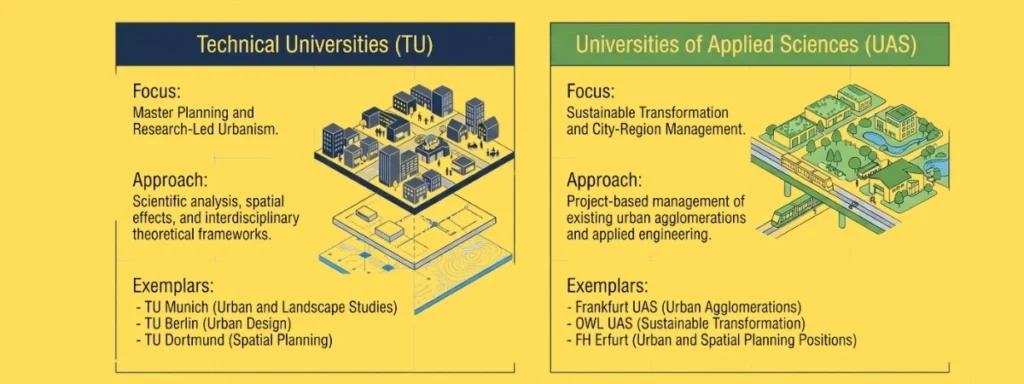
For those researching urban planning Germany universities, the choice between these two tracks defines the eventual professional trajectory: a research-led university typically prepares one for “master planning,” while a University of Applied Sciences often focuses on “sustainable transformation” and the management of existing city-regions.
Top 10 Universities for Urban Planning Masters in Germany
| University Name | Specific Program Title | Core Focus | Language |
| Technical University of Munich (TUM) | M.Sc. Urbanism – Urban and Landscape Studies and Design | Interdisciplinary urbanism addressing the ecological, economic, and social transformations of global urbanisation | German (some modules in English) |
| TU Berlin | M.Sc. Urban Design | Transdisciplinary design and research at the interface of architecture, sociology, and landscape architecture | English |
| TU Berlin | M.Sc. Urban and Regional (Development) Planning | Local and regional overall planning, town planning, residential building, and regeneration of urban units | German |
| TU Dortmund | M.Sc. Spatial Planning | Scientific analysis of spatial effects and interdisciplinary solutions for complex planning assignments | German (English specialisations available) |
| TU Darmstadt | M.Sc. Sustainable Urban Development | Multi- and interdisciplinary methods for initiating and implementing sustainable processes at various urban levels | English |
| Bauhaus-Universität Weimar | M.Sc. Urban Studies | Scientifically grounded approach to urban development policy, spatial planning theory, and stakeholder interaction | German |
| University of Kassel | M.Sc. Urban and Regional Planning | Preparation for interdisciplinary research and practice in redevelopment, leisure areas, and industrial conversion | German |
| Frankfurt University of Applied Sciences | M.Sc. Urban Agglomerations | Sustainable planning, management, and operation of large agglomerations and city-regions | English |
| Fachhochschule Erfurt (FH Erfurt) | M.Sc. Urban and Spatial Planning Positions | Specialisation in sustainable planning and construction, land use, and resource management | German (requires C1 level) |
| Ruhr University Bochum (UNIC) | M.Sc. Re-designing the Post-Industrial City | Revitalisation of cities in transition and responding to the challenges of post-industrial and diverse societies | English |
Suggested Post: Fulbright-Nehru Fellowships
Top Universities for International Students Urban Planning (English-taught)
The following table details the specialized Master’s programs in urban planning and related fields in Germany that are taught entirely in English
| University Name | Specific Program Title | Core Focus | Key Feature / Language |
| TU Berlin | M.Sc. Urban Design | Transdisciplinary design at the interface of architecture, sociology, and landscape architecture. | English; Offers a double degree with Tongji University (Shanghai). |
| Frankfurt University of Applied Sciences | M.Sc. Urban Agglomerations | Sustainable planning, management, and operation of city-regions and large agglomerations | English; Includes a mandatory international exchange semester |
| TU Darmstadt | M.Sc. Sustainable Urban Development | Solving challenges of sustainable urban development on a project-related basis | English; Joint degree with Vietnamese-German University (Ho Chi Minh City) |
| OWL University of Applied Sciences and Arts | MA Urban Planning and Sustainable Transformation | Creative solutions for complex urban landscapes and spatial design | English; Located in Detmold |
| Ruhr University Bochum (UNIC) | Erasmus Mundus (RePIC) | Re-designing post-industrial cities and responding to super-diverse societies | English; Multi-city program including Rotterdam and Bochum |
| HafenCity University Hamburg | Resource Efficiency in Architecture and Planning (REAP) | Emphasis on sustainability, global perspectives, and interdisciplinary learning | English |
| Bauhaus-Universität Weimar | European Urban Studies | Focuses on urban development policy and spatial planning within a European context | English |
| TU Dortmund | M.Sc. Spatial Planning (English Tracks) | Specializations in “Urban Transformation” and “Planning in the Global South” | English specializations within a larger German program |
| International Academy Ruhr University Bochum | M.Sc. Sustainable Energy and Hydrogen Infrastructures | Planning future-oriented sites and infrastructure for sustainable energy systems | English; Focus on hydrogen technology |
| Deggendorf Institute of Technology | M.Eng. Healthy and Sustainable Buildings | Qualifications for careers in the sector of healthy and sustainable building construction | English |
| Wismar University (WINGS) | Master Green Architecture | Professional study course specifically focused on sustainable architectural design | English; Distance learning format |
Program Curricula and Specializations
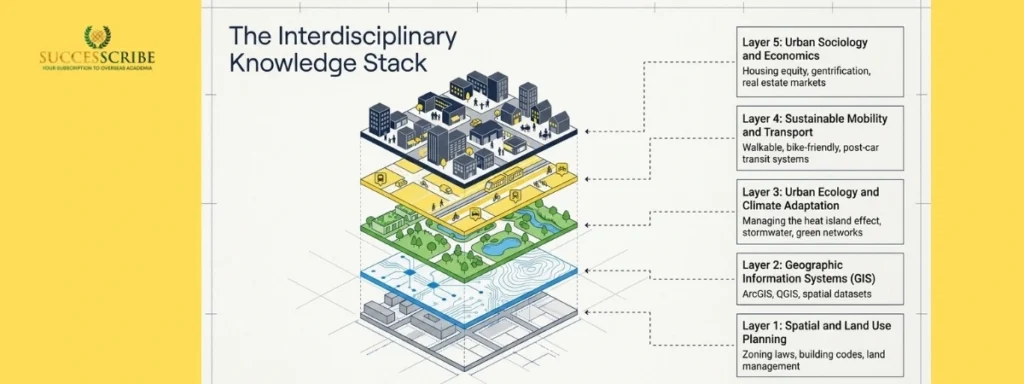
An advanced degree in this field is highly interdisciplinary. When pursuing a masters in urban planning in Germany, your coursework will generally bridge the gap between technical, social, and aesthetic domains.
A typical curriculum for a city planning masters Germany in English is divided into core modules, elective modules, studio projects, and the final Master’s thesis.
Core Academic Modules
- Spatial and Land Use Planning: Understanding building codes, zoning laws, and land management strategies.
- Geographic Information Systems (GIS): Utilizing software like ArcGIS and QGIS to analyze geospatial patterns and build spatial datasets.
- Urban Ecology and Climate Adaptation: Developing strategies to combat the urban heat island effect, manage stormwater, and design green networks.
- Sustainable Mobility and Transport Planning: Moving away from car-centric layouts to design walkable, bike-friendly transit systems.
- Urban Sociology and Economics: Analyzing housing equity, demographic shifts, gentrification, and real estate market trends.
The Role of Project Studios
Project studios are the cornerstone of a masters in urban planning in Germany. Students form multidisciplinary teams to tackle real-world development sites. For example, a studio project might require your team to re-envision a decommissioned railway yard in Stuttgart or design a carbon-neutral neighborhood block in Berlin, complete with public participation strategies and legal planning compliance.
Eligibility and Admission Requirements
Requirements vary slightly by university, but most programs offering a Masters in Urban Planning in Germany share a common admissions framework:
- A relevant bachelor’s degree (architecture, urban planning, geography, civil engineering, or a closely related field), typically with a minimum of 65–70% or a comparable GPA
- English proficiency: IELTS 6.5+ or TOEFL iBT 90+ for English-taught programs
- A motivation letter explaining your academic background and career goals
- 1 – 2 academic pr professional letters of recommendation.
- A portfolio (for design-heavy programs like Urban Design at TU Berlin)
- Application through uni-assist, the centralized platform most German universities use to evaluate international applications (processing typically takes 4 – 6 weeks)
- The APS Certificate: Applicants from India, China, and Vietnam must obtain this certificate to verify academic authenticity – a mandatory administrative step that can take several months.
Application deadlines generally fall between April and July for the winter intake (October start), though some universities also offer a summer intake. Given how competitive spots have become, applying at least eight to ten months in advance is a wise idea.
Suggested Post: Sample SOP for MBA in Germany
Urban Design Germany Fees: Tuition and Living Costs
This is usually where the real decision-making happens, so let’s talk numbers. When people search for urban design Germany fees, the good news is that the figure is almost always smaller than they expect.
Germany abolished tuition fees at public universities back in 2014, and this policy still holds for the overwhelming majority of states in 2026. Instead of tuition, students pay a semester contribution (Semesterbeitrag) that covers administration, student services, and – in most cities – a discounted or free regional transport pass.
| Cost Component | Typical Amount |
| Semester contribution (public universities) | €150 – €400 per semester |
| Tuition at Baden-Württemberg public universities (non-EU) | €1,500 per semester |
| Tuition at select TUM programs (non-EU) | €2,000 – €6,000 per semester |
| Private university tuition (Master’s) | €10,000 – €25,000 per year |
| Blocked account requirement (visa) | €11,904 per year (€992/month) |
| Average monthly living cost | €900 – €1,500 |
| Health insurance | €120 – €130 per month |
Scholarships and Funding Options for Urban Planning Masters in Germany
A number of funding routes can meaningfully offset the cost of a Masters in Urban Planning in Germany:
- DAAD Scholarships: Cover tuition, a monthly stipend, travel costs, and sometimes health insurance for postgraduate students.
- Deutschlandstipendium: Offers €300 per month, funded jointly by universities and private donors.
- Erasmus+: Available for students on programs with an EU exchange component, such as the SPRING or IUSD tracks.
- Heinrich Böll Foundation Scholarships: Provide up to €992 per month for master’s students, with additional allowances in some cases.
- University-specific merit scholarships: Many urban planning Germany universities run their own partial-tuition or living-cost grants for high-performing international applicants.
Applying to two or three of these simultaneously is common practice and significantly improves your odds of securing at least partial funding.
Urban Planning Germany Job Opportunities After Graduation
This is the section most applicants care about the most, and rightly so – a degree only matters if it leads somewhere. The good news is that urban planning Germany job opportunities have been steadily expanding, driven by a persistent housing shortage, climate-adaptation mandates, and infrastructure renewal across nearly every major German city.
Salaries
The financial reward for planners in Germany is highly competitive, and having a master’s degree significantly boosts your entry-level positioning.
- Entry-Level Salary: Typically ranges from €45,000 to €50,000 gross per year.
- Mid-Career Salary (4 – 8 years): Ranging from €55,000 to €68,000 annually.
- Senior Positions / Team Leaders: Senior planners, private firm partners, or directors of municipal planning offices easily earn €75,000 to €95,000+ per year.
To give you a clearer view of the landscape of urban planning Germany job opportunities, the following table contrasts popular roles, typical employers, and standard average salary expectations:
Career Options in Urban Planning in Germany
| Job Title | Typical Employer | Required Language Skills | Average Annual Salary (Gross) |
| Junior Urban Planner | Municipal Offices / Private Firms | German (B2/C1) or English (for global firms) | €47,000 |
| GIS Analyst / Spatial Modeler | Research Institutes / Private Consultants | English (B2/C1), German is a plus | €52,000 |
| Sustainability Consultant | Engineering firms (e.g., Arup, WSP) | English (fluent), German (B1) | €58,000 |
| Senior City Planner | State/Federal Planning Agencies | German (C1/C2 is mandatory) | €75,000+ |
| Real Estate Project Manager | Private Developers | German (B2) and English | €68,000 |
Undoubtedly, secure urban planning Germany job opportunities exist across both highly technical spatial coding niches and client-facing urban design roles.
Suggested Post: Sample SOP for Germany student visa
Step-by-Step Application Roadmap for Urban Planning Masters in Germany
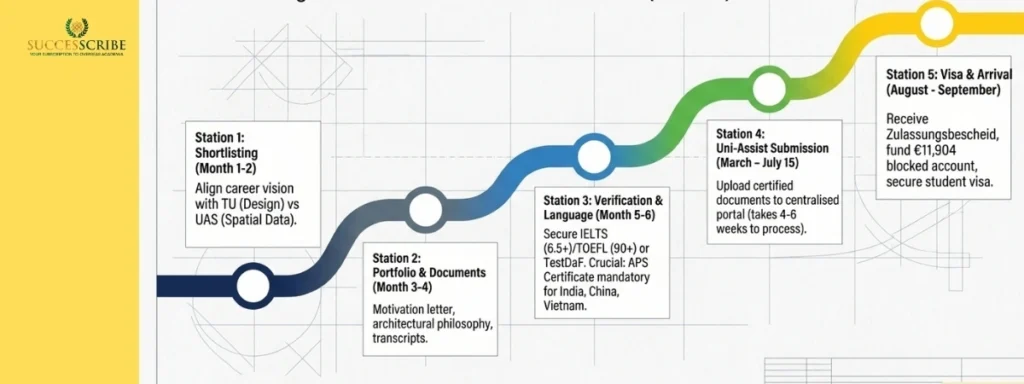
To ensure a seamless transition into a master’s program, it is essential to begin planning at least 10 to 12 months before your target winter intake.
Step 1: Program Research and Shortlisting
Determine whether you want to focus on highly architectural designs or large-scale regional spatial data. Identify which of the top urban planning Germany universities align with your career vision.
Step 2: Assemble Your Portfolio and Documents
Request official academic transcripts, draft a focused letter of motivation outlining your architectural/planning philosophy, and assemble your design/project portfolio.
Step 3: Check Language Requirements and Take Exams
If applying to a city planning masters Germany in English, ensure your IELTS or TOEFL certificate is valid. If your program requires German skills, secure your Goethe-Institut or TestDaF certificates.
Step 4: Submit via Uni-Assist or Direct Portal
Many German universities process international applications through a centralized portal called Uni-Assist. Gather your certified documents and submit your application online. The application window for the winter semester typically opens in early March and closes on May 15th or July 15th for international applicants.
Step 5: Secure Visa and Set Up Blocked Account
Once you receive your letter of admission (Zulassungsbescheid), schedule your student visa appointment at your local German embassy. Set up your blocked account containing the mandatory €11,900+ to cover your first year’s living expenses.
Conclusion
The urban challenges of 2026 – from climate resilience to digital equity – demand a generation of planners who are both technically rigorous and socially conscious. Germany has established itself as the global leader in this pedagogical transition. Pursuing a masters in urban planning in Germany is no longer just an academic choice; it is a strategic career pivot into the heart of European innovation. Whether you are drawn to the design-led multidisciplinary studios of TU Berlin or the management-oriented international exchange tracks of Frankfurt UAS, the German system offers the analytical depth required to lead.
FAQs
Can I work while studying in Germany?
Absolutely. International students are typically permitted to work 20 hours per week. In 2026, this is more than just a way to pay the bills; it is a critical professional tool. By taking a “Studentische Hilfskraft” (student assistant) position at a university or an internship at a planning firm, you gain local experience that is essential for your post-graduation job hunt.
Is German proficiency required for English programs?
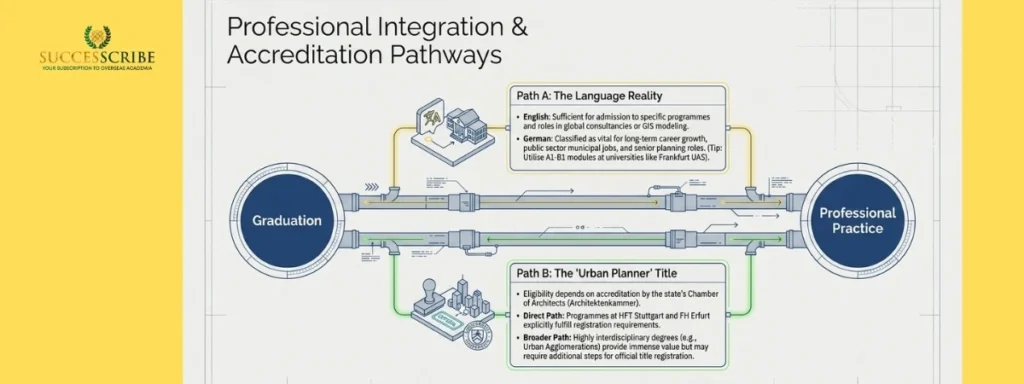
Technically, no. For programs like Urban Design at TU Berlin, English is the prerequisite for admission. However, the Consultant’s advice is clear: German is “useful” for daily life and “vital” for long-term career growth in the public sector. Many programs, including Frankfurt UAS, offer German modules (A1 to B1) to help bridge this gap.
Is a masters in urban planning in Germany worth the investment?
The ROI is exceptionally high. When you combine the low tuition of public universities (even the specialized ones) with the high salary potential and the 18-month job-seeker visa, the financial logic is sound. Furthermore, the global recognition of German engineering and planning degrees means you are not just tied to the German market; you are positioned for a career in global urban innovation.
Can I study Urban Planning in Germany in English?
Yes. Several prestigious universities offer Master’s programs taught entirely in English to attract international students. Key examples include:
1. TU Berlin: M.Sc. Urban Design
2. Frankfurt UAS: M.Sc. Urban Agglomerations
3. TU Darmstadt: M.Sc. Sustainable Urban Development
4. HafenCity University Hamburg: Resource Efficiency in Architecture and Planning (REAP)
Will I be eligible to practice as a professional “Urban Planner” in Germany?
Eligibility depends on whether the program is accredited by the state’s Chamber of Architects (Architektenkammer).
1. Programs at HFT Stuttgart and FH Erfurt specifically state they fulfill requirements for registration in the list of urban planners
2. Highly interdisciplinary or international programs (like Frankfurt UAS’s Urban Agglomerations) may not automatically grant eligibility for the professional title “Urban Planner” in Germany due to their broader focus
Related Post
Media studies Germany Universities
Masters in Biotechnology in Germany
Masters in food technology in Germany
Transportation in Germany for Students