If you’re trying to work out whether it makes sense to study pharmacy in Italy, here is the short version. Pharmacy in Italy is a five-year, single-cycle Laurea Magistrale degree (class LM-13), taught in English at a small number of public universities and in Italian at dozens more. You get in through a dedicated admission test rather than a general application, tuition at public universities can be as low as €157 a year once income-based reductions are applied, and the degree is recognised across the European Union the moment you graduate. Interest from India is rising fast – more than 6,000 Indian students were on Italian study visas in 2024, a 16% jump over the previous year, and healthcare programmes like pharmacy are a meaningful part of that growth. This topic covers eligibility, the entrance exam, the strongest universities, real fee and living-cost figures, scholarships, the visa process, and what a pharmacy career in Italy actually pays – everything you need before you decide to study pharmacy in Italy.
Key Highlights: Study Pharmacy in Italy
| Aspect | Details |
| Degree | Laurea Magistrale a Ciclo Unico (LM-13) – single-cycle, Master’s-equivalent |
| Duration | 5 years / 300 CFU (credits) |
| Entrance exam | CEnT-S (English-taught programmes) or TOLC-F (Italian-taught programmes) |
| Minimum language level | B2 English (English-taught) or B2 Italian (Italian-taught) |
| Public university fees | €157–€4,000/year, income-assessed (ISEE) |
| Living costs | €800–€1,200/month, city-dependent |
| Intake | Academic year begins September/October; entrance tests run Nov–June |
| Post-degree licensing | Final degree exam directly qualifies graduates to practise (Law No. 163/2021) |
Why Study Pharmacy in Italy
Cost is the first reason most Indian families look seriously at Italy. Public university fees are income-linked: students whose family income falls below roughly €23,000 (assessed through the Italian ISEE certificate) pay as little as €156–€157 a year, while most other applicants pay somewhere between €900 and €4,000 annually – figures that are a fraction of pharmacy tuition in the UK, US, Canada or Australia.
There’s also academic heritage behind the price tag. The University of Bologna, home to one of the country’s strongest pharmacy faculties, was founded in 1088 and is the oldest university in Europe still operating today. Because Italy follows the EU’s Bologna Process credit system, an LM-13 pharmacy degree earned in Italy is recognised across the European Union without additional conversion.
English-taught access is also expanding: for the 2026–27 cycle, the University of Bologna’s Rimini campus and Tor Vergata University of Rome both run their entire LM-13 programme in English, admitting students through the CEnT-S test rather than requiring Italian from day one. And thanks to Law No. 163 of 8 November 2021, graduates are qualified to practise as pharmacists immediately upon passing their final degree exam – there’s no separate national licensing exam layered on top, which shortens the path from classroom to career considerably. Add in Italy’s position as one of Europe’s largest pharmaceutical manufacturing bases, and it’s easy to see why more students choose to study pharmacy in Italy each year.
There’s also a growing peer network to lean on. With Indian enrolment on Italian study visas rising 16% between 2023 and 2024 alone, incoming students increasingly find an established community of Indian peers, alumni networks and consultancy support already in place at the universities that matter most, rather than having to navigate the system entirely from scratch.
Eligibility & Academic Requirements to Study Pharmacy in Italy
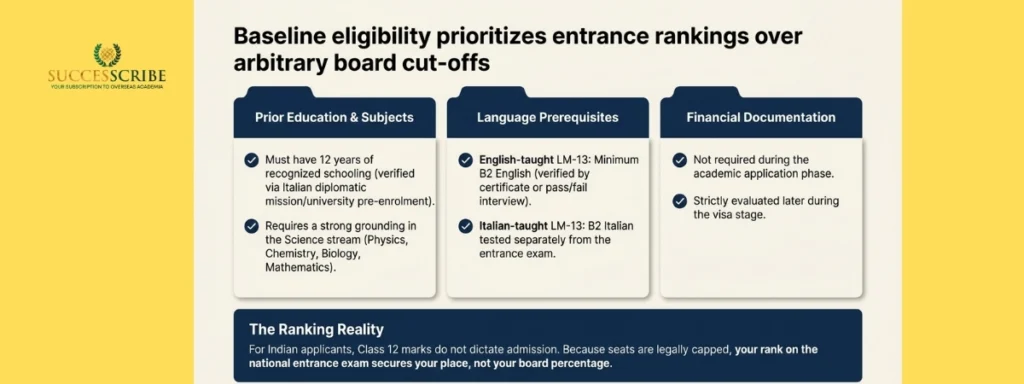
Before you can apply, make sure you meet Italy’s baseline entry conditions. These are set nationally by Italy’s Ministry of University and Research (MUR) and then applied by each university.
| Requirement | Detail |
| Prior education | 12 years of schooling recognised as granting university access in Italy, per MUR’s international student procedures |
| Subject background | Strong grounding in Biology, Chemistry, Physics and Mathematics – tested directly in the entrance exam |
| English proficiency | Minimum B2 level for English-taught programmes, verified by certificate or a pass/fail interview |
| Italian proficiency | B2 Italian typically required for Italian-taught programmes, tested separately from the entrance exam |
| Qualification recognition | Foreign qualifications (like Indian Class 12) must be verified as equivalent via the university or the Italian diplomatic mission |
| Financial proof | Not required for the academic application – needed later at the visa stage |
For Indian applicants specifically, your Class 12 marksheet in the Science stream (ideally Physics, Chemistry, and Biology or Mathematics) is the baseline document, and it goes through the standard recognition process during pre-enrolment. Most Italian universities don’t set a fixed minimum percentage cut-off the way many Indian institutions do – your entrance exam ranking decides your seat, not your board score alone.
Entrance Exam: The Real Gateway to Study Pharmacy in Italy
For most applicants, the admission test is the single biggest factor in whether you get to study pharmacy in Italy. Pharmacy places are capped by law (numero chiuso – a fixed number of seats), so your ranking against other candidates matters more than simply clearing a minimum score.
| Feature | CEnT-S (English-taught) | TOLC-F (Italian-taught) |
| Administered by | CISIA | CISIA |
| Test subjects | General culture/logic, Biology, Chemistry, Physics, Mathematics | Biology, Chemistry, Physics, Mathematics, logic |
| Language | English | Italian |
| Format | Computer-based – in person (CENT@UNI) or online (CENT@CASA) | Computer-based |
| Fee | €55 per attempt | €30–€40, varies by sitting |
| Attempts | Multiple allowed; best score counts | Multiple sittings offered through the year |
| Used by (2026–27 examples) | University of Bologna (Rimini), Tor Vergata University of Rome | Most Italian-medium pharmacy faculties nationwide |
At Tor Vergata’s Rome campus, for example, the CEnT-S testing window for the 2026–27 cycle runs from 1 November 2025 through 9 June 2026, while the university’s own ranking application (via its Delphi portal) is open separately, from 18 February to 12 June 2026. You must register on both the CISIA testing portal and the university’s own admissions portal – a test score alone does not enter you into the ranking. Missing either registration is one of the most common, and most avoidable, reasons applicants lose their place when they try to study pharmacy in Italy.
Top Universities to Study Pharmacy in Italy
Bologna and Tor Vergata currently stand out because they deliver the entire LM-13 programme in English, which matters if your Italian isn’t yet at B2. Nearly every other well-regarded pharmacy faculty in the country – Milan, Sapienza, Padua, Turin, Naples Federico II and others – teaches in Italian, so budget for a year of intensive language preparation if that’s the route you choose. Whichever university you shortlist, check its own admission call (bando) for the specific cycle, since seat numbers, deadlines and exact fee bands are reconfirmed annually and can shift year to year.
| University | City | Language | Degree | Notable For |
| University of Bologna (Rimini Campus) | Rimini | English | LM-13, 5 yrs | Oldest university in Europe (est. 1088); dedicated international student support |
| Tor Vergata University of Rome | Rome | English | LM-13, 5 yrs | Fully English-medium pharmacy faculty; competitive, capped seats |
| Università degli Studi di Milano (Statale) | Milan | Italian | LM-13, 5 yrs | Large, research-intensive faculty in Italy’s pharma-industry hub |
| Sapienza University of Rome | Rome | Italian | LM-13, 5 yrs | One of Europe’s largest universities; long-established pharmacy faculty |
| University of Padua | Padua | Italian | LM-13, 5 yrs | Historic faculty at Italy’s second-oldest university |
| University of Turin | Turin | Italian | LM-13, 5 yrs | Strong industrial pharmacy and cosmetic science specialisations |
Programme Structure: What 5 Years to Study Pharmacy in Italy Looks Like
The LM-13 degree is built around 300 CFU (credits, Italy’s equivalent of ECTS) split into two phases: a two-year preparatory block covering general culture, mathematics, physics, chemistry and biology fundamentals, followed by a three-year specialised block covering pharmaceutical, biological, chemical and clinical disciplines. Students who don’t clear the initial assessment test in these foundation subjects are assigned additional learning obligations (OFA) to complete alongside regular coursework, rather than being held back a year outright.
The later years introduce laboratory-based pharmaceutical technology, pharmacology, toxicology and legislation, plus a mandatory practical training placement, typically inside a community or hospital pharmacy. As noted above, Law No. 163/2021 means passing the final degree examination directly qualifies graduates to practise as pharmacists in Italy — a meaningfully shorter path than in countries that require a separate post-degree licensing exam.
| Parameter | Key Details |
| Total Credits & Structure | 300 CFU (ECTS equivalent) spread over 5 years, divided into two primary phases: foundational studies and advanced professional training. |
| Phase 1: Years 1 – 2 (Preparatory Block) | Focuses on core sciences and foundational knowledge: mathematics, physics, chemistry, biology fundamentals, and general culture. |
| Phase 2: Years 3–5 (Specialised Block) | Focuses on advanced pharmaceutical sciences: laboratory-based pharmaceutical technology, pharmacology, toxicology, medicinal chemistry, and pharmaceutical legislation. |
| Academic Catch-Up (OFA) | Students who do not pass the initial foundational assessment are assigned Additional Learning Obligations (OFA) to complete alongside their coursework, preventing year-long delays. |
| Practical Experience | Includes a mandatory practical training placement, typically completed in a community or hospital pharmacy setting. |
| Licensing Shortcut | Under Law No. 163/2021, passing the final degree examination directly qualifies graduates to practise as pharmacists in Italy, eliminating the need for a separate post-graduation licensing exam. |
Tuition Fees & Cost of Living
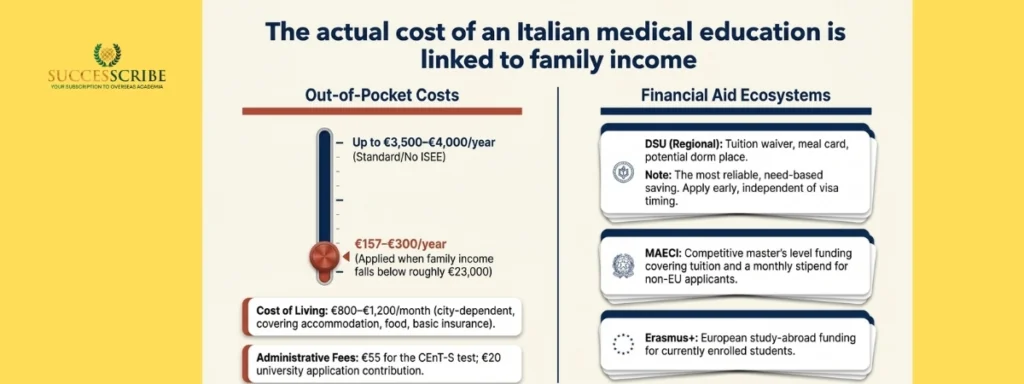
Living costs shift with the city: Rome and Milan sit toward the higher end of that range, while Rimini, Turin and smaller university towns run closer to €800/month for a modest, comfortable student lifestyle. Compared with pharmacy programmes in the UK, US or Australia – where tuition alone can exceed €15,000–€25,000 a year before living costs are even added – the affordability gap is one of the clearest reasons Indian families are choosing to study pharmacy in Italy right now.
| Item | Approx. Cost | Notes |
| Public tuition, low family income (ISEE-assessed) | €157–€300/year | Applies when family income is below roughly €23,000; full exemption possible at the lowest brackets |
| Public tuition, standard / no ISEE submitted | Up to €3,500–€4,000/year | Applies when income documentation isn’t provided |
| Private university tuition | €15,000–€20,000+/year | Varies significantly by institution – confirm directly |
| Living costs | €800–€1,200/month | Accommodation, food, transport, basic insurance |
| CEnT-S test fee | €55 | One-time cost per attempt |
| University application/registration contribution | €20 | Charged when submitting your admission application |
Scholarships & Financial Aid
Apply for regional DSU scholarships as soon as your enrolment is confirmed – deadlines are typically set months before the academic year starts and don’t wait for your visa to come through. If you plan to study pharmacy in Italy on a tight budget, the ISEE-based fee reduction is usually the most reliable saving, since it’s automatic once your documentation is verified rather than competitive like MAECI or DSU awards.
| Scheme | What It Covers | Who It’s For |
| ISEE-based fee reduction | Reduces tuition to as low as €157/year; sometimes full exemption | Students who submit verified family income documentation |
| Regional DSU (Diritto allo Studio) scholarships | Tuition waiver, meal card, sometimes dormitory place, cash grant | Merit- and need-based; terms set annually by each Italian region |
| MAECI scholarships | Tuition plus a monthly stipend | Non-EU applicants at master’s/doctoral level; competitive, limited seats |
| Erasmus+ | Funding for a study period at a partner European university | Students already enrolled who want a semester elsewhere in Europe |
Visa & Enrolment Process for Indian Students
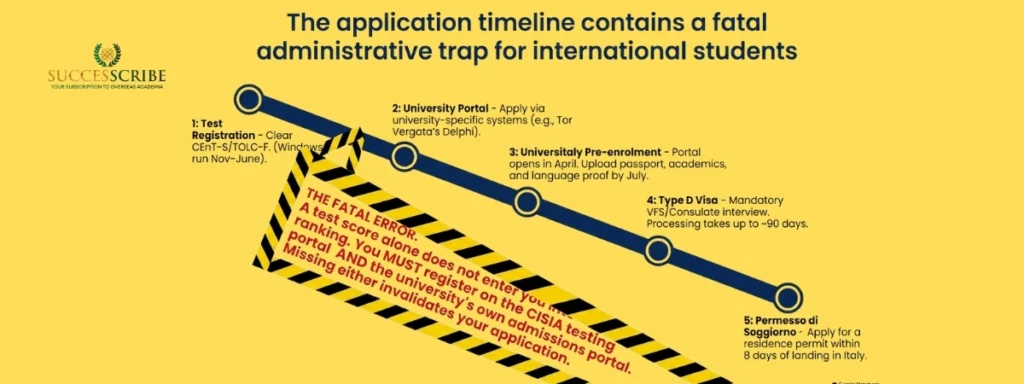
Every non-EU applicant, including Indian students, must complete Universitaly pre-enrolment before a visa application can even be submitted – getting this step’s timing wrong is one of the most common causes of delay. Because the process runs through both your university and the Italian Consulate in New Delhi, Mumbai or Kolkata, start gathering financial proof, health insurance and apostilled academic documents as soon as you accept your offer, well before you plan to actually study pharmacy in Italy in September.
| Step | What Happens | Typical Timing |
| 1. University admission | Clear the CEnT-S/TOLC-F test and receive an offer letter (conditional or unconditional) | Test windows run Nov–June; offers follow the ranking list |
| 2. Universitaly pre-enrolment | Register on universitaly.it and upload your passport, academic documents and language proof | Portal typically opens in April; university deadlines often fall by end of July |
| 3. Type D student visa | Submit documents and attend a mandatory interview at VFS Global or the Italian Consulate | Processing can take up to ≈90 days — apply early |
| 4. Permesso di Soggiorno | Apply for the residence permit after arriving in Italy | Within 8 days of landing |
Career Outcomes After You Study Pharmacy in Italy
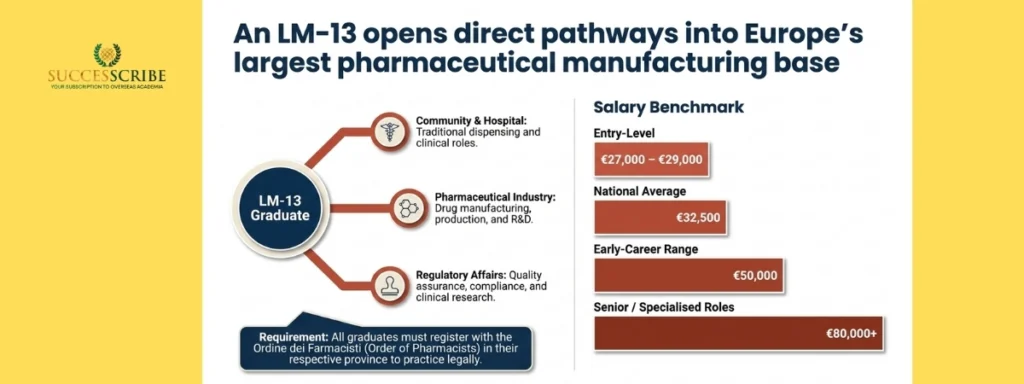
Graduates typically move into community or hospital pharmacies, the pharmaceutical industry, regulatory affairs, or research roles, and Italy’s large domestic pharmaceutical manufacturing sector means industry placements are a realistic option alongside the traditional dispensing route.
| Category | Details |
| Primary Career Pathways | • Community & Hospital Pharmacies: Traditional dispensing and clinical roles. • Pharmaceutical Industry: Drug manufacturing, production, and R&D (driven by Italy’s strong domestic manufacturing sector). • Regulatory Affairs & Research: Quality assurance, compliance, and academic/clinical research. |
| Salary Benchmarks | • National Average: €32,500 / year (PayScale) • Entry-Level (City Data): €27,000 – €29,000 / year (Glassdoor) • Early-Career Range: €50,000 / year (ERI SalaryExpert) • Senior / Specialised Roles: €80,000+ / year (ERI SalaryExpert) |
| Key Variables Influencing Pay | • Location: Varies noticeably by city. • Sector: Retail vs. Hospital vs. Pharmaceutical Industry. • Specialisation & Experience: Technical expertise and career longevity significantly increase earning potential. |
| Mandatory Licensing | Registration: Must register with the Ordine dei Farmacisti (Order of Pharmacists) in the respective province to legally practise upon graduation. |
Conclusion
Deciding to study pharmacy in Italy comes down to three things: whether you’re ready for a rigorous, ranking-based entrance exam, whether you’re targeting one of the limited English-taught seats or willing to build your Italian to B2, and whether the fee-and-living-cost math works for your family’s budget. For the right student, it remains one of the most affordable, EU-recognised routes into a pharmacy career currently open to Indian applicants.
FAQs
Is it worth it to study pharmacy in Italy as an Indian student?
For students who want an EU-recognised degree, lower fees than the UK, US or Australia, and a direct route to professional licensing, yes – provided you’re prepared for a competitive, ranking-based entrance exam.
Can I study pharmacy in Italy in English?
Yes, at a small number of universities – the University of Bologna’s Rimini campus and Tor Vergata University of Rome currently run full English-medium LM-13 programmes. Most other faculties teach in Italian.
How much does the whole degree cost?
Public tuition alone can run from about €157 to €4,000 a year depending on your family’s ISEE-assessed income, plus roughly €800–€1,200 a month in living costs – still well below equivalent programmes in the UK, US or Australia.
Is the degree recognised outside Italy?
The LM-13 is recognised across the EU under the Bologna Process credit system. For recognition in India, plan to go through the standard foreign-qualification equivalence process once you graduate.
What’s the biggest mistake applicants make?
Registering for the entrance exam but forgetting to also register on the university’s own admissions portal – or missing the Universitaly pre-enrolment window. Both are separate steps from taking the test itself, and missing either can cost you your seat.
Related Post
Cost of MBBS in Italy for Indian students
Cost of MBA in Italy for Indian students
Highest paying jobs in world
Highest-paying MBA specialization