Italy is more than a destination for art, history and culture. It also hosts some of Europe’s respected universities and cities that welcome students. From Milan’s business and career opportunities to Bologna’s lively student life and Rome’s historic academic schools, each Italian city gives a unique experience for international students. Choosing the city where you can study involves more than just the university you want to attend.
Choosing Italy as a study destination means looking at tuition, living costs, English‑taught programmes, student life, housing, public transport and career chances.This guide looks at the Top 10 cities to study in Italy and explains why each one is a great option for international students.
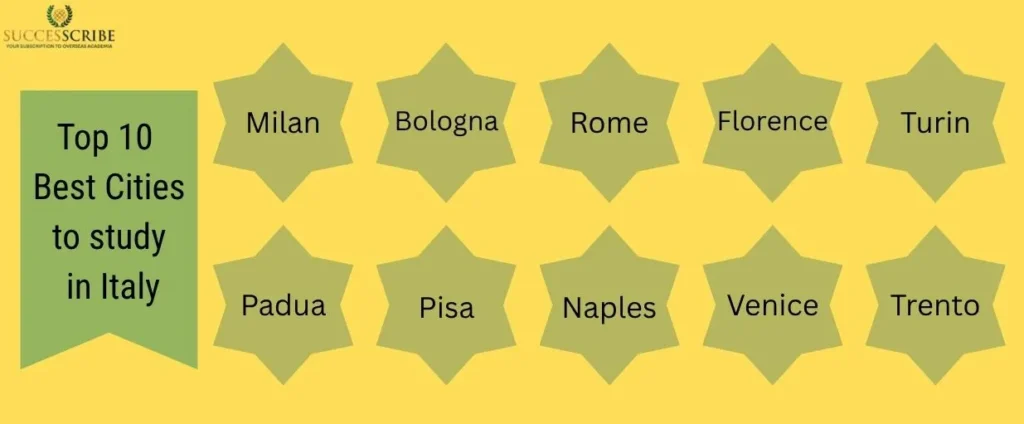
Top 10 Best Cities to study in Italy
Italy has several cities that attract international students, but the right choice can vary depending on your course, budget, lifestyle, and career plans. Some cities are known for prestigious universities and research, while others stand out for affordable living, strong student communities, or better access to internships and jobs.
These are the top 10 best cities to study in Italy for international students:
- Milan
- Bologna
- Rome
- Florence
- Turin
- Padua
- Pisa
- Naples
- Venice
There is no answer about which city is best to study in Italy. A city that is good for a business student who wants internships may not be the city for someone who wants an affordable student life or a quieter city to focus on academics.
When looking at the cities, it’s important to think about more than just university rankings. The cost of housing, how easy it is to get, whether there are classes taught in English, what the daily life is like, chances to work while studying and what jobs are available in your area of interest can all make a big impact on your experience. Each of these things can shape your time in the city as much as the school’s reputation.
1. Milan
The city of Milan can prove to be very interesting for students of business, finance, economics, fashion, design, architecture, and technology. Educational institutes like Bocconi University and Politecnico di Milano are known to be connected with these areas, whereas Milan itself has a great many organizations working in these spheres.
Milan can be especially interesting for students in business, finance, economics, fashion, design, architecture, and technology. Institutions such as Bocconi University and Politecnico di Milano are closely associated with these fields, while the city itself hosts a large number of companies, design houses, financial institutions, and international organisations.
One point which the students will need to keep in mind is the cost of living. Milan could place more strain on your budget than a lot of other cities in Italy especially if you wish to live near your university or in the central locations. The good thing is that you will have greater options when it comes to selecting the neighborhoods as well as the transport connectivity through the metro and tram system.
What is it that sets Milan apart?
- More appropriate for students who wish to balance academics and industry
- Mainly relevant for students studying business, finance, design, fashion, architecture, and technology
- Greater opportunities for networking outside the campus
- Public transport is so good that it allows living away from the city center
- Higher cost of living might be an important factor compared to other cities in Italy
Choose Milan if you want your university experience to be closely connected to Italy’s corporate, financial, fashion, or design industries.
2. Bologna
In terms of size, there may be many other Italian cities which can match or surpass the City of Bologna; however, the City of Bologna offers an additional advantage that is unique to this city and which many other cities do not offer. The entire city can be seen as a university campus; and not only this, students are not just confined to a particular university zone, but rather, they are integrated into the very fabric of the city in Bologna.
Bologna can also be a perfect choice for those looking for something between a big metropolitan city and a small town. In addition to being relatively easy to get around in, you will have all the perks of a city, including restaurants, cultural activities, entertainment, parks, and convenient train connections to cities such as Milan, Florence, and Rome.
The only difficulty could be in finding accommodation, as Bologna’s attractiveness to students has made the housing market somewhat competitive, especially in the neighborhood of the university and downtown.
What makes Bologna different?
- A genuinely student-oriented atmosphere rather than simply having universities located in the city
- A compact environment that is relatively easy to explore on foot or by bicycle
- Strong university traditions alongside a young and social population
- Convenient location for travelling to other major Italian cities
- Student accommodation can be competitive, especially in popular areas
Choose Bologna if you want your social and academic life to be closely connected and prefer a city with a strong university-town identity.
3. Rome
Rome is a good option for students who don’t want their university experience to be limited to one particular type of city. As Italy’s capital, it brings together universities, government institutions, international organisations, cultural institutions, museums, businesses, and a huge range of communities. This gives students exposure to areas that go well beyond the classroom.
The main strength of Rome, however, lies outside the realm of the university experience itself. History lectures can be followed by tours of historical sites, architecture courses can be accompanied by studies of buildings from various eras, and politics and international relations students study in the heart of the capital.
On the other hand, unlike some other cities, Rome demands more planning ahead from its students. It is a big city, and where you choose to live plays a very important role in your daily routine. A more affordable room will mean a longer commute, and therefore transport links should be checked as attentively as housing costs.
What makes Rome different?
- Exceptional variety of subjects and academic institutions
- Particularly interesting for architecture, arts, humanities, politics and international studies
- Everyday access to historical and cultural resources
- A large-city experience with students and residents from many backgrounds
- Choosing accommodation based on university location is especially important
Choose Rome if you want a broad academic environment and like the idea of living in a city where history, culture and public life are part of everyday surroundings.
4. Florence
Florence may prove to be an amazing choice for those who pursue academic disciplines linked to art, design, architecture, fashion, or any other form of history. This is because in such a place, one will find all topics that are normally covered in books and classes in their real-life surroundings like buildings, museums, galleries, etc.
Florence is also relatively small in size, thus making things more convenient for students in their daily routine. Students will have access to the heart of Florence and won’t need to spend much time commuting across the city. On the other hand, the tourist factor will add some variations to the experience of living in Florence, depending on the tourist parts of the city and quiet student neighborhoods.
One thing to keep in mind is that Florence is a popular tourist destination, which affects the price and availability of accommodation there.
What makes Florence different?
- A natural fit for art, architecture, design, fashion, and humanities
- Historic and cultural sites can directly complement academic study
- Compact city centre makes many everyday journeys easier
- Strong creative atmosphere rather than a primarily corporate identity
- Tourism can make central accommodation more competitive
Choose Florence if your course is connected to art, design, architecture, culture, or history and you want the city itself to become part of your learning experience.
5. Turin
Turin is often overlooked when students first start researching Italy, but it can be a particularly sensible choice for students interested in engineering, technology, architecture, economics, and applied sciences. The city’s long industrial history has shaped its academic and professional landscape, giving it a more technical and practical character than cities such as Florence or Rome.
Another specialty of the city is that Turin provides an escape from the hectic lifestyle of Milan. Although Turin is an important Italian city, it has a much slower pace and layout compared to its counterpart. There are museums, cafes, parks, theaters, and unique architecture that students can experience without facing too much urban stress.
Finally, cost is yet another reason whyTurin should be considered by students. Since costs largely depend on the choice of accommodation and lifestyle, Turin is a relatively cheaper city to stay at compared to Milan.
What makes Turin different?
- Particularly relevant for engineering, technology and applied sciences
- Strong connection with Italy’s industrial and automotive heritage
- More relaxed alternative to Milan while still offering a major-city environment
- Good mix of academic, cultural, and recreational spaces
- Can be worth considering for students looking beyond Italy’s most obvious study destinations
Choose Turin if you want a technically oriented city with an industrial background and a somewhat calmer alternative to Milan.
6. Padua
Padua would be an excellent choice for students who are looking for an educational atmosphere without being surrounded by one of the bigger and busier cities of Italy. The city has an established history associated with academics, which revolves around the University of Padua, established in 1222.
Padua is definitely an ideal choice for students who would like to pursue their studies in the field of medicine, sciences, engineering, psychology, economics and any other field of study that involves research. The university environment would suit those students who like research and the academic schedule, but still require some social aspects of the university life such as cafes and cultural activities.
Finally, the location of the city is a great advantage as well. Padua is located in the north of Italy and it has excellent rail connections allowing easy access to Venice, Bologna and Milan.
What makes Padua different?
- Long-established university and strong research culture
- A more manageable student environment than Italy’s biggest cities
- Particularly good for those interested in science, medicine, engineering, and research
- Bicycle-oriented and navigable
- Good place to get to know northern Italy
Choose Padua if you want a strong academic environment in a city that feels smaller and more manageable than Milan or Rome.
7. Pisa
Unlike Milan, Rome and Turin, Pisa is a relatively small city which can be exactly the reason why foreign students should consider going there. The fact that the city is closely connected with higher education and the number of students is sufficient to get acquainted with the city quite fast is also beneficial.
The fact that the city is small is one of its advantages. It allows students to go from one place to another, whether it is their accommodation, university, shop or any other place without wasting much time on transportation. Students who want to devote most of their time to studies or leisure and not to the process of travelling may find such an option very helpful.
In contrast, since Pisa is a small city, the number of choices it offers cannot be compared to that in large cities such as Rome and Milan. In addition, the city is popular among tourists as a place where the Leaning Tower is situated, resulting in many places of the city being overcrowded.
What makes Pisa different?
- Compact city where university life is closely connected to the rest of the city
- Particularly strong option for STEM and research-oriented students
- Numerous highly reputable education institutes despite its relatively small size
- More easy to navigate than most Italian cities
- Recommended for students who like concentrating on studies
Choose Pisa if you want a smaller city with a strong academic and research culture and don’t need the variety of a major metropolitan centre.
8. Naples
The experience of Naples is unlike that of Milan, which has a very professional, business-like environment and is also unlike the small, scholarly atmosphere of Pisa. This is a city with a strong sense of itself, bustling streets, local markets, ancient architecture, and a large number of university students. All of these elements can create a very immersive experience for international students.
One advantage of studying in Naples is the ability to control living expenses in a way that is not possible in places like Milan and Florence, depending largely on accommodation and lifestyle choice. Naples also boasts an excellent transport system and a geographical location that make visits to places like the Amalfi coast and islands in the Bay of Naples or archaeological sites like Pompeii easier.
The drawback with Naples is that it takes some time getting used to it. the city is known for its energy and the hustle and bustle of its traffic-filled streets and different neighbourhoods. Students who prefer a less hectic environment will perhaps be better off in cities like Padua and Trento.
What makes Naples different?
- A strong public-university environment with a wide range of subjects
- Often a more budget-friendly alternative to Italy’s most expensive student cities
- Particularly interesting for medicine, engineering and science
- Strong local culture and a distinctly southern Italian atmosphere
- Excellent base for exploring Campania and nearby coastal destinations
Choose Naples if you want a lively Italian city, a broad choice of academic fields, and potentially lower living costs than in cities such as Milan or Florence.
9. Venice
Venice is one of those cities where the location becomes an educational tool as well. Rather than the usual university atmosphere of surrounding commercial districts, students encounter old buildings, galleries, museums and historical architecture that become a part of the cityscape and the students’ daily experience.
However, the way of living in the city is completely different from spending a couple of days there. There are no usual roads in the center of the city, thus, walking and water transport play a significant role. Moreover, in peak seasons, some parts of the city become overcrowded with tourists. Selecting the housing in less popular districts or even in the mainland part will make living easier.
What else Venice has to offer to the students is the possibility of observing the city which is itself a major subject of study. Architecture, urban planning, conservation and art students have the unique chance to watch the interaction of history, tourism, infrastructure and conservation in practice.
What makes Venice different?
- Exceptional setting for architecture, art, design and heritage-related studies
- Home to universities with strong links to culture, languages, economics and creative disciplines
- The city’s physical environment can directly complement academic interests
- Walking and water transport shape everyday student life
- Tourist crowds and accommodation choices are important practical considerations
Choose Venice if you want an academically and culturally distinctive environment, particularly for creative, architectural, or heritage-related studies.
10. Trento
Trento is a good choice for those students interested in studying in Italy but not willing to reside in overcrowded and large metropolitan regions in the country. This town, which is situated in Northern Italy, provides for small-size town life combined with a lot of educational and research activities.
What makes Trento unique is its geographical position – surrounded by the Italian Alps, this city provides for a quite specific way of life compared to other Italian cities like Milan, Rome, or Naples. People who are fond of spending time outdoors may enjoy the mountains around Trento, while the small size of the city makes it possible to move around easily.
This fact can be considered both positive and negative because it may make it easier to settle down in Trento but will not be good for people searching for an active nightlife and lots of multinational companies.
What makes Trento different?
- Strong focus on research, technology, and sciences
- Smaller and quieter than Italy’s major metropolitan cities
- Particularly attractive for students who enjoy an outdoor lifestyle
- Compact city that can be easier to navigate
- A good alternative for students who want academic quality without a large-city environment
Choose Trento if you want a research-focused university experience in a smaller city surrounded by nature.
Best Cities in Italy for International Students
For international students, selecting a city is also based on their ability to integrate into the city’s environment. Two cities could have equally good possibilities in terms of academic education, but they might be quite different when it comes to accommodation, health care, banking, transportation, bureaucracy, and communication.
Another factor that is often overlooked is the level of Italian proficiency that will be needed. Even though an English language course does not imply that everything outside the classroom has to be done in English, it certainly helps if you know at least some Italian, as your dealings with landlords, shopkeepers, transportation services, and other public offices will become much easier.
Larger cities with established communities of international residents would probably provide more opportunities for English language communication, but some knowledge of Italian would still be useful anywhere.
Other Factors International Students Should Consider
It is much easier to decide where to go if one imagines how his daily routine would be there. Apart from the university itself and the chosen course of study, some minor details may turn out to influence the whole life in the city, from understanding the lease agreement to moving around the city or getting any kind of assistance.
One may not pay much attention to such things while comparing foreign universities, but considering all these points in advance may prevent one from troubles later on.
- Settling in: Large numbers of students in cities allow one to socialize through university organizations, orientation programs, student unions, and accommodation. This could be very useful during the first few months.
- Healthcare and routine needs: International students have to consider the ease of accessing pharmacies, doctors, grocery stores, banks, and other necessary services in proximity to the place of accommodation. The proximity to the university is good but not more important than access to healthcare and services.
- Contract for housing: Just because you choose the least expensive place doesn’t mean you get the easiest place. Be sure you know what is included in the price of the housing, if any utilities are additional, what the length of the contract is, and what kind of deposit will be required.
- Traveling without a car: It can make a big difference in your life here. Cities which allow for walking, biking, or convenient transportation are usually easier to cope with than those which involve lengthy travel each day.
- Transportation links: Some students might find that it matters how easy it is to access major air and train stations from where you will be staying. This is especially true of international students who plan on going back to their country during break periods.
- Integration: A city can be international without being easy to integrate into the local student society. You should focus more on the availability of student clubs, social events organised by the university and other opportunities rather than just the number of international students.
Ultimately, the best Italian cities to attend university should not just be based on the presence of famous universities. It is always better to choose the city where you will manage to handle the practical aspect of studying abroad along with the educational aspect of your study.
Conclusion
There are many places where you can study in Italy. There is not only one choice. If your interest is in business, then you may decide to study in Milan, but if you plan to stay in a university city for longer, Bologna may be a better choice for you. There is also the option of choosing a more particular university city like Florence, Pisa, or Padua
Before coming to a conclusion, there is more to think about apart from the reputation of the university. Such aspects as accommodation, cost of life, transport, language, and possibilities of your extracurricular life may matter just as much as the course.
FAQs
Should I choose accommodation near my university or near the city centre?
For most students, being reasonably close to the university is more useful than paying extra to live in the most central tourist area.
What is better, learning in a large Italian city or in a university town?
This depends on your preferences. In a big city, there is a greater variety of services, activities, industry, and communities, whereas in a university town, your life is more convenient and your university experience is more focused.
What should I check about a university city before accepting an offer?
Apart from the university itself, check the exact campus location, typical commute from student accommodation, nearby grocery and healthcare facilities, transport options, housing availability, and whether the university has an international or student support office.
How early should international students start looking for accommodation?
It is sensible to start researching accommodation as soon as you have a realistic idea of where you will study, rather than waiting until you arrive in Italy
Is it possible for international students to visit other Italian cities while studying?
Yes. Travelling between various cities with universities is easy due to the efficient rail services of Italy. Traveling via the rail services may be easy if the university cities are located in the northern or central parts of Italy.
Related Post
IMAT Exam Syllabus
Study Pharmacy in Italy
Study Nursing in Italy
Btech in Italy for Indian Students