Crafting a compelling Motivation Letter for Germany University is your most powerful tool to stand out in a highly competitive applicant pool. With Germany being a top destination for international students, understanding how to write this crucial document is not just important; it is often the deciding factor in your admission. Many universities assign a weight of 10% to 40% to the motivation letter in their selection process, and in some cases, it can even account for over 70% of the total score.
This comprehensive topic is updated for 2026, providing you with detailed, easy-to-read content on how to write a motivation letter that meets the expectations of German universities. We will clarify the difference between a motivation letter and an SOP, provide a step-by-step writing guide, offer tips for tailoring your letter to specific programs, and include a sample template to help you get started. By the end, you will have all the knowledge you need to create a powerful Motivation Letter for Germany University that gets you noticed.
Key Highlights: Motivation Letter for Germany University
- It’s a major decision-maker – Your motivation letter can influence 10% to 70% of your admission score and often acts as the tie-breaker when grades are similar
- Be specific, never generic – Never use templates. Mention exact module names, professor names, and research areas. Personalize every letter for each university
- Keep it direct and fact-based – German committees value logic over emotion. Avoid clichés. Use clear, concise sentences and stick to facts and achievements
- Follow formatting rules strictly – Keep it 500–800 words (1–2 pages). Use 11–12 pt font, aTimes New Roman or Arial, 2.5 cm margins, and 1.5-line spacing. Always check university-specific guidelines
Motivation Letter Sample for Masters Germany
To help you visualize all the advice, here is a motivation letter sample for masters germany based on a hypothetical candidate applying for a Data Science program. This sample is for illustrative purposes only; you should always personalize your letter.
[Your Name]
[Your Address]
[Your Phone Number]
[Your Email]
[Date]
Admissions Committee
[Name of University]
[University Address]
Subject: Motivation Letter for Master of Science in Data Science
Dear Members of the Admissions Committee,
I am writing to express my strong interest in the Master of Science in Data Science program at the [Name of University]. As a recent graduate in Computer Science from [Your University] with a strong focus on data analysis and machine learning, I am eager to deepen my expertise and contribute to your renowned research community.
My academic journey has provided me with a solid foundation in this field. My undergraduate thesis, “Predictive Modeling for Stock Market Trends Using LSTM Networks,” allowed me to apply advanced machine learning techniques to a real-world problem. Through this project, I honed my skills in Python, TensorFlow, and statistical analysis, which are directly relevant to the core curriculum of your program. Furthermore, my internship as a Data Analyst at [Company Name] gave me practical exposure to handling large datasets and deriving actionable insights for business decisions.
I am particularly drawn to the program at [Name of University] because of its unique focus on “Big Data Analytics” and its strong integration with industry. The curriculum’s emphasis on scalable machine learning and its close collaboration with tech companies in the region align perfectly with my career aspirations. I am also excited by the prospect of learning from Professor [Professor Name], whose research on Natural Language Processing is highly influential and a field I wish to explore further.
My decision to apply to a German university is driven by your country’s reputation for excellence in engineering and technology. I am confident that the rigorous academic environment in Germany, combined with its strong economy and post-study work opportunities, offers an ideal setting to launch my international career.
My short-term goal is to secure a position as a Data Scientist at a multinational company in Germany to apply the skills I will learn in your program. In the long run, I aim to become a leader in data-driven strategy, leveraging analytics to solve complex challenges in the technology sector.
I am convinced that the Master of Science in Data Science at [Name of University] is the perfect next step to achieve my goals. My academic background, practical experience, and deep passion for this field make me a suitable candidate for this program. Thank you for your time and consideration.
Sincerely,
[Your Name]
The Importance of a Motivation Letter for German Universities
The increasing popularity of Germany as a study destination has made admission more competitive. Over the last decade, international applications for STEM programs have jumped by 95%. With over 400 universities offering thousands of English-taught programs, admission committees need a way to differentiate between applicants with similar grades and test scores. This is where your motivation letter plays its most critical role.
A Motivation Letter for Germany University is more than just a formality; it is a strategic document that allows you to
- Show Genuine Interest: It demonstrates your passion for the specific program and the university.
- Present Your Story: It gives a voice to your academic journey, career aspirations, and personal motivations that grades alone cannot convey.
- Prove Career Clarity: It shows the admissions committee you have a clear plan for your future and how the degree fits into it.
- Differentiate Yourself: In a sea of applications, a well-written letter helps you stand out as a unique and serious candidate.
It is one of the most important application documents. According to research, it is the second-most important document after your GPA. Therefore, investing time and effort into crafting the perfect letter is non-negotiable.
Motivation Letter vs SOP Germany: Understanding the Nuance
While often used interchangeably, there is a distinct difference between a Statement of Purpose (SOP) and a Motivation Letter for Germany University. Understanding this difference is the first step in writing a targeted document.
| Aspect | Statement of Purpose (SOP) | Letter of Motivation (LOM) |
| Primary Focus | Your academic journey, research interests, and professional achievements | Your personal motivation, goals, and reasons for choosing the specific program and university |
| Tone | Can be slightly more narrative and story-driven | Highly formal, concise, and fact-based |
| Scope | Broader focus on “who you are” as a scholar and professional | Narrower focus on “why this program and why you” |
| Emotional Appeal | Acceptable in moderation | Kept minimal; the focus is on clear logic and facts |
German universities tend to favor the Motivation Letter for Germany University format, expecting a direct and objective document. However, some universities use these terms interchangeably, so you should always check the specific requirements of your chosen program. To be safe, focus on producing a structured, program-specific letter that directly answers the “why” behind your application.
How to Write a Motivation Letter for Germany: A Step-by-Step Guide

If you are wondering how to write motivation letter for germany, follow this structured approach. German universities appreciate clarity, logic, and directness. Avoid emotional storytelling and stick to the facts.
1. Research and Preparation (The Foundation)
Before you write a single word, conduct thorough research. This step is crucial for a personalized and effective Motivation Letter for Germany University. You need to understand:
- The Program: Study the curriculum, focus areas, and unique modules.
- The University: Look into the faculty, their research, specific labs, or industry partnerships.
- The City: Understanding the city can show you’ve thought about the practicalities of your move.
2. Structure and Format (The Framework)
German universities value structure. While you should always follow the specific guidelines provided by the university, a standard format for your Motivation Letter for Germany University is generally acceptable.
- Length: Typically 500–800 words, which is about one to two pages.
- Margins: 2.5 cm (one inch) on all sides.
- Font: 11 or 12-point, using a standard, professional font like Times New Roman or Arial.
- Line Spacing: 1.5-point for readability.
- Justification: Justify the text so it is aligned with both margins
3. The Content (The Narrative)
Here is a breakdown of what to include in each section of your Motivation Letter for Germany University.
Introduction: The Hook
Start by stating your purpose directly and briefly introduce yourself. Mention your current academic status and your interest in the program.
- Example: “I am writing to express my strong interest in the Master of Science program in Data Science at your esteemed university. As a recent graduate in Computer Science from XYZ University, I have developed a keen interest in applying machine learning to solve complex real-world problems.”
Academic Background: Prove You’re Prepared
This is where you provide evidence that you are academically ready for the program. Reference relevant courses, projects, internships, and work experience.
- What to include: Mention specific courses taken, relevant internships, publications, or personal projects. If possible, link to a portfolio or code repository to provide concrete proof .
- Tip: Be specific. Instead of saying “I took many relevant courses,” say “My undergraduate thesis on ‘Predictive Modeling for Stock Prices’ and my coursework in Advanced Statistics and Python Programming have provided me with a solid foundation for this program.”
Why This Program: Show Your Fit
Demonstrate that you have a clear and logical reason for choosing this specific program. Referencing its curriculum or the expertise of its faculty is a powerful way to show you have done your homework.
- Example: “I am particularly drawn to your program’s strong focus on ‘Big Data Analytics’ and the ‘Applied Machine Learning’ module. Furthermore, the opportunity to research under Professor [Name] in the area of Natural Language Processing aligns perfectly with my academic interests.”
Why This University and City: Show Your Interest
Explain what makes the university and its location attractive for you. This shows you are thinking about the practicalities of your move and the specific environment you want to be part of.
- Example: “Beyond the curriculum, I am excited about the research culture at the University of Munich and its close ties to the thriving tech scene in Bavaria, home to companies like Siemens and BMW, which are leaders in data-driven technologies.”
Career Goals: Show Your Vision
German universities want to see that you have a clear plan for your future after graduation. Connect your chosen program to your short-term and long-term career goals. Mentioning Germany’s 18-month post-study job seeker visa can demonstrate your understanding of the career opportunities available.
- Example: “My short-term goal is to secure a position as a Data Analyst in a global tech company in Germany to apply my skills and gain international experience. In the long term, I aspire to lead data-driven strategy for a multinational corporation.”
Conclusion: The Closing Summary
Briefly summarize your main points, reinforce your motivation and readiness for the program, and thank the committee for their time and consideration. End with a professional closing like “Sincerely” or “Respectfully”.
Common Mistakes to Avoid
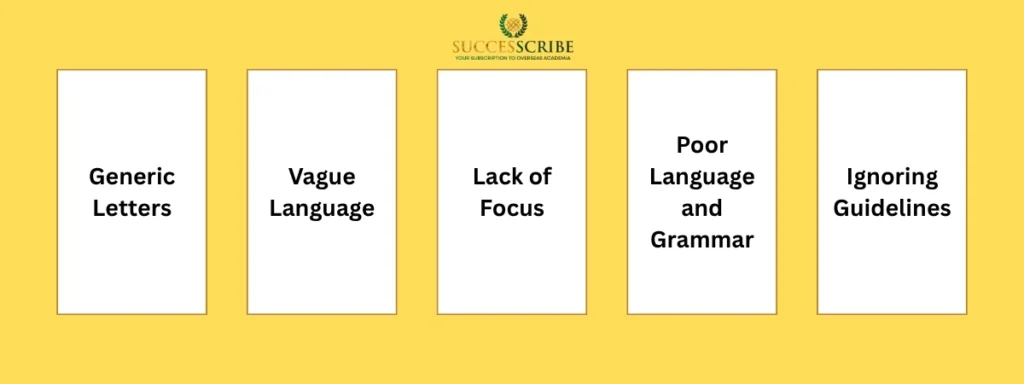
Knowing what not to do is as important as knowing what to do. Here are common pitfalls to avoid when writing your Motivation Letter for Germany University:
- Generic Letters: Avoid copying templates from the internet. A generic letter is easily spotted and will be rejected. Every university expects a personalized letter
- Vague Language: Don’t use clichés like “I have always dreamed of studying in Germany.” Instead, use specific and factual language
- Lack of Focus: Do not include unrelated personal stories. Stay focused on your academic and professional journey.
- Poor Language and Grammar: Always proofread your letter carefully. Grammatical errors and typos create a bad impression
- Ignoring Guidelines: Always follow the university’s specific requirements for length, format, and content
Conclusion
Writing a powerful Motivation Letter for Germany University is your opportunity to make a compelling case for your admission. It is the one document in your application that can truly set you apart, showcasing not just your qualifications, but your vision and determination. By following the updated 2026 strategies in this guide – understanding the difference between an SOP and motivation letter, tailoring your content to each program, and adopting a clear, factual style – you can create a letter that resonates with German admissions committees. Remember, this is your story; make it a convincing one. Good luck with your application!
FAQs
Is a motivation letter mandatory for German universities?
Yes, in most cases. Around 90% of Bachelor’s and Master’s programs in Germany require a motivation letter as a standard application document. It is especially common for competitive fields like engineering, medicine, computer science, business, and social sciences. Always check your specific program’s requirements, as some universities may use different terms like “Statement of Purpose” or “Personal Statement” interchangeably.
How important is the motivation letter in the admission process?
It is the second-most important document after your GPA. Universities typically assign it 10% to 40% weight in the selection process, and in some cases, it can account for over 70%. A strong letter can be the deciding factor when applicants have similar grades.
Can I use AI tools to write my motivation letter?
It is not advisable. AI-generated motivation letters are increasingly easy to detect and create a negative impression. German universities expect a personal document reflecting your genuine voice, experiences, and goals. You may use AI as an aid for editing or brainstorming, but the final letter must be your own.
Can I use the same motivation letter for all German universities?
No. Each university expects a personalized letter tailored to their specific program and curriculum. Mention unique features like a particular professor, research group, or module that attracted you to that institution. Generic letters are easily spotted and often rejected
Related Post
TestAS exam for Germany universities
Masters in urban planning in Germany
Masters in food technology in Germany
Transportation in Germany for students