If you are planning to Study Nursing in Italy, this complete topic covers everything international students need to know. From public university tuition starting at €156 per year to English-taught degree options, entry exams, visa steps, and fully funded DSU regional scholarships worth up to €8,000 annually, this article resolves all your queries.
Key Highlights: Study Nursing in Italy
| Parameter | Details & Figures |
| Degree Awarded | Bachelor of Science (BSc) in Nursing (Laurea in Infermieristica) |
| Program Duration | 3 Years (180 ECTS / Crediti Formativi Universitari) |
| Language of Instruction | English or Italian (Depending on university track) |
| Public University Tuition | €156 – €3,900/year (Based on family income / ISEE Parificato) |
| Private University Tuition | €3,000 – €15,000/year |
| DSU Financial Aid Support | Up to €8,000/year stipend + free housing + daily canteen meals |
| Entrance Exam | University-specific entrance test or TOLC-F |
| Employment Rate Post-Graduation | 92% within 6 months |
| Average Starting Nurse Salary | €27,000 – €35,000/year gross |
Why Study Nursing in Italy?
Italy has emerged as one of the most attractive destinations in Europe for medical and healthcare education. When you choose to Study Nursing in Italy, you earn an EU-standard qualification that opens career pathways across all 27 European Union member states, the UK, Switzerland, and international markets. Key Benefits are:
- EU-Wide Professional Recognition: Italian nursing degrees adhere to Directive 2005/36/EC, ensuring automatic professional recognition across the European Union.
- Subsidized Higher Education: Public universities in Italy charge fees scaled to your household income. If you qualify for regional DSU grants, tuition fees drop to the base admin tax of roughly €156/year.
- Rigorous Hands-On Clinical Training: Programs integrate at least 1,800 clinical internship hours inside major teaching hospitals, such as Policlinico Umberto I in Rome or Humanitas Research Hospital in Milan.
- High Demand for Healthcare Workers: Italy and neighboring European nations face a severe shortage of registered nurses, creating a high post-graduation job placement rate of 92% within 6 months.
Top Italian Universities Offering Nursing Degrees
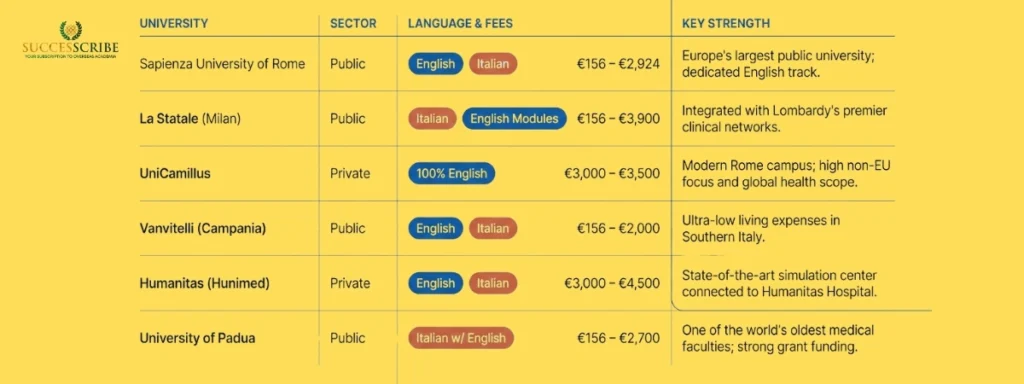
International students who want to Study Nursing in Italy can choose between established public research universities and specialized private health science institutions.
Public vs. Private Nursing Institutions Comparison
| Institution Name | Sector | Teaching Language | Estimated Annual Tuition | Key Features & Strengths |
| Sapienza University of Rome | Public | English & Italian | €156 – €2,924 | Europe’s largest public university with a dedicated English nursing track. |
| University of Milan (La Statale) | Public | Italian & English modules | €156 – €3,900 | Ranked high globally; integrated with Lombardy’s premier clinical networks. |
| UniCamillus (Saint Camillus University) | Private | 100% English | €3,000 – €3,500 | Modern Rome campus with non-EU focus and international global health scope. |
| University of Campania “Luigi Vanvitelli” | Public | English & Italian | €156 – €2,000 | Ultra-low living expenses in Southern Italy; low public fee tiers. |
| Humanitas University (Hunimed) | Private | English & Italian | €3,000 – €4,500 | State-of-the-art simulation center connected to Humanitas Hospital Milan. |
| University of Padua | Public | Italian (English tracks) | €156 – €2,700 | One of the world’s oldest medical faculties with strong DSU funding availability. |
Eligibility Criteria and Document Requirements
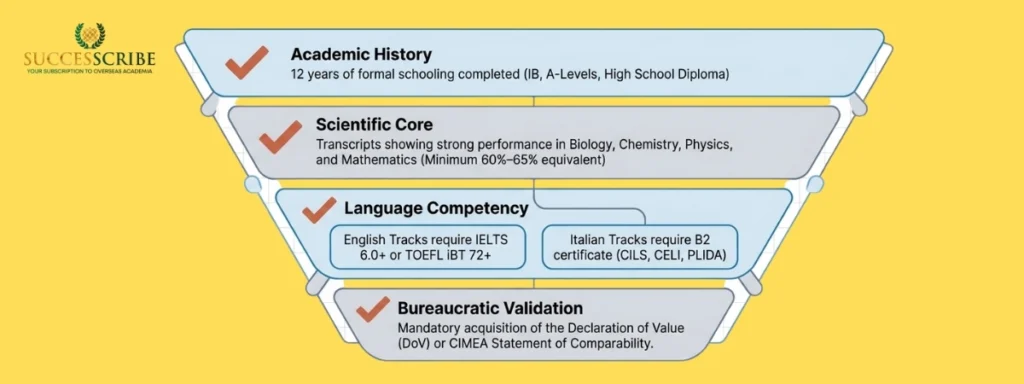
To Study Nursing in Italy, international candidates from non-EU countries must meet specific academic and legal prerequisites.
Academic & Language Requirements
- Secondary Education: Completion of 12 years of formal schooling (e.g., Higher Secondary Certificate, A-Levels, IB Diploma, or High School Diploma).
- Core Subjects: High school transcripts must show strong performance in Biology, Chemistry, Physics, and Mathematics.
- Minimum Marks: Most public and private universities require a minimum grade point equivalent of 60%–65% or above.
- Language Proficiency:
- For English-taught tracks: IELTS score of 6.0+ or TOEFL iBT score of 72+ (some private universities like UniCamillus test language during their internal entrance exam).
- For Italian-taught tracks: B2 level Italian language certificate (CILS, CELI, or PLIDA).
Mandatory Document Checklist
- High School Diploma and transcripts (translated into Italian by an official translator).
- Declaration of Value (Dichiarazione di Valore – DoV) issued by the Italian Embassy/Consulate OR a CIMEA Statement of Comparability.
- Valid Passport (valid for at least 18 months from the intended date of departure).
- Universitaly Pre-enrollment Summary Sheet.
- Passport-sized photographs adhering to Schengen visa specifications.
- Proof of financial independence or official DSU scholarship application receipts.
Entrance Exams for Nursing in Italy
Admission to health profession degrees in Italy (Professioni Sanitarie) is legally restricted by a national admissions quota (Numero Chiuso). Anyone seeking to Study Nursing in Italy must pass an entrance test.
Exam Breakdown for Public Universities (National Entrance Test / TOLC-F Format)
Public university entrance exams consist of 60 multiple-choice questions to be completed in 100 minutes.
| Subject Section | Number of Questions | Weightage / Focus |
| Reading Skills & General Knowledge | 4 Questions | Text comprehension, logical analysis, historical/scientific context |
| Logical Reasoning & Problem Solving | 5 Questions | Analytical logic, sequence completion, deductive reasoning |
| Biology | 23 Questions | Cell biology, genetics, human anatomy & physiology, biological chemistry |
| Chemistry | 15 Questions | Atomic structure, chemical bonds, stoichiometry, organic chemistry basics |
| Physics & Mathematics | 13 Questions | Mechanics, thermodynamics, algebra, geometry, functions |
Public Exam Scoring Matrix
- Correct Answer: +1.5 points
- Unanswered Question: 0 points
- Incorrect Answer: -0.4 points
- Maximum Score: 90 points
Private University Entrance Exams
Private institutions like UniCamillus and Humanitas University conduct their own computer-based entrance tests online. UniCamillus utilizes a computer-based exam testing basic scientific knowledge (Biology, Chemistry, Physics, Math) alongside English language fluency and general comprehension.
Cost of Studying and Living in Italy
One of the biggest reasons international students choose to Study Nursing in Italy is financial affordability.
Annual Cost Breakdown
| Expense Category | Monthly Estimated Cost | Annual Total (10 Months) |
| Public Tuition Fee (with ISEE) | N/A | €156 – €1,000 (Average for non-EU) |
| Student Accommodation (Shared Room) | €250 – €500 | €2,500 – €5,000 |
| Student Accommodation (Private Room) | €450 – €800 (higher in Milan/Rome) | €4,500 – €8,000 |
| Food & Grocery Budget | €180 – €250 | €1,800 – €2,500 |
| Public Transportation Pass | €22 – €35 | €220 – €350 |
| Health Insurance (SSN Registration) | N/A | €700 (National Health Service annual fee) |
| Study Materials & Supplies | €30 – €50 | €300 – €500 |
| Total Estimated Cost (Public University) | €500 – €1,100/month | €5,000 – €11,000/year |
DSU Regional Scholarships and Financial Aid
You can dramatically lower costs when you Study Nursing in Italy by applying for DSU (Diritto allo Studio Universitario) regional scholarships.
- Full Tuition Waiver (Base tax €156 only)
- Free Accommodation in University Dormitories
- 1 Free Meal per day at Campus Canteens
- Annual Cash Stipend (up to €8,000/year)
How to Qualify for DSU Grants
- ISEE Parificato (Equivalent Economic Status Indicator): Measures family income and assets. If your family’s annual ISEE status is below €25,000, you qualify for maximum scholarship coverage.
- Academic Performance: Continued scholarship disbursement in Year 2 and Year 3 requires earning a minimum number of university credits (ECTS) each semester.
Step-by-Step Admission & Visa Process
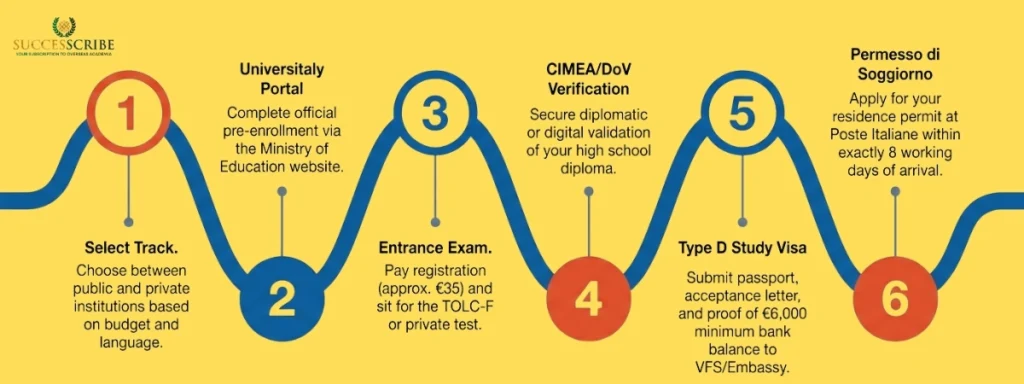
To successfully register to Study Nursing in Italy, follow this chronological order:
- Select University & Track: Decide between public universities (Sapienza, Milan, Vanvitelli) or private universities (UniCamillus, Humanitas).
- Register on Universitaly: Complete your online pre-enrollment application on the official Italian Ministry of Education portal.
- Register & Sit for Entrance Exam: Pay the required examination registration fee (€35 for Sapienza public exam) and sit for the online or in-person test.
- Secure DoV / CIMEA Certification: Obtain your Dichiarazione di Valore from the Italian consulate or request a digital statement of comparability from CIMEA.
- Apply for Schengen National Study Visa (Type D): Submit your passport, acceptance letter, proof of financial support (€6,000/year minimum balance in bank), travel insurance, and accommodation confirmation to your local Italian VFS / Embassy center.
- Arrive in Italy & Apply for Stay Permit (Permesso di Soggiorno): Within 8 working days of arriving in Italy, apply for your residence permit at a post office (Poste Italiane).
Post-Graduation Career Scope, Salary & Registration
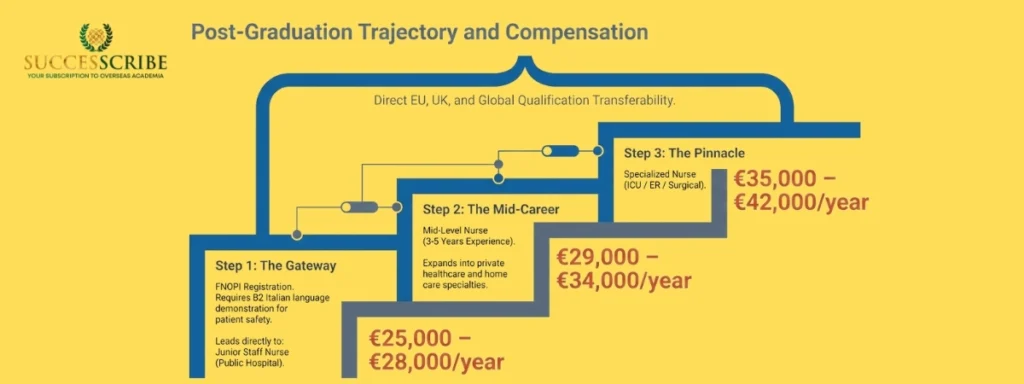
After completing your 3-year degree when you Study Nursing in Italy, you are eligible to work as a Registered Nurse (RN) across Europe.
Professional Licensing (FNOPI Registration)
To practice in Italy, graduates must register with FNOPI (Federazione Nazionale Ordini Professioni Infermieristiche). Registration requires demonstrating B2-level Italian language competence for safe patient communication during hospital duties.
Salary Expectations for Nurses in Italy
| Career Stage / Sector | Average Gross Monthly Salary | Average Gross Annual Salary |
| Junior Staff Nurse (Public Hospital) | €1,800 – €2,200 | €25,000 – €28,000 |
| Mid-Level Nurse (3–5 Years Experience) | €2,300 – €2,700 | €29,000 – €34,000 |
| Specialized Nurse (ICU / ER / Surgical) | €2,800 – €3,400 | €35,000 – €42,000 |
| Private Healthcare / Home Care Specialist | €2,200 – €3,200 | €30,000 – €40,000 |
Conclusion
Choosing to Study Nursing in Italy offers international students a world-class, EU-accredited medical education at an exceptionally low cost. With tuition fees starting as low as €156 per year at public universities, generous fully funded DSU regional scholarships worth up to €8,000 annually, and mandatory hands-on clinical internships in top-tier European teaching hospitals, Italy stands out as one of the best study-abroad destinations for aspiring healthcare professionals in 2026.
Whether you opt for English-taught tracks at institutions like Sapienza University of Rome or private specialists like UniCamillus, earning an Italian nursing degree opens doors to high job security, rapid employment, and seamless professional recognition across the European Union, the UK, and beyond. By staying on top of key deadlines for Universitaly pre-enrollment, entrance exam prep, and visa documentation, you can turn your ambition of becoming a registered nurse into a reality.
FAQs
Can I Study Nursing in Italy in English?
Yes, several universities in Italy offer Bachelor of Science degrees in Nursing taught entirely in English. Popular options include Sapienza University of Rome (public) and UniCamillus – Saint Camillus International University of Health Sciences (private). However, while lectures and coursework are in English, learning basic conversational Italian is necessary for clinical hospital rotations and patient interactions during your second and third years.
Is there an entrance exam required to Study Nursing in Italy?
Yes. Nursing in Italy falls under the Professioni Sanitarie (Healthcare Professions) umbrella, which is regulated by a national quota system (Numero Chiuso). Public universities conduct a national 60-question multiple-choice exam testing Biology, Chemistry, Physics, Mathematics, Logic, and General Knowledge. Private universities conduct their own online computer-based admission tests.
How much does it cost to Study Nursing in Italy?
Public university tuition ranges from €156 to €3,900 per year, depending on your family’s financial status (calculated using the ISEE Parificato index). Private universities cost between €3,000 and €15,000 annually. Average monthly living costs (accommodation, groceries, utilities, transit) range from €500 to €800 in smaller university towns and €800 to €1,200 in major cities like Milan or Rome.
What is the DSU scholarship, and who can apply?
The DSU (Diritto allo Studio Universitario) is an income-based regional grant provided by Italian local governments. It is open to both EU and non-EU international students. If your household annual income (ISEE) is below the regional threshold (typically under €25,000/year), you can qualify for a 100% tuition waiver, free university dormitory housing, daily meal vouchers, and a cash stipend of up to €8,000 per year.
Are Italian nursing degrees recognized internationally?
Yes. Nursing degrees earned from accredited Italian universities comply with European Union Directive 2005/36/EC. This ensures direct professional recognition across all 27 EU member states, Switzerland, and the EEA. Graduates seeking to practice in the UK, USA, Canada, or Australia can also transfer their qualification after satisfying local nursing board requirements (such as the NCLEX-RN in the US or the NMC registration in the UK).
Related Post
Study Pharmacy in Italy
Cost of MBBS in Italy for Indian students
Cost of MBA in Italy for Indian students
Country for Commercial pilot training