Germany stands as the undisputed global market leader in environmental technology, a position solidified by the federal government’s strategic commitment to the Energiewende (Energy Transition) and a closed-loop circular economy. Environmental engineering has moved beyond a niche discipline to become a primary economic driver, creating a landscape where technical sustainability is integrated into every level of heavy industry and urban planning. From an institutional perspective, pursuing a masters in environmental engineering in germany is a high-value career move, offering graduates direct access to a “Green Economy” that is currently facing a significant labor shortage.
Key Highlights: Masters in Environemental Engineering
- Environmental Science vs Environmental Engineering Germany
- Best Universities Environmental Engineering Germany
- Environmental Engineering Germany Fees
- Scholarships for International Students
- Admission Requirements for Master’s in Environmental Engineering in Germany
- Curriculum and Specializations
- Career Opportunities for Enviromental Engineering in Germany
- Is It Worth pursuing Master’s in Environmental Engineering in Germany in 2026?
- Conclusion
- FAQs
Environmental Science vs Environmental Engineering Germany
Choosing the correct academic path is a strategic necessity for 2026 applicants. The pivot between environmental science vs environmental engineering germany hinges on your desired career outcome: whether you seek to analyze natural systems or design the anthropogenic infrastructure that protects them. While environmental science programs at institutions like Leibniz University Hannover often emphasize ecology and natural processes, the masters in environmental engineering in germany focuses on the technical protection of resources, hydraulic engineering, and process-oriented solutions for waste and energy.
The conceptual differentiator in environmental science vs environmental engineering germany is summarized in the following strategic comparison, derived from TU Hamburg (TUHH) and Leibniz Uni Hannover insights:
| Feature | Environmental Science | Environmental Engineering |
| Primary Focus | Theoretical and natural systems; ecological impacts and monitoring. | Technical and anthropogenic solutions; engineering design and plant operation. |
| Typical Modules | Biology, Environmental Chemistry, Statistics, Ecology. | Mechanics, Thermodynamics, Waste Management, Process Engineering. |
| Career Outcomes | Policy advisory, research, and environmental education. | Site oversight, plant construction, and technical project management. |
Understanding the distinction of environmental science vs environmental engineering germany determines your eligibility for specific technical roles, as German engineering chambers (Ingenieurkammern) require a rigorous background in mathematics and mechanics. Effectively navigating the choice of environmental science vs environmental engineering germany will ultimately influence your university selection, as explored in the following landscape analysis.
Suggested Post: MS in Economics in Germany
Best Universities Environmental Engineering Germany
The German higher education system offers a strategic choice between Technical Universities (TU9), which provide research-oriented in-depth study, and Universities of Applied Sciences (UAS/Fachhochschulen), which prioritize application-oriented learning in cooperation with industry. When evaluating the best universities environmental engineering germany, students must align their selection with their specific specialization goals.
| University Name | Program Offered | Language of Instruction |
| Technical University of Munich (TUM) | Environmental Engineering | English |
| TU Berlin | Process Energy and Environmental Systems Engineering (M.Sc.) | German and English |
| Hamburg University of Technology (TUHH) | Environmental Engineering (M.Sc.) | English |
| HTW Dresden | Environmental Engineering (M.Eng.) | English |
| Weihenstephan-Triesdorf University (HSWT) | International Environmental Engineering (M.Eng.) | English |
| HAW Hamburg | Renewable Energy Systems – Environmental and Process Engineering (M.Sc.) | English |
| Leibniz University Hannover | Environmental Engineering (M.Sc.) | German |
| University of Kassel | Environmental Engineering (M.Sc.) | German |
| Darmstadt University of Applied Sciences (h_da) | Environmental Engineering (M.Eng.) | German |
| Ravensburg-Weingarten University (RWU) | Environmental and Process Engineering (M.Eng.) | German |
| Bochum University of Applied Sciences | Environmental Engineering (M.Sc.) | German |
For international scholars, the availability of environmental engineering germany in english tracks has expanded significantly. TUM and HSWT lead the market with their respective environmental engineering germany in english Master’s programs, which focus on global warming impairment and resource efficiency. Other notable tracks accessible via environmental engineering germany in english include HTW Dresden’s program. Note that the M.Sc. at Bochum UAS is transitioning to a specialized “Geothermal Energy Systems” degree, which officially launches in Summer 2026. These best universities environmental engineering germany ensure a qualification that meets the highest global standards for engineering recognition.
Environmental Engineering Germany in English
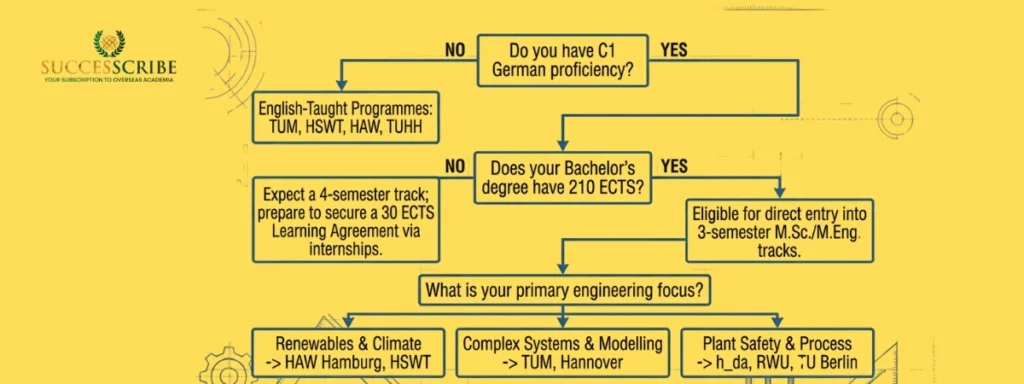
The internationalization of German Engineering has accelerated, making the best universities environmental engineering germany provides accessible without immediate C1 German. However, while you can study environmental engineering germany in english, you cannot work in the field effectively without local language skills.
Current top-tier English-taught programs include:
- TU Munich (TUM): M.Sc. in Environmental Engineering (11 specializations).
- HSWT Triesdorf: M.Eng. International Environmental Engineering (Mandatory A2 German by end of semester 2).
- HAW Hamburg: M.Sc. Renewable Energy Systems.
- TU Hamburg (TUHH): M.Sc. Environmental Engineering.
These environmental engineering germany in english programs cater to a global workforce, but non-German speakers must reach A2 proficiency by the second semester – a mandatory requirement at HSWT – to remain eligible for graduation and local internships.
Suggested Post: Masters in Public Health in Germany
Environmental Engineering Germany Fees
The 2026 landscape features a clear distinction: state-funded “tuition-free” education versus international tuition fees in specific regions or elite institutions. Pursuing a masters in environmental engineering involves the following costs:
| Expense Category | Estimated Cost (EUR) | Frequency |
| Semester Contribution | 72–397 EUR | Per Semester |
| TUM International Tuition | 6,000 EUR | Per Semester |
| Baden-Württemberg Fees | 1,500 EUR | Per Semester |
| Monthly Living Expenses | 992 EUR | Monthly |
Scholarships for International Students
Several funding streams exist to offset living costs:
- DAAD Scholarships: Full funding for students from developing nations.
- Deutschlandstipendium: 300 EUR/month merit-based grant.
- HSWT Oskar Karl Forster: One-off grants for books and technical learning resources.
- Bavarian State Ministry Grants: Support for internationalization at Bavarian universities.
Admission Requirements for Masters in Environmental Engineering in Germany
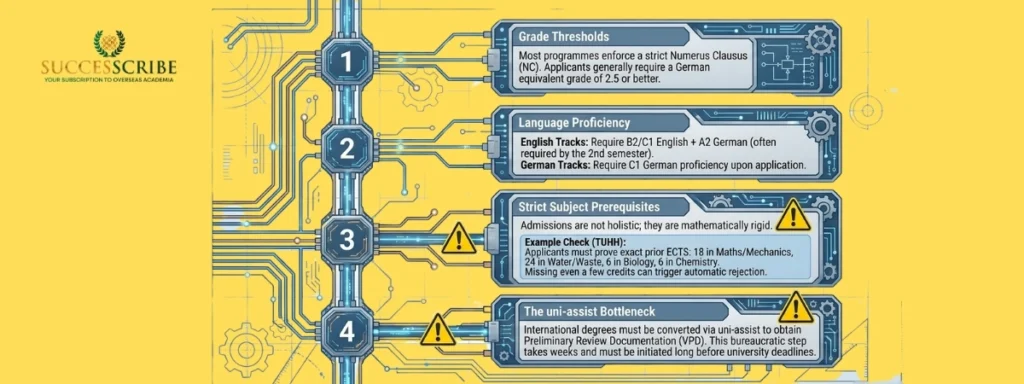
Being admitted to the best universities environmental engineering germany requires passing a rigorous “Aptitude Assessment.” This process evaluates whether your Bachelor’s degree meets the strict ECTS distribution requirements.
| Requirement Category | Criteria | Key Details & Variations |
| Academic Degree | Bachelor’s or equivalent in Environmental Engineering or related technical fields | Related fields include Civil, Chemical, Mechanical Engineering, or Natural Sciences |
| Minimum GPA | Generally 2.5 or better on the German grading scale | Some institutions accept a GPA up to 2.9 depending on the specific program |
| Credit Points (ECTS) | 210 ECTS (typically for 3-semester programs) or 180 ECTS (for 4-semester programs) | Applicants with 180 ECTS are often required to earn an additional 30 credits via a preliminary semester or “learning agreements” |
| English Proficiency | Level B2 is the standard for most programs | Typical scores include IELTS (5.5–6.5) or TOEFL iBT (79–87) |
| German Proficiency | Level C1 for German-taught degrees; Level A2 for many English-taught degrees | For English programs, the A2 certificate is often required by the end of the second semester |
| Document Review (VPD) | Preliminary Review Documentation (VPD) from uni-assist | Mandatory for most international applicants with a degree obtained outside of Germany |
| Country Verification | APS Certificate for specific regions | Compulsory for students from India, China, and Vietnam to verify academic authenticity |
| Standardised Tests | GRE (Graduate Record Examination) | Often required for applicants from non-EU countries applying to specific technical universities |
| Practical Experience | 10–12 week industry internship | Some programs require proof of a relevant internship either at the point of application or before the final thesis |
Commonly Required Application Documents
- Transcript of Records: A detailed list of all subjects and grades from your undergraduate studies
- Statement of Purpose: A letter of motivation explaining your interest in the specific field and your career goals
- Curriculum Vitae (CV): An up-to-date résumé highlighting academic and professional achievements
- Financial Proof: Evidence of sufficient funds, which for 2026 is approximately €992 per month (or roughly €11,904 per year)
Suggested Post: Masters in Psychology in Germany
Suggested Post: Masters in Psychology in Germany
The “300-Credit” Puzzle: Navigating the Administrative Bridge
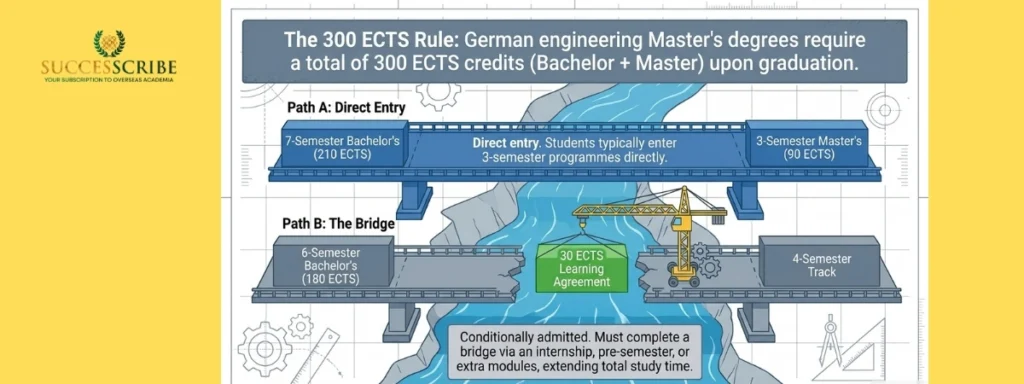
One of the most common administrative hurdles I see international students encounter is “The ECTS Deficit.” In Germany, a Master’s degree is legally considered a completion of a 300-credit cycle. The math is simple but often catches applicants off guard:
- The Scenario: You hold a 3-year (6-semester) Bachelor’s degree worth 180 ECTS.
- The Program: You apply for a standard 3-semester Master’s program (90 ECTS).
- The Gap: 180 + 90 = 270 ECTS. You are 30 credits short of the 300-credit requirement for the M.Eng. or M.Sc. title.
To bridge this, universities like Bochum, RWU, and HSWT utilize “Learning Agreements.” You may be admitted under the condition that you complete these 30 credits during your first year.
Strategic Options for Fulfilling Bridge Requirements:
- Mandatory Internships: Some programs, such as TU Berlin, require a mandatory 10-week industry internship before the final exam.
- Additional Theory: Elective modules from the university’s Bachelor’s catalog.
- VHB Modules: Online courses via the Virtual University of Bavaria.
- Professional Recognition: At HSWT, “proven working time as an engineer” can be recognized to fulfill these credits – a vital detail for mid-career professionals.
Curriculum and Specializations
The 2026 curriculum is designed for the “Nexus” engineer. At TU Munich, the program has expanded to 11 distinct fields of study, including the Water-Food-Energy Nexus, Sustainable Urban Mobility, and Environmental Hazards.
Innovative Modules:
- Decarbonization & CO2 Capture: Designing technical systems for net-zero industry.
- Micro & Macroplastics Management: Monitoring and filtering plastic process flows.
- Subsurface Hydrology: Managing groundwater and geothermal reservoirs.
Career Opportunities for Enviromental Engineering in Germany
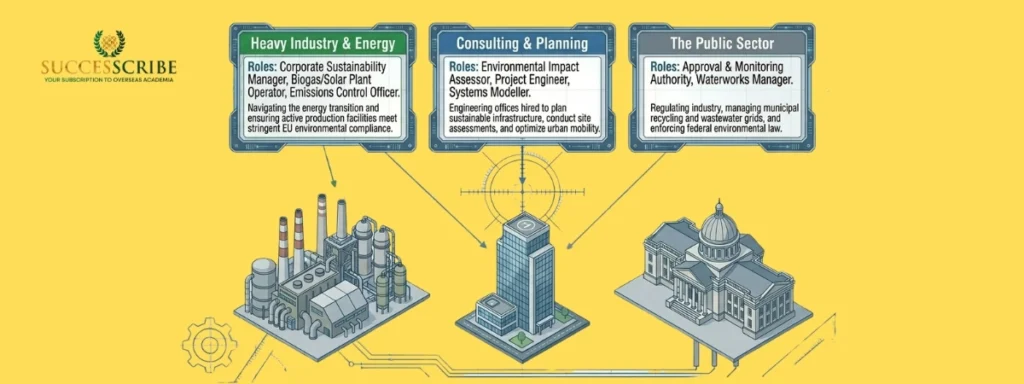
Graduates in 2026 are entering a market where “Circular Economy” management is the new standard. Hiring sectors include Wastewater Management, Plant Construction, Renewable Energy (Wind/Solar), and Corporate Sustainability (EHS). In the environmental science vs environmental engineering germany job market, engineers are prioritized for senior roles in infrastructure and large-scale plant operation.
Salary After Graduation
Earning potential in Germany remains robust, with salaries often dictated by regional cost-of-living (e.g., Munich vs. Dresden).
| Job Level/Role | Annual Salary (EUR) | Typical Employers |
| Entry-level Engineer | 45,000 – 55,000 | Engineering Firms, Utilities |
| Sustainability Officer | 55,000 – 70,000 | Manufacturing, Corporates |
| Project Manager (5+ yrs) | 70,000 – 85,000 | Infrastructure, Plant Build |
| PhD / Research Assoc. | 50,000 | Research Centers, Universities |
Is It Worth pursuing Masters in Environmental Engineering in Germany in 2026?
The value proposition for a masters in environmental engineering in germany is absolute. As Germany deconstructs its nuclear fleet and rapidly expands wind/solar infrastructure to meet EU climate targets, the need for technical oversight is unprecedented. By selecting from the best universities environmental engineering germany offers, you are positioning yourself at the center of Europe’s decarbonization efforts.
Conclusion
In summary, the masters in environmental engineering in germany provides an unparalleled pathway to a career in sustainability. To succeed, students must Initiate the VPD process at least six months in advance, Plan for environmental engineering germany germany fees if studying in Munich or Baden-Württemberg, Target the best universities environmental engineering germany hosts based on specialization (e.g., TUM for Nexus Engineering), Acquire at least A2 German to facilitate field-work opportunities. Whether you choose a program taught in German or a track in environmental engineering germany in english, your focus should remain on “field-ready” skills. Begin your masters in environmental engineering in germany journey today by securing your APS and VPD documentation early.
FAQs
Do I need to speak German for an English-taught program?
For admission to English programs, you typically need Level B2 proficiency. However, many universities require you to reach Level A2 German by the end of your second semester to assist with integration and local career prospects.
Is a driver’s license important for my career?
Surprisingly, yes. Industry feedback indicates that many environmental engineering roles require field work and site visits, making a valid driver’s license a significant advantage for employment.
Can I work while studying?
Yes. Students from non-EU countries are generally allowed to work 140 full days or 280 half days per year. Alternatively, you can work up to 20 hours per week during the lecture period.
What academic background do I need?
You must hold a Bachelor’s degree in Environmental Engineering or a related field such as Civil, Chemical, or Mechanical Engineering. Most programs require a final grade (GPA) of 2.5 or better on the German scale.
What is the job market like for Environmental Engineers in Germany?
The sector is booming, There is high demand for engineers to handle the deconstruction of nuclear plants, manage water and waste systems, and expand renewable energy infrastructure like wind and solar parks.
Related Post
Transportation in Germany for students
Indian food and culture in Germany
Health insurance for students in Germany
Student accommodation options in Germany