To understand the cost of living in germany city wise comparison, we must first define what the national average looks like in 2026. For a single professional, the national average monthly expenditure sits around €2,000 to €2,700 (warm rent included). For an international student, the absolute baseline legal requirement is anchored by the German Federal government’s blocked account (Sperrkonto) regulations.
The official legal blocked account requirement for student visas in 2026 is €11,904 per year, allowing a maximum monthly withdrawal of €992. While this is legally sufficient to secure a visa, inflation and structural housing shortages mean that in premium cities, your actual required monthly budget can safely exceed €1,200.
The phrase “Warm Rent” (Warmmiete) is highly critical in Germany. Unlike “Cold Rent” (Kaltmiete), warm rent includes baseline utilities like heating, hot water, and building maintenance. However, it typically excludes internet and electricity, which you must secure independently.
Key Highlights: Living Cost in Germany city-wise comparison
- Cost of Living in Germany City Wise Comparison
- The Top 10 Ranking: Cheapest Cities in Germany for Students
- Cost of Living Berlin vs Munich for Students
- Monthly Budget Framework: Fixed vs. Variable Costs
- Most Affordable Cities to Study in Germany
- Practical Tactical Advice to Minimize Expenses in Germany
- Transportation Costs in Major German Cities
- Actionable Money-Saving Hacks:
- Conclusion
- FAQs
Cost of Living in Germany City Wise Comparison
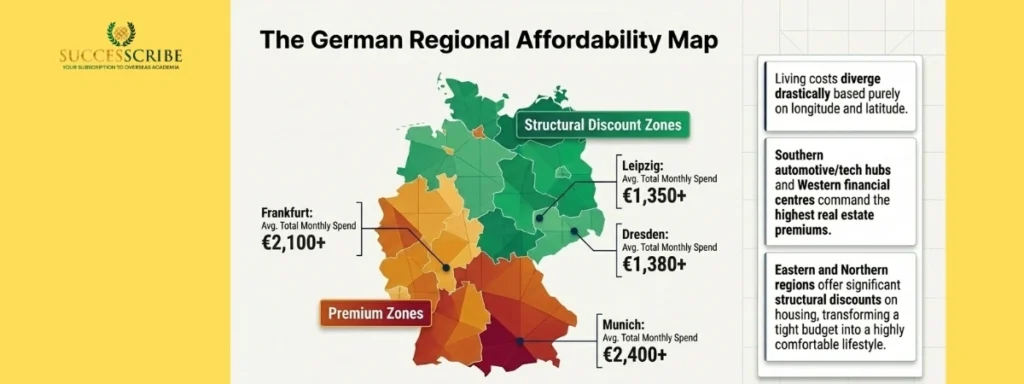
Living costs diverge significantly based on geographical region. Southern Germany (Bavaria and Baden-Württemberg) and major financial hubs command the highest premiums. Conversely, Eastern Germany (Saxony, Saxony-Anhalt) and parts of North Rhine-Westphalia offer structural discounts on housing.
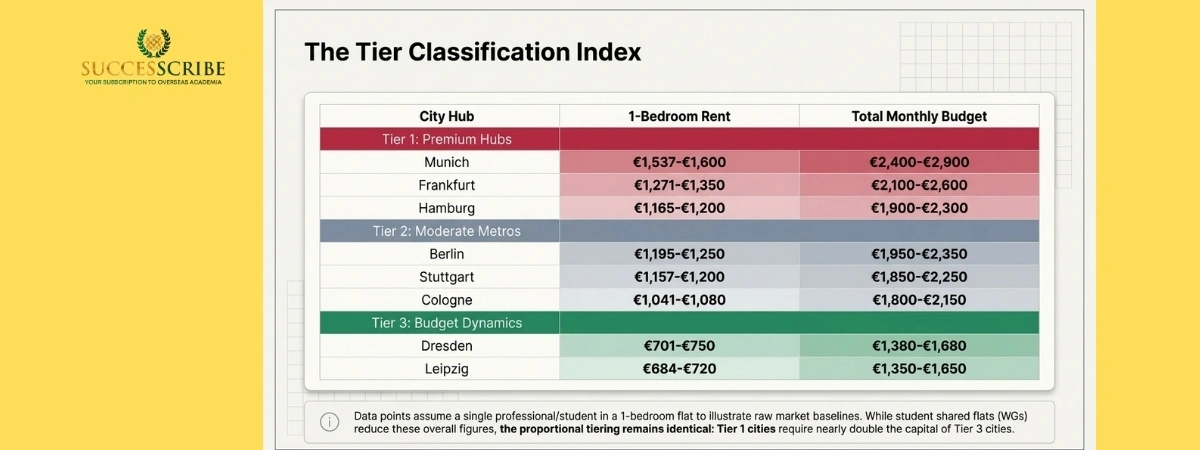
Comprehensive City-Wise Living Cost Index (2026 Data)
| City | Tier Classification | Average 1-Bedroom Rent (City Center) | Average 1-Bedroom Rent (Outside Center) | Average Monthly Groceries & Leisure | Estimated Total Monthly Budget (Single) |
| Munich | Premium / Core South | €1,537 – €1,600 | €1,191 – €1,250 | €350 – €450 | €2,400 – €2,900 |
| Frankfurt | Premium / Financial Hub | €1,271 – €1,350 | €1,019 – €1,100 | €330 – €420 | €2,100 – €2,600 |
| Berlin | Capital / High Demand | €1,195 – €1,250 | €889 – €950 | €300 – €380 | €1,950 – €2,350 |
| Hamburg | Premium / Northern Port | €1,165 – €1,200 | €826 – €900 | €320 – €400 | €1,900 – €2,300 |
| Cologne | Moderate / Western Hub | €1,041 – €1,080 | €842 – €900 | €290 – €370 | €1,800 – €2,150 |
| Stuttgart | Industrial / Automotive | €1,157 – €1,200 | €700 – €850 | €310 – €390 | €1,850 – €2,250 |
| Leipzig | Budget / Eastern Dynamic | €684 – €720 | €480 – €550 | €260 – €330 | €1,350 – €1,650 |
| Dresden | Budget / Eastern Academic | €701 – €750 | €500 – €580 | €260 – €330 | €1,380 – €1,680 |
The Top 10 Ranking: Cheapest Cities in Germany for Students
For students whose primary constraint is liquidity, the eastern and northern regions of Germany offer the highest financial sustainability. These cities allow for a quality of life that is nearly impossible to replicate in Munich or Frankfurt on a part-time wage. We have analyzed the cost of living in germany city wise comparison to rank the absolute leaders in affordability for 2026.
Top 10 Cheapest Cities for International Students in Germany
| Rank | City | Avg. Rent (1-BR) | Total Monthly Est. | Primary University |
| 1 | Chemnitz | €280 | €700 – €800 | Chemnitz Univ. of Tech |
| 2 | Gera | €285 | €720 – €820 | Gera-Eisenach Coop State Univ |
| 3 | Gelsenkirchen | €320 | €750 – €850 | Westphalian Univ. of App. Sci |
| 4 | Magdeburg | €340 | €780 – €880 | Otto von Guericke University |
| 5 | Bremerhaven | €345 | €790 – €890 | Hochschule Bremerhaven |
| 6 | Halle (Saale) | €360 | €800 – €900 | Martin Luther University |
| 7 | Duisburg | €365 | €810 – €910 | Univ. of Duisburg-Essen |
| 8 | Schwerin | €380 | €830 – €930 | Univ. of Fed. Employment Agency |
| 9 | Erfurt | €380 | €840 – €940 | University of Erfurt |
| 10 | Kassel | €400 | €850 – €950 | University of Kassel |
Cost of Living Berlin vs Munich for Students
One of the most searched topics among international students is the cost of living Berlin vs Munich for students. While Berlin has seen a significant rise in housing demand over the last few years, Munich remains the most expensive city in Germany for students by a wide margin. On average, a student living in Munich needs about 18% to 22% more capital per month than a student living in Berlin. When planning an international relocation, analyzing a detailed cost of living in Germany city wise comparison helps expatriates allocate their moving budgets with high mathematical precision
| Expense Category | Berlin Student Budget | Munich Student Budget | Budget Dynamic & Insight |
| Shared Flat Room (WG) | €420 – €550 / month | €580 – €750 / month | Munich’s private room market is highly competitive; finding anything under €550 is extremely rare. |
| Private Studio Apartment | €650 – €850 / month | €750 – €950+ / month | Center-city studios in Munich often carry a heavy premium. Moving to the outskirts reduces this slightly. |
| State Dormitory (Studentenwerk) | €280 – €380 / month | €330 – €430 / month | This is the cheapest option in both cities, but waiting lists span 2 to 3 semesters. |
| Mandatory Health Insurance | €125 / month | €125 / month | Nationally fixed rate for public insurance (Krankenkasse) for students under 30. |
| Groceries & Essentials | €200 – €240 / month | €230 – €270 / month | Supermarket baselines (Aldi/Lidl) are identical, but local organic shops and daily items skew higher in Munich. |
| Semester Transport Ticket | €29.40 / month | €29.40 / month | Tied to the Deutschlandsemesterticket – giving you unlimited regional transit across all of Germany. |
| Mandatory Broadcasting Tax | €18.36 / month | €18.36 / month | The Rundfunkbeitrag is a fixed fee per apartment. If living in a WG, this is split among flatmates. |
| Leisure, Dining & Lifestyle | €120 – €180 / month | €150 – €220 / month | A casual restaurant meal or a beer in a Bavarian Biergarten costs roughly 15% more than Berlin’s casual cafes. |
| Total Estimated Monthly Spend | €950 – €1,200 | €1,200 – €1,500 | Assumes living in a standard shared student flat (WG). |
Suggested Post: Scholarships for Masters in Germany
Monthly Budget Framework: Fixed vs. Variable Costs
If you look closely at a cost of living in Germany city wise comparison, you will see that housing costs are the primary factor driving up student budgets in metropolitan areas. Managing your money as an international student means separating your non-negotiable fixed costs (expenses that stay the same every month) from your flexible variable costs (expenses you can control based on your lifestyle choices).
The table below breaks down the realistic monthly expenses student in germany 2026 to help you map out your personal ledger accurately.
| Expense Category | Type | Average Cost (Monthly) | Strategic Insight & Savings Tip |
| Rent & Utilities (Warm Rent) | Fixed | €350 – €650 | Includes building maintenance and heating. To keep this low, prioritize applying for state-subsidized Studentenwerk dorms the day you get your admission letter. |
| Public Health Insurance | Fixed | €120 – €130 | A legal requirement for your visa. This is a nationally locked rate for all student public providers (like TK, AOK, or Barmer) for individuals under 30. |
| Broadcasting Fee (Rundfunkbeitrag) | Fixed | €18.36 | A mandatory national fee charged per apartment. Tip: If you live in a shared flat (WG), you split this evenly with your flatmates, bringing your cost down to a few Euros. |
| Semester Transit Pass | Fixed | €29.40 | Billed as a lump sum within your university’s semester contribution fee. The Deutschlandsemesterticket gives you unlimited access to all regional trains and buses nationwide. |
| Groceries & Consumables | Variable | €190 – €250 | Shop exclusively at major discount supermarkets like Aldi, Lidl, Netto, or Penny instead of premium stores like Rewe or Edeka to save up to 40% on food. |
| Mobile Plan & Home Internet | Variable | €20 – €40 | Look for student-specific discount codes (Studentenrabatt) on networks like o2 or Vodafone. Many shared flats bundle high-speed Wi-Fi directly into the rent. |
| Leisure, Dining & Culture | Variable | €100 – €150 | Always flash your student ID (Studierendenausweis). It unlocks massive discounts at museums, cinemas, theaters, public pools, and even select local eateries. |
| Course Materials & Copies | Variable | €15 – €30 | Never buy textbooks brand new. Utilize your university library’s digital access portals or scan required chapters to your tablet for free. |
Most Affordable Cities to Study in Germany
If minimizing debt is your primary operational objective, redirect your focus away from the major economic hubs and look toward the highly ranked universities situated within the affordable cities to study in germany. These locations feature world-class research institutes without the severe financial strain of metropolitan real estate.
| City | Top University Highlights | Average Shared Room (WG) Rent | Estimated Total Monthly Student Budget | Why It is Highly Affordable & Strategic |
| Aachen | RWTH Aachen University (Elite TU9 Engineering Hub) | €330 – €430 | €850 – €980 | Incredible student density means massive student-focused infrastructure, cheap dining options, and highly active state-subsidized student dorms. |
| Leipzig | Leipzig University (Vibrant, historic research center) | €320 – €400 | €820 – €950 | Frequently named one of the absolute cheapest cities in Germany for students while offering a culture and nightlife scene that rivals Berlin. |
| Dortmund | TU Dortmund University (Strong IT & Engineering focus) | €340 – €420 | €860 – €990 | Located in the Ruhr Valley. Rent is structurally lower, and your semester ticket lets you travel for free across a massive network of neighboring industrial cities. |
| Dresden | TU Dresden (Elite University of Excellence) | €330 – €410 | €840 – €960 | Highly affordable everyday commodities, excellent student housing managed by the Studentenwerk, and exceptionally rich cultural architecture. |
| Magdeburg | Otto von Guericke University Magdeburg | €270 – €340 | €750 – €880 | Eastern Germany’s hidden gem for budget management. Real estate pressures are practically non-existent here, allowing for sub-€300 room prices. |
Practical Tactical Advice to Minimize Expenses in Germany
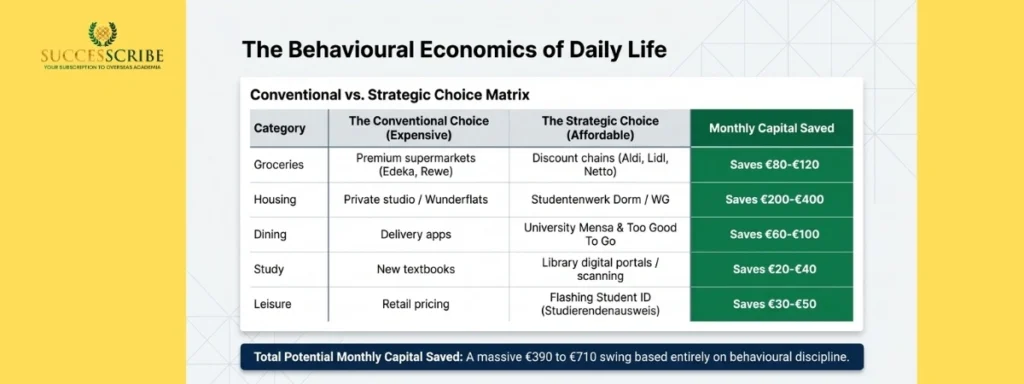
To give you a clearer picture of the local economy, this cost of living in Germany city wise comparison breaks down exactly what you will spend on rent, transit, and groceries. To ensure that your actual outgoings stay securely aligned with your budget projections, implement these three operational strategies immediately upon arrival:
| Expense Category | Conventional Choice (Expensive) | Strategic Choice (Affordable) | Monthly Savings Impact | How to Execute the Strategy |
| Weekly Groceries | Shopping at premium supermarkets (Edeka, Rewe) | Shopping at discount supermarket chains (Aldi, Lidl, Penny, Netto) | €80 – €120 | Buy store-brand lines (e.g., Ja! or Gut & Günstig) and download supermarket apps for weekly coupons. |
| Housing & Utilities | Private studio flats or short-term rentals (e.g., Wunderflats) | Subsidized Studentenwerk Dorms or a shared flat (WG) | €200 – €400 | Apply for a state-subsidized dormitory room the exact afternoon you receive your university admission letters to beat the waiting list. |
| Furnishing Your Room | Buying new furniture from major retail stores | Sourcing via Kleinanzeigen and local Facebook “Free Your Stuff” groups | €150 – €300 (One-time) | Use the Kleinanzeigen app to find locals giving away or selling study desks, mattresses, and chairs for nominal sums (€5–€20) because they are moving out. |
| Dining Out & Socials | Standard sit-down restaurants and ordering delivery | Utilizing your Mensa (University Canteen) and apps like Too Good To Go | €60 – €100 | Eat your hot meals at the student Mensa, where a complete nutritious plate costs €3–€5. Use the Too Good To Go app to buy surplus bakery or restaurant meals at 70% off. |
| Study Materials | Purchasing brand-new textbooks and literature | Utilizing your University Library and digital scanning options | €20 – €40 | Never buy textbook copies. Borrow them from the campus library or use the university’s book scanners to create searchable, free PDFs for your tablet. |
| Entertainment & Leisure | Paying full retail price for cinema, gym, or museum entry | Always flashing your Student ID (Studierendenausweis) | €30 – €50 | Look for signs that say Studentenrabatt (student discount). Almost all public pools, museums, theaters, and software providers offer hefty student price cuts. |
Transportation Costs in Major German Cities
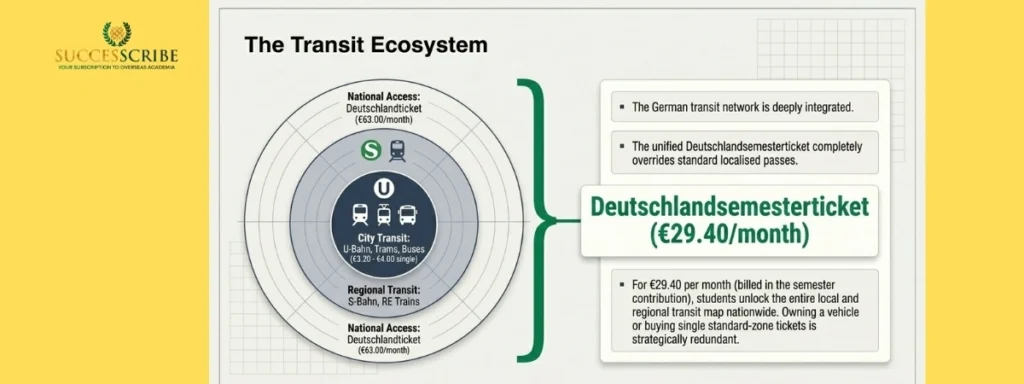
Public transportation across major German cities is incredibly reliable, clean, and highly integrated. A single ticket almost always covers buses, trams, the U-Bahn (underground subway), and the S-Bahn (suburban regional trains) within a specific city zone.
Managing your transit budget in 2026 relies on a major nationwide strategy: the Deutschlandticket, which saw a price adjustment to €63 per month from January 1, 2026. For regular commuters, this ticket completely overrides standard localized monthly passes. Additionally, university students benefit heavily from the unified Deutschlandsemesterticket, which drops the monthly cost even lower.
| City | Single Ticket (Standard Zone) | Local Day Pass | Unified National Pass Option | Student Network Ticket (Semesterticket) | Strategic Transit Insight |
| Berlin | €4.00 | €8.80 | €63.00 / month | €29.40 / month | Cover zones A, B, and C with the standard network. Short-trip tickets (Kurzstrecke) are available for under 3 stops. |
| Munich | €3.70 | €8.20 | €63.00 / month | €29.40 / month | Munich’s local “M-Zone” covers the entire inner city. A standard ticket allows transfers but no return trips. |
| Hamburg | €3.60 | €7.80 | €63.00 / month | €29.40 / month | Managed by the HVV network. The local ferry lines on the Elbe River are entirely included in standard tickets. |
| Frankfurt | €3.40 | €7.20 | €63.00 / month | €29.40 / month | Managed by the RMV. Extremely fast links connect Frankfurt Airport to the main central financial hub. |
| Cologne | €3.30 | €7.50 | €63.00 / month | €29.40 / month | Part of the KVB/VRS network. Connects seamlessly across the Rhine river via high-frequency tram lines. |
| Leipzig | €3.20 | €6.80 | €63.00 / month | €29.40 / month | Deeply dense tram network makes owning a vehicle totally redundant for student commuters. |
Actionable Money-Saving Hacks:
By integrating these hacks, you will find that the monthly expenses student in germany 2026 are highly elastic and responsive to your behavioral choices.
- Prioritize the Wohngemeinschaft (WG): Sharing a flat is the cultural norm. In cities like Kassel or Erfurt, a WG room can drop to €280, effectively halving your largest expense.
- Master the Supermarket Tiering: Avoid premium retailers like Rewe or Edeka for daily staples. Discount chains like Aldi, Lidl, and Netto can cut your grocery bill by 30%.
- Weaponize the Student ID: Your ID grants “Social Discounts.” Use it for health insurance (fixed student rate), museums, software, and even university-run gyms (Hochschulsport).
- The Semester Ticket Advantage: This pass eliminates the need for a car or Deutschlandticket (€49/mo). It is your most valuable mobility tool—use it for regional travel to cheaper shopping hubs.
- Cook at Home (The €3 Rule): A home-cooked meal costs under €3, whereas a simple Döner or inexpensive meal starts at €10–€15.
- Second-Hand Economy: Use Kleinanzeigen or Vinted for furniture, books, and winter clothing. The depreciation on new items in Germany is steep; never buy new furniture.
- Studentenwerk Dormitories: Apply the day you receive your admission letter. Dorm rooms are subsidized at €250-€400, but the waiting lists are long.
- Free Leisure Infrastructure: Leverage Germany’s public parks, free city festivals, and hiking trails for entertainment. Avoid the €15 cinema trap.
- Digital Banking Strategy: Opt for digital-first banks that offer zero-maintenance student accounts. Avoid traditional “Sparkasse” fees for basic transactions.
- Seasonal Shopping Strategy: Buy winter gear in the Sommerschlussverkauf (Summer Sale). High-quality German winter coats can be 50% cheaper out of season.
Conclusion
Successfully managing your finances relies heavily on making data-driven decisions before you pack your bags. As our cost of living in germany city wise comparison demonstrates, the financial demands of living and studying in Germany vary drastically by geography. While western and southern metros like Munich, Frankfurt, and Hamburg offer extensive corporate networks, they command premium rent prices that easily stretch a student’s budget past the breaking point.
To minimize financial stress, structural positioning is everything. Redirecting your university applications toward the affordable cities to study in germany—such as Aachen, Dortmund, or Dresden—allows you to enjoy world-class, tuition-free education while keeping your outgoings perfectly manageable. By anchoring your baseline monthly expenses student in germany 2026 around the state-subsidized Studentenwerk dormitories, shopping strategically at local discount supermarkets, and maximizing your student ID discounts, you can easily stretch your capital further.
FAQs
Which are the cheapest cities in Germany for students?
Leipzig, Dresden, Chemnitz, Halle, Magdeburg, Erfurt, and Dortmund are among the cheapest cities in Germany for students.
Does the 2026 Blocked Account allowance change based on a cost of living in Germany city-wise comparison?
No, the German Federal Government enforces a single national legal standard for the student visa blocked account (Sperrkonto), regardless of which city you choose. In 2026, the required amount is €11,904 per year, allowing you to withdraw a fixed €992 per month.
However, the real-world utility of this payout changes drastically when looking at a cost of living in germany city wise comparison:
1. In the cheapest cities in germany for students (like Chemnitz, Magdeburg, or Leipzig), €992 is highly comfortable and leaves room for savings.
2. In high-demand or premium tier hubs (like Munich or Frankfurt), a realistic monthly expenses student in germany 2026 allocation can easily climb to €1,200 or €1,400 due to intense real estate inflation. In these cities, you must be prepared to supplement your blocked account with family support or a part-time job.
Can students work part-time to cover living expenses?
Yes. International students can work within the legal limits set by German regulations and use earnings to help manage living costs.
Is Germany cheaper than other European countries for students?
Yes. Germany generally offers lower tuition fees and competitive living costs compared to countries such as the UK, Ireland, and the Netherlands.
Does accommodation cost more than food in Germany?
Yes. Accommodation is usually the largest expense and often accounts for 40–50% of a student’s monthly budget.
Related Post
German spouse visa for Indian students
Germany Blue Card for Indian professionals
Germany Work Permit After Study
Germany job seeker visa for Indian students