If you have been researching a Masters in Human Computer Interaction in Germany, you already know the country is one of the strongest destinations in the world for this field right now. Germany combines tuition-free public education, a booming UX and product-design job market, and more than 20 universities offering dedicated HCI, interaction design, and media informatics programmes taught fully in English. This topic walks you through everything you need before you apply: the best HCI Germany universities, real fee and cost figures, admission requirements for Indian students, and the career outlook after graduation.
Whether you come from a computer science, design, psychology, or business background, a Masters in Human-Computer Interaction in Germany gives you a research-driven, industry-connected route into UX research, interaction design, accessibility engineering, and product strategy roles across Europe.
Key Highlights: Masters in Human Computer Interaction in Germany
- Low-Cost Education: Most public universities have no standard tuition fees.
- English-Taught Courses: Many HCI and UX programmes are available in English.
- Top Universities: Siegen, Weimar, RWTH Aachen, TH Ingolstadt and others.
- Interdisciplinary Field: Combines technology, design, psychology and research.
- Career Options: UX Designer, UX Researcher, Product Designer and HCI Researcher.
- Affordable Fees: Semester contributions generally range from €150–€400.
- Proof of Funds: €11,904 per year for student visa purposes.
- Admission: Relevant bachelor’s degree, ECTS credits and language proficiency are commonly required.
- Portfolio: Particularly important for UX and interaction design careers.
- German Advantage: German language skills can improve job opportunities.
- Strong Career Scope: Opportunities in tech, automotive, healthcare, AI, AR/VR and research.
- Popular Career Hubs: Ingolstadt, Siegen and Weimar offer specialised opportunities
Why Choose a Masters in Human-Computer Interaction in Germany
Germany sits at the intersection of engineering precision and user-centred design thinking, which makes it a natural home for HCI education. A few reasons this degree stands out in 2026:
- Tuition-free public education: Most public universities in Germany, including the top HCI Germany universities, charge no tuition fee to international students — you only pay a modest semester contribution.
- Industry proximity: Companies like SAP, BMW, Siemens, Bosch, and a fast-growing Berlin UX and startup scene actively recruit HCI and UX design masters Germany graduates for internships and full-time roles.
- Research strength: German universities run dedicated HCI labs with eye-tracking, EEG, VR/AR, and usability-testing equipment, giving students hands-on research exposure rarely available at this scale elsewhere.
- English-taught options: You do not need fluent German to complete a full Masters in Human Computer Interaction in Germany – most programmes are 100% English-taught, though basic German helps with daily life and part-time jobs.
- Growing demand: Germany hosts over 250,000 international students today, and digitalisation across manufacturing, automotive, and healthcare is driving fresh demand for UX and interaction specialists.
The Core Paradigm: Deciphering the Academic DNA of German HCI
When looking for a masters in human computer interaction in germany, it is critical to recognize that the discipline does not exist within a singular, monolithic academic silo. German higher education segregates user-facing technology programs into three primary structural branches, each demanding a distinct prerequisite background and yielding specialized career competencies.
Suggested Post: Executive MBA in Germany
HUMAN-COMPUTER INTERACTION (HCI) SPECTRUM IN GERMANY
| TECHNICAL CORE(Media Inf) | HYBRID FOCUS(Pure M.Sc. HCI) | CREATIVE CORE(Inter. Design) |
| Heavy codingGraphics enginesAlgorithm dev. | Balances CSPsychEthicsDesign & testing | AestheticsUX StrategyForm Physical Design |
Top HCI Germany Universities
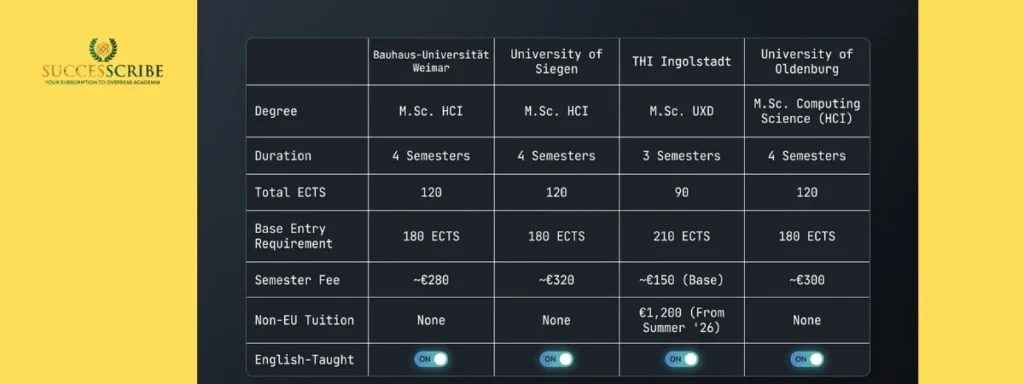
There is no single “best” university – your ideal choice depends on whether you want a technical, design-led, or research-heavy programme. Below is a comparison of the leading HCI Germany universities offering English-taught Master’s degrees relevant to human-computer interaction, UX, and interaction design.
Top HCI and UX Master’s Programmes in Germany
| University | Programme Name | Language | Duration | Key Features |
| University of Siegen | M.Sc. Human-Computer Interaction | English | 4 Semesters | Ranked among the top 4 HCI programmes in Germany; focuses on “Grounded Design” and qualitative ethnographic research |
| Bauhaus-Universität Weimar | M.Sc. Human-Computer Interaction | English | 4 Semesters | A research-oriented programme focusing on interface design and technical aspects; accredited by ACQUIN |
| RWTH Aachen University | M.Sc. Human-Technology Interaction and Communication | German and English | 4 Semesters | Interdisciplinary programme bridging humanities and technical sciences; unique in Germany for its technical and communication science integration |
| Technische Hochschule Ingolstadt (THI) | M.Sc. User Experience Design | English | 3 Semesters (Full-time) | Combines Computer Science, Design, and Usability Research; includes AR/VR applications and mobile prototyping |
| Julius-Maximilians-Universität Würzburg | M.Sc. Human-Computer Interaction | German and English | 4 Semesters | Focuses on advanced concepts that link psychology and computer science |
| University of Oldenburg | M.Sc. Informatics (Specialisation in HCI) | English | 4 Semesters | Focuses on user-friendly design of interactive systems and human-machine interfaces |
Interaction Design Germany in English: Language and Cultural Integration
The growth of interaction design Germany in English has lowered the barrier for entry, but cultural integration remains a prerequisite for the local job market. At Weimar, Siegen, and TH Ingolstadt, the curriculum is 100% English. However, there are specific linguistic hurdles that often catch students off-guard.
For instance, at Bauhaus-Universität Weimar, while you can study in English, you must provide proof of German A1 proficiency and English C1 proficiency specifically to register for your Master’s thesis. This ensures that by the time you reach your final semester, you are prepared for both the academic rigour and the local professional environment. In my experience, students who ignore German language acquisition until after graduation struggle significantly more with the “Hidden Champions” of industry, who often operate in German. High-level interaction design Germany in English programmes usually offer integrated language modules – use them.
Admission Mechanics: Eligibility and the Uni-Assist Workflow
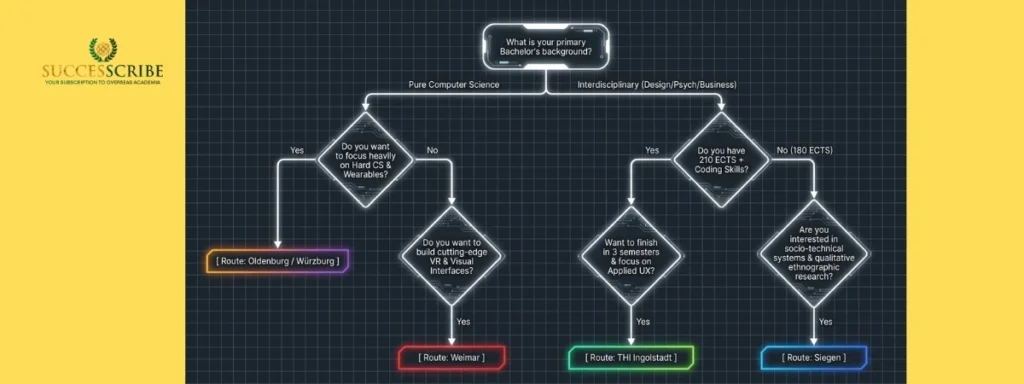
The competitive nature of German admissions requires a rigorous adherence to the “Selection Procedure.” Central to this is the 60 ECTS Rule, which dictates that a candidate’s precursor degree must contain a specific distribution of credits in relevant areas – Computer Science, Psychology, or Design – to ensure “subject relevance.”
Standard entry requirements across HCI germany universities include:
- Grade Requirements: A cumulative GPA of 2.5 or better on the German grading scale (where 1 is the highest and 4 is the lowest).
- English Language Proficiency: A TOEFL iBT score of at least 85–94 or an IELTS score of at least 6.5.
- German Language Exception: If you opt for an interdisciplinary hybrid track like RWTH Aachen’s Human-Technology Interaction, you may need to demonstrate German language proficiency at a CEFR B2 or C1 level alongside English skills.
- Application Routing: Most international applicants must use the Uni-Assist platform for credential evaluation.
The Uni-Assist & Application Checklist:
- VPD/Preliminary Evaluation: Request your Preliminary Review Documentation via Uni-Assist.
- Credit Verification: Ensure your transcript shows the required 60 ECTS in technical or psychological modules.
- Language Certification: Secure your IELTS/TOEFL and, if applying to Weimar, begin German A1.
- Digital Submission: Upload all certified copies to the university’s direct portal (like TH Ingolstadt’s PRIMUSS) or Uni-Assist.
Failing to provide a complete transcript that proves foundational knowledge for a UX design masters germany will result in immediate disqualification. Strategic preparation for these mechanics is vital for admission to HCI germany universities, ensuring you can secure a place in a high-demand UX design masters germany program.
Suggested Post: GMAT score for MBA in Germany
Human Computer Interaction Germany Fees
This is usually the first question every applicant asks, so let’s break down the real human computer interaction Germany fees, from tuition to living costs.
Tuition and semester contribution
The good news: almost every public university offering a Masters in Human Computer Interaction in Germany charges zero tuition fee, regardless of your nationality. Instead, you pay a “semester contribution” that funds student services, administration, and – in most cases – a public transport pass valid across the city or state.
| Cost Component | Typical Amount |
| Semester contribution (most public universities) | €150 – €400 per semester |
| Baden-Württemberg non-EU tuition fee (exception) | €1,500 per semester |
| Uni-assist application processing fee | €75 (first application) + €30 (each additional) |
| Blocked account for student visa (2026 rate) | €11,904 per year (€992/month) |
| Average monthly living cost | €900 – €1,200 |
| Health insurance | €152 per month |
| Student cafeteria (Mensa) meal | €4 – €5 per meal |
Scholarships to Fund Your Studies
Even with tuition-free public universities, living costs add up – so it’s worth applying for funding alongside your programme:
- DAAD Scholarships: Germany’s national academic exchange service funds hundreds of international master’s students annually; DAAD-funded students are also exempt from the APS certificate requirement.
- Deutschlandstipendium: A merit-based scholarship offering around €300 per month, funded jointly by universities and private donors.
- Erasmus+: Relevant if you’re combining study across multiple European institutions during your Master’s in Human-Computer Interaction in Germany.
- University-specific waivers: Some universities offer partial fee waivers or research-assistant positions within HCI labs.
Career opportunities after Masters in Computer Interaction in Germany
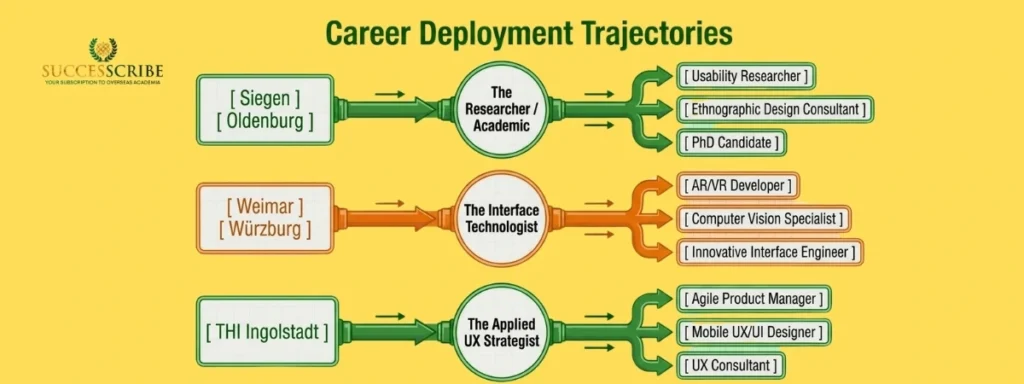
Graduates with a Master’s in Human-Computer Interaction (HCI) or User Experience (UX) Design from German universities have access to a wide range of opportunities in the technology, design, and research sectors. Because digital technologies are now pervasive in both professional and private life, there is a growing strategic demand for specialists who can design usable and intuitive interactive products.
Career Opportunities and Job Market Profile
| Category | Typical Job Roles | Target Industries |
| Design & Strategy | Interaction Designer, UI/UX Designer, Product Designer, Web Designer, Prototyping Specialist | IT & Tech: Software houses, startups, and digital agencies |
| Research & Evaluation | UX Researcher, Usability Engineer, Requirements Analyst, Usability Tester, Ergonomics Evaluator | Automotive & Engineering: “Hidden champions” in electrical and mechanical engineering (e.g., automated driving) |
| Technical & Development | Software Developer (Interface Focus), Systems Designer, UI Developer, XR (AR/VR) Specialist | Healthcare: Medical technology and digital health providers |
| Management & Consulting | UX Consultant, Product Manager, Information/Knowledge Manager, Agile Project Manager | Communication & Media: Corporate PR, technical journalism, and media management firms |
| Academic & Research | “Innovator Researcher,” Doctoral Candidate (PhD), University Lecturer | Research Institutions: Public and private labs focusing on AI, VR, and socio-technical systems |
Advantages and Challenges: A Balanced Perspective
Pursuing a UX design masters Germany is a high-reward endeavour, but the path is not without its obstacles.
| Advantages | Challanges |
| Academic Rigour: World-class research facilities and internationally renowned professors. | Bureaucracy: The APS certificate and Uni-Assist processes are slow and uncompromising. |
| Economic Security: Access to a thriving job market with a high demand for digital specialists. | Work Limits: International students are limited to 140 full days (or 280 half days) of work per year. |
| Cost-Effectivity: No tuition fees at public HCI Germany universities. | Language: While the degree is in English, social and professional life often requires German. |
Best German Cities for HCI and UX Careers
Your choice of city is a strategic career move. Germany is a polycentric country with specific industrial clusters.
- Ingolstadt: The automotive heart. If you want to design the future of autonomous vehicle interiors or mobility services, this is your city. The proximity to Audi and its suppliers is an unmatched career catalyst.
- Siegen: The industrial lab. Perfect for those interested in B2B interfaces and industrial HCI. The city’s “Hidden Champions” provide a stable and high-paying career path away from the noise of the bigger metropolises.
- Weimar: The research hub. Ideal for the academic-minded or those focused on high-end AR/VR and “Digital Bauhaus” philosophy. It offers a culturally rich, international atmosphere that is perfect for creative thinkers.
When choosing between interaction design Germany in English programmes, consider where your target industry sleeps.
Conclusion
A masters in human computer interaction in germany is a strategic investment in the future of the digital economy. Whether you are drawn to the “Grounded Design” of Siegen, the “Digital Bauhaus” of Weimar, or the automotive innovation of Ingolstadt, the German education system offers a pathway to becoming a leader in human-centred technology.
While the fee landscape is evolving, with some states introducing tuition for non-EU students, the cost remains relatively low compared to the UK or USA.
FAQs
Do German public universities charge tuition fees for HCI Master’s programmes?
Most public universities, such as the University of Siegen and Bauhaus-Universität Weimar, charge no tuition fees for both EU and non-EU students. . However, some institutions like TH Ingolstadt (THI) charge service fees for non-EU students (€500 per semester), which is planned to increase to a €1,200 tuition fee starting in the summer semester of 2026
Is “User Experience Design” the same as “Human-Computer Interaction”?
While closely related, the sources distinguish them by focus. HCI (e.g., at Siegen or Weimar) is often more research-oriented and technical, focusing on the design and evaluation of socio-technical systems. UX Design (e.g., at THI) is described as an interdisciplinary bridge between product development, IT, design, and marketing
What are the job prospects after graduation?
The demand for specialists who understand human-technology interaction is growing. Graduates work as UX/UI Designers, UX Researchers, Usability Engineers, Interaction Designers, and Product Managers.
How important is a portfolio compared to the degree?
Extremely important. Employers often value a portfolio of real-world projects (from internships or university collaborations) more than the degree certificate itself.
Can I apply if my Bachelor’s degree is in a different field?
Yes, provided you have a background in a related discipline such as Computer Science, Psychology, Design, or Sociology. Most programmes require at least 60 ECTS credits from these subject areas in your previous degree to be eligible
Related Post
Masters in Urban planning in Germany
Masters in Biotechnology in Germany
Masters in food technology in Germany
Health insurance for students in Germany