Germany is facing an unprecedented skilled labor shortage, with the Federal Employment Agency (Bundesagentur für Arbeit) estimating over 628,000 structural vacancies across the economy. To bridge this gap, the German government has significantly modernized its immigration laws under the Skilled Immigration Act. This framework positions the EU Blue Card as the absolute gold standard for international recruitment.
For qualified individuals looking to move from India, the Germany Blue Card for Indian Professionals offers an accelerated, highly secure pathway to live, work, and build a long-term future in Europe’s largest economy. Historically, Indian citizens represent the single largest group of EU Blue Card recipients in Germany, making up nearly one-third of all cards issued.
This comprehensive topic maps out the legal frameworks, updated salary rules, structural shifts, and exact steps required to successfully secure your residence title.
Key Highlights: Germany Blue Card for Indian Professionals
- What is the Germany Blue Card and Who Qualifies?
- What is the EU Blue Card Germany Salary requirement in 2026?
- What are the Shortage Occupations for the Blue Card?
- How Does the Germany Blue Card Work for IT Professionals?
- Germany Blue Card vs. Standard Work Permit: What’s the Difference?
- What is the B3lue card Germany application process step-by-step?
- What Documents Do You Need for the Germany Blue Card Application?
- How Long Does It Take to Get Permanent Residency (PR)?
- What Are the Most Common Mistakes Indian Applicants Make?
- Conclusion
- FAQs
What is the Germany Blue Card and Who Qualifies?
The EU Blue Card (Blaue Karte EU) is a premium, merit-based residence permit regulated under Section 18g of the German Residence Act (AufenthG). Unlike standard temporary work visas, it is specifically tailored for highly qualified individuals from non-EU countries. It serves as an all-in-one work and residence authorization that grants unparalleled fast-track privileges, flexible cross-border mobility, and streamlined paths to permanent settlement.
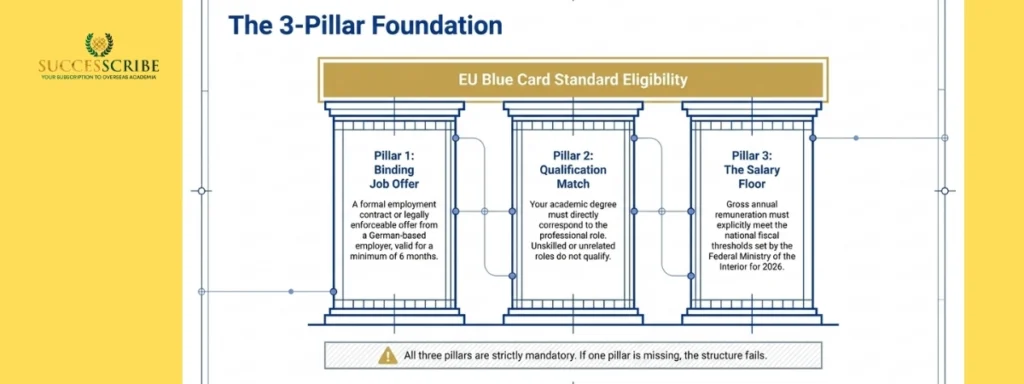
To qualify for the Germany Blue Card for Indian Professionals, an applicant must satisfy three core legal pillars:
| A Valid Job Offer | You must possess a binding employment contract or a concrete, legally enforceable job offer from an employer physically based in Germany. The contract must span a minimum duration of six months. |
| Qualification Match | The position you are being hired to fill must directly correspond to your professional qualifications. You cannot be hired for an unskilled or completely unrelated role. |
| The Salary Floor | Your gross annual remuneration must meet or exceed the mandatory national fiscal thresholds set by the Federal Ministry of the Interior for the current calendar year |
Evaluating Your University Degree via Anabin and ZAB
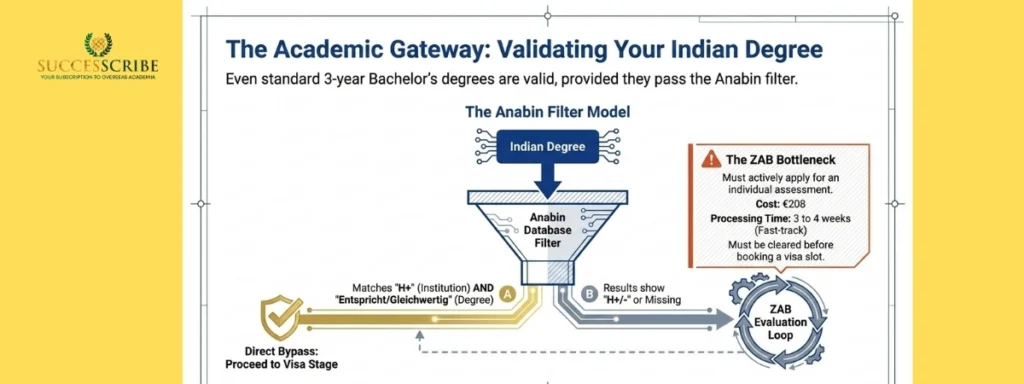
If you are applying based on an academic background, your degree cannot simply be assumed to be valid. The German state must formally recognize your Indian university degree as equivalent to a German higher education qualification.
This verification relies on the Anabin database, an official portal run by the Central Office for Foreign Education (Zentralstelle für ausländisches Bildungswesen – ZAB). When assessing your credentials, look for two distinct markers:
- The Institution Status: Your university must be explicitly classified as H+ in the Anabin system. This indicates that the institution’s academic status is fully acknowledged in Germany. An H- rating means recognition is denied, while an H+/- indicates that only specific programs or branches are recognized.
- The Degree Comparability: The specific nomenclature of your degree (e.g., Bachelor of Engineering, Master of Science) must be classified as Entspricht (corresponds to) or Gleichwertig (equivalent to) a German degree.
Crucial Action Item: If your specific degree or university layout is missing from the Anabin archive, or if your university holds an H+/- classification, you cannot proceed automatically. You must actively apply to the ZAB for an individual Statement of Comparability (Zeugnisbewertung). This digital assessment costs €208 and takes roughly three to four weeks to process under the fast-track professional scheme. It must be completed before scheduling your visa window in India.
Who Is Eligible for the Germany Blue Card for Indian Professionals?
To be eligible for the Germany Blue Card for Indian Professionals, you must meet all of the following conditions:
- Hold a university degree (Bachelor’s, Master’s, or equivalent) that is recognised in Germany. Indian degrees from IITs, NITs, central universities, and many private universities are generally recognised via the anabin database maintained by the Standing Conference of the Ministers of Education (KMK).
- Have a concrete job offer from a German employer in a field that matches your qualification.
- The job offer must meet the applicable EU Blue Card Germany salary requirement for your profession category.
- Hold a valid passport with at least 6 months validity beyond your intended stay.
- Have no adverse immigration or criminal history in Germany or Schengen area countries.
- Be able to demonstrate basic financial self-sufficiency.
Suggested Post: Ludwig maximilian university of Munich
What is the EU Blue card Germany Salary requirement in 2026?
One of the most critical eligibility criteria is the EU Blue Card Germany salary requirement. The German government sets minimum gross annual salary thresholds, which are updated annually to reflect the economic landscape. For 2026, the requirements have been adjusted to ensure that the EU Blue Card remains an attractive option for highly skilled talent while maintaining fair compensation standards.
Salary Thresholds for 2026
- Standard Salary Threshold: Your job in Germany must enable you to earn a gross annual salary of at least €50,700. This threshold applies to most professional roles across various sectors.
- Shortage Occupations: If you are employed in a shortage occupation, you can obtain an EU Blue Card with a lower gross annual salary of at least €45,934.20. This reduced threshold is designed to attract professionals to fields where Germany has a critical need for expertise.
| Category | Minimum Gross Annual Salary (2026) | Monthly Equivalent (Approx.) |
| Standard Occupations | €50,700 | €4,225 |
| Shortage Occupations | €45,934.20 | €3,828 |
| New Entrants (Graduates < 3 years) | €45,934.20 | €3,828 |
| IT Specialists (without formal degree) | €45,934.20 | €3,828 |
It is important to note that the EU blue card germany salary requirement is calculated based on gross income before taxes and social security contributions. Indian professionals should carefully review their job offers to ensure they meet these specific financial criteria before initiating the blue card germany application process.
What are the Shortage Occupations for the Blue Card?
Shortage occupations are professions where Germany faces a significant lack of skilled workers. The list of these occupations has been expanded recently to include a wider range of fields, reflecting the evolving needs of the German economy. The following professions are currently considered shortage occupations in Germany:
- Management Roles: Manufacturing, mining, construction, and distribution managers.
- ICT Services: Information and communications technology service managers.
- Professional Services: Managers in childcare, health services, and education.
- STEM Fields: Academic professionals in Science, Technology, Engineering, and Mathematics.
- Architecture & Planning: Professionals in architecture, spatial planning, and transport planning.
- Healthcare: Medical doctors, veterinarians, dentists, pharmacists, and academic nursing professionals.
- Education: School and out-of-school teachers and educators .
For those working in these fields, the Germany Blue Card for Indian Professionals is particularly accessible due to the lower salary requirements and the high demand for their skills.
How Does the Germany Blue Card Work for IT Professionals?
The tech landscape is handled differently within the German immigration framework. Recognizing that elite programming ability often develops outside of traditional university systems, the blue card germany for IT professionals offers a dedicated non-degree pathway.
Under Section 18g (2) of the Residence Act, you can successfully obtain an EU Blue Card in the IT sector without holding a university degree, provided you satisfy three clear conditions:
| Sufficient Professional Experience | You must prove at least three years of relevant, professional experience in the information and communications technology (ICT) sector acquired within the last seven years. |
| Academic Level Scope | Your past experience must not be clerical or entry-level; your resume and reference letters must demonstrate that you have operated at an analytical, systems-architect, or graduate level |
| Income Verification | Your German employment contract must meet the reduced threshold of €45,934.20 gross per year. |
Documentary Proof Required for Non-Degree Tech Profiles
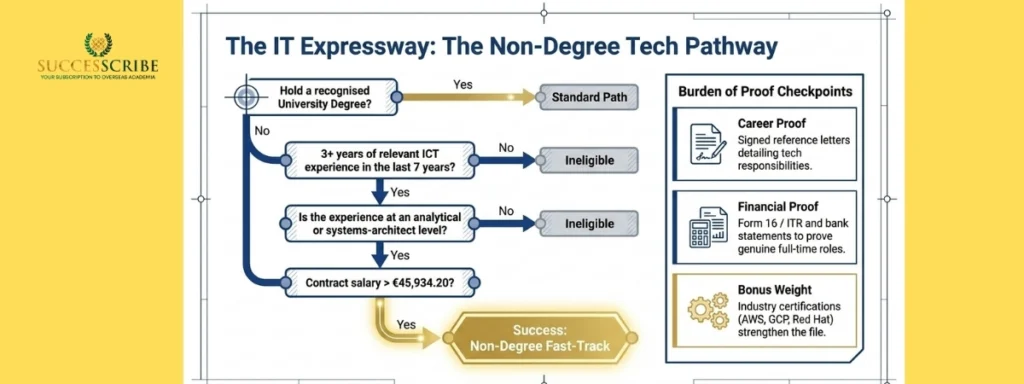
When navigating the blue card germany for IT professionals without an academic certificate, the burden of proof shifts heavily to your employment history. You must provide a comprehensive, verifiable portfolio of your career, including:
- Detailed Service Certificates: Signed reference letters from your previous employers in India or abroad. These must explicitly detail your exact technical responsibilities, projects managed, programming languages utilized, and your level of autonomy.
- Tax and Financial Corroboration: Income tax statements (Form 16 / Income Tax Returns) and formal bank salary statements corresponding to those three years of employment to verify that the roles were genuine and full-time.
- Industry Certifications: While optional, supplementary technical credentials (such as AWS Solutions Architect, Google Cloud Professional, Enterprise Red Hat, or advanced Scrum certifications) help reinforce your profile during the Federal Employment Agency’s review.
Germany Blue Card vs. Standard Work Permit: What’s the Difference?
When assessing your options for relocating, it helps to understand how a Blue Card compares to a standard skilled worker visa. While both paths allow you to legally work in Germany, the blue card germany vs work permit analysis reveals clear structural advantages for Blue Card holders, particularly regarding long-term residency and family rights.
| Operational & Legal Feature | EU Blue Card (Section 18g AufenthG) | Standard Skilled Worker Visa (Section 18b AufenthG) |
| Minimum Salary Requirement | High Standard (€50,700) or Shortage Floor (€45,934.20). | No fixed statutory floor; must match local average market wages (Tarifvertrag). |
| Fast-Track Permanent Residency | 21 months (with B1 German) or 27 months (with A1 German). | 36 months (for German university graduates) or 60 months (standard path). |
| Spousal Language Requirement | Zero. Your spouse requires no basic German knowledge to obtain a visa. | A1 Level German language certification is often mandatory prior to entry. |
| Spousal Access to Labor Market | Immediate, unrestricted permission to work or start a business. | Dependent on the primary holder’s visa category and local labor authority approval. |
| EU-Wide Mobility Rights | Allowed to move to another EU state after 12 months of holding the card. | Strictly bound to German national territory; no simplified cross-border relocation. |
| Permitted Inactivity Outside EU | Can stay outside the EU for up to 12 consecutive months without losing your visa status. | Limited to a maximum of 6 consecutive months outside Germany before the visa lapses. |
Suggested Post: Masters in pharmacy in Germany
What is the Blue Card Germany application process step-by-step?
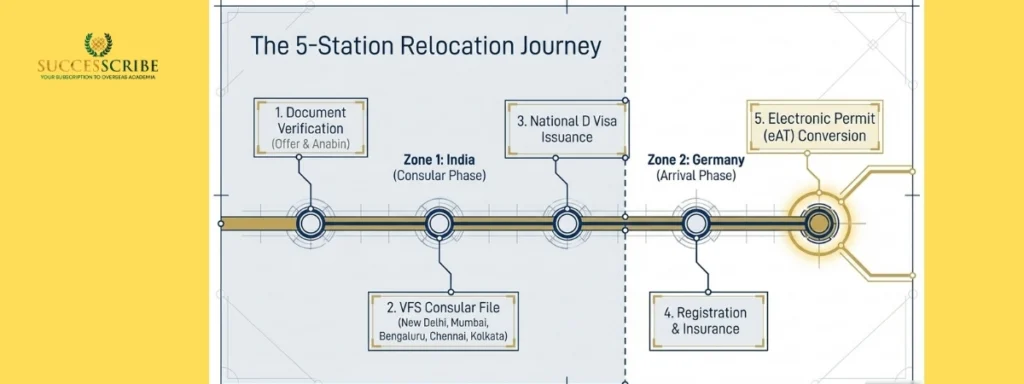
Beyond just the legal status, the Germany Blue Card for Indian Professionals unlocks a significantly high quality of life. Securing your visa requires careful coordination between you, your employer, the German consular network in India, and the local immigration office (Ausländerbehörde) within Germany. The blue card germany application process is split into two distinct operational phases: the entry visa phase in India and the subsequent residence permit conversion upon arrival.
- Step 1: Offer & Anabin
- Step 2: Consular File
- Step 3: National D Visa
- Step 4: German Registration
- Step 5: Electronic Permit (eAT)
Step 1: Document Gathering and Verification
Secure your formal employment contract signed by both parties. Download and have your employer fill out the mandatory official Erklärung zum Beschäftigungsverhältnis (Declaration of Employment Relationship). Print your Anabin extracts showing both an H+ institution rating and an equivalent degree status.
Step 2: Scheduling the National Visa Appointment
You must apply for a National Visa (Category D) via VFS Global, the official processing partner for German missions in India. Book your appointment under the specific “EU Blue Card” drop-down tab. Ensure you choose the correct jurisdictional mission based on your current place of residence:
- German Embassy New Delhi: Serves Northern India.
- German Consulate General Mumbai: Serves Maharashtra, Gujarat, Goa, and Madhya Pradesh.
- German Consulate General Bengaluru: Serves Karnataka and Kerala.
- German Consulate General Chennai: Serves Tamil Nadu, Andhra Pradesh, and Telangana.
- German Consulate General Kolkata: Serves Eastern India.
Step 3: Consular Interview and Visa Issuance
Attend your appointment to submit your physical application, provide biometric data, and pay the visa fee (the local currency equivalent of €75). The consular team will verify your documents and forward the file to the Federal Employment Agency (Bundesagentur für Arbeit) for an internal layout review if your role requires it.
Once approved, the mission will issue a 6-month National Category D entry visa in your passport. This processing timeline generally takes between 10 to 20 business days.
Step 4: Arrival, Registration, and Health Insurance
Travel to Germany. Within your first 14 days of arrival, you must secure a permanent apartment and register your address at the local town hall (Bürgeramt). This step yields your Meldebescheinigung (Registration Certificate), which is required for all subsequent administrative steps.
Simultaneously, activate your German health insurance. Your employer will usually enroll you in a statutory health insurance provider (Gesetzliche Krankenversicherung like TK, AOK, or Barmer). If your salary sits above the statutory threshold of €77,400, you can opt for private health coverage instead.
Step 5: Conversion to the Electronic Residence Permit (eAT)
File your formal conversion application at your city’s local Foreigners’ Authority (Ausländerbehörde). Submit your registration certificate, German insurance card, contract, and biometric photos.
The office will issue your physical, credit-card-sized Electronic Residence Permit (elektronischer Aufenthaltstitel – eAT). The creation of this card at the federal printing office takes roughly four to six weeks, and the card is issued for the duration of your work contract plus an additional three months, up to a maximum initial duration of four years.
What Documents Do You Need for the Germany Blue Card Application?
The blue card germany application process requires a specific set of documents. Missing even one can delay or reject your application. Here is what you will typically need:
- Valid passport (minimum 6 months’ validity)
- Completed visa application form (available on the German Embassy website)
- Biometric passport photographs (35mm x 45mm, recent)
- Recognised university degree certificate with official transcript
- Credential recognition statement (Statement of Comparability from ZAB, or anabin verification)
- Employment contract signed by both parties, clearly stating gross annual salary
- Proof that the salary meets the EU Blue Card Germany salary requirement
- Health insurance proof (German statutory or private insurance)
- Rental agreement or accommodation proof in Germany
- Curriculum Vitae (CV) in German or English
- Application fee: €100 for the Blue Card residence permit (charged at Ausländerbehörde)
For the National Visa (D-type) appointment at the German Embassy in India, you will also need to pay a non-refundable consular fee of approximately €75 (₹6,800).
How Long Does It Take to Get Permanent Residency (PR)?
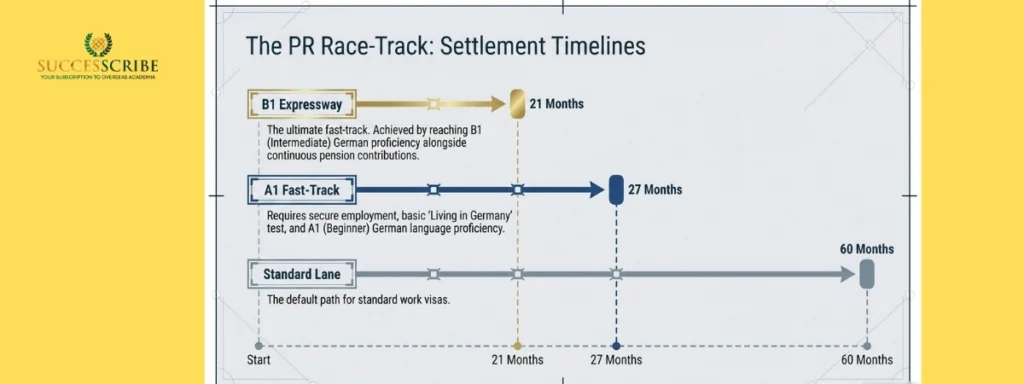
One of the most attractive features of the Germany Blue Card for Indian Professionals is the uniquely accelerated timeline it offers to secure a permanent Settlement Permit (Niederlassungserlaubnis). While standard immigration pathways require five full years of continuous residency, Blue Card holders can fast-track this process down to under two years. Your German language proficiency determines your exact timeline to a permanent settlement permit:
| German Language Proficiency Level | Required Months of Employment & Pension Contributions | Additional Requirements |
| B1 Level (Intermediate) | 21 Months | Secure employment, clean criminal record, and passing the basic “Living in Germany” test. |
| A1 Level (Beginner) | 27 Months | Secure employment, clean criminal record, and passing the basic “Living in Germany” test. |
What Are the Most Common Mistakes Indian Applicants Make?
Based on patterns observed by immigration practitioners and BAMF processing data, here are the most common reasons for delay or rejection in the blue card germany application process for Indian nationals:
- Submitting a degree not listed in the anabin database without getting a ZAB evaluation first
- Job offer letter that does not explicitly state gross annual salary – ensuring the offer letter includes the exact euro figure is critical
- Applying with a salary just below the EU Blue Card Germany salary requirement threshold – even €1 short disqualifies the application
- Not booking a German Embassy appointment early enough – leading to expired job offers
- Insufficient health insurance – many Indian applicants underestimate the coverage requirements (minimum coverage of €30,000 for EU travel)
- Uploading scanned documents in low resolution (under 300 DPI) for online submissions.
Conclusion
The Germany Blue Card for Indian Professionals has emerged as one of the most effective pathways for skilled workers looking to build a successful career in Europe. With Germany facing ongoing shortages in technology, engineering, healthcare, research, and other specialized sectors, qualified Indian professionals are in a strong position to benefit from growing employment opportunities.
FAQs
Can I apply for the Germany Blue Card for Indian Professionals if I only have a 3-year Bachelor’s degree (like a BSc, BCA, or BCom)?
Yes, absolutely. Germany does not require a 4-year degree (like a B.Tech). As long as your 3-year degree is from an Indian university classified as H+ on the Anabin database and the degree itself is marked as equivalent (Entspricht), you are fully eligible. For IT roles, you can even bypass the degree requirement completely if you have 3 years of verifiable work experience.
Does a bonus, variable pay, or a relocation allowance count toward the EU blue card germany salary requirement?
No. The Federal Employment Agency explicitly states that the EU blue card germany salary requirement must be met via your fixed, guaranteed gross annual salary stated in your contract. Variable performance bonuses, discretionary yearly allowances, stock options, or non-cash benefits (like a company car or relocation stipend) are strictly excluded from the baseline threshold math.
What is the standard processing time for the blue card germany application process from India?
The entry visa phase of the blue card germany application process via VFS Global in India typically takes between 10 to 20 business days once your physical documents are submitted. To accelerate this significantly, your employer can pay a €411 fee in Germany to initiate the Accelerated Skilled Worker Procedure, which legally binds the German consulate to issue your entry visa within 3 weeks of approval.
How long can I stay outside of Germany or visit India without losing my Blue Card status?
Unlike a standard German work permit (which expires if you stay outside Germany for more than 6 months), an EU Blue Card allows you to stay outside the EU for up to 12 consecutive months without your visa becoming invalid. This is highly beneficial for Indian professionals who need to return home for extended family matters or remote work projects.
Can I move and work in another European country immediately after receiving my German Blue Card?
Not immediately. You must hold your German EU Blue Card and reside in Germany for at least 12 months first. After one year, you unlock intra-EU mobility rights, allowing you to move to another participating EU member state (e.g., France, Netherlands, or Sweden) for a new highly-qualified job under a highly simplified, visa-free transition framework.
Related Post
Germany Work Permit After Study
Germany job seeker visa for Indian students
Study in Germany in English
MBA Scholarship in Germany