Pursuing an MBA in the United States remains one of the most sought-after goals among students and professionals worldwide. Home to many of the world’s top-ranked business schools, the USA attracts thousands of MBA applicants every year who aspire to build successful careers in consulting, finance, technology, entrepreneurship, healthcare management, and various other industries.
One of the most important components of the MBA admission process is the Graduate Management Admission Test (GMAT). Although many universities have adopted test-optional policies in recent years, a strong GMAT score continues to play a crucial role in strengthening an applicant’s profile, especially when applying to highly competitive MBA programs.
As we move into 2026, business schools across the USA continue to evaluate candidates holistically, considering academic performance, work experience, leadership potential, essays, recommendations, and GMAT scores. However, the GMAT remains one of the most standardized indicators of a candidate’s readiness for graduate-level business education.
Understanding the ideal GMAT score for MBA in USA can help applicants set realistic goals, identify suitable universities, improve admission chances, and even secure valuable scholarships.
Key Highlights: GMAT Score for MBA in USA
Why Do US Business Schools Consider GMAT Scores?
GMAT Score for MBA in USA: Competitive Overview
Why Do US Business Schools Consider GMAT Scores?
Business schools receive thousands of applications every year from candidates with diverse educational and professional backgrounds. Since academic systems vary across countries, universities need a standardized metric to compare applicants fairly.
Key Reasons MBA Programs Value GMAT Scores
- Academic Readiness: MBA programs involve rigorous coursework in finance, accounting, statistics, economics, data analytics, and operations management. A strong GMAT score demonstrates that an applicant possesses the quantitative and analytical skills needed to succeed.
- Quantitative Competence: Many MBA courses include data-driven decision-making and financial analysis. Schools use GMAT scores to assess numerical proficiency without relying solely on undergraduate transcripts.
- Global Benchmarking: The GMAT provides admissions committees with a standardized measure to compare applicants from different countries and educational systems.
- Ranking Considerations: Average GMAT scores contribute to various MBA rankings published by organizations such as the Financial Times, QS Rankings, Bloomberg, and U.S. News & World Report. As a result, schools actively seek academically strong candidates to preserve their standing.
- Scholarship Allocation: Many merit-based scholarships consider GMAT scores as one of the primary deciding factors.
GMAT Score for MBA in USA: Competitive Overview
The 2026 admissions landscape is defined by the “GMAT Arms Race.” While total test-takers have decreased slightly over the last five years, the intensity of preparation among those applying to elite programs has increased. This has driven average scores at Top 15 institutions to record highs.
The most critical strategic realization for 2026 is that “645 is the New 700.” Under the GMAT Focus Edition, a 645 places you in the 87th percentile – the exact percentile occupied by the legendary 700 score on the Classic exam. Candidates who fixate on the 700 number are misinterpreting the scale; on the Focus Edition, a 705 is actually an elite, 98th-percentile performance (equivalent to a 760 Classic).
Typical GMAT Expectations by School Category
When planning your business school journey, finding the competitive GMAT Score for MBA in USA programs is the first critical step to setting a realistic target for your preparation.
| School Category | Typical GMAT Focus Range | Equivalent Classic Range |
| Top 10 MBA Programs | 675 – 705+ | 720 – 760 |
| Top 25 MBA Programs | 645 – 685 | 690 – 730 |
| Top 50 MBA Programs | 615 – 655 | 650 – 700 |
| Mid-Tier Universities | 575 – 615 | 600 – 650 |
| Emerging MBA Programs | 535 – 575 | 550 – 620 |
Note: These are competitive ranges, not official cutoffs. US business schools evaluate applications holistically and routinely admit candidates with lower scores if they demonstrate exceptional professional achievements.
It is important to understand that these are not official cutoffs. Many schools evaluate applications holistically and may admit candidates with lower scores if they demonstrate strong professional achievements.
| Score Range (Focus) | Percentile | Top 20 Admission Prob. | Scholarship Potential |
| 705 – 805 | 98th – 100th | High (Elite Qualifier) | Full – Tuition Potetial |
| 675 – 695 | 95th – 97th | Competitive for M7 | Significant Merit Aid |
| 645 – 665 | 87th – 92nd | Target for Top 20 | Moderate Aid Potential |
| 605 – 635 | 70th – 82nd | Reach for Top 25 | Limited/Profile-Based |
Average GMAT Scores at Top MBA Colleges in USA
When evaluating target schools, it is imperative to distinguish between the mean (average) and the median (middle value). Median scores are often higher than means and are now the primary reporting metric for U.S. News rankings. Furthermore, candidates must analyze the Middle 80% range, which represents the floor and ceiling for the vast majority of admitted students. An analysis of recent class profiles reveals that the average GMAT Score for MBA in USA at elite M7 institutions routinely hover at or above the 95th global percentile.
High-prestige schools like Stanford and Harvard maintain higher averages because they possess the “luxury of choice.” They use high GMAT scores as a baseline, allowing them to focus their holistic review on leadership qualities. A “So What?” analysis of this data reveals that even at Stanford, the mean of 689 (Focus) is equivalent to a 738 (Classic), placing their average student in the top 4% of test-takers globally.
| University Name | 2026 Avg/Median Focus Score | Equivalent Classic Score | Middle 80% Focus Range | Admission Rate |
| Stanford GSB | 689 (Mean) | 738 | 615 – 785 | 7.5% |
| Harvard (HBS) | 685 (Median) | 730 | 645 – 735 | 11% |
| Wharton (UPenn) | 676 (Mean) | 732 | 620 – 780 | 14% |
| Northwestern (Kellogg) | 687 (Mean) | 733 | 515 – 775 | 20% |
| Chicago Booth | 670 (Mean) | 729 | 615 – 725 | 22% |
| MIT Sloan | 675 (Median) | 730 | 645 – 735 | 15% |
| Columbia (CBS) | 690 (Mean) | 734 | 615 – 805 | 18% |
| NYU Stern | 682 (Mean) | 733 | 645 – 725 | 20% |
| Yale SOM | 675 (Median) | 730 | 638 – 715 | 25% |
| Berkeley Haas | 675 (Median) | 730 | 637 – 725 | 16% |
| Dartmouth Tuck | 671 (Mean) | 727 | 595 – 775 | 25% |
| Virginia Darden | 671 (Mean) | 712 | 626 – 715 | 28% |
| Michigan Ross | 681 (Mean) | 731 | 635 – 725 | 25% |
| Duke Fuqua | 665 (Median) | 710 | 630 – 760 | 24% |
| Cornell Johnson | 655 (Median) | 710 | 615 – 675 | 29% |
The New Rules: Cracking the GMAT Focus Edition
The retirement of the “Classic” GMAT in early 2024 was the most significant disruption in business school testing in decades. As of 2026, the GMAT Focus Edition is the universal metric. This streamlined exam is nearly an hour shorter than its predecessor, yet it is significantly more concentrated on the skills relevant to the future of work. By removing the Analytical Writing section and legacy Geometry concepts, the GMAC has created an exam that measures efficiency and data literacy over pure rote memorization.
The introduction of the Data Insights (DI) section is the true “So What?” of this transition. In the 2026 business environment, being able to solve an algebraic equation is less valuable than being able to synthesize multi-source data to drive a strategic decision. Because the DI section is now a core part of the total scaled score, your ability to interpret table analysis, graphic interpretation, and two-part analysis is now as visible to the AdCom as your quantitative precision. A lopsided score that neglects DI is a significant red flag, particularly for candidates targeting STEM-designated MBA programs where data fluency is non-negotiable.
Why “645 is the New 700”
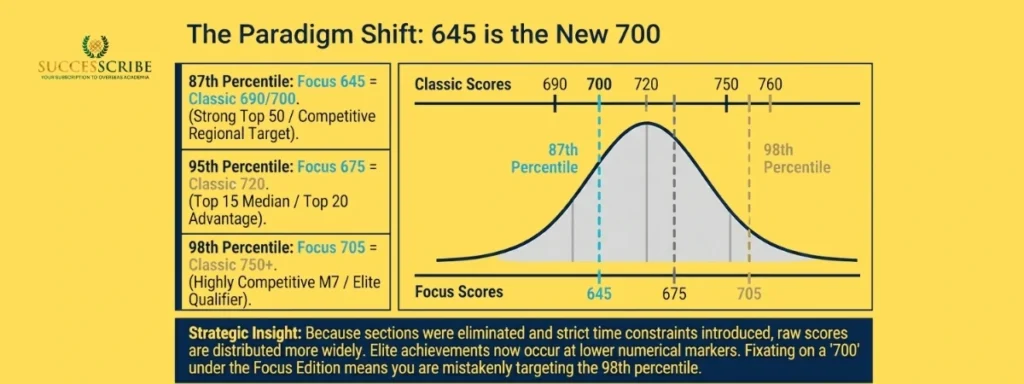
The most prominent source of confusion for applicants in the current admissions cycle is the nominal downward shift in raw average scores reported by elite business schools. A GMAT Focus Edition score of 645 corresponds to the 90th percentile of global test-takers, making it structurally equivalent to a legacy score of 700.
Because GMAC eliminated sentence correction questions and geometry, while introducing a strict time constraint across all three sections, raw scores are distributed more widely. Elite tier achievements now occur at numerical markers that look lower than historical norms but indicate identical or superior global competitive positioning.
GMAT Focus Edition Structure and Skills Assessment
| Section Name | Questions | Time | Primary Skill Assessed |
| Quantitative Reasoning | 21 | 45 Mins | Algebra, Arithmetic, and Algebraic Reasoning. (Note: No Geometry) |
| Verbal Reasoning | 23 | 45 Mins | Critical Reasoning and Reading Comprehension; No Sentence Correction. |
| Data Insights | 20 | 45 Mins | Data Literacy, Multi-source Reasoning, Table Analysis, and Graphic Interpretation. |
| Total | 64 | 2h 15m | Scaled composite score (205-805 scale) weighted equally across sections. |
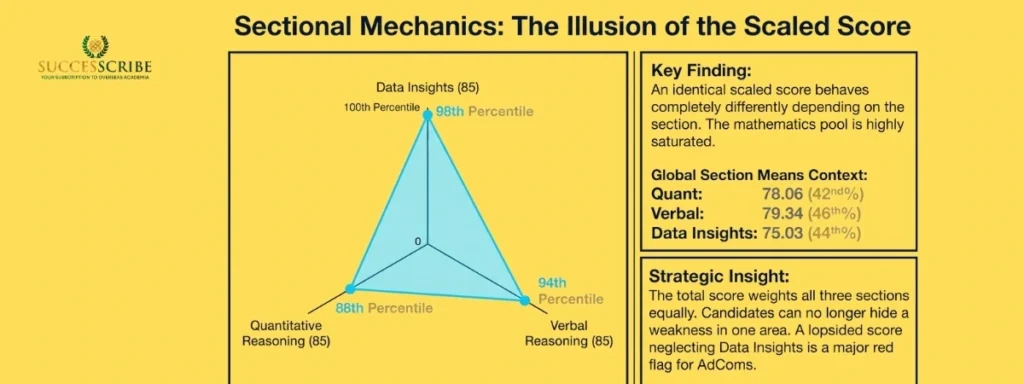
The scoring methodology for the Focus Edition treats the three sections with equal weight. Unlike the Classic version, where Quant and Verbal were the primary drivers, the Data Insights section is now a 1/3 contributor to your total score. The results are reported in 10-point increments, and the total score is a scaled composite. This shift means that candidates cannot afford to “hide” a weakness in one area. Mastery of the DI section is now the primary differentiator for elite candidates.
Section Mean Scores
| Section | Mean Score | Percentile Context |
| Quantitative Reasoning | 78.06 | 42nd Percentile |
| Verbal Reasoning | 79.34 | 46th Percentile |
| Data Insights | 75.03 | 44th Percentile |
| Global Total Score | 554.67 | 48th Percentile |
The Math Behind the GMAT: Percentiles and Concordance Explained
To accurately gauge competitiveness at elite US institutions, applicants must understand the official GMAC concordance cross-references. Admissions committees do not look at the three-digit number in isolation; they evaluate the application relative to the global percentile distribution.
The Cross-Reference: Translating Focus Scores to Legacy Standards
| GMAT Focus Score | Classic GMAT Equivalent | Global Percentile Rank | Institutional Competitiveness Level |
| 755–805 | 790–800 | 100% | Ultra-Elite / Maximum Scholarship Leverage |
| 735 | 770–780 | 99.5% | Elite M7 Target Outlier |
| 715 | 760 | 99th | Strong M7 Baseline / Ivy League Tier |
| 705 | 750 | 98th | Highly Competitive M7 / Top 10 Preferred |
| 685 | 730 | 96th | M7 Average Median / Top 15 Competitive |
| 675 | 720 | 95th | Top 15 Median / Top 20 Competitive Advantage |
| 665 | 710 | 91st | Top 20 Baseline / Top 25 Competitive |
| 655 | 700 | 90th | Top 25 Baseline / Solid Top 40 Target |
| 645 | 690 | 87th | Strong Top 50 / Competitive Regional Target |
| 615 | 650 | 70th | Top 50 Baseline |
| 575 | 600 | 48th | Below Average for Top Ranked Programs |
| 555 | 560 | 38th | Global Median Foundation Range |
The Adaptive Trap: How Sectional Weighting Can Make or Break You
The final composite three-digit score is derived from a cross-sectional algorithm that measures item difficulty alongside response accuracy. Because the Focus Edition employs an item-adaptive format – where the difficulty of subsequent questions adjusts based on your previous answers – the sectional scaled scores (60–90) reveal uneven percentile behavior.
Sectional Scaled Score to Percentile Mapping
| Scaled Section Score | Quantitative Percentile | Verbal Percentile | Data Insights Percentile | Performance Evaluation |
| 90 | 100% | 100% | 100% | Absolute Theoretical Maximum |
| 87 | 94% | 99% | 99% | Exceptional |
| 85 | 88% | 94% | 98% | Outstanding |
| 82 | 74% | 72% | 94% | Highly Competitive |
| 80 | 64% | 56% | 83% | Above Average |
| 78 | 50% | 38% | 69% | Solid / Average Target |
| 75 | 32% | 18% | 47% | Developing Competency |
The percentile divergence across sections emphasizes that an identical scaled score of 85 yields a 98th percentile in Data Insights but an 88th percentile in Quantitative Reasoning. This highlights the intense competition at the upper end of the mathematics distribution pool.
Admissions Benchmarks: US MBA Program Tiers
US business schools group into clear tiers based on selectivity, post-graduation compensation, and historical prestige. Analyzing the average, median, and middle-80% score distribution arrays across these tiers reveals the high standards maintained by top institutions.
The M7 Cohort (Magnificent Seven)
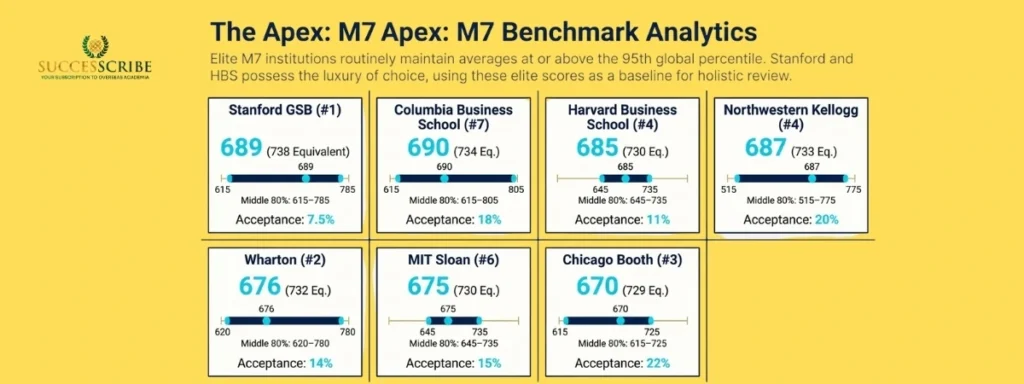
The elite M7 institutions represent the apex of global business education management. For these programs, GMAT Focus Edition class averages concentrate firmly between 670 and 690.
| Institution | US News Rank | GMAT Focus Mean/Median | Estimated Legacy Match | Reported Middle 80% Score Range |
| Stanford GSB | #1 | 689 (Mean) | 738 | 615–785 (Full Range) |
| Harvard Business School | #4 | 685 (Median) | 740 | 645–735 |
| Northwestern (Kellogg) | #4 | 687 (Mean) | 733 | 630–770 |
| UPenn (Wharton) | #2 | 676 (Mean) | 735 | 625–755 |
| Columbia Business School | #7 | 690 (Mean) | 734 | 615–805 (Full Range) |
| MIT (Sloan) | #6 | 675 (Median) | 730 | 645–735 |
| Chicago (Booth) | #3 | 670 (Mean) | 736 | 615–725 |
Top 15 to 25 Beyond the M7
Schools ranked 8 through 25 offer highly competitive options with clear paths into elite consulting, investment banking, and technology leadership. Their averages sit just below the M7 band, typically ranging from 645 to 685.
Top 15–25 Institutional Score Profiles
| Institution | US News Rank | GMAT Focus Mean/Median | Middle 80% Focus Range | Key Class Profile Note |
| NYU (Stern) | #7 | 682 (Mean) | 645–725 | High focus on Data Insights section |
| Michigan (Ross) | #13 | 681 (Mean) | 635–725 | Strong preference for balanced sub-scores |
| Yale SOM | #11 | 675 (Median) | 638–715 | High emphasis on academic transcripts |
| Dartmouth (Tuck) | #9 | 671 (Mean) | 595–775 | Extremely broad total distribution range |
| Virginia (Darden) | #11 | 671 (Mean) | 626–715 | Known for case-method rigor |
| UC Berkeley (Haas) | #10 | 675 (Median) | 637–725 | Tech-heavy profile distribution |
| Duke (Fuqua) | #14 | 665 (Mean) | 615–715 | High emphasis on teamwork metrics |
| UT Austin (McCombs) | #18 | 668 (Mean) | 615–725 | Strong energy/tech regional pipeline |
| Cornell (Johnson) | #15 | 655 (Mean) | 605–715 | Asset management tracking focus |
| CMU (Tepper) | #16 | 659 (Mean) | 605–725 | Highly analytics-centric evaluation |
Top 26 to 50 Elite Regional Programs
For ranked institutions outside the top 25, the competitive GMAT Focus threshold opens up considerably. These schools prioritize regional corporate pipelines and specialized domain expertise over elite test percentiles.
| Institution | US News Rank | Average GMAT Focus Score | Target Candidate Strategy |
| Indiana (Kelley) | #21 | 607 | Offset score with leadership evidence |
| UNC (Kenan-Flagler) | #21 | 652 | Target 655+ for merit scholarship access |
| Emory (Goizueta) | #23 | 648 | Strong consulting placement for mid-600s |
| Vanderbilt (Owen) | #16 | 660 | High corporate finance integration |
| Georgetown (McDonough) | #27 | 635 | Focus on international relations alignment |
| University of Washington | #20 | 655 | Pacific Northwest tech sector preference |
Demographic and Contextual Applicant Variations
A standard rule of MBA admissions consulting is that your GMAT score is not evaluated against the entire global testing pool. Instead, it is assessed against your specific demographic and professional peer group. This reality creates distinct target goals across different applicant profiles. Admissions dynamics vary significantly by profile, meaning an overrepresented applicant often requires a significantly higher GMAT Score for MBA in USA than a non-traditional candidate to achieve the same acceptance probability
The Overrepresented Applicant Pool
Candidates coming from competitive pools – such as Indian Male Engineers, East Asian Finance Professionals, and Software Developers – face elevated score expectations. Because these pools typically feature high average quantitative scores, applicants must exceed their target school’s public class averages to truly stand out.
- M7 Target Strategy: If the published class average is 685, an overrepresented candidate should target 705 or higher (98th+ percentile).
- Quantitative Threshold: A sectional score of 85+ in Quantitative Reasoning is often required to prove analytical capability among peers.
Non-Traditional and Humanities Backgrounds
Conversely, candidates with backgrounds in the arts, non-profit management, public policy, or specialized humanities face a different evaluation standard. For these profiles, the standardized test score serves primarily as a risk-mitigation tool.
- Admissions Goal: Prove to the admissions committee that you can handle the academic rigor of core microeconomics, statistics, and corporate finance courses.
- Target Strategy: Scoring at or slightly below a school’s median (e.g., 645 – 665 for an M7) is often perfectly acceptable if paired with a strong undergraduate GPA and a compelling narrative.
- Strategic Pivot: A solid score in the Data Insights (DI) section can help offset a lower Quantitative score by demonstrating modern analytical capability.
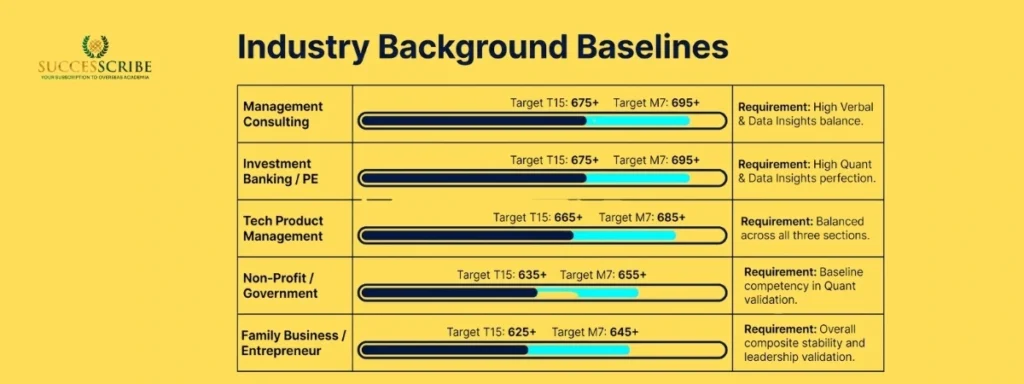
Corporate Background Baselines
The industry you come from also shapes how admissions committees interpret your score. The table below outlines the realistic score bands expected based on your professional track.
Target Score Variations by Industry Track
| Industry Track | Target GMAT Focus (M7) | Target GMAT Focus (T15-25) | Core Areas Evaluated |
| Management Consulting | 695+ | 675+ | High Verbal & Data Insights balance |
| Investment Banking / PE | 695+ | 675+ | High Quant & Data Insights perfection |
| Tech Product Management | 685+ | 665+ | Balanced across all three sections |
| Non-Profit / Government | 655+ | 635+ | Baseline competency in Quant |
| Family Business / Entrepreneur | 645+ | 625+ | Overall composite and leadership validation |
The Holistic Admissions Equation
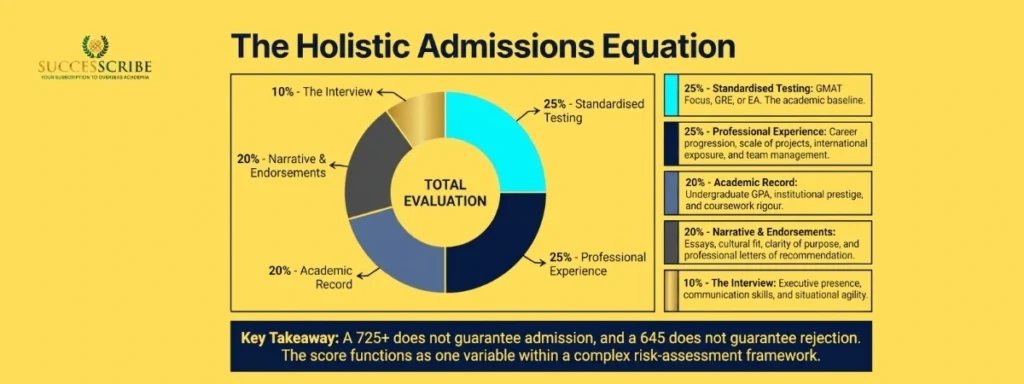
Elite US business schools use a holistic admissions process. A high GMAT score does not guarantee admission, nor does a lower score automatically disqualify an applicant. The standardized test score functions as one variable within a complex assessment framework.
Component Weight Breakdown
While exact weighting metrics vary by institution, admissions decisions generally balance across five core categories:
- Standardized Testing (25%): GMAT Focus Edition, GRE, or Executive Assessment.
- Professional Experience & Leadership (25%): Career progression, project scale, international exposure, and team management.
- Undergraduate Academic Record (20%): GPA, institutional prestige, and coursework difficulty.
- Essays, Recommendations, & Clarity of Purpose (20%): Cultural fit, unique perspective, personal statements, and professional recommendations.
- Admissions Interview (10%): Communication skills, executive presence, and situational agility.
Balancing a Lower GMAT Score
If your GMAT Focus Edition score falls below your target program’s middle-80% range, you must strengthen the remaining elements of your application to compensate.
- Address an Analytical Shortfall: If your Quant score is on the lower side, highlight data-driven projects at work, or consider completing a certified quantitative program like Harvard Business School Online CORe to build academic credibility.
- Highlight Career Progression: Focus your resume on rapid promotions, ownership of major budgets, or leading cross-functional teams. Demonstrating strong leadership can help balance a less-than-ideal test score.
- Refine Your Recommendation Strategy: Work closely with your recommenders to ensure they highlight your analytical skills, strategic thinking, and emotional intelligence with specific, real-world examples.
Financial ROI and Scholarship Correlation
Beyond securing admission, your GMAT Focus Edition score serves as a powerful tool for securing institutional funding. Top US business schools use merit-based scholarships and fellowships to attract top talent, and test scores play a central role in these financial decisions.
Merit-Based Scholarships vs. Need-Based Aid
Unlike undergraduate funding, which often relies heavily on financial need, top-tier MBA funding in the US is primarily merit-driven. Exceptional test scores can turn an expensive educational investment into a highly subsidized career pivot.
Scholarship Return on Investment Tiers
| GMAT Focus Score | Percentile Rank | Estimated Scholarship Coverage | Average Financial Yield Range |
| 725+ | 99th+ | 75% to 100% Tuition | $120,000 – $160,000 (Full Ride) |
| 705 | 98th | 50% to 75% Tuition | $80,000 – $120,000 |
| 685 | 96th | 25% to 50% Tuition | $40,000 – $80,000 |
| 665 | 91st | Regional Fellowships / Partial Aid | $15,000 – $40,000 |
Strategic Takeaways for Applicants
- The Funding Retake Strategy: If you are accepted into a Top 15 program with a score of 665, retaking the test to achieve a 695+ can completely change your financial aid package, potentially unlocking substantial tuition fellowships.
- Look Beyond Rankings for Funding: An M7-level score (such as a 695) can make you a prime candidate for full-tuition awards at excellent Top 20 or Top 25 programs like Virginia Darden, Duke Fuqua, or UNC Kenan-Flagler.
- Long-Term Career Impact: Graduating with minimal student debt significantly improves your post-MBA financial flexibility. This freedom allows you to explore early-stage startups, search funds, or entrepreneurial ventures without the pressure of managing massive monthly loan repayments.
Can You Get an MBA in USA Without GMAT?
Yes. The MBA admissions landscape has evolved significantly since 2020. Many universities now offer alternatives to traditional standardized testing requirements. While highly experienced executives can successfully bypass the exam via waivers, presenting a strong GMAT Score for MBA in USA remains the safest way to validate academic capability for most applicants.
GMAT Waiver Options
Business schools may grant waivers for applicants with:
- Significant work experience
- Strong quantitative backgrounds
- Advanced degrees
- Professional certifications
- Exceptional academic records
Common GMAT Waiver Profiles
| Applicant Profile | Waiver Possibility |
| Engineers | High |
| Chartered Accountants | High |
| CFA Holders | High |
| Data Analysts | Moderate to High |
| Senior Managers | High |
| Entrepreneurs | Moderate |
Factors Beyond GMAT Scores
One of the biggest misconceptions among MBA applicants is that admission depends primarily on GMAT performance.
In reality, top business schools evaluate candidates holistically.
Work Experience
MBA programs prefer candidates who have:
- Professional achievements
- Career progression
- Team management exposure
- Industry expertise
Leadership Potential
Admissions committees seek evidence of:
- Initiative
- Responsibility
- Impact
- Decision-making capability
Application Essays
Essays help schools understand:
- Career goals
- Motivation for MBA
- Leadership experiences
- Personal values
Letters of Recommendation
Strong recommendations provide:
- Credibility
- Professional validation
- Character assessment
- Leadership insights
Interview Performance
The MBA interview evaluates:
- Communication skills
- Professional maturity
- Cultural fit
- Motivation
Conclusion
The importance of the GMAT score for MBA in USA remains significant, despite the growing popularity of test-optional and waiver-based admissions policies. A strong GMAT score not only enhances admission prospects but can also improve scholarship opportunities and strengthen an applicant’s overall profile.
For students targeting elite MBA programs such as Harvard, Stanford, Wharton, MIT Sloan, Kellogg, and Chicago Booth, aiming for a GMAT score of 720–750+ can substantially increase competitiveness. Applicants targeting Top 25 business schools should generally aim for 700+, while a score between 650 and 700 remains competitive for many respected MBA programs across the United States.
FAQs
Is 645 a good score for M7?
645 is the equivalent of a 700 Classic (87th%). While it is “academically viable,” current M7 averages sit closer to 675–690. To get into an M7 with a 645, your profile must be exceptional.
Can I get into HBS with a 500 GMAT?
Source data proves Kellogg accepted a 515 and HBS has accepted as low as 540 (Classic). These are extreme outliers (celebrities/athletes) and should not be used as a target for professional candidates.
How long are my GMAT Focus scores valid, and how many times can I take the exam?
Validity: Your GMAT Focus Edition scores are valid for 5 years from your test date.
Testing Limits: You are allowed a maximum of 5 attempts in a rolling 12-month period, and a maximum of 8 attempts in your lifetime across all versions of the GMAT.
Cooling-Off Period: You must wait at least 16 calendar days between exam attempts, whether you take the test at a physical test center or online at home.
Should I take the GMAT Focus or the GRE for US MBA applications?
Over 90% of top US business schools state they treat the GMAT and GRE with equal weight. However, the data reveals a deeper strategic choice:
Take the GMAT Focus if: You are targeting highly analytical tracks like investment banking, private equity, or management consulting (firms in these industries often request raw GMAT scores during post-MBA hiring), or if you excel at data interpretation and logic.
Take the GRE if: You have a phenomenal vocabulary, find the GMAT’s strict time constraints overly stressful, or are applying to dual-degree programs (like a joint MBA/Master in Public Policy).
Can I change my answers during the test? How does the new review feature work?
Yes! Unlike the old Classic GMAT, the GMAT Focus Edition allows you to bookmark as many questions as you want and skip questions if you get stuck.
At the end of each 45-minute section, if you have time remaining, you will be taken to a Question Review Screen.
From this screen, you can review any question in that section.
The Catch: You can change your answers for a maximum of 3 questions per section. Use this feature wisely – never change an answer unless you are absolutely certain you made a logical or calculation error, as your first instinct is often correct.
Related Post
MBA in USA without GMAT
MBA in USA without work experience
MBA in business analytics in USA
Masters in Petroleum Engineering in USA