
The aviation industry is experiencing one of the strongest growth periods in its history. As global air travel continues to expand, airlines worldwide are facing a growing demand for qualified commercial pilots. According to industry forecasts from major aircraft manufacturers and aviation organizations, the global aviation sector will require hundreds of thousands of new pilots over the next two decades to support fleet expansion, pilot retirements, and increasing passenger traffic.
For aspiring aviators, choosing the best country for commercial pilot training is one of the most important decisions they will make. The country where you receive your flight training can influence your license recognition, training quality, career opportunities, total expenses, and future earning potential.
Today, students have access to pilot training programs in countries such as the United States, Canada, Australia, New Zealand, Germany, South Africa, and the United Kingdom. Each destination offers unique advantages, ranging from internationally recognized licenses and advanced aviation infrastructure to affordable training costs and excellent weather conditions for flying.
Whether your goal is to fly for a major international airline, work in corporate aviation, become a flight instructor, or pursue specialized aviation careers, understanding the available training options is essential. This comprehensive topic covers everything you need to know about Commercial Pilot Training.
Key Highlights: Best Country for Commercial Pilot Training
- Understanding the Path to Becoming a Commercial Pilot
- Commercial Pilot Course Fees: A Detailed Breakdown
- The Best Countries for Commercial Pilot Training
- Top Flight Schools in the World for Commercial Pilots
- Commercial Pilot Exam Structures
- Commercial Pilot Salary & Career Paths
- Eligibility Criteria for Commercial Pilot Training
- The Exams Required to Become a Commercial Pilot
- CPL vs ATPL
- Building an Elite Aviator Profile: From Youth to Airline Selection
- Crucial Strategic Consideration: The Conversion Trap
- Conclusion
- FAQs
Understanding the Path to Becoming a Commercial Pilot
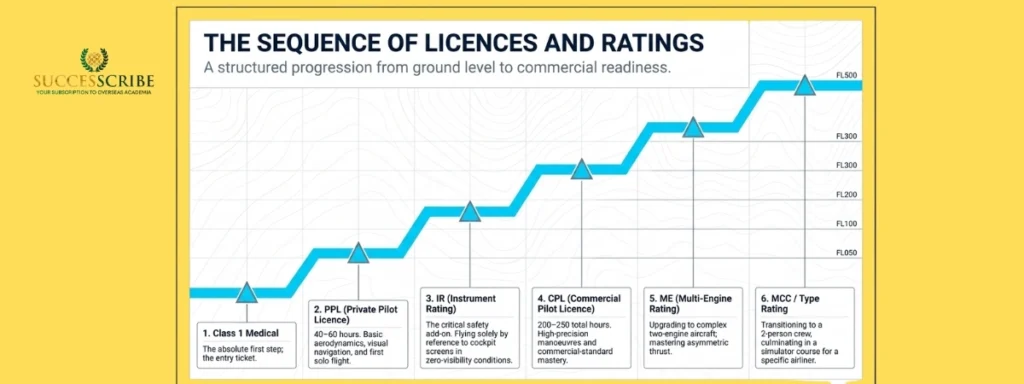
How to Become a Commercial Pilot is a journey that demands dedication and adherence to a structured progression of licenses and ratings. While specific requirements may vary slightly between regulatory bodies, the fundamental steps remain largely consistent worldwide. Navigating the structured sequence of licenses and ratings becomes significantly more efficient once you identify the best country for commercial pilot training to anchor your ab-initio or modular journey.
Step-by-Step Guide to Becoming a Commercial Pilot
- Class 1 Medical Certification: This is your absolute first step before investing any capital. A Class 1 medical certificate assesses an applicant’s cardiovascular health, vision, hearing, and neurological functions to ensure they meet commercial airline safety standards. This is your entry ticket. Before you spend a single dollar on flight school, a doctor needs to check your eyes, hearing, heart (ECG), and general health. They want to make sure you are 100% physically fit to handle the responsibility of flying passengers.
- Private Pilot License (PPL): This is where you learn the absolute basics. You will practice how a plane flies, basic steering, map reading, and taking off and landing by yourself (your first “solo” flight). Focuses on basic aerodynamics, maneuvers, visual navigation, and solo flight. Students typically log between 40 to 60 total flight hours.
- Instrument Rating (IR): The most critical safety qualification. This rating trains you to operate an aircraft solely by reference to flight instruments under Instrument Meteorological Conditions (IMC), such as clouds, heavy fog, or zero-visibility situations. A “Rating” is just an add-on skill to your license. Normally, a beginner pilot navigates by looking out the window at roads, rivers, and mountains. But what happens if you fly into a thick cloud or heavy fog and can’t see anything? The Instrument Rating trains you to look only at the screens and dials on your dashboard to safely fly and land the plane without ever looking out the window.
- Commercial Pilot License (CPL): Elevates piloting skills to commercial standards. Focuses on high-precision flight maneuvers, advanced systems operation, and mastery of cross-country operations. You must accumulate a minimum of 200 to 250 total flight hours depending on the regulatory path.
- Multi-Engine Rating (ME): Upgrading from a small one-engine plane to a bigger two-engine plane. Up until this point, you’ve likely been training in a small, single-engine propeller plane. But airlines don’t fly single-engine planes. This add-on training teaches you how to fly a plane with two engines, and most importantly, how to safely control the aircraft if one of those engines suddenly stops working.
- Multi-Crew Coordination (MCC) or Type Rating: Learning to fly as a team, specifically on a massive commercial airliner.
- MCC: Up until now, you’ve been a lone wolf in the cockpit. The MCC course teaches you how to work smoothly as a 2-person team (Captain and First Officer).
- Type Rating: A pilot license doesn’t automatically let you fly any plane. You have to get certified on one specific “type” at a time. A Type Rating is a 1-to-2 month intensive simulator course where you learn the exact buttons, emergency drills, and systems of a specific airliner, like an Airbus A320 or Boeing 737.
Integrated vs. Modular Flight Training Pathways
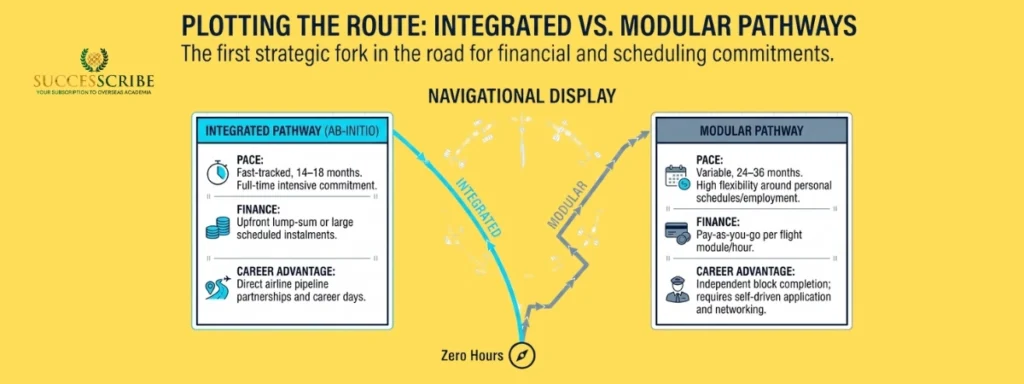
Aspiring pilots must select between two primary instructional tracks:
- Integrated Training Pathways: Often referred to as “Ab-Initio” programs, these courses take a student from zero flight experience to a frozen Airline Transport Pilot License (ATPL) or full CPL within a highly structured, fast-paced environment. Integrated programs are typically run by large, multinational aviation academies with direct airline pipeline partnerships.
- Modular Training Pathways: This route allows students to complete each license block independently at their own pace. This offers immense financial flexibility, enabling students to pay as they go and complete theory classes alongside other employment.
| Attribute | Integrated Pathway | Modular Pathway |
| Typical Timeline | 14 to 18 Months | 24 to 36 Months (Variable) |
| Financial Structure | Upfront lump-sum or scheduled large installments | Pay-as-you-go per flight module/hour |
| Schedule Flexibility | None; full-time intensive commitment | High; adaptable around personal schedules |
| Airline Placement Access | Direct career pipelines and career days | Self-driven application and networking |
Commercial Pilot Course Fees: A Detailed Breakdown
The financial investment required for commercial pilot training is substantial, and understanding the various components of Commercial pilot course fees is crucial for effective planning. Financial planning is an essential step in your aviation journey, as identifying the best country for commercial pilot training allows you to strategically balance high-quality flight tuition against competitive local living expenses. These costs can vary widely based on the country, flight school, type of program (integrated vs. modular), and the individual student’s pace of learning. Below is a breakdown of typical expenses:
| Cost Component | Description | Estimate Range (USD) |
| Tuition Fees | Ground school, flight instruction, aircraft rental hours (PPL, IR, CPL, ME) | $60,000 – $150,000 |
| Examiner Fees | Fees paid to Designated Pilot Examiners (DPEs) or civil authority examiners for checkrides | $3,000 – $8,000 |
| Knowledge Test Fees | Fees for computerized written examinations (e.g., FAA, EASA ATPL theory) | $1,000 – $3,000 |
| Medical Certificates | Initial Class 1 medical and subsequent renewals | $500 – $1,500 |
| Study Materials | Textbooks, charts, navigation tools, iPad apps, online resources | $1,000 – $3,000 |
| Pilot Supplies | Headset, flight bag, kneeboard, uniform | $1,500 – $4,000 |
| Accomodation | Living expenses during training (rent, utilities, food) | $12,000 – $36,000+ (per year) |
| Transportation | Local transport, flights between training bases | Varies |
| Type Rating | Training for a specific aircraft type (often post-CPL/ATPL) | $15,000 – $40,000 (often separate) |
| Contingency | Unexpected costs, extra flight hours, exam retakes | 10-15% of total tuition |
Global Cost Comparison Table
The following dataset breaks down the realistic Commercial pilot course fees across the top global training destinations. These estimates reflect standard dual and solo hour rates, ground structures, and local living baselines.
| Training Hub Country | Base Tuition Range (USD) | Additional Checkride & Material Fees (USD) | Average Living Expenses (14-18 Mos Baseline) | Total Estimated Cost Range (USD Equivalent) |
| United States | $75,000 – $95,000 | $2,000 – $3,500 | $15,000 – $22,000 | $92,000 – $120,500 |
| United Kingdom | $105,000 – $130,000 | $3,500 – $5,000 | $20,000 – $26,000 | $128,500 – $161,000 |
| Canada | $55,000 – $75,000 | $1,800 – $2,800 | $14,000 – $19,000 | $70,800 – $96,800 |
| Australia | $65,000 – $85,000 | $2,200 – $3,200 | $16,000 – $21,000 | $83,200 – $109,200 |
| South Africa | $40,000 – $55,000 | $1,200 – $2,200 | $8,000 – $12,000 | $49,200 – $69,200 |
The Best Countries for Commercial Pilot Training
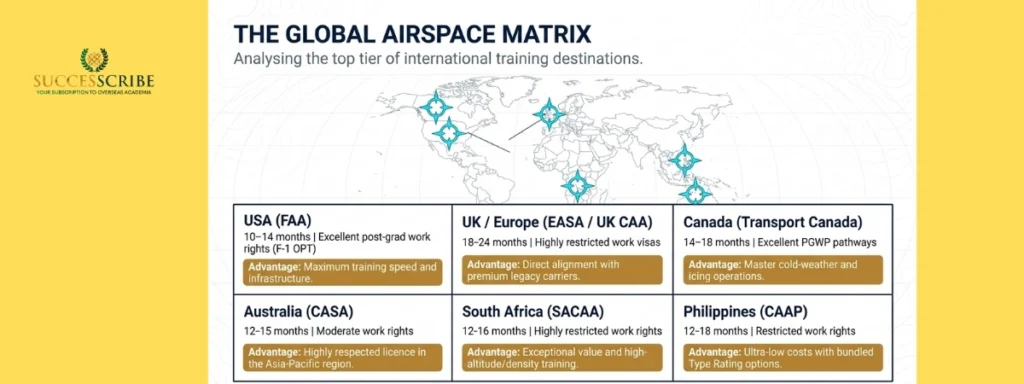
Selecting your flight training destination requires balancing your financial budget against your long-term career goals. Different countries offer distinct advantages depending on your target airline market, preferred training timeline, and available funding.
Finding the best country for commercial pilot training requires a careful analytical breakdown of global training hubs, local weather patterns, regional regulatory bodies, and post-graduation work rights.
| Country | Lead Regulatory Body | Average Zero-to-CPL Timeline | Flying Days Per Year | Post-Graduation Work Rights for International Students | Key Advantage |
| United States | FAA | 10 – 14 Months | 300+ Days (Sun Belt States) | Excellent (via F-1 Visa OPT pathways) | Maximum training speed and infrastructure. |
| Europe / UK | EASA / UK CAA | 18 – 24 Months | 180 – 220 Days | Highly restricted for non-citizens | Direct alignment with premium legacy carriers. |
| Canada | Transport Canada | 14 – 18 Months | 220 – 250 Days | Excellent (via PGWP pathways) | Master cold-weather and complex icing operations. |
| Australia | CASA | 12 – 15 Months | 280+ Days | Moderate (via work holiday visas) | Highly respected license in the Asia-Pacific region. |
| South Africa | SACAA | 12 – 16 Months | 280+ Days | Highly Restricted | Exceptional value and density altitude training. |
| Philippines | CAAP | 12 – 18 Months | 240 – 265 Days | Restricted | Ultra-low costs with bundled Type Rating options. |
1. United States (FAA Framework)
The United States remains a top choice for global commercial pilot training due to its extensive aviation infrastructure and high training efficiency.
- Regulatory Framework: Federal Aviation Administration (FAA) Part 141 (highly structured, accelerated curriculum) or Part 61 (flexible, modular learning).
- Timeline Efficiency: A zero-to-CPL track can be completed within 10 to 14 months due to seamless aircraft availability and high instructor density.
- Airspace Diversity: Trainees navigate highly complex, radar-dense terminal environments, building excellent radio communication and situational awareness skills early on.
- The Post-Graduate Advantage: International students who secure an F-1 academic visa can qualify for up to 12 months of Optional Practical Training (OPT). This allows them to build hours legally as a Certified Flight Instructor (CFI) within the US aviation ecosystem.
- Pros: High-quality training, abundant flight schools, diverse flying conditions, strong job market, competitive salaries, widely recognized license.
- Cons: Can be expensive, visa complexities for international students, high cost of living in some areas.
2. Europe & United Kingdom (EASA / UK CAA Framework)
European training standards are highly respected worldwide, making this route ideal for pilots targeting premium international network carriers.
- Regulatory Framework: European Union Aviation Safety Agency (EASA) and the UK Civil Aviation Authority (CAA).
- Timeline Realities: Programs typically require 18 to 24 months. Timelines are structurally longer due to the grueling 14-subject Airline Transport Pilot License (ATPL) ground school requirement and frequent winter weather delays in northern regions.
- Operational Landscape: Students face highly congested airspace and strict Instrument Flight Rule (IFR) routes from day one, preparing them well for complex airline operations.
- Employment Limits: Non-EU/UK citizens face strict post-graduation work visa limitations, which usually requires international students to return to their home countries immediately upon completion.
- Pros: High-quality, globally recognized training, excellent theoretical foundation, strong regulatory oversight.
- Cons: Can be very expensive, extensive theoretical exams, competitive job market for new graduates.
3. Canada (Transport Canada Framework)
Canada offers an excellent training ground that combines premium regulatory oversight with practical, real-world operational challenges.
- Regulatory Framework: Transport Canada (TC).
- Climatic Challenges: Canada introduces pilots to demanding winter operations, airframe icing risks, and cold-weather aircraft management. This intense environment develops resilient, safety-minded aviators highly valued by regional operators.
- Post-Graduation Rights: Canada’s Post-Graduation Work Permit (PGWP) program offers a pathway for eligible students at designated learning institutions to stay, instruct, and build flight hours locally.
- Pros: High-quality training, experience in diverse weather, ICAO-compliant license, moderate costs.
- Cons: Can be challenging weather conditions for some, potentially slower progression to major airlines compared to the USA.
4. Australia (CASA Framework)
Australia features expansive flight training infrastructure, particularly across its southern and western territories, backed by exceptional year-round flying weather.
- Regulatory Framework: Civil Aviation Safety Authority (CASA).
- Training Conditions: Excellent visual flight weather combined with massive expanses of uncontrolled airspace, ideal for building early cross-country confidence.
- Global Recognition: A CASA CPL is highly sought after by prominent carriers across the Asia-Pacific region.
- Pros: Excellent flying weather, high training standards, vast and diverse airspace, ICAO-compliant license.
- Cons: Higher cost of living in major cities, potentially smaller domestic airline market compared to the USA.
5. South Africa (SACAA Framework)
For pilots focused on maximizing their training budget without compromising foundational skills, South Africa presents an exceptional value proposition.
- Regulatory Framework: South African Civil Aviation Authority (SACAA).
- The Currency Advantage: Because the South African Rand (ZAR) provides highly favorable exchange rates against Western currencies, the hourly operating costs for aircraft rentals and instructor fees are among the lowest in the world.
- Terrain & Environment: High-altitude training environments (e.g., around Johannesburg, which sits over 5,000 feet above sea level) teach students critical, real-world lessons about aircraft performance, density altitude, and engine efficiency.
- Pros: Most affordable high-quality training, excellent flying weather, English-medium instruction, ICAO-compliant license.
- Cons: Domestic job market can be competitive, requires an international job search post-graduation.
6. The Philippines (CAAP Framework)
The Philippines has rapidly grown into one of the most popular value-driven hubs, particularly for aspiring aviators from India, the Middle East, and Southeast Asia.
- Regulatory Framework: Civil Aviation Authority of the Philippines (CAAP).
- The Cost Factor: Base tuition is highly competitive, and premium academies offer unique all-inclusive packages that bundle the CPL, multi-engine rating, and a full Jet Type Rating (like the Airbus A320) for a fraction of the cost of Western schools.
- The Language Advantage: The entire country operates an English-medium aviation system. All ground instruction, air traffic control (ATC), and CAAP exams are conducted 100% in English, eliminating language barriers.
- Weather Considerations: While it offers around 265 excellent flying days a year, students must plan around the annual monsoon and typhoon season (typically July to October), which can temporarily ground flight lines.
- Pros: Very affordable training, good flying weather, ICAO-compliant license, fast-paced training.
- Cons: Domestic job market can be challenging, lower starting salaries compared to Western countries, potential cultural adjustments.
Top Flight Schools in the World for Commercial Pilots
Selecting an elite flight training provider is just as critical as choosing your country destination. The world’s top flight academies are broadly divided into two structural categories: collegiate aviation universities (which bundle an academic degree with pilot certificates) and independent global flight academies (which offer fast-tracked, highly structured vocational pathways or direct airline cadet programs). Once you have determined the best country for commercial pilot training, your next critical step is alignment with an elite flight academy that offers advanced simulator fleets and direct airline pipeline partnerships.
The global tier of institutions below features updated fleet sizes, primary training certifications, and established regional airline pipelines.
| Flight Academy | Primary Region | Licensing Pathways Offered | Estimated Training Cost Range (USD) | Primary Airline Pipeline Partners | Best Suited For |
| Embry-Riddle (ERAU) | United States | FAA | $105,000 – $135,000 (Degree inclusive) | United Airlines, Delta Air Lines, Corporate Sectors | Students seeking a formal Bachelor’s Degree alongside elite FAA wings. |
| CAE Global Academy | Canada / Global | FAA, EASA, CASA, DGCA | $70,000 – $100,000 | IndiGo, Emirates, AirAsia, regional operators | International cadet applicants looking for a direct airline job guarantee. |
| L3Harris Academy | UK / Europe | EASA, UK CAA, FAA | $85,000 – $120,000 | British Airways, easyJet, Ryanair, Wizz Air | Fast-tracked, high-intensity European Integrated ATPL preparation. |
| UND Aerospace | United States | FAA | $90,000 – $120,000 (Degree inclusive) | US Regionals, FedEx/UPS feeder networks, Cargo | Comprehensive weather management and collegiate team flying. |
| Alpha Aviation Group | Philippines | CAAP | $55,000 – $65,000 (Type Rating bundled) | Cebu Pacific, Philippine Airlines | Budget-conscious students targeting an early Airbus A320 Type Rating. |
1. Embry-Riddle Aeronautical University (ERAU)
Widely referred to as the “Harvard of the Sky,” Embry-Riddle is the world’s largest fully accredited university specializing in aviation and aerospace.
- Primary Locations: Daytona Beach, Florida and Prescott, Arizona (USA).
- Regulatory Track: FAA Part 141.
- Fleet & Infrastructure: Operates over 100 high-tech training aircraft (primarily Cessna 172 Skyhawks and Diamond DA42 VI multi-engine trainers) equipped with modern Garmin G1000 NXi glass cockpits, alongside Level 6 flight training devices (FTDs).
- The Pipeline: Direct integration into major US airline pathways, including Delta Propel and United Aviate, alongside an immense global alumni network that spans hundreds of legacy carriers.
2. CAE Global Academy
CAE is a global giant in civil aviation training, processing thousands of pilots annually across an interconnected network of international training campuses.
- Primary Locations: Phoenix (USA), Montreal (Canada), Oxford (UK), Melbourne (Australia), and various satellite hubs across Europe and Asia.
- Regulatory Track: Dual track options including FAA, EASA, and CASA.
- Fleet & Infrastructure: A massive global fleet of over 200 training aircraft backed by their industry-standard Full Flight Simulators (FFS).
- The Pipeline: Famous for managing specialized Cadet Pilot Programs for premier global carriers like Emirates, AirAsia, and the highly sought-after IndiGo Cadet Program pipeline.
3. L3Harris Airline Academy
L3Harris operates some of the most advanced, highly standardized full-time integrated flight lines in the world, focused heavily on preparing students for high-density multi-crew environments.
- Primary Locations: Sanford, Florida (USA) and Cranfield (United Kingdom).
- Regulatory Track: EASA, UK CAA, and FAA.
- Fleet & Infrastructure: Combines high-utilization single-engine training fleets with advanced multi-crew synthetic training devices.
- The Pipeline: Holds deep structural placement partnerships across European and British short-haul networks, functioning as a primary recruitment source for British Airways (via the Speedbird Pilot Academy), easyJet, and Ryanair.
4. University of North Dakota (UND Aerospace)
UND houses one of the largest collegiate fleets in the world, renowned for developing highly disciplined pilots trained under challenging northern weather profiles.
- Primary Location: Grand Forks, North Dakota (USA).
- Regulatory Track: FAA Part 141.
- Fleet & Infrastructure: Operates an active, highly standardized fleet of over 100 aircraft, predominantly Piper Archers and Piper Seminoles.
- The Pipeline: Direct recruitment pipelines with major US cargo networks and regional feeds, featuring robust license convertibility paths for international corporate flight sectors.
5. Alpha Aviation Group (AAG)
AAG has positioned itself as the premier technology-driven academy in Southeast Asia, specializing in taking zero-hour students smoothly into medium-range jet environments.
- Primary Location: Clark Freeport Zone (Philippines).
- Regulatory Track: CAAP (ICAO-compliant).
- Fleet & Infrastructure: Features a clean, modern fleet of single and multi-engine aircraft, paired with high-end, in-house Airbus A320 Full Flight Simulators.
- The Pipeline: The definitive training hub for regional low-cost carriers, with direct First Officer placement links into Cebu Pacific, Philippine Airlines, and regional AirAsia groups.
Commercial Pilot Exam Structures
Earning your wings requires demonstrating both practical skills in the air and deep theoretical knowledge on the ground. The theoretical commercial pilot exam framework differs significantly depending on the regulatory authority overseeing your training destination. Ground school intensity and testing regulations vary across regions, making it essential to evaluate how different exam structures fit your learning style when researching the best country for commercial pilot training.
EASA ATPL Theory (Europe & United Kingdom)
The European Union Aviation Safety Agency (EASA) implements the most demanding theoretical training framework globally. Rather than a single commercial test, career-track students face the EASA Airline Transport Pilot License (ATPL) theory examinations.
- The Blueprint: A grueling layout of 14 separate theoretical subjects, including Advanced Instrumentation, Mass & Balance, Operational Procedures, Performance, and Meteorology.
- The Testing Engine: Powered by the European Central Question Bank (ECQB), these exams are continuously updated to reflect modern fuel management systems, all-weather operations (AWOPS), and high-level airspace rules.
- The Rules: Candidates must pass all 14 subjects within 6 exam sittings, spanning a maximum timeline of 18 months from their first attempt.
FAA Written Knowledge Tests (United States)
The Federal Aviation Administration takes a highly practical, modular approach to its knowledge testing.
- The Blueprint: Students complete individual, dedicated multiple-choice examinations corresponding to each specific license phase: FAA Private Pilot (PAR), Instrument Rating (IRA), and Commercial Pilot (CAX).
- The Mechanics: Rather than a unified 14-exam block, you sit for a single comprehensive computer-based test per certificate. This test covers practical performance calculations, weather interpretation, and Federal Aviation Regulations (FARs).
Practical Flight Tests (The Checkride)
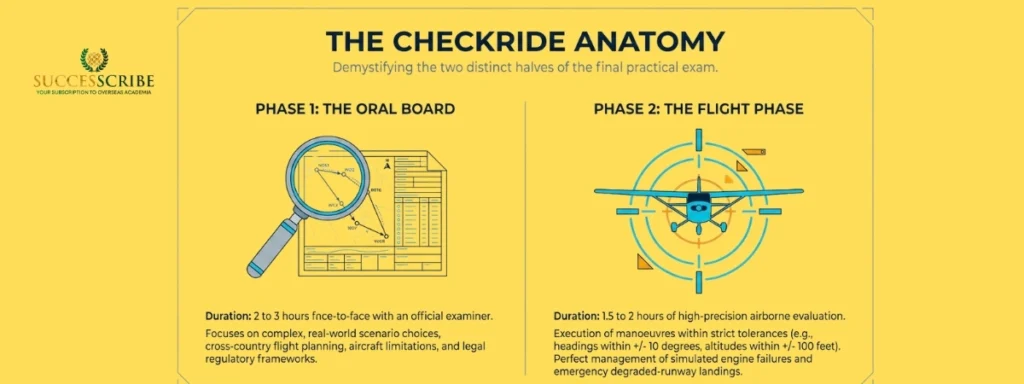
Every regulatory framework requires passing a formal checkride to earn a certificate. This practical test is divided into two phases:
- The Oral Examination: A thorough, face-to-face questioning session where the examiner tests your understanding of aircraft limitations, weather data, cross-country flight planning, emergency procedures, and legal regulatory frameworks.
- The Flight Phase: A high-precision flight evaluation where you must execute all required maneuvers within strict tolerances (e.g., maintaining headings within +/- 10 degrees, altitudes within +/- 100 feet, and managing simulated engine failures smoothly).
Commercial Pilot Salary & Career Paths
Your ultimate career progression from a low-hour flight school graduate to a high-earning airline captain is deeply shaped by the training infrastructure and hours-building pathways provided by the best country for commercial pilot training.
The Career Progression Pay Scale
A Commercial pilot salary is determined by your accrued flight hours, your rank (First Officer vs. Captain), the type of aircraft you operate (narrow-body vs. wide-body), and your specific aviation sector.
- Regional Airlines: The typical starting step for entry-level aviators. Pilots operate regional jets or turboprops on shorter domestic routes.
- Legacy / Major Carriers: The premier tier of commercial aviation (e.g., Delta, United, Air India, British Airways). These roles command maximum compensation packages, especially on long-haul international wide-body fleets.
- Cargo & Corporate Charter: Cargo operators (e.g., FedEx, UPS) offer compensation packages that closely match or exceed legacy passenger carriers, paired with unique, night-focused flying schedules.
| Region / Market | Role Rank & Fleet Type | Average Monthly Salary (USD Equiv.) | Average Annual Base Compensation |
| North America (USA/Canada) | Regional First Officer | $6,000 – $10,000 | $72,000 – $120,000 |
| Major Legacy Captain (Wide Body) | $22,000 – $42,000 | $264,000 – $504,000+ | |
| Europe & United Kingdom | Short-Haul First Officer | $5,000 – $8,500 | $60,000 – $102,000 |
| Legacy Airline Captain | $15,000 – $25,000 | $180,000 – $300,000 | |
| Middle East (UAE/Qatar) | Wide-Body First Officer | $8,000 – $12,000 | $96,000 – $144,000 (Tax-Free) |
| Senior Wide-Body Captain | $16,000 – $26,000 | $192,000 – $312,000 (Tax-Free) | |
| India & South Asia | Airline First Officer | $2,500 – $4,800 | ₹25 Lakhs – ₹48 Lakhs |
| Senior Fleet Commander | $9,500 – $18,000 | ₹96 Lakhs – ₹1.8 Crores+ |
Overcoming the “Low-Hour” Flight Gap
The biggest challenge for a new flight school graduate is bridging the gap between earning a fresh CPL (roughly 200-250 hours) and meeting the hiring minimums for major airlines. In the United States, for example, the FAA mandates a strict 1,500-hour minimum for an Airline Transport Pilot Certificate (ATP) to fly for a scheduled commercial carrier.
To bridge this gap and build hours productively, low-hour pilots utilize several key career pathways:
- Certified Flight Instructor (CFI): Working as an instructor is the most common path. CFIs build hours quickly by teaching new students, all while refining their own foundational safety and aeronautical knowledge.
- Aerial Survey & Photography: Flying specialized single-engine aircraft over mapped grid lines to gather geographical data or monitor infrastructure.
- Banner Towing & Skydiver Operations: Operating in high-cycle environments that build strong short-field landing skills, rudder control, and energy management.
- Bush Flying & Regional Charter: Flying utility aircraft into remote airfields (prevalent across parts of Canada, Africa, and Australia), which builds exceptional hands-on piloting experience.
Eligibility Criteria for Commercial Pilot Training
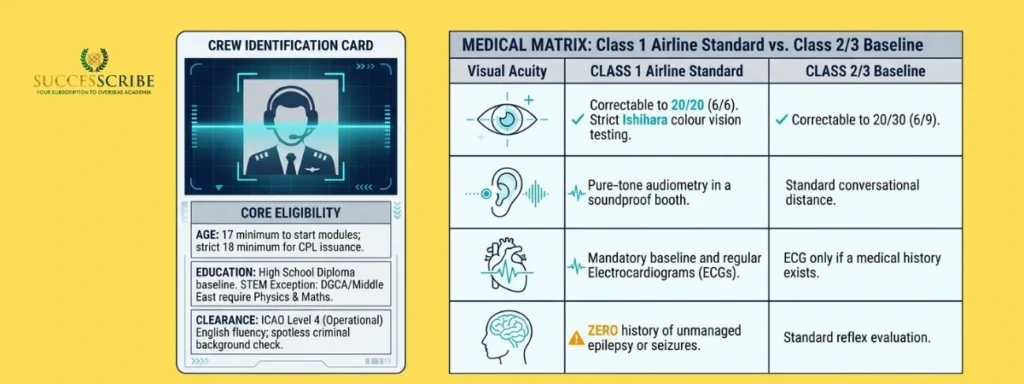
Meeting the entry-level eligibility criteria is the definitive gateway to your aviation career. Before investing significant capital into flight school tuition, you must ensure you meet the legal, medical, educational, and linguistic requirements set by global aviation authorities.
The criteria have become increasingly standardized worldwide to facilitate cross-border pilot licensing, but key regional differences remain.
Core Foundational Eligibility Criteria
This table highlights the universal age, academic, and language benchmarks you must meet before a flight academy can officially clear you for a commercial flight line.
| Eligibility Factor | Minimum Baseline Standard | Key Regional Variations & Nuances |
| Minimum Age to Start | 17 Years Old | You can fly solo at 16, but structured commercial training tracks usually require you to be 17 to start your modules. |
| Minimum Age to Graduate | 18 Years Old | This is a strict international law. Even if you finish all flight hours early, a Commercial Pilot License (CPL) cannot be issued until your 18th birthday. |
| Educational Minimum | High School Diploma (or 10+2 equivalent) | The STEM Exception: If you plan to fly in India (DGCA) or the Middle East, you must have taken Physics and Math in high school. If you didn’t, you must pass bridge exams (like NIOS) first. |
| Language Fluency | ICAO Level 4 (Operational) | You must be able to read, write, speak, and understand English fluently. Your pronunciation and comprehension will be formally audited during your radio license exams. |
| Criminal Background | Clean Record | International students must clear extensive criminal background checks (e.g., TSA clearance in the US, NBI clearance in the Philippines) before training can begin. |
Class 1 Medical vs. Class 2/3 Medical Requirements
Your medical certificate is your absolute “fit to fly” passport. This side-by-side comparison shows the difference between the elite commercial standard and the recreational baseline.
| Evaluation Metric | Class 1 Medical (Commercial Airline Standard) | Class 2 / 3 Medical (Private / Student Baseline) |
| Primary Purpose | Mandatory to legally exercise the privileges of a commercial license (CPL) or airline pilot license (ATPL). | Sufficient only for flying as a student pilot or for recreational flying (PPL). |
| Visual Acuity | Must be correctable to 20/20 (6/6) in each eye individually. Monocular vision is generally disqualifying. | Must be correctable to at least 20/30 (6/9) in the better eye. |
| Color Vision | Strict testing via Ishihara plates. You must be able to instantly tell the difference between aviation red, green, and white signals. | Less stringent, but severe color blindness will restrict you from flying at night. |
| Hearing Thresholds | Must pass a formal pure-tone audiometry test inside a soundproof booth to catch hidden hearing loss. | Must be able to hear a normal conversational voice from a standard distance (2 meters). |
| Cardiovascular Health | Regular Electrocardiograms (ECGs) are mandatory. The frequency of these tests increases sharply once you turn 40. | ECGs are typically only required if you have a known history of heart conditions. |
| Neurological Baseline | Zero history of unmanaged epilepsy, clinical seizures, chronic severe migraines, or unexplained fainting. | Standard physical reflex and neurological baseline check during the exam. |
| Mental Health Status | Strict screening; zero history of active, unmanaged clinical depression, severe anxiety, or substance dependency. | Baseline evaluation of psychological stability during your physical interview. |
The Exams Required to Become a Commercial Pilot
Successfully clearing your theoretical written papers and final checkrides depends largely on the regulatory framework and testing style utilized by the best country for commercial pilot training. To prove you understand the science, math, and regulations of aviation, you must clear two types of testing: computer-based Written Theory Exams and a practical flying test called a Checkride.
- Written Theory Exams (Ground School)
You do not take a single general exam; you must pass specific subject papers. The breakdown varies depending on the civil aviation authority governing your region:
- In India (DGCA Exams): You must pass 6 core subjects with a minimum score of 70%. These are Air Navigation, Aviation Meteorology (weather), Air Regulations (laws), Technical General (aircraft systems), Technical Specific (your specific training aircraft details), and Radio Telephony Restricted (RTR-A) for live radio communications with air traffic controllers.
- In Europe (EASA Exams): Europe divides ground school into 14 highly detailed multiple-choice exams based on the updated European Central Question Bank (ECQB). You must score 75% or higher on all 14 individual subjects within an 18-month window.
- In the USA (FAA Exams): The path is highly streamlined. You take one comprehensive written exam per license stage (one for PPL, one for Instrument Rating, and one 100-question computer test for your CPL) requiring a 70% minimum passing score.
The Final Practical Exam (The Checkride)
Once you complete your required flight hours (usually 200 to 250 hours), you must pass a full-day, two-part exam with an official government examiner:
- The Oral Board Exam: A 2-to-3 hour face-to-face grilling session where the examiner poses complex, real-world scenario choices regarding navigation, fuel planning, and emergency diversions.
- The Flight Test: A 1.5-to-2 hour check flight where you must demonstrate high-precision steep turns, simulated engine-failure emergency landings, and perfect landings on short or degraded runways. Passing both components earns you your physical Commercial Pilot License.
CPL vs ATPL
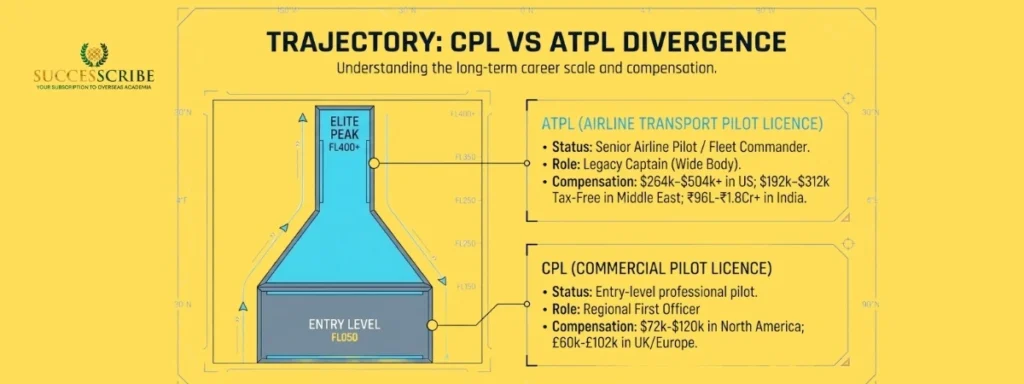
Many aspiring pilots become confused between CPL and ATPL.
Understanding the difference is crucial for long-term career planning.
What is CPL?
CPL stands for Commercial Pilot License.
It allows a pilot to work professionally and earn income from flying.
What is ATPL?
ATPL stands for Airline Transport Pilot License.
It is the highest level of pilot certification and is generally required for airline captains.
| Feature | CPL | ATPL |
| Full Form | Commercial Pilot License | Airline Transport Pilot License |
| Career Stage | Entry-Level Professional Pilot | Senior Airline Pilot |
| Flying Hours Required | Lower | Significantly Higher |
| Airline First Officer Eligibility | Yes | Yes |
| Captain Eligibility | Usually No | Yes |
| Difficulty Level | Moderate | Advanced |
| Salary Potential | Good | Very High |
Building an Elite Aviator Profile: From Youth to Airline Selection
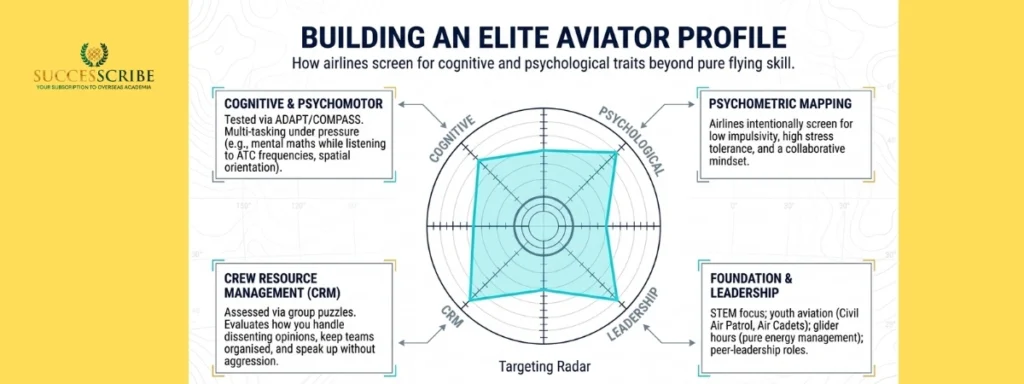
Modern commercial aviation has moved away from the legacy “stick-and-rudder” hiring mindset. Major international carriers and top-tier flight academies now utilize highly advanced, data-driven profiling matrices to select candidates.
Airlines look for specific behavioral, cognitive, and psychological traits. They want to see Crew Resource Management (CRM) potential, high emotional stability, structural leadership, and spatial cognitive speed.
Whether you are starting early as a teenager or refining your profile as an adult applicant, preparing your background strategically will maximize your chances of clearing competitive elite cadet screenings (such as the United Aviate, Delta Propel, British Airways Speedbird, or the IndiGo Cadet program).
1. The Early Journey: Foundations for Young Aviators (Ages 13–18)
If you know you want to be a pilot from a young age, you can build a massive competitive edge before ever touching the controls of a training aircraft.
- Focus on the STEM Foundation: While a university degree isn’t universally required, foundational academic metrics are heavily vetted. Prioritize Physics and Mathematics (specifically calculus, trigonometry, and classical mechanics) in high school. Top academies look for strong performance in these subjects as proof of your technical learning capacity.
- Join Youth Aviation Formations: Getting involved in structured youth organizations demonstrates long-term dedication to the field. Seek out programs like the Civil Air Patrol (CAP) in the United States, the Air Training Corps (ATC) / Air Cadets in the UK and Commonwealth, or local youth soaring clubs. These programs introduce you to military-grade discipline, basic aerodynamics, and uniform wear early on.
- Log Glider or Soaring Hours: If your budget allows, start flying gliders. In many countries, you can legally pilot a glider solo at 14 or 15 years old—well before you can drive a car. Airlines highly value glider experience because it teaches pure energy management, deep stick-and-rudder coordination, and real aerodynamic feel without relying on an engine.
2. The Selection Matrix: How Elite Academies Screen Candidates
When you apply for a premium flight school or an airline-backed cadet program, you will navigate a multi-stage screening process. Most tier-1 institutions use specialized testing platforms like ADAPT, COMPASS, or CUT-E/AON to evaluate your baseline potential.
The Assessment Breakdown
- Cognitive & Psychomotor Testing: These automated systems test your ability to execute split-second tasks under pressure. Expect split-screen tracking tasks, mental math equations while listening to ATC radio frequencies, spatial orientation tests (such as rapid cube-folding or instrument-crosscheck reading), and short-term memory recall.
- Psychometric and Personality Mapping: Airlines use these evaluations to identify specific personality types. They look for candidates with low impulsivity, high stress tolerance, a collaborative mindset, and a strong sense of personal accountability. They intentionally screen out overly aggressive or passive personality types.
- Group Resource Management (CRM) Exercises: Candidates are placed into teams and given a complex, time-sensitive problem to solve (e.g., an urban planning logic puzzle or a simulated logistics emergency). Assessors don’t just look for who solves the puzzle; they evaluate how you listen, how you handle dissenting opinions, your ability to speak up firmly without being aggressive, and how well you keep the team organized under stress.
3. Profile Optimization: Maximizing Your Selection Probability
To ensure your application stands out in a competitive selection pool, focus on building a well-rounded, high-value profile that hits every key operational box:
| Profile Core Element | Actionable Optimization Strategy | Why Assessors Look for This |
| Aviation Tech Literacy | Complete your target authority’s ground school modules (FAA written or local DGCA/EASA theory exams) before applying. | Demonstrates strong self-discipline and drastically reduces training timeline risks. |
| Leadership Evidence | Secure visible peer-leadership positions (e.g., Captain of an athletic team, Eagle Scout rank, or university club president). | Shows early potential for transitioning from a First Officer to a Flight Deck Commander. |
| Physical & Mental Fitness | Maintain an active lifestyle with a focus on aerobic fitness and spatial coordination. Keep your BMI between 18.5 and 24.9. | Protects your high-value Class 1 Medical status and prevents sudden medical groundings. |
| Advanced Aptitude Prep | Utilize specialized pre-assessment flight software packages (e.g., LatestPilotJobs, Skytest, or PilotAssessments). | Trains your brain to process the exact multi-tasking algorithms used in CUT-E or ADAPT tests. |
| Community Engagement | Volunteer for continuous, team-focused social service initiatives or disaster relief frameworks. | Proves high empathy, service-oriented mindset, and solid communicative alignment. |
Crucial Strategic Consideration: The Conversion Trap
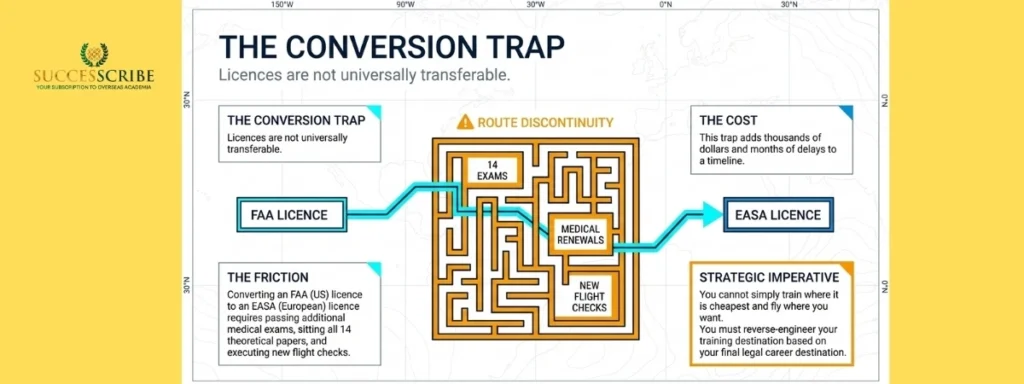
Before choosing a country, you must decide where you legally intend to work. Aviation licenses are not universally transferable. Converting an FAA (US) license to an EASA (European) license – or vice versa – requires passing additional medical exams, theoretical papers, and flight checks, which can add thousands of dollars and months of delays to your timeline. It is almost always best to train under the regulatory authority of the region where you plan to build your career.
Conclusion
There is no single country that fits every student perfectly. The ideal choice depends on your budget, your preferred timeline, and where you hold legal working rights.
If your goal is unmatched speed, high-density radar exposure, and a clear path to build hours as an instructor, the United States remains the premier choice.
If you are focused on maximizing your training budget and want to learn in an environment that tests your aircraft performance skills, South Africa offers excellent value.
If your career goals are centered on European or Middle Eastern legacy airlines, completing an integrated program in the United Kingdom or Europe aligns you directly with those specific hiring pipelines from day one. Ultimately, the best country for commercial pilot training is not a one-size-fits-all answer, but rather the destination that perfectly aligns with your personal budget, timeline, and long-term legal working rights.
Before signing a training contract or transferring funds, ensure you secure your Class 1 Medical certificate, tour your chosen flight academies, and confirm that your visa paths align with your long-term career goals.
FAQs
Which country is the fastest for completing commercial pilot training?
The United States offers the most accelerated timeline, allowing students to go from zero experience to a Commercial Pilot License (CPL) in 10 to 14 months. This efficiency is driven by high instructor density, constant aircraft availability, and favorable flying weather in the Sun Belt states.
Which country offers the best budget-friendly pilot training without compromising on international standards?
South Africa provides exceptional financial value. Because the South African Rand (ZAR) has a highly favorable exchange rate against Western currencies, the hourly rates for aircraft rentals and instructors are among the lowest in the world. Additionally, the Philippines is a major value-driven hub, offering bundled packages that include a Type Rating for a fraction of Western costs.
What is the difference between Integrated and Modular flight training?
Integrated training (Ab-Initio) is a full-time, fast-paced, highly structured course that takes you from zero experience to a frozen ATPL/CPL in 14–18 months, often featuring direct airline partnerships. Modular training allows you to complete each license block independently at your own pace, offering massive schedule flexibility and a “pay-as-you-go” financial structure.
Do I need a university degree to become a commercial pilot?
No, a formal university degree is not universally required; a High School Diploma (or equivalent) is the standard baseline. However, if you intend to fly in certain regions like India (DGCA) or the Middle East, you face the “STEM Exception,” meaning you must have completed high school physics and mathematics or pass regional bridge exams first.
Why is the European (EASA) ground school considered the hardest globally?
Unlike the US FAA system, which uses streamlined computer tests per license stage, the EASA framework requires students to pass 14 separate, highly detailed theoretical subjects based on the European Central Question Bank (ECQB). Candidates must score 75% or higher on all 14 individual subjects within an 18-month window.
Related Post
MS in Cloud Computing in Germany
Masters in Artificial Intelligence in Germany
Masters in Data Science in Germany
Entrance exam for masters in Germany