The United States continues to be home to some of the world’s most prestigious universities. Institutions such as Harvard, Yale, Stanford, Columbia, and the University of Chicago attract students from nearly every country because of their academic excellence, global reputation, research opportunities, and strong career outcomes.
However, studying at these institutions comes at a significant cost. Over the last decade, tuition fees, housing expenses, student services, and healthcare costs have increased steadily across the American higher education sector. As a result, several elite universities now have an annual cost of attendance approaching or even exceeding USD 100,000 per year when tuition, accommodation, food, books, and miscellaneous expenses are included.
For students planning higher education in America, understanding the actual cost of studying is essential. While sticker prices may appear overwhelming, many universities also provide generous scholarships and financial aid packages that can substantially reduce expenses.
This detailed topic explores the Most Expensive Universities in USA, including tuition fees, total annual costs, reasons behind their high fees, and whether these institutions provide value for the money invested.
Key Highlights: Most Expensive Universities in USA
- Top 15 Most Expensive Universities in USA
- Why These Universities Command Premium Pricing
- The Grand Budget Breakdown (Beyond Tuition)
- The Ivy League Paradox: Sticker Price vs. Net Price
- Strategic ROI Analysis: Is a $400,000 Degree Worth It?
- International Student Perspective
- Institutional Scholarship & Aid Matrix
- Conclusion
- FAQs
Top 15 Most Expensive Universities in USA
These universities are characterized not just by their high costs but by their significant reinvestment into student resources, research infrastructure, and global branding. From a consulting perspective, these schools represent the high end of the institutional market, where the institutional discount rate often determines the actual student experience. While these figures are the highest in the nation, they correlate with high graduate outcomes.
| University Name | Location | Annual Tuition Fee | Total Cost of Attendance (COA) | Acceptance Rate |
| Pepperdine University | Malibu, CA | $72,672 | $101,450 | 42% |
| University of Southern California | Los Angeles, CA | $73,260 | $99,139 | 11.2% |
| Harvey Mudd College | Claremont, CA | $72,699 | $98,984 | Highly Selective |
| University of Chicago | Chicago, IL | $72,948 | $98,301 | 13.0% |
| Tufts University | Medford, MA | $71,654 | $97,928 | 11.0% |
| Columbia University | New York, NY | $70,170 | $96,990 | 5.8% |
| Vassar College | Poughkeepsie, NY | $73,275 | $96,668 | 18.6% |
| Northwestern University | Evanston, IL | $69,375 | $96,236 | 7.0% |
| Brown University | Providence, RI | $71,700 | $92,400 | 5.0% |
| Duke University | Durham, NC | $70,265 | $92,042 | 4.3% |
| Boston College | Chestnut Hill, MA | $67,680 | $91,342 | 22.0% |
| Barnard College | New York, NY | $68,822 | $91,170 | 8.0% |
| Vanderbilt University | Nashville, TN | $63,946 | $89,590 | 7.0% |
| Stanford University | Stanford, CA | $67,731 | $87,833 | 4.3% |
| MIT | Cambridge, MA | $44,720 | $85,000+ | 7.0% |
While these figures are undeniably daunting, the drivers behind the pricing of the Most Expensive Universities in USA are multifaceted. These institutions operate as complex mini-cities that provide everything from high-level security to world-class research laboratories. The premium pricing is essentially a reflection of a high-resource ecosystem designed to produce the next generation of global leaders. As we evaluate these institutions, it is important to remember that these costs manifest in specific line items for the student, including technology fees and specialized support.
Why These Universities Command Premium Pricing

Elite American universities operate as complex, self-sustaining mini-cities. Because they are structured as non-profit institutions, they reinvest every dollar of revenue back into the campus environment. This creates a highly competitive resource cycle driven by four main factors:
- Global Talent Acquisition: Recruiting and retaining Nobel laureates, field pioneers, and top-tier researchers requires globally competitive salaries and extensive administrative support.
- R&D and Laboratory Infrastructure: Elite U.S. universities collectively spend tens of billions annually on research. Maintaining state-of-the-art laboratory facilities, clean rooms, and computing clusters is exceptionally capital-intensive.
- The Lifestyle Package: Modern campus ecosystems are expected to provide comprehensive 24-hour services, specialized mental and physical healthcare facilities, and highly secure residential spaces.
- Location Premiums: The cost of living in primary urban hubs outpaces core tuition inflation. In cities like New York, Los Angeles, and Boston, housing premiums and auxiliary campus services can drive the non-academic portion of the budget up to 40% of the total annual bill.
The Grand Budget Breakdown (Beyond Tuition)
Tuition is simply the cost of academic instruction. To build an accurate financial plan, families must look at the comprehensive Total Cost of Attendance (COA).
The table below illustrates a typical annual budget allocation, highlighting the financial variations encountered in high-cost metro areas:
| Budget Category | Estimated Base Annual Cost | High-Cost City Variance (NYC / LA / Boston) |
| Housing (Room) | $12,000 – $16,000 | Up to $21,000 |
| Meal Plans (Board) | $6,000 – $8,000 | Up to $9,000 |
| Health Insurance | $3,000 – $5,000 | Mandatory unless waived via a domestic parent plan |
| Books & Supplies | $1,000 – $1,500 | Discipline-dependent (higher for Art, Architecture, Film) |
| Personal Expenses | $2,000 – $4,500 | Local laundry, local transit, cell plans, clothing |
| Transportation | $1,000 – $3,000 | Includes multi-seasonal domestic flights home |
The “Hidden” Cost Checklist: Beyond these figures, families must budget for one-time orientation fees, mandatory student activity or wellness fees, technology/lab fees specific to engineering or art tracks, and the cost of moving or storing student belongings during winter and summer campus shutdowns.
The Ivy League Paradox: Sticker Price vs. Net Price
The Ivy League and peer institutions occupy a unique economic space: they are simultaneously the most expensive schools by sticker price and the most affordable for qualified lower-to-middle-income families.
Because of their multi-billion-dollar endowments, these institutions utilize need-blind admissions (admitting students regardless of their ability to pay) and commit to meeting 100% of demonstrated financial need without student loans.
- Income Thresholds: Schools like Harvard and Princeton completely eliminate the parent contribution requirement for families earning below $85,000 to $100,000 annually.
- Grant-Based Aid: Under programs like Opportunity Vanderbilt or Columbia’s financial aid initiatives, traditional student loans are replaced entirely with institutional grants that do not need to be repaid.
- The Reality: For a middle-income domestic family, attending an elite Ivy League institution can frequently result in a lower out-of-pocket “net price” than attending an in-state public university.
Strategic ROI Analysis: Is a $400,000 Degree Worth It?
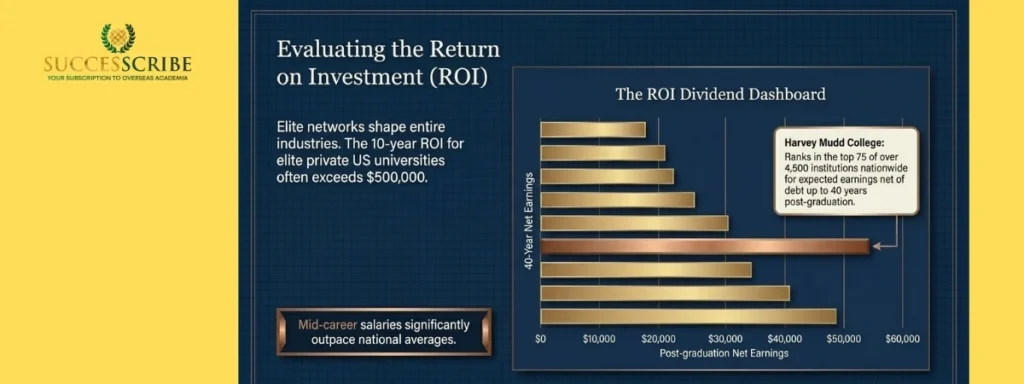
For high-net-worth families, international applicants, or those who do not qualify for need-based aid, a four-year undergraduate career will require a cash outlay or debt structure close to $400,000.
Whether this investment is mathematically justified depends heavily on the intended career trajectory and the specific industry pipelines of the institution:
| Undergraduate Degree Investment: $400K | |
| High-Growth Fields(AI, Quant Finance, Biotech) | Low-Ceiling / General Fields(Varies wildly by industry) |
| Top-tier starting salaries ($80K-$110K+)Direct Silicon Valley/Wall Street pipelines10-Year ROI can exceed $500,000 | Slower initial capital recoveryNetwork value relies heavily on individual leverage |
- Starting Salaries & Early Career: Graduates from schools like Columbia, MIT, and Stanford enter the market with median starting salaries ranging from $80,000 to over $110,000 in technical and financial sectors. Employment rates consistently hover above 95% within six months of graduation.
- The Prestige Premium: In ultra-competitive fields like quantitative finance, venture-backed tech, or specialized research and development, an elite degree brand functions as an entry prerequisite. The long-term acceleration of the career arc, combined with lifetime access to a powerful global alumni network, serves as a permanent professional safety net that helps recover the initial capital outlay.
International Student Perspective

The cost of studying in the United States is structurally higher for international applicants due to non-tuition variables mandated by visa status and cross-border logistics. International families should budget an additional $5,000 to $10,000 annually to cover mandatory overhead.
Logistical Overhead Estimates
- Visa & SEVIS Fees: $500 – $800 (Initial setup and processing)
- Premium Health Insurance: $3,500 – $5,500 (Mandatory international university-sponsored plans)
- International Travel: $3,000 – $6,000 (Based on 2–3 round-trip flights home annually)
- Emergency Buffer: $2,000 (Recommended for local housing adjustments or unexpected campus closures)
Currency & Income Notes: Because all fees are denominated in USD, international families face exposure to local currency exchange volatility. Furthermore, international students on F-1 visas are restricted to working a maximum of 20 hours per week on-campus only. This income is legally constrained and intended for minor personal spending money – it cannot be factored in as a mechanism to offset tuition or housing costs.
Institutional Scholarship & Aid Matrix
Many of these high-cost institutions offer highly competitive merit-based or geographic scholarships that run independently of standard financial need models. Applying early is critical, as these programs often feature accelerated application deadlines.
| University | Scholarship / Program Name | Award Type | Average Coverage / Value |
| Duke University | Karsh International Scholarship | Merit | Full-ride (Tuition, Fees, Room & Board) |
| Boston University | Trustee Scholarship | Merit | Full Undergraduate Tuition & Mandatory Fees |
| University of Chicago | Chicago Commitment | Need / Regional | Full Tuition for qualified local/regional high schoolers |
| USC | Presidential / Trustee Scholarships | Merit | Varies from $10,000 up to Full Tuition (Over 1,000 awarded) |
| Vanderbilt University | Opportunity Vanderbilt | Need-Based | 100% of demonstrated need met entirely without loans |
Conclusion
The trajectory of tuition for the Most Expensive Universities in USA suggests that the $100,000 annual price tag is becoming a standard feature of the elite educational landscape. As we move through 2026, the trends indicate a move toward “comprehensive pricing,” where universities bundle high-quality housing, wellness services, and career acceleration into a single package. For the discerning applicant, the focus must shift from the sticker price to a personalized ROI audit that accounts for net price and career trajectory.
FAQs
Which is officially the most expensive university in the USA for 2026?
Rankings vary by program, but Pepperdine University currently reports one of the highest total costs of attendance, reaching approximately $101,450 when including tuition and all living expenses. This reflects its private status and coastal Malibu setting.
Why is Pepperdine University so expensive compared to some Ivies?
Pepperdine’s high cost is primarily driven by its private status, which means it receives no government grants, and its premium Malibu location. Maintaining high-quality facilities and infrastructure in a high-cost coastal area requires a higher tuition revenue stream.
What is the difference between “Sticker Price” and “Net Price”?
The sticker price is the advertised cost (often $90k+). The net price is what a family actually pays after institutional scholarships and grants are applied. At many elite schools, the average net price for domestic students is significantly lower than the sticker price.
Is a degree from one of the Most Expensive Universities in USA worth $400,000?
For students entering high-growth fields like AI, finance, or medicine, the ROI is often positive due to higher starting salaries and the long-term value of the alumni network. Harvey Mudd, for example, ranks top 75 for long-term earnings.
Are public universities always cheaper than private ones?
Not necessarily for out-of-state or international students. The total COA for a non-resident at a top public school can often rival that of a private institution among the Most Expensive Universities in USA.
Related Post
Minimum ielts score for USA
Fulbright scholarship in USA
Bank for international students in USA
Profile building bachelors in USA