You have received your acceptance letter, secured your visa, and are ready to begin your academic journey in Germany. The excitement is palpable, but for many, it is followed by a sudden, sobering realization: finding a place to sleep is a separate and complex mission that requires just as much strategic preparation as your university application itself.
In many popular study destinations, a university offer comes with a guaranteed spot in a campus dormitory. There are several student accommodation options in germany available to international and domestic students alike. Navigating these options successfully requires exploring public housing networks, estimating the costs of the private market, and evaluating temporary short-term stays.
This topic is to help you navigate the nuances of the German housing market. By understanding the local norms, costs, and bureaucratic requirements, you can transition from the “housing maze” into your new home with the confidence of a seasoned relocation expert.
Key Highlights: Student Accommodation Options in Germany
- Overview of Student Accommodation Types in Germany
- Public Student Dormitories (Studierendenwerk)
- Shared Private Apartments (WG – Wohngemeinschaft)
- Private Studios and Premium Managed Housing
- Comprehensive Student Housing Comparison Matrix
- Understanding the German Housing Market Terminology
- Why Finding Accommodation in Germany is Challenging in 2026
- Comparative Analysis: Student Hostel vs. Apartment Germany
- Strategic Roadmap: Securing Your Housing from Abroad
- Conclusion
- FAQs
Overview of Student Accommodation Types in Germany
Choosing the right living arrangement requires balancing your financial budget with your social needs and academic focus. In Germany, the market is broadly categorized into four tiers, each offering a distinct experience. As a consultant, I evaluate these choices based on “Total Value” – considering not just rent, but utility inclusions, social networking potential, and commute times.
- Student Dormitories: These are the traditional “Studentenwohnheime,” managed by the local Studierendenwerk (Student Services). They represent the pinnacle of affordability.
- Shared Apartments (WGs): The Wohngemeinschaft is a cultural staple. You share a flat with other students or young professionals, splitting costs and social responsibilities.
- Private Student Housing: These are modern, purpose-built complexes often operated by international firms. They offer high-end amenities and “all-inclusive” billing but at a premium price.
- Short-term/Temporary Housing: Essential for the initial arrival phase, including hostels (Jugendherberge) and pensions, providing a base for in-person viewings.
| Accommodation Type | Monthly Cost (€) | Privacy | Avaliability | Best For |
| Student Dormitory | 250–450 | Moderate | Limited | Budget-conscious students |
| Shared Apartment (WG) | 350–700 | Moderate | Good | Social students |
| Private Student Housing | 500–1,000 | High | Moderate | Students seeking convenience |
| Short-term/Temporary Housing | 20–50 per day | Moderate | Moderate | New arrivals, Independent living, and Cultural immersion |
Among all student accommodation options in Germany, student dormitories remain the most affordable option. However, due to limited availability, many students also explore shared apartments and private housing alternatives.
Public Student Dormitories (Studierendenwerk)
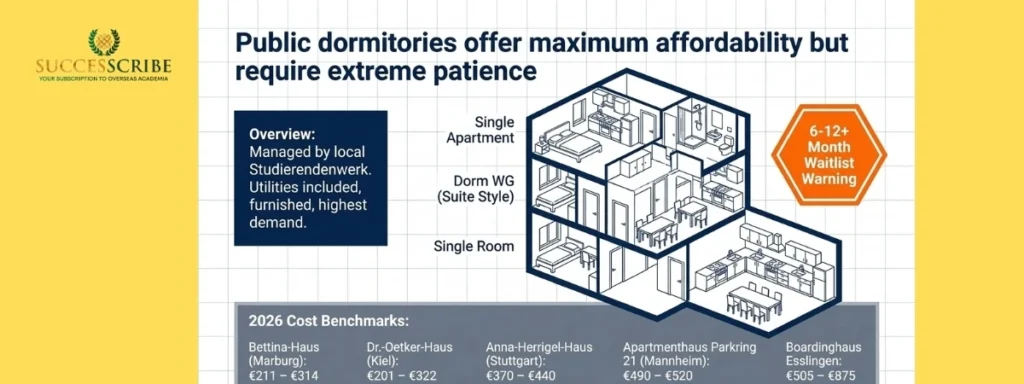
Public dormitories represent the most affordable and structurally supported choice among all student accommodation options in germany. These complexes are operated by the Studierendenwerk (the regional non-profit student services organization tied to your university area). In cities like Munich or Berlin, the waiting list can span two or three semesters.
- Lowest market rates
- Furnished options
- Utilities included in rent
- High demand / Waitlists
The Cost Structure
Rents in public dormitories are structured as all-inclusive flat rates, meaning heating, water, electricity, and high-speed internet are folded into a single monthly payment. On average, a room in a public dormitory ranges from €250 to €450 per month, depending on the city, building age, and layout type (e.g., a single room with a shared corridor kitchen vs. a self-contained studio).
To give you a sense of the budget required, here are representative costs from the 2026 Studierendenwerk database:
- Bettina-Haus (Marburg): €211 – €314 per month.
- Carl-Ludwig-Haus (Marburg): Approximately €225 per month.
- Dr.-Oetker-Haus (Kiel): €201 – €322 per month.
- Anna-Herrigel-Haus (Stuttgart): €370 – €440 per month.
- Apartmenthaus Parkring 21 (Mannheim): €490 – €520 per month.
- Boardinghaus Esslingen (Esslingen): €505 – €875 per month
Popular Room Configurations
- Single Room in a Shared Corridor: You have a private bedroom, but share a large kitchen and bathroom facilities with multiple students on the same floor.
- Dorm WG (Suite Style): A built-in apartment within the dormitory where 2 to 5 students share a specific kitchen and bathroom.
- Single Apartments: A completely private studio featuring an integrated kitchenette and an attached bathroom.
Step-by-Step: Student Dormitory Germany How to Apply
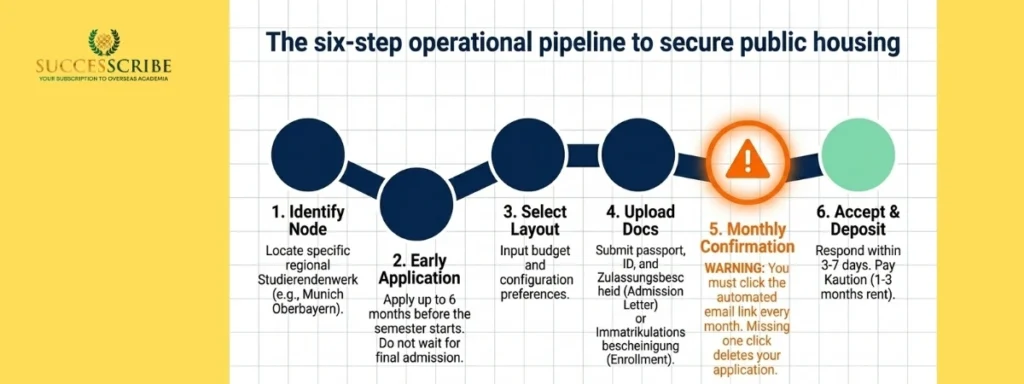
Because demand heavily outweighs supply, securing a spot requires strict adherence to institutional timelines. You do not need to wait for a final admission letter to begin your initial registration with some student unions.
Here is exactly how to manage the student dormitory germany how to apply process:
- Identify Your Regional Office: Locate the specific Studierendenwerk webpage associated with your host university (e.g., Studierendenwerk München Oberbayern for Munich or Studierendenwerk Berlin for Berlin).
- Submit an Online Application Early: Navigate to their housing portal. You can submit an initial application up to six months before your semester begins. Do not delay this step; waitlists routinely range from one to three semesters in high-demand areas like Frankfurt, Munich, and Cologne.
- Select Your Layout Preferences: Choose your preferred housing styles (e.g., shared flat, single room, studio) and input your maximum target budget.
- Upload Required Verification Documents: You will need to upload your formal university admission letter (Zulassungsbescheid) or your enrollment certificate (Immatrikulationsbescheinigung), along with a valid copy of your passport or ID.
- Confirm Your Waitlist Status Regularly: Many regional portals require you to click a confirmation link sent via automated email every month to maintain your active spot on the waitlist. Missing a single confirmation will result in your application being deleted from the system.
- Accept the Formal Offer: If a room opens up, you will receive an official offer via email. These offers usually come with a short response window (often 3 to 7 days). You must sign the lease agreement digitally and transfer the initial security deposit (Kaution) – which typically equals 1 to 3 months of base rent – to secure the room.
Suggested Post: German student visa checklist
Shared Private Apartments (WG – Wohngemeinschaft)
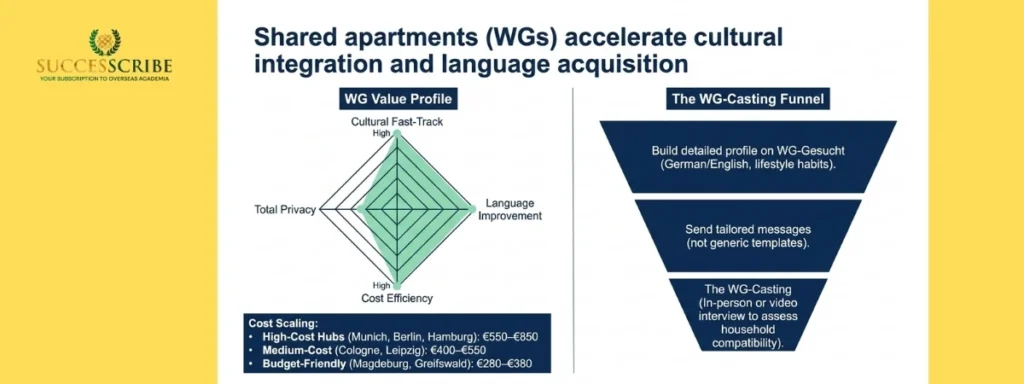
If public dormitories are full, the most culturally integrated selection among alternative student accommodation options in germany is the Wohngemeinschaft, universally known as a WG. In this setup, several students team up to rent a large private flat, or an existing tenant sublets an extra bedroom.
The Cost Breakdown
In a shared apartment, expenses like rent, internet, electricity, and gas are divided among the roommates. The private student housing germany cost within a WG scales significantly based on geographical location:
- High-Cost Hubs (Munich, Berlin, Frankfurt, Hamburg): Expect to pay between €550 and €850 per month for a furnished bedroom.
- Medium-Cost Cities (Cologne, Stuttgart, Leipzig, Aachen): Average rates hover between €400 and €550 per month.
- Budget-Friendly Locations (Magdeburg, Chemnitz, Greifswald): A comfortable room can often be found for €280 to €380 per month.
Key Advantages of WG Living
- Cultural Fast-Track: You learn German slang, social cues, and “the German way” of living (like proper waste separation) much faster.
- Cost Efficiency: While a WG is slightly more expensive than a dorm, it is far cheaper than a private flat. You split the “Nebenkosten” (ancillary costs) like internet, electricity, and even basic staples like salt and cleaning supplies.
- Language Improvement: Daily interaction with German-speaking flatmates is the most effective “language course” you can get.
How to Find and Apply for a WG
The undisputed primary platform for finding shared housing is WG-Gesucht. To stand out in a competitive market, construct a detailed profile written clearly in either German or English. Explain who you are, what you are studying, your lifestyle habits, and your past experiences living in shared environments
Once an existing WG likes your profile, they will invite you to an interview called a WG-Casting. This meeting is designed to check your compatibility with the household. These interviews can be conducted in person or via video calls for international students moving from abroad.
Private Studios and Premium Managed Housing
For students with a more flexible budget or those who require housing security before they even board their flight, the rise of purpose-built student housing (PBSA) is a game-changer. These properties, such as those operated by providers like Amber or UniAcco, offer a streamlined booking process that is much more familiar to international students.
When evaluating private student housing germany cost, you are paying for convenience. These units are almost always fully furnished and located in prime districts.
- Higher availability
- Modern fitness centers
- Private kitchen & bath
- All-inclusive premium billing
Representative Private Housing Costs
| Property Name | City | Price Range per Month | Features |
| Wilde Checkpoint Charlie | Berlin | €1,130 – €1,375 | City Center, High-End |
| Urbanum | Frankfurt | €908 – €1,361 | Near Financial District |
| Alvarium | Frankfurt | €884 – €1,084 | Bockenheim area, Modern |
| Navale | Hamburg | €709 – €1,029 | Vibrant Wandsbek district |
| Elementum | Darmstadt | €585 – €859 | Tech Hub proximity |
| Alfred-Jung-Straße | Berlin | €619 – €1,249 | Lichtenberg, Renovated |
| Georg-Voigt-Straße | Frankfurt | €545 – €730 | Budget-friendly private |
Essential Security Protections: Spotting Rental Scams

The high demand for private rentals makes international students prime targets for online housing fraud. To protect yourself and your finances, follow these strict security rules:
- Never Wire Money Upfront: Do not transfer a security deposit or the first month’s rent before you have signed a legally binding lease agreement and physically seen the property (or had a trusted contact verify it).
- Avoid Western Union and Cash Transfers: Scammers regularly request untraceable transfer methods. Always use secure, standard European bank transfers (IBAN) that leave a legal paper trail.
- Be Skeptical of “Too Good to Be True” Listings: A spacious, fully furnished studio apartment located in central Berlin or Munich listed for just €400 is almost certainly a scam.
- Verify Identity Papers Carefully: Be cautious of listings where the self-proclaimed landlord claims they are currently out of the country and promises to mail you the front door keys only after receiving an advance payment.
Suggested Post: Benefits of German language course
Comprehensive Student Housing Comparison Matrix
To help you evaluate the various student accommodation options in germany, this table compares pricing, privacy, waiting times, and legal registration eligibility for 2026.
| Accommodation Type | Average Monthly Cost (Warm) | Privacy Level | Average Wait Time | Anmeldung Eligible? | Target Student Profile |
| Public Dormitory (Studierendenwerk) | €250 – €450 | Low to Medium | 6 to 12+ Months | Yes | Budget-focused students who plan far in advance. |
| Shared Private Flat (WG) | €400 – €850 | Medium | 1 to 3 Months | Yes (Confirm with main tenant) | Socially active students looking to integrate locally. |
| Private Studio / Managed Housing | €750 – €1,300+ | High | 1 to 4 Weeks | Yes | Students with a flexible budget who prioritize privacy. |
| Student Hostel (Temporary) | €300 – €600 (calculated per week) | Very Low | None (Instant Booking) | No | Arriving students needing a base camp for property viewings. |
Understanding the German Housing Market Terminology
When analyzing student accommodation options in germany, you will frequently encounter specific rental terms. Knowing the difference between these terms prevents unexpected financial surprises:
- Kaltmiete (Cold Rent): This is the base cost of renting the physical space itself, excluding all utilities, heating, and building maintenance fees.
- Warmmiete (Warm Rent): This is the total monthly amount paid to the landlord. It includes the Kaltmiete plus operating costs (Nebenkosten), such as heating, water, trash collection, and building management.
- Nebenkosten (Additional/Operating Costs): Variable monthly fees for shared building services. Crucial note for 2026: Internet access, electricity, and the mandatory German broadcasting fee (Rundfunkbeitrag) are typically not included in the Warmmiete for private apartments and must be factored into your budget separately.
Why Finding Accommodation in Germany is Challenging in 2026
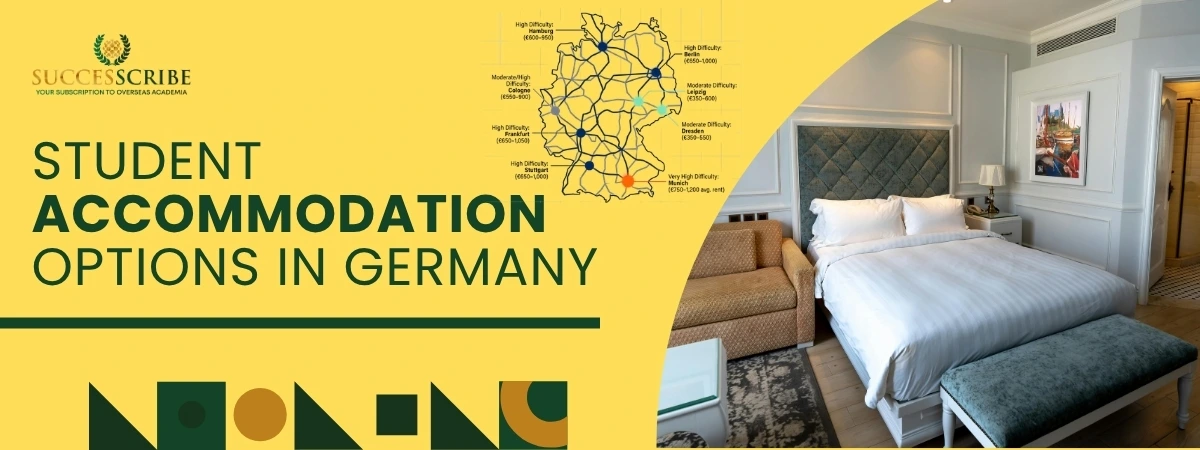
The German housing market has become increasingly competitive over the past few years. Rising student enrollment, urban migration, and limited residential construction in major cities have contributed to accommodation shortages.
According to data from Destatis (Germany’s Federal Statistical Office), Germany continues to attract a growing number of international students, creating significant demand for affordable student housing. Simultaneously, university cities are experiencing rising rental prices due to increased population growth.
Students often encounter waiting periods ranging from several weeks to multiple semesters when applying for university-managed housing.
Housing Difficulty and Average Rent in Major German Cities
| City | Housing Difficulty | Average Monthly Rent (€) |
| Munich | Very High | 750–1,200 |
| Berlin | High | 650–1,000 |
| Hamburg | High | 600–950 |
| Frankfurt | High | 650–1,050 |
| Cologne | Moderate to High | 550–900 |
| Stuttgart | High | 650–1,000 |
| Leipzig | Moderate | 350–600 |
| Dresden | Moderate | 350–550 |
Students planning to study in major cities should begin their accommodation search at least three to six months before arrival.
The good news is that various student accommodation options in Germany cater to different budgets and lifestyles. Understanding these options can help students secure housing more efficiently.
Suggested Post: Best studienkolleg in Germany
Comparative Analysis: Student Hostel vs. Apartment Germany
When moving to a new city, you may need to choose between a temporary budget stay or jumping straight into a long-term rental contract. Understanding the functional differences between a student hostel vs apartment germany is essential for managing your budget and timeline.
| Student Hostel | Appartment |
| Short-term flexible stay | Long-term legal home |
| Shared bunk rooms | Private kitchen/bath |
| Daily/Weekly payments | Fixed 1-2 year contract |
| No City Registration | Allows “Anmeldung” |
Key Differences Defined
Hostels function as short-term, daily or weekly hospitality spaces. They feature open bunk rooms, shared hallway bathrooms, and a lack of private storage space. They are highly useful as a temporary launching pad during your first two weeks in the country while you attend local housing viewings.
In contrast, a formal apartment is a long-term residential property that requires a signed contractual commitment (usually 1 to 2 years) and an upfront security deposit.
The Registration Factor (Anmeldung)
The most critical distinction when weighing a student hostel vs apartment germany is your eligibility for Anmeldung (the mandatory official address registration with the local city hall). Under German federal law, you must register your residential address within 14 days of moving into a home.
You cannot complete this process without a landlord’s signed confirmation certificate (Wohnungsgeberbestätigung). A standard student hostel cannot provide this long-term legal certificate. Without your Anmeldung, you cannot obtain your German tax ID, open a traditional local bank account, or finalize your student residence permit at the immigration office. Therefore, finding an actual apartment or WG room that offers Anmeldung must be your top long-term priority.
Strategic Roadmap: Securing Your Housing from Abroad
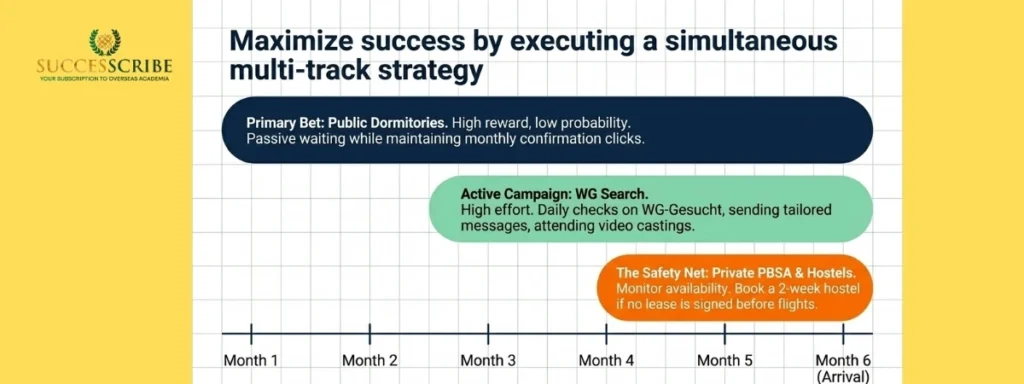
Landing a room within the diverse landscape of student accommodation options in germany requires an organized timeline. Use this step-by-step roadmap to guide your search:
| Timeline | Priority Action | Practical Steps & Strategy |
| 5 – 6 Months Out | Dorm Registration | Apply to your local Studierendenwerk portal immediately. Do not wait for your final university admission letter to get on the waitlist. |
| 3 – 4 Months Out | Document Prep & Alerts | Compile your application PDF (Passport, Visa/Admission letter, Blocked Account proof). Set up daily email alerts on WG-Gesucht and ImmobilienScout24. |
| 1 – 2 Months Out | Active Outreach & Interviews | Send tailored messages to WG listings. Arrange online video interviews (WG-Castings). Never wire money upfront without a verified, signed lease. |
| 4 Weeks Out | Fallback Security | If no long-term lease is signed, book a 2-week stay at a local student hostel. This gives you a safe home base to conduct vital, safe in-person viewings. |
| Arrival Week | Legalization | Move in, sign the lease, collect your Wohnungsgeberbestätigung (landlord confirmation), and visit City Hall within 14 days for your mandatory Anmeldung (address registration). |
Conclusion
Navigating student accommodation options in germany in 2026 is undoubtedly a challenge, but it is one that can be mastered with early preparation and a strategic mindset. Whether you are aiming for the high-energy streets of Berlin, the academic prestige of Munich, or the affordable charm of Marburg, the rules of the game remain the same: speed, documentation, and persistence.
We strongly advise our students to pursue a multi-track strategy. Apply for the Studierendenwerk dormitories immediately, but do not rely on them. Simultaneously build your “Search Folder” for WGs and keep an eye on private providers like Wilde or Alvarium for a secure fallback. Utilizing official resources like the DAAD and your university’s International Office (Akademisches Auslandsamt) will provide the expert edge you need.
Germany offers a life-changing educational experience and a gateway to a global career. Finding your home is the first, and perhaps most important, test of your independence. Approach it with the professionalism it deserves, and your transition to German life will be seamless.
FAQs
How early should I apply for a student dormitory?
Immediately upon receiving your admission letter. Some cities even allow you to apply before admission, though this is rare.
What is the average price of a private student apartment?
According to the private student housing germany cost analysis for 2026, prices range from €545 to over €1,300 depending on the city and luxury level.
Can I register my official address (Anmeldung) if I live in a student hostel or Airbnb?
Generally, no. Under German law, you must complete your Anmeldung (city registration) within 14 days of moving in. This requires a legally signed landlord confirmation certificate (Wohnungsgeberbestätigung). Standard tourist hostels, hotels, and most short-term vacation rentals cannot issue this document. You will need a formal room contract in a public dormitory, private apartment, or a verified long-term WG to register.
How do I avoid rental scams if I am applying for private housing from abroad?
Follow the golden rule of German real estate: Never transfer money before you have a signed, legally binding contract and have verified the property. Scammers often create fake listings using stolen photos and request upfront deposits via untraceable methods (like Western Union or cash apps). Always use standard European SEPA bank transfers (IBAN) which leave a traceable paper trail, and if a deal looks too cheap for a major city center, treat it as a red flag.
What is the difference between “Kaltmiete” and “Warmmiete”?
Kaltmiete (Cold Rent): The base price of renting the physical four walls of the apartment, completely excluding utilities.
Warmmiete (Warm Rent): The total monthly amount you pay to the landlord. It includes the base rent plus basic building utilities (Nebenkosten) like heating, water, and trash disposal.
Important Note: For private apartments, electricity and home internet are frequently not included in the Warmmiete and must be set up with external providers by the tenant.
Related Post
Cost of living in Germany city wise comparison
German spouse visa for Indian students
Germany blue card for Indian professionals
Germany Work Permit After Study