The MEXT Scholarship for Indian students (Monbukagakusho Scholarship) is a fully funded flagship award funded by the Government of Japan’s Ministry of Education, Culture, Sports, Science and Technology. Established in 1954 to foster international exchange and academic collaboration, MEXT covers 100% of university tuition fees, provides free round-trip international air travel, and pays a monthly stipend to cover all living expenses in Japan.
For Indian candidates, this scholarship opens doors to Japan’s top institutions, including the University of Tokyo, Kyoto University, Tokyo Institute of Technology, Osaka University, and Tohoku University. Because Japanese state universities feature research facilities and technology transfer programs, securing the MEXT Scholarship for Indian students eliminates the financial barrier of studying abroad.
Key Highlights: MEXT Scholarship for Indian Students
- 100% Fully Funded: Zero tuition or admission fees, plus fully covered round-trip economy air travel between India and Japan.
- Monthly Allowance: A tax-free living stipend of ¥117,000-¥145,000/month (₹68,800-₹85,300) depending on your study level.
- Clear Age Limits: Under 25 years for Undergraduate/KOSEN (80%+ marks); under 35 years for Master’s/Ph.D. (65%-70%+ marks).
- No Japanese Required: Prior fluency is not compulsory – selected scholars receive 6 to 12 months of free language prep in Japan.
- Two Entry Tracks: Apply via the Embassy Route (April-May intake window) or directly via a Japanese University Nomination.
- 3-Stage Selection: Evaluation based on Document Screening, Written Exams (Math, Science, English/Japanese), and an Embassy Interview.
- Fast-Track PR & Careers: Graduates gain direct access to Japan’s tech and industrial job market, qualifying for Permanent Residency in 1 to 3 years via the points system.
What Does the MEXT Scholarship Cover & How Much Stipend Will You Get?
The primary advantage of the MEXT Scholarship for Indian students is its comprehensive, zero-cost structure. Selected scholars do not need to take out education loans or block funds in bank accounts.
Monthly Allowance & Funding Details
Note on Currency Conversion: Conversion rates fluctuate, but for reference, ¥1 JPY is approximately ₹0.58 – 0.59 INR in 2026.
| Program Level | Monthly Allowance (JPY) | Approx. Monthly Allowance (INR) | Duration Covered |
| Undergraduate Students | ¥117,000 | ₹68,800 | 5 Years (incl. 1 yr Japanese prep) |
| College of Technology (KOSEN) | ¥117,000 | ₹68,800 | 4 Years (incl. 1 yr Japanese prep) |
| Specialized Training College | ¥117,000 | ₹68,800 | 3 Years (incl. 1 yr Japanese prep) |
| Research Students (Non-degree) | ¥143,000 | ₹83,100 | 1.5 to 2 Years |
| Master’s Degree Students | ¥144,000 | ₹84,700 | 2 Years |
| Doctoral (Ph.D.) Students | ¥145,000 | ₹85,300 | 3 Years |
Regional Allowance: Students residing in specially designated regions subject to severe winter conditions or high living costs receive an additional regional stipend top-up of ¥2,000 to ¥3,000 per month.
Additional Included Allowances
- 100% Tuition Fee Exemption: Entrance examination fees, matriculation fees, and tuition fees at national, public, or participating private universities are waived or paid directly by MEXT.
- Travel Allowance: An economy class air ticket is provided from the nearest international airport in India (e.g., New Delhi, Mumbai, Kolkata, Chennai, Bengaluru) to Narita/Haneda or Kansai International Airport. A return air ticket is provided upon successful completion of the course.
- Preparatory Language Training: Fully paid 6-month to 1-year intensive Japanese language course at a designated preparatory institute prior to entering the formal degree program.
Am I Eligible for the MEXT Scholarship? (Age & Qualification Limits)
The MEXT Scholarship for Indian students is split across distinct categories tailored to different educational milestones.
| Scholarship Category | Maximum Age Limit | Minimum Academic Qualification | Japanese Language Requirement |
| Research Students (Master’s / Ph.D.) | Under 35 years (Born on/after April 2, 1992) | Bachelor’s degree (60%+ in STEM, 65%+ in Humanities) | Not mandatory at application; desire to learn required. |
| Undergraduate (UG) | Under 25 years (Born on/after April 2, 2002) | 12th Grade / Senior Secondary Pass (80%+ aggregate) Note for UG: If results are pending, a certificate from your Principal predicting 80%+ is mandatory. | Willingness to study Japanese during prep year. |
| College of Technology (KOSEN) | Under 25 years (Born on/after April 2, 2002) | 11th or 12th Grade Pass with Mathematics and Physics | High interest in practical engineering and Japanese. |
| Specialized Training College (STC) | Under 25 years (Born on/after April 2, 2002) | 12th Grade Pass in relevant stream | High motivation for vocational Japanese immersion. |
| Teacher Training Students | Under 35 years | Graduate of teacher training facility + 5 yrs experience | Must be willing to conduct pedagogical research in Japanese. |
| Young Leaders Program (YLP) | Under 40 years | Bachelor’s degree + 3-5 yrs public administration work | English medium; leadership background mandatory. |
Specific Requirements for Indian Applicants
- Nationality: Applicants must hold valid Indian citizenship. Individuals holding dual citizenship with Japan are ineligible.
- Health: Candidates must submit a certified Certificate of Health signed by a registered medical practitioner confirming mental and physical fitness for abroad study.
- Academic Record: Consistently high marks across Class 10, Class 12, and undergraduate semesters.
Suggested Post: Japan study visa requirements for Indians
Should You Apply via the Japanese Embassy or a University Track?
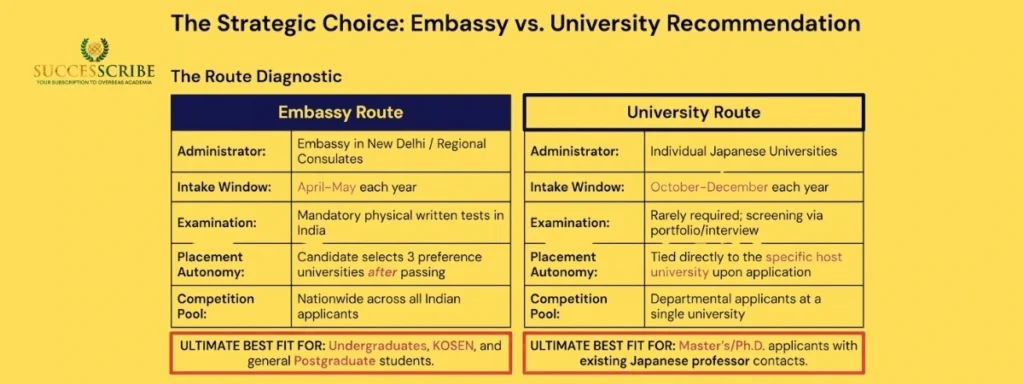
Indian candidates can pursue the MEXT Scholarship for Indian students through two distinct routes.
| Feature | Embassy Recommendation Route | University Recommendation Route |
| Primary Administrator | Embassy of Japan in New Delhi / Regional Consulates | Individual Japanese Universities (e.g., Tokyo, Kyoto) |
| Application Window | April – May each year | October – December each year |
| Written Examinations | Mandatory physical written tests in India | Rarely required; screening via portfolio/interview |
| Placement Process | Candidates select 3 preference universities after passing | Tied directly to the host university where you apply |
| Competition Pool | All applicants nationwide across India | Applicants applying to that specific university department |
| Best For | Undergraduate, KOSEN, and general Postgraduate students | Master’s/Ph.D. applicants with existing professor contacts |
How Do You Apply for the MEXT Scholarship? (Step-by-Step Guide & Documents)
Applying for the MEXT Scholarship for Indian students requires precise document preparation. Incomplete dossiers are rejected during the preliminary screening.
Precision is non-negotiable. MEXT has a “zero-tolerance” policy for incorrect formats. Check your submission route carefully.
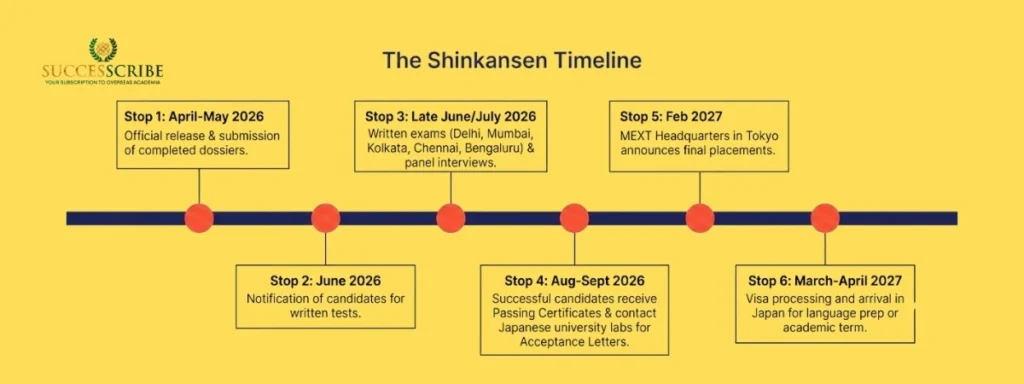
Step-by-Step Walkthrough (Embassy Track)
- Notification Monitoring: Check the official Embassy of Japan in India website around April every year for official announcements.
- Document Assembly: Prepare prescribed application forms, academic mark sheets, recommendation letters, and field of study plans.
- Preliminary Submission: Send hard copies or soft copies (as instructed by the embassy notification) before the specified deadline in May.
- First Screening (Written Test & Interview): Shortlisted candidates are called for written examinations and personal interviews in June/July.
- Provisional Selection & Placement: Successful first-screening candidates contact Japanese universities to obtain Provisional Letters of Acceptance.
- Second Screening: MEXT Headquarters in Tokyo reviews the embassy recommendations and confirms final university placements between December and February.
- Departure & Arrival: Visa processing takes place in March, with arrival in Japan scheduled for April or October.
Essential Document Checklist
Crucial Tip: All non-English/non-Japanese documents (like state board mark sheets in regional languages) must be accompanied by an official, notarized English translation.
- Official MEXT Application Form (Duly filled and signed)
- Field of Study and Research Program Plan (For Research candidates)
- Official Academic Transcripts for all completed years (10th, 12th, Bachelor’s, Master’s)
- Graduation Certificate or Degree Certificate (or Certificate of Expected Graduation)
- Recommendation Letter(s) from Dean, Principal, or Academic Supervisor
- Medical Health Certificate completed on the official MEXT template
- Abstracts of Thesis / Publications (If applicable, for Ph.D. / Master’s applicants)
- Language Proficiency Certificates (IELTS, TOEFL, or JLPT certificates, if available)
- Passport Copy (First and last page)
Track A: Research Students (Master’s/PhD)
- Submission Method: EMAIL ONLY to scholarship-india@nd.mofa.go.jp.
- CRITICAL WARNING: Your Preliminary Application must be in MS Word format only. Scanned PDFs, handwritten copies, or Google Drive links will result in immediate rejection.
- Documents: Preliminary Application Form, Research Plan (detailed), Certificate of Health.
Track B: UG / KOSEN / Specialized Training
- Submission Method: POST, COURIER, OR IN-PERSON ONLY. Email submissions are NOT accepted.
- Documents: Application form, 10th/12th Transcripts, Recommendation Letter (Principal/Dean), Certificate of Health.
Route B: University Recommendation (The “Second Chance”)
If rejected by the Embassy, you can apply directly to a Japanese university that has a MEXT quota. You must persuade a specific professor to recommend you. Note: You cannot apply for both tracks simultaneously.
Suggested Post: Study in Japan For Indian Students
How to Pass the MEXT Written Exams and Embassy Interview?
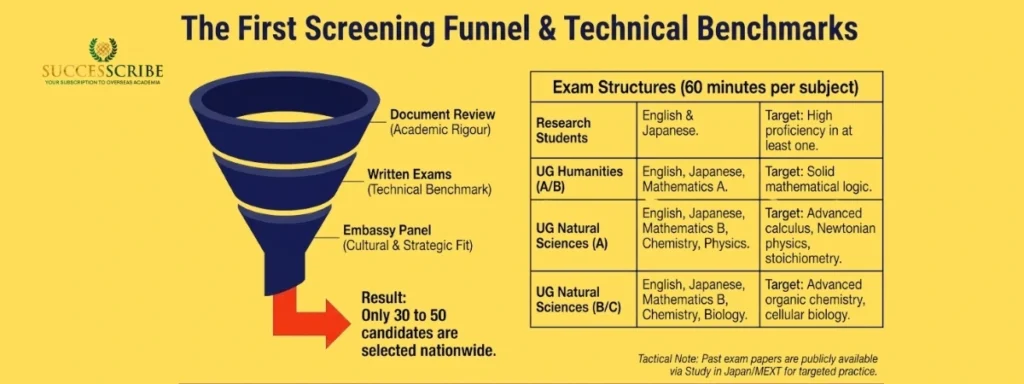
The first screening conducted by the Embassy of Japan in India determines who moves forward.
EMBASSY FIRST SCREENING STAGES
- Document Review (Academic Record)
- Written Exam(Math, Sci, Lang)
- Embassy Interview (Panel Screening)
Written Examination Structure
Written exams are designed to test foundational knowledge. Past exam papers are made publicly available by Study in Japan / MEXT for practice.
| Category | Tested Subjects | Duration per Subject | Target Benchmark |
| Research Students | English, Japanese | 60 Minutes | High proficiency in at least one language. |
| Undergraduate (Humanities – A/B) | English, Japanese, Mathematics A | 60 Minutes | Solid mathematical logic and English score. |
| Undergraduate (Natural Sciences – A) | English, Japanese, Mathematics B, Chemistry, Physics | 60 Minutes | Advanced calculus, Newtonian physics, stoichiometry |
| Undergraduate (Natural Sciences – B/C) | English, Japanese, Mathematics B, Chemistry, Biology | 60 Minutes | Advanced organic chemistry and cellular biology |
Embassy Interview Strategy
The interview panel consists of Japanese diplomats and academic experts. Questions assess four core dimensions:
- Academic Preparedness: Why is Japan necessary for your field of study instead of Indian institutions like IITs or IISc?
- Adaptability: How will you overcome culture shock, language barriers, and living independently in Japan?
- Research / Study Clarity: Can you articulate your proposed study topic without jargon in under 2 minutes?
- Bilateral Contribution: How will your studies strengthen India-Japan academic or industrial ties?
How to Write a Winning Research Proposal
For postgraduate candidates seeking the MEXT Scholarship for Indian students, the Research Proposal (Field of Study and Research Program Plan) carries the highest weight in evaluation.
STRUCTURE OF A COMPETITIVE RESEARCH PROPOSAL
- Project Title (Clear, Specific, Impact-driven)
- Background & Problem Statement (Gaps in current studies)
- Research Objectives & Methodology (Step-by-step approach)
- Why Japan? (Specific labs, equipment, or professors)
- Expected Outcomes & Impact on India-Japan Collaboration
Key Elements of a Strong Proposal
- Specific Focus: Avoid vague statements like “I want to study Artificial Intelligence.” Instead, focus on specific applications, such as “Optimization of Neural Network Architectures for Edge Computing in Autonomous Robotics.”
- Alignment with Japanese Expertise: Identify specific Japanese laboratories, professors, or ongoing research projects that align with your proposed study.
- Feasibility: Ensure your methodology can realistically be executed within a 2-year Master’s or 3-year Ph.D. timeframe.
Top Japanese Universities and Jurisdictions
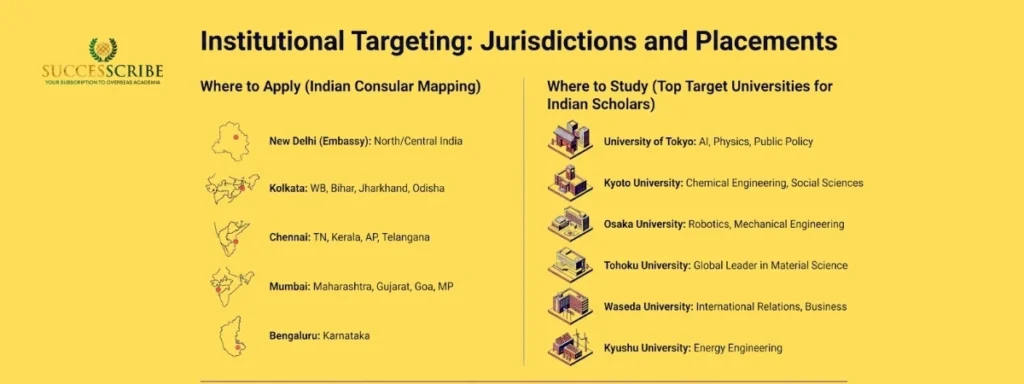
Where to Apply (Indian Jurisdictions)
| If you reside in… | Submit to… |
| North/Central India | Embassy of Japan, New Delhi |
| WB, Bihar, Jharkhand, Odisha | Consulate General, Kolkata |
| TN, Kerala, AP, Telangana | Consulate General, Chennai |
| Maharashtra, Gujarat, Goa, MP | Consulate General, Mumbai |
| Karnataka | Consulate General, Bengaluru |
Top Universities for Indian Scholars
- University of Tokyo: Public Policy, AI, Physics.
- Kyoto University: Chemical Engineering, Social Sciences.
- Osaka University: Robotics, Mechanical Engineering.
- Tohoku University: Material Science (Global Leader).
- Waseda University: International Relations, Business.
- Kyushu University: Energy Engineering.
MEXT Scholarship 2026/2027 Timeline & Important Dates
Understanding the timeline ensures you don’t miss application deadlines for the MEXT Scholarship for Indian students.
ANNUAL APPLICATION TIMELINE
| April – May | Official Application Release (Embassy Track) |
| June – July | Document Screening, Written Exams & Interviews |
| Aug – Sept | Passing First Screening & Contacting Uni Labs |
| Dec – Feb | Final Selection Approval by MEXT Tokyo |
| March – April | Visa Issuance & Departure for Japan |
Official Schedule for 2026-2027 Cycle
- April 2026: The Embassy of Japan in India opens the application window for the 2027 academic intake.
- May 2026: Deadline for submitting completed application packages to the embassy.
- June 2026: Notification of shortlisted candidates for written exams.
- Late June / July 2026: Written examinations conducted across designated cities in India (New Delhi, Mumbai, Kolkata, Chennai, Bengaluru).
- July 2026: Personal interviews for written-exam qualifiers.
- August 2026: Release of First Screening results. Successful applicants receive official Passing Certificates.
- August – September 2026: Candidates submit application files to selected Japanese universities to secure Provisional Placement / Acceptance Letters.
- February 2027: MEXT Tokyo announces final university placements and award confirmations.
- April 2027: Scholars depart for Japan to begin language prep or academic terms.
Alternative Japan Scholarships & Career Opportunities
If competition for the MEXT Scholarship for Indian students proves challenging, several alternative fully funded and partial funding options exist in Japan.
| Scholarship Program | Target Level | Stipend / Benefits | Key Eligibility |
| ADB-Japan Scholarship (ADB-JSP) | Master’s Degree | Full tuition + ¥140,000/mo stipend + Airfare | 2+ years work experience; citizens of ADB borrowing countries |
| JASSO Honors Scholarship | UG / Graduate | ¥48,000 per month | Enrolled international students with outstanding academic records |
| Mitsuibussan Scholarship | Undergraduate | Full tuition + ¥145,000/mo + Airfare | Under 20 years old; high academic standing in Science/Commerce |
| University-Specific Waivers | All Levels | 30% to 100% Tuition Fee Reduction | Merit-based academic evaluation at admission |
Post-Graduation Career Scope in Japan
Japan’s job market actively recruits international talent due to workforce shortages across tech, engineering, and business sectors.
- Work Visa Transition: MEXT graduates can convert their student visa directly into an “Engineer / Specialist in Humanities / International Services” work visa or a “Specified Skilled Worker” visa upon job offer confirmation.
- Fast-Track Permanent Residency: Scholars with a Master’s or Ph.D. degree qualify for Japan’s Highly Skilled Professional (HSP) points system, allowing them to apply for Permanent Residency in as little as 1 to 3 years.
- Top Hiring Sectors: Automotive (Toyota, Honda), Electronics & Robotics (Sony, Panasonic, Fanuc), IT & Software (Rakuten, Line, Mercari), and Semiconductor engineering.
Conclusion
Securing the MEXT Scholarship for Indian students is a life-changing academic milestone. Beyond providing complete financial independence – covering 100% of university tuition, international airfare, and a generous monthly stipend of up to ¥145,000 – it offers a direct gateway into Japan’s world-class research ecosystem, cutting-edge technology, and safe, vibrant culture.
Because the selection process is highly competitive, success relies on thorough preparation rather than chance alone.
FAQs
How do Research students submit their first application?
They must email only the MS Word preliminary form to scholarship-india@nd.mofa.go.jp. No other documents should be attached at this stage.
Is Japanese language proficiency compulsory for the MEXT Scholarship for Indian students?
No, Japanese language proficiency (such as JLPT) is not mandatory at the initial application stage for most STEM and English-medium tracks. However, demonstrating basic Japanese skills (N5/N4) shows motivation and enhances your application profile during embassy interviews.
Can 12th-grade students waiting for board results apply for Undergraduate MEXT?
Yes, students appearing for their final Class 12 exams can apply by submitting an “Expected Graduation Certificate” issued by their school principal. Final mark sheets must be submitted before departure.
What is the success rate for the MEXT Scholarship for Indian students?
The MEXT scholarship is highly competitive. Each year, the Embassy of Japan in India selects roughly 30 to 50 candidates across all categories (Research, Undergraduate, KOSEN, and STC combined) from thousands of applicants nationwide.
Are medical and dental courses covered under the Undergraduate category?
Yes, medical, dental, veterinary, and pharmaceutical fields are covered. However, these courses last 7 years in total (including 1 year of Japanese language preparation) instead of the standard 5-year duration.
Related Post:
Hardest degrees in the World
Toughest exams in the World
Highest-paying finance jobs
Entrance exam for UK universities