
Finance has long been one of the most lucrative career tracks in the world – and in 2026, that reputation is stronger than ever. As global markets grow more complex, demand for highly skilled finance professionals has surged across investment banking, private equity, risk management, and fintech. Whether you’re a student choosing a specialisation or a working professional planning your next move, knowing which roles actually pay the most – and what they demand – is essential. Many ambitious professionals are drawn to finance jobs that pay well because of their high earning potential and global opportunities.
This topic breaks down the highest paying finance jobs available today, complete with verified salary data, qualification requirements, and realistic career trajectories. We’ve also included a dedicated section on the highest paying entry level finance jobs for those just starting out.
Key Highlights: Highest Paying Finance Jobs
- Finance remains a top-paying career, with senior roles earning $500K to $1M+.
- Investment Banking, Private Equity, and Hedge Funds offer the highest salaries.
- Entry-level roles like IB Analyst and Quant Analyst start at $100K+.
- Bonuses and incentives often make up a major part of total pay.
- Private Equity & Hedge Funds create long-term wealth via carry/profit share.
- CFOs and senior leaders earn big through equity and stock options.
- Quant and fintech roles are rising fast due to A3I and data skills.
- Certifications like CFA, FRM, CPA boost salary and career growth.
- In India, top roles pay ₹50L to ₹3Cr+ annually.
- Key skills: Financial modelling, Python, data analysis, AI in finance.
Why Finance Careers Pay So Well
Finance professionals sit at the core of capital allocation – they decide where money flows, how risk is managed, and how companies grow. The stakes are high, the skillsets are rare, and the output is directly measurable in dollars. This creates a compensation structure unlike most industries: high base salaries, significant bonuses, and long-term incentives like carried interest or profit-sharing. The highest paying finance jobs are not just about money – they offer prestige, influence, and global exposure.
A few structural factors driving high pay in 2026:
- Talent scarcity: CFA, FRM, and CPA holders remain in short supply relative to demand.
- AI augmentation: Finance roles now require hybrid skills – quantitative depth plus data literacy.
- Global deal activity: M&A, PE buyouts, and infrastructure financing rebounded sharply in 2025 – 26
- Regulatory complexity: Risk and compliance roles have expanded across banks and asset managers.
Top 12 Highest Paying Finance Jobs
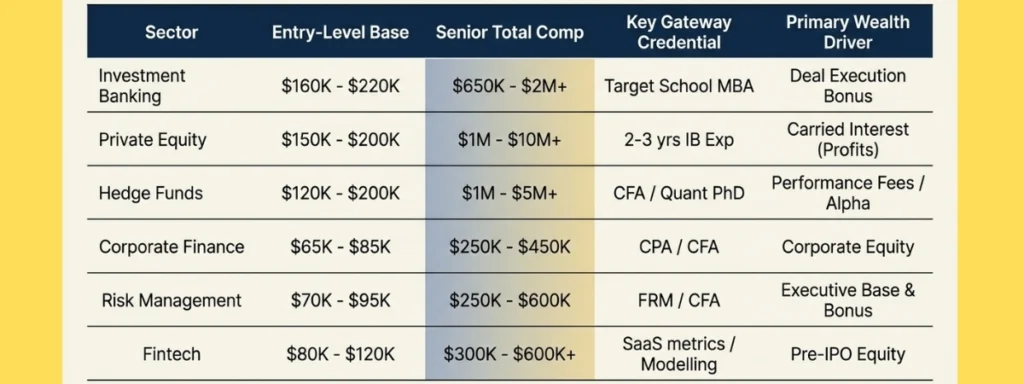
The highest paying finance jobs combine analytical expertise with strategic decision-making at the highest level. Below is a detailed breakdown of the best paying jobs in finance, including realistic salary ranges.
1. Investment Banker
- Average Base Salary (US): $120,000 – $200,000
- Total Compensation (with bonus): $250,000 – $500,000+
- Experience Level: Mid to Senior
Investment banking remains the flagship of best paying jobs in finance. IBankers advise corporations, governments, and institutions on mergers, acquisitions, IPOs, and capital raising. The work is demanding – 80-hour weeks are standard at bulge bracket firms – but the financial reward is unmatched at the junior and mid levels.
| Level | Base Salary (USD) | Bonus (USD) | Total Comp |
| Analyst (0-2 yrs) | $110,000 – $130,000 | $50,000 – $90,000 | $160,000 – $220,000 |
| Associate (3-5 yrs) | $175,000 – $225,000 | $100,000 – $200,000 | $275,000 – $425,000 |
| VP (6-9 yrs) | $250,000 – $300,000 | $200,000 – $350,000 | $450,000 – $650,000 |
| MD/Director | 400,000 | $500,000 – $1M+ | $900,000 – $2M+ |
- Required Qualifications: Bachelor’s in Finance, Economics, or Engineering; MBA from a target school for Associate-level entry
- Key Skills: Financial modelling, valuation, deal execution, client management
- Top Employers: Goldman Sachs, Morgan Stanley, JP Morgan, Lazard, Evercore
2. Private Equity Associate / Principal
- Average Total Compensation: $300,000 – $800,000+
- Experience Level: Mid to Senior
Private equity is where many investment bankers migrate after 2-3 years. PE professionals acquire companies, restructure them, and exit at a profit – a cycle that can take 5-7 years per deal. The real wealth in PE comes from carried interest – a share of the fund’s profits, typically 20% – which can generate millions for senior professionals on successful exits.
| Level | Base (USD) | Bonus (USD) | Carry (est.) |
| Associate | $150,000 – $200,000 | $100,000 – $150,000 | Minimal |
| Prinicipal | $250,000 – $350,000 | $200,000 – $300,000 | Moderate |
| Partner/MD | $500,000+ | $500,000+ | $1M – $10M+ |
- Required Qualifications: Investment banking experience (2-3 years minimum), MBA preferred for Principal and above
- Key Skills: LBO modelling, due diligence, portfolio management, deal sourcing
- Top Employers: Blackstone, KKR, Apollo, Carlyle, Bain Capital
3. Hedge Fund Manager / Portfolio Manager
- Average Total Compensation: $500,000 – $3,000,000+
- Experience Level: Senior
Hedge fund portfolio managers are among the highest-earning professionals on the planet. They manage investment strategies across equities, fixed income, derivatives, and alternative assets. Compensation is heavily performance-linked – a fund manager running a $500M book and generating 15% returns could earn $5M+ in a single year.
- Required Qualifications: CFA Charter, MBA, or PhD in quantitative fields; prior sell-side or asset management experience
- Key Skills: Portfolio construction, risk-adjusted return analysis, macroeconomic modelling
- Top Employers: Citadel, Bridgewater Associates, Two Sigma, D.E. Shaw, Man Group
Key Performance Metrics Linked to Pay:
- Fund AUM (Assets Under Management)
- Annual alpha generated vs. benchmark
- Sharpe ratio and drawdown management
4. Financial Officer (CFO)
- Average Base Salary (US): $250,000 – $450,000
- Total Compensation (with equity): $500,000 – $5,000,000+
- Experience Level: Executive
The CFO is the most senior finance job that pays well within a corporate structure. CFOs oversee all financial strategy – capital structure, investor relations, treasury, tax, and financial reporting. In large-cap companies, CFO packages include significant equity grants (RSUs and stock options) that dwarf the base salary.
| Company Size | Base Salary | Bonus | Equity/year | Total |
| Startup (Series B/C) | 200K | $50K – $100K | $200K – $500K | $450K – $900K |
| Mid-cap | $300K – $400K | $150K – $250K | $500K – $1M | $950K – $1.65M |
| Fortune 500 | $450K – $700K | $400K – $800K | $1M – $4M | $1.85M – $5.5M |
- Required Qualifications: CPA, CFA, or MBA; 15-20 years of progressive finance experience
- Key Skills: Strategic planning, capital markets, M&A oversight, financial reporting (GAAP/IFRS)
5. Quantitative Analyst (Quant)
- Average Total Compensation: $200,000 – $600,000+
- Experience Level: Entry to Senior
Quants are the mathematicians of Wall Street. They build pricing models, risk engines, and algorithmic trading strategies using advanced mathematics, statistics, and programming. In 2026, quant roles have expanded significantly into machine learning-driven trading and AI-based risk modelling.
| Level | Base (USD) | Bonus | Total |
| Junior Quant (0-3 yrs) | $120,000 – $160,000 | $40,000 – $80,000 | $160,000 – $240,000 |
| Mid-level (4-7 yrs) | $200,000 – $300,000 | $100,000 – $200,000 | $300,000 – $500,000 |
| Senior/Lead | $350,000 – $500,000 | $200,000 – $400,000 | $550,000 – $900,000 |
- Required Qualifications: Master’s or PhD in Mathematics, Statistics, Physics, or Financial Engineering; strong Python, R, or C++ skills
- Key Skills: Stochastic calculus, Monte Carlo simulation, machine learning, algorithmic trading
- Top Employers: Jane Street, Citadel Securities, Two Sigma, Renaissance Technologies, DE Shaw
6. Risk Manager / Chief Risk Officer (CRO)
- Average Base Salary: $130,000 – $300,000
- Total Compensation: $180,000 – $600,000+
- Experience Level: Mid to Senior
Risk management has become one of the most strategically important – and well-compensated – roles in financial services. The 2008 financial crisis and subsequent waves of regulatory reform (Basel III, DORA, Dodd-Frank) permanently elevated the status and pay of risk professionals. In 2026, with cyber risk, climate risk, and geopolitical volatility all on board agendas, CROs are indispensable.
- Required Qualifications: FRM (Financial Risk Manager) certification, CFA; experience in credit risk, market risk, or operational risk
- Key Skills: VaR modelling, stress testing, regulatory reporting, scenario analysis
- Top Employers: Major commercial banks (Citi, HSBC, BofA), insurance conglomerates, asset managers
7. Actuary
- Average Base Salary (US): $120,000 – $200,000
- Total Compensation: $140,000 – $280,000
- Experience Level: Entry to Senior
Actuaries are among the most consistently well-paid professionals in finance and insurance. They assess financial risk using probability and statistics – pricing insurance products, calculating pension liabilities, and stress-testing reserves. The U.S. Bureau of Labor Statistics projects actuary employment to grow 22% between 2022 and 2032, far above average.
| Credential Level | Average Salary (USD) |
| Exam 1-3 Passed | $70,000 – $95,000 |
| Associate (ASA/ACAS) | $100,000 – $145,000 |
| Fellow (FSA/FCAS) | $150,000 – $250,000+ |
| Chief Actuary | $250,000 – $400,000 |
- Required Qualifications: Actuarial exams (SOA or CAS pathway); Bachelor’s in Actuarial Science, Math, or Statistics
- Key Skills: Statistical modelling, pricing, reserving, experience studies
8. Corporate Finance Director / VP of Finance
- Average Total Compensation: $180,000 – $450,000
- Experience Level: Mid to Senior
Corporate finance roles within large organisations – VP of Finance, Finance Director, Head of FP&A – represent the upper tier of finance jobs that pay well in non-banking sectors. These professionals lead budgeting, forecasting, treasury operations, and strategic financial planning.
- Required Qualifications: CPA, CFA, or MBA; 8-12 years of finance experience
- Key Skills: Financial planning & analysis (FP&A), M&A integration, ERP systems (SAP, Oracle), business partnering
9. Financial Advisor / Wealth Manager (Senior)
- Average Total Compensation: $120,000 – $500,000+
- Experience Level: Mid to Senior
Senior wealth managers and private bankers managing HNI (High Net Worth Individual) portfolios earn compensation that scales directly with AUM and client retention. The top quartile of financial advisors at major wirehouses (Merrill Lynch, Morgan Stanley Wealth, UBS) regularly earn $500K+ annually.
| AUM Range | Typical Annual Revenue | Advisor Comp (40% payout) |
| $50M – $100M | $500K – $1M | $200K – $400K |
| $100M – $500M | $1M – $5M | $400K – $2M |
| $500M+ | $5M+ | $2M+ |
- Required Qualifications: CFP (Certified Financial Planner), Series 7 & 66 licenses; CFA for investment advisory
- Key Skills: Portfolio management, estate planning, client relationship management, tax strategy
10. Commercial Banker / Corporate Banker (Senior)
- Average Total Compensation: $120,000 – $350,000
- Experience Level: Mid to Senior
Senior commercial and corporate bankers manage large credit relationships, structure complex lending deals, and cross-sell treasury and capital markets products. At the Managing Director level in large banks, total comp routinely exceeds $300,000.
- Required Qualifications: Bachelor’s in Finance or Accounting; MBA or CFA for senior roles
- Key Skills: Credit analysis, relationship management, loan structuring, cash flow modelling
11. Compliance Officer / Chief Compliance Officer (CCO)
- Average Total Compensation: $130,000 – $500,000+
- Experience Level: Mid to Senior
In 2026, compliance has shifted from a back-office function to a strategic imperative. With expanding regulatory frameworks across the EU, US, and Asia, CCOs at large financial institutions command packages comparable to front-office professionals.
- Required Qualifications: JD, CPA, or CAMS (Certified Anti-Money Laundering Specialist); financial services experience
- Key Skills: Regulatory interpretation, AML/KYC, internal controls, governance frameworks
12. Fintech Product Finance Lead / Head of Finance (Fintech)
- Average Total Compensation: $150,000 – $400,000
- Experience Level: Mid to Senior
The fintech sector – payments, embedded finance, crypto infrastructure, and insurtech – has created a new class of high-paying finance roles that blend traditional expertise with product and data skills. Finance leads at late-stage fintech startups often receive significant equity packages that can substantially increase total wealth upon IPO or acquisition.
- Required Qualifications: CPA, CFA, or MBA; experience in SaaS metrics, unit economics, or financial modelling for tech companies
- Top Employers: Stripe, Razorpay, Plaid, Brex, Revolut, Zepto (India)
Suggested Post: Best place to study in USA
Highest Paying Entry Level Finance Jobs
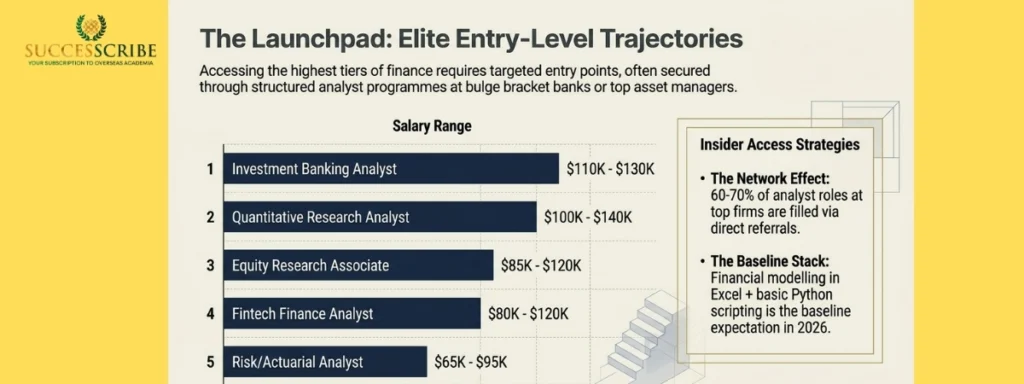
For those starting their careers, several roles offer strong starting salaries – particularly if you enter through a structured analyst programme or with a relevant certification.
| Role | Starting Salary (USD) | Key Credential | Growth Path |
| Investment Banking Analyst | $110,000 – $130,000 | Bachelor’s (target school) | Associate → VP → MD |
| Quantitative Research Analyst | $100,000 – $140,000 | MS/PhD in STEM | Senior Quant → PM |
| Actuarial Analyst | $65,000 – $90,000 | 2-3 SOA/CAS exams passed | ASA → FSA → Chief Actuary |
| Financial Analyst (Corp. Finance) | $65,000 – $85,000 | CFA Level 1, Bachelor’s | FP&A Manager → Director |
| Risk Analyst | $70,000 – $95,000 | FRM Part 1, Bachelor’s | Risk Manager → CRO |
| Credit Analyst | $65,000 – $85,000 | CFA Level 1 | VP Credit → Credit Director |
| Audit Associate (Big 4) | $65,000 – $80,000 | CPA candidate | Manager → Partner |
| Equity Research Associate | $85,000 – $120,000 | CFA progress | Senior Analyst → PM |
| Insurance Underwriter | $60,000 – $80,000 | CPCU designation | Senior Underwriter → Actuary |
| Compliance Analyst | $65,000 – $85,000 | CAMS, JD | CCO track |
Tips to Land the Highest Paying Entry Level Finance Jobs
- Target analyst programmes at bulge bracket banks, Big 4 firms, or top asset managers – these are the fastest tracks to high total compensation
- Certifications matter early: CFA Level 1 pass, FRM Part 1, or passing 2-3 actuarial exams dramatically improve starting salary offers.
- Network on LinkedIn: 60-70% of analyst roles at top firms are filled through referrals.
- Master Excel and Python: In 2026, financial modelling in Excel combined with basic Python scripting is the baseline expectation for entry-level roles.
Salary Comparison: Finance Jobs by Sector
| Sector | Entry Level | Mid Level | Senior Level |
| Investment Banking | $160K – $220K | $275K – $425K | $650K – $2M+ |
| Private Equity | $150K – $200K | $300K – $550K | $1M – $10M+ |
| Hedge Funds | $120K – $200K | $300K – $600K | $1M – $5M+ |
| Corporate Finance | $65K – $85K | $120K – $200K | $250K – $450K |
| Commercial Banking | $60K – $80K | $100K – $180K | $200K – $350K |
| Risk Management | $70K – $95K | $130K – $200K | $250K – $600K |
| Insurance/Actuarial | $65K – $90K | $100K – $160K | $200K – $400K |
| Fintech | $80K – $120K | $150K – $250K | $300K – $600K+ |
Most In-Demand Finance Certifications (and Their Salary Impact)
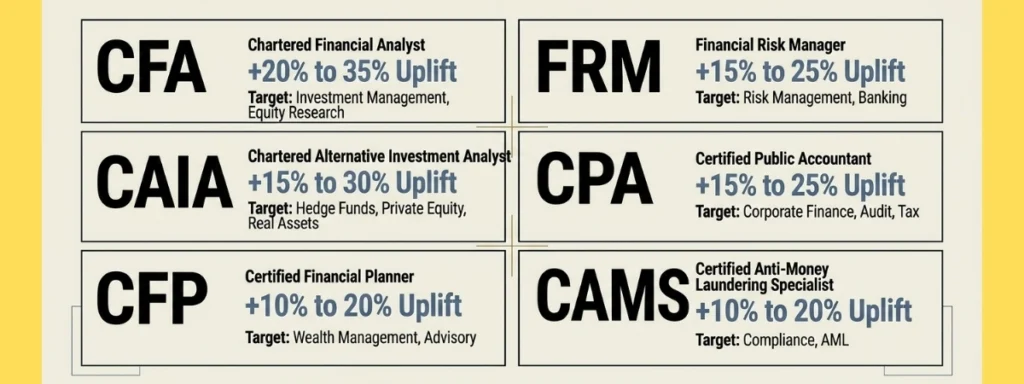
Certifications are one of the most reliable ways to access best paying jobs in finance, regardless of the prestige of your undergraduate institution.
| Certification | Full Form | Avg. Salary Uplift | Best for |
| CFA | Chartered Financial Analyst | +20% – 35% | Investment management, equity research |
| FRM | Financial Risk Manager | +15% – 25% | Risk management, banking |
| CPA | Certified Public Accountant | +15% – 25% | Corporate finance, audit, tax |
| CFP | Certified Financial Planner | +10% – 20% | Wealth management, advisory |
| CAIA | Chartered Alternative Investment Analyst | +15% – 30% | Hedge funds, PE, real assets |
| CAMS | Certified Anti-Money Laundering Specialist | +10% – 20% | Compliance, AML |
| FCA/ACCA | UK-based accountancy qualifications | +10% – 20% | Global roles, UK/EU markets |
Finance Careers in India: Salary Context
For Indian professionals, finance careers – both domestic and international – offer substantial earning potential. Here’s a realistic snapshot of senior finance role salaries in India.
| Role | Average CTC (INR/year) |
| Investment Banker (VP) | ₹40L – ₹1.2Cr |
| CFO (Large Corporate) | ₹80L – ₹3Cr+ |
| Risk Manager (Senior) | ₹25L – ₹60L |
| Portfolio Manager | ₹30L – ₹1Cr |
| Quantitative Analyst | ₹25L – ₹80L |
| Compliance Head | ₹25L – ₹70L |
| Actuarial Fellow | ₹20L – ₹60L |
| Fintech Finance Lead | ₹30L – ₹90L |
Suggested Post: MBA salary in USA
Finance Jobs That Pay Well: Skills That Matter in 2026
The best finance jobs that pay well are found in investment banking, private equity, and fintech sectors. Beyond qualifications, the highest-paying finance professionals in 2026 share a specific skill profile:
Technical Skills
- Advanced financial modelling (3-statement, LBO, DCF)
- Python and SQL for financial data analysis
- Bloomberg Terminal and FactSet proficiency
- Risk system knowledge (Murex, Calypso, Moody’s Analytics)
Soft Skills
- Executive communication and board-level storytelling
- Cross-functional stakeholder management
- Commercial judgment – understanding business, not just numbers
- Adaptability to regulatory and market shifts
Emerging Skills (2026 specific)
As industries evolve, finance jobs that pay well are increasingly integrating technology, data, and AI.
- AI/ML model interpretation for financial applications
- ESG risk integration and reporting frameworks
- Digital asset and tokenised securities knowledge
- Cloud-based financial system architecture (AWS/Azure)
Conclusion
The finance industry offers some of the most rewarding career opportunities in 2026. From investment banking to fintech, the highest paying finance jobs provide not just high salaries but also strong career growth and global exposure.
Whether you are just starting or planning a career switch, focusing on high-demand skills, certifications, and the right specialization can significantly increase your earning potential.
If your goal is to secure one of the best paying jobs in finance, start early, stay updated with industry trends, and continuously upgrade your skills. The opportunities are vast – and the rewards are even bigger. The journey to landing finance jobs that pay well requires dedication, continuous learning, and smart career planning.
FAQs
Which finance job has the highest salary in 2026?
At the top end, hedge fund portfolio managers and private equity partners earn the most – often $1M to $10M+ annually when carried interest and performance fees are included. For salaried professionals with more defined compensation, CFOs of Fortune 500 companies and investment banking MDs are the highest earners.
Can you earn well in finance without an MBA?
Yes. The CFA is increasingly seen as equivalent to or better than an MBA for investment roles. Quants and actuaries rarely need MBAs. However, for investment banking and private equity above associate level, an MBA from a target school (Harvard, Wharton, LBS) remains the standard pathway.
What are the highest paying entry level finance jobs without prior experience?
Investment banking analyst programmes ($110K – $130K base) and quantitative research roles at trading firms ($100K – $140K) are the highest-paying for fresh graduates. Both require strong academics, financial modelling skills, and – for IB – a degree from a target school.
Is finance still a good career choice in the age of AI?
Absolutely. AI is augmenting finance roles, not replacing them wholesale. The professionals most at risk are those doing purely repetitive, rule-based tasks (basic bookkeeping, standard reporting). Roles requiring judgment, client relationships, regulatory interpretation, and complex modelling are growing – and paying more – precisely because AI makes the data-handling portions faster, freeing senior professionals to do higher-value work.
How long does it take to reach a $200K+ salary in finance?
In investment banking, this can happen within 2 – 3 years (Associate level). In corporate finance or commercial banking, expect 8 – 12 years. In quant finance with the right firm, 4 – 6 years. The fastest track to $200K+ is banking or trading.
Related Post
Engineering Management in Germany
Universities for engineering in Germany
Engineering management courses in USA
Aerospace engineering in USA