
The United Kingdom continues to be one of the most preferred destinations for international students in 2026. With globally ranked universities, internationally recognized degrees, advanced research opportunities, and strong career prospects, thousands of students apply to UK universities every year. However, gaining admission into top British universities often requires students to clear specific entrance exams depending on their chosen course and institution. Whether you are planning to pursue engineering, MBA, medicine, law, or undergraduate studies, understanding the entrance exam for UK universities is extremely important. Different universities and programs require different exams, and students must prepare strategically to secure admission.
According to recent higher education reports, the UK hosts more than 750,000 international students annually, and the number continues to rise due to the UK Graduate Route Visa and increasing employability opportunities. As competition increases, entrance exams have become a major factor in university selection and scholarship opportunities.
In this detailed topic, you will learn everything about UK university entrance exams, including MBA entrance exams in UK, UK entrance exam for Engineering, eligibility requirements, minimum scores, exam fees, preparation tips, and university-wise requirements.
Why UK Universities Require Entrance Exams: The Strategic Filter
A holistic review process now requires deeper data points than traditional transcripts can provide. Because global grading standards vary significantly, UK universities utilize entrance exams as a “strategic filter” to ensure academic readiness.
Universities rely on these assessments for several critical reasons:
- Handling Academic Rigor: Identifying students who can navigate the intensive, research-led curriculum of a Russell Group institution.
- Differentiating High-Achieving Applicants: Providing a secondary layer of assessment when thousands of applicants present identical top-tier predicted grades.
- Assessing Specific Cognitive Skills: Evaluating high-level Verbal Reasoning, Mathematical Logic, and Critical Thinking – traits that correlate more strongly with university success than rote memorization.
Academic transcripts alone no longer suffice; therefore, the standardized Entrance Exam for UK Universities acts as a crucial strategic filter to measure global applicants against a uniform academic yardstick. This categorization of talent leads to a clear distinction in the types of tests an applicant will encounter.
Types of Entrance Exam for UK Universities
Depending on your academic track, the specific Entrance Exam for UK Universities you will face is broadly split into English language proficiency tests and highly specialized subject aptitude tests.
| Exam Category | Primary Purpose | Key Examples |
| English Proficiency | Mandatory for Tier 4 (Student) visa compliance and academic integration. | IELTS Academic, TOEFL iBT, PTE Academic |
| Undergraduate Aptitude | Required for competitive STEM, Law, Medicine, and Social Science courses. | UCAT, LNAT, ESAT, TMUA, TARA, STEP |
| Graduate/Management | Assesses advanced analytical and management potential for MBAs and select MScs. | GMAT Focus Edition, GRE General Test |
While subject tests are course-dependent, English proficiency remains the non-negotiable foundation for every international application.
English Language Proficiency Tests: The Foundation of Admission
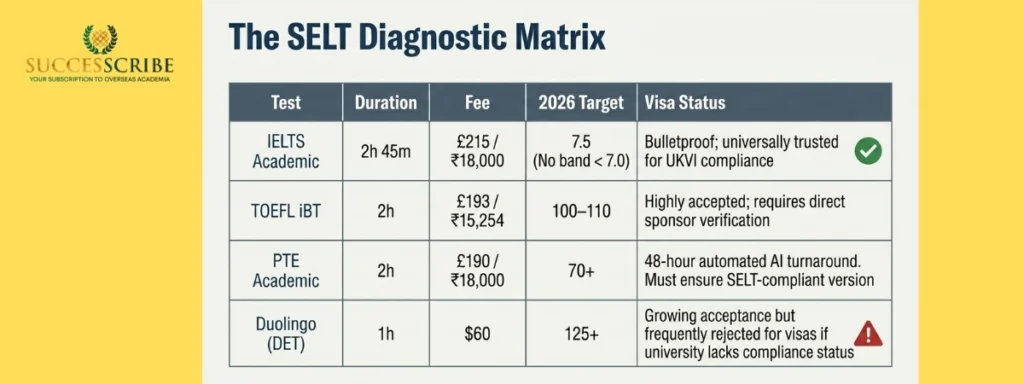
Language proficiency is the first essential step for Secure English Language Test (SELT) compliance. For 2026, the stakes are higher; elite universities have shifted toward demanding higher sub-scores in Writing and Speaking to ensure students can lead seminars and produce high-level research. Before attempting advanced subject-specific papers, clearing an English language proficiency test is the foundational Entrance Exam for UK Universities required to satisfy visa and academic communication compliance
1. IELTS Academic
The gold standard for UK admissions and visa safety.
- 2026 Fees: £215 in the UK or ₹18,000 in India.
- Score Targets: Mid-tier universities require 6.0–6.5; top-tier (Oxbridge/LSE) demand 7.0–7.5 with no sub-band below 6.5 or 7.0.
2. TOEFL iBT
A preferred choice for students comfortable with computer-based, integrated tasks.
- 2026 Fees: Approximately £193 (USD 245–250) or Rs. 15,254 in India.
- Score Targets: Undergraduate programs typically require 80–92; Russell Group postgraduate programs look for 90–110.
3. PTE Academic
Known for its automated scoring and rapid results turnaround.
- 2026 Fees: £190 in the UK or ₹18,000 (inclusive of 18% GST) in India.
- Score Targets: Competitive programs generally require a score of 62–70+.
4. Duolingo English Test (DET)
While acceptance is growing at institutions like Exeter and Surrey, it is often not accepted for visa purposes by universities that lack “Higher Education Provider with a track record of compliance” status.
| Exam Name | Duration | Typical Fee (GBP/INR) | Min. Score (Top-Tier) | Validity |
| IELTS Academic | 2h 45m | £215 / ₹18,000 | 7.5 (No band < 7.0) | 2 Years |
| TOEFL iBT | 2h | £193 / Rs. 15,254 | 100–110 | 2 Years |
| PTE Academic | 2h | £190 / ₹18,000 | 70+ | 2 Years |
| Duolingo (DET) | 1h | $60 | 125+ | 2 Years |
Undergraduate Entrance Exams: High-Stakes Aptitude Testing
The 2024 – 2026 cycle has seen a seismic shift toward university-consortium-led testing. Critically, the BMAT is officially discontinued. All former BMAT universities (Oxford, Cambridge, UCL) now require the UCAT for Medicine. Furthermore, UCL has introduced the TARA for specific 2026 entry pathways. For high-school leavers targeting competitive courses, the undergraduate Entrance Exam for UK Universities has shifted entirely toward consortium-led digital testing like the UCAT and ESAT.
UAT-UK & Undergraduate Matrix
| Exam | Primary Subjects | Key 2026 Elite Adopters |
| UCAT | Medicine, Dentistry | Oxford, Cambridge, UCL, KCL, Imperial |
| LNAT | Law, Jurisprudence | Oxford, Cambridge, LSE, UCL, KCL |
| ESAT | Engineering, Physics, Natural Sciences | Cambridge, Imperial, UCL |
| TMUA | Mathematics, Computer Science, Economics | Cambridge, LSE, Imperial, Durham, Warwick |
| TARA | PPE, Management, Social Sciences | Oxford, UCL |
| STEP | Advanced Mathematics | Cambridge, Warwick, Imperial |
Standardized Tests (SAT/ACT) for US-Curriculum Students
For students in the American system, standardized scores remain vital.
- SAT: UK universities typically require 1200–1400+. Top-tier institutions like Oxbridge/Imperial require 1450+.
- ACT: A composite score of 24 – 28+ is standard, with elite courses demanding 32+.
Post-Graduate Management Admissions: Entrance Exam for MBA in UK
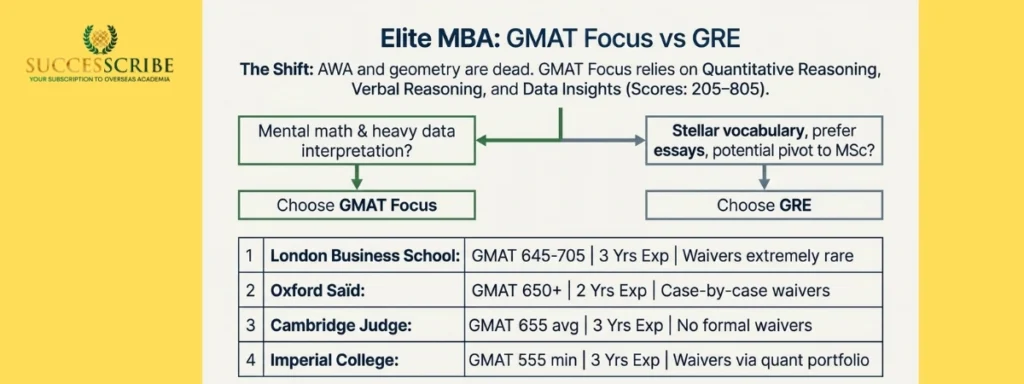
The United Kingdom remains an attractive global hub for management education, anchored by elite institutions like London Business School (LBS), Oxford Saïd, Cambridge Judge, and Imperial College Business School. When applying to these highly selective business programs, navigating the entrance exam for mba in uk is essential for validating your academic and quantitative readiness.
By 2026, the testing ecosystem for elite UK MBAs has completely aligned with the GMAT Focus Edition and the GRE General Test. Additionally, while top-tier schools consider these test scores foundational pillars of an application, several competitive regional institutions offer distinct waivers for executive or highly experienced corporate professionals.
The Domination of the GMAT Focus Edition
The traditional GMAT has been phased out entirely. In 2026, all elite business schools in the UK accept only the GMAT Focus Edition. This streamlined format filters out legacy geometry and sentence correction elements, focusing instead on digital-age business analytics, data literacy, and critical reasoning.
The GMAT Focus Edition consists of three equally weighted sections:
- Quantitative Reasoning (21 questions, 45 minutes): Covers arithmetic and algebra; calculators are barred.
- Verbal Reasoning (23 questions, 45 minutes): Tests critical reasoning and reading comprehension.
- Data Insights (20 questions, 45 minutes): Evaluates data sufficiency, multi-source analysis, and table analysis; an on-screen calculator is permitted.
Scores range strictly from 205 to 805. A score above 645 places a candidate in the competitive bracket for top-tier UK institutions like LBS and Oxford Saïd.
The GRE General Test Alternative
Virtually all prominent UK business schools treat the GRE as a direct equivalent to the GMAT. Shorter than its historic predecessor, the GRE consists of Analytical Writing, Verbal Reasoning, and Quantitative Reasoning, taking just under two hours to complete.
| Business School | Average / Target GMAT Score (Focus Edition) | GRE Minimum Benchmarks | Work Experience Minimums | GMAT/GRE Waiver Availability |
| London Business School (LBS) | 645 – 705 | 160 Verbal / 160 Quant | 3 Years (Average 5.5 Years) | Extremely rare; reserved for exceptional cases. |
| Oxford Saïd Business School | 650+ | 160 Verbal / 160 Quant | 2 Years Minimum | Considered on unique individual case review. |
| Cambridge Judge Business School | 655 (Class Average) | 160+ in both sections | 3 Years Minimum | No formal waivers for the traditional MBA track. |
| Imperial College Business School | 555 Minimum (615+ competitive) | 156 Verbal / 158 Quant | 3 Years Continuous | Available via quantitative portfolio review. |
| University of Edinburgh Business School | 555 Minimum | Equivalent GRE Distribution | 3 Years Managerial | Automatically waived if holding a UK 2:1 Honours degree. |
UK Entrance Exam for Engineering and STEM
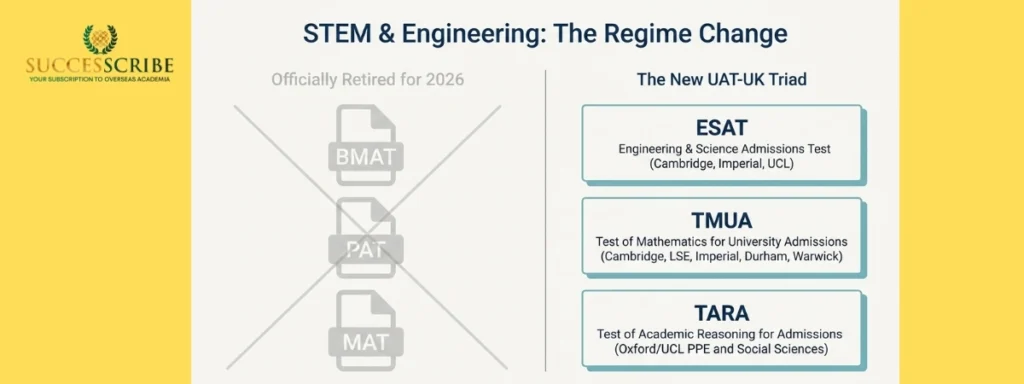
Engineering applications within the UK are at an all-time high, driven by advancements in artificial intelligence, aerospace innovations, and renewable energy infrastructure. To filter the massive volume of top-tier applicants, elite engineering faculties have mandated highly rigorous technical screenings. If you are looking to secure a seat in a competitive technical track, mastering the UK entrance exam for Engineering is your critical first step.
The primary gateway for elite engineering programs in 2026 is the Engineering and Science Admissions Test (ESAT), complemented by the Test of Mathematics for University Admissions (TMUA) for data-intensive and computing-heavy engineering fields.
Admissions for STEM at Russell Group universities have transitioned to the ESAT and TMUA. Oxford has moved to UAT-UK managed tests for 2026, meaning applicants must take the October sitting; a January sitting disqualifies Oxbridge applicants.
The Test of Mathematics for University Admissions (TMUA): The Warwick Loophole)
For students leaning toward Computer Engineering, Software Engineering, or Information Systems, the TMUA serves as the primary technical filter. Adopted widely by Cambridge, Imperial, Warwick, LSE, and Durham, the TMUA tests mathematical logic and reasoning rather than advanced curricular memorization.
- Paper 1 (Applications of Mathematical Knowledge): 20 multiple-choice questions over 40 minutes focusing on core algebraic and geometric mathematical concepts.
- Paper 2 (Mathematical Reasoning): 20 multiple-choice questions over 40 minutes focusing on logic, identifying flaws in mathematical proofs, and analytical deduction.
The Warwick Loophole: A high TMUA score provided in the early testing windows can lead the University of Warwick to issue a reduced conditional offer that excludes the notoriously difficult STEP requirement, removing a massive hurdle during the stressful June A-Level exam season.
The Engineering and Science Admissions Test (ESAT)
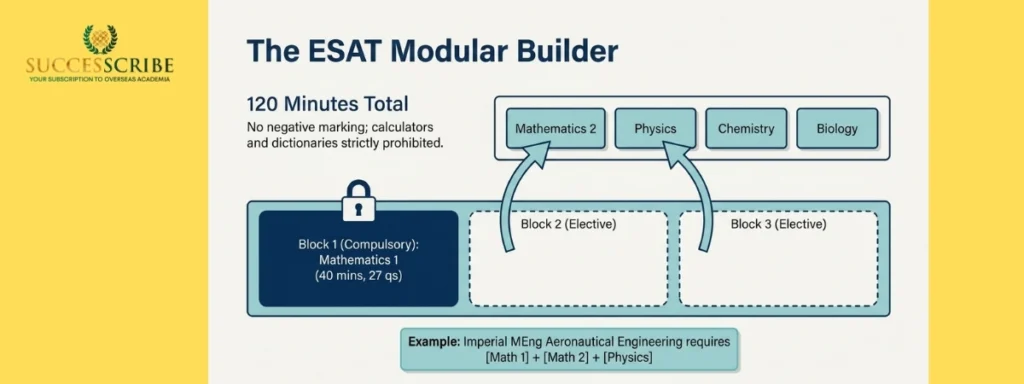
The ESAT is a mandatory computer-based assessment utilized by the University of Cambridge, Imperial College London, and University College London (UCL) for standard undergraduate engineering and physical science pathways.
Test Structure and Mechanics
The ESAT is a 120-minute exam split into discrete, distinct modules. Each individual module is timed tightly at 40 minutes and consists of 27 multiple-choice questions.
The Core Module: Mathematics 1 is compulsory for every single candidate. It tests foundational algebraic proficiency, calculus, geometry, and trigonometry.
The Elective Modules: Depending on the specific engineering branch (e.g., Chemical, Aeronautical, Mechanical, or Civil), candidates must complete two additional modules from the following pool:
- Mathematics 2 (Advanced calculus, vectors, complex numbers)
- Physics (Newtonian mechanics, electricity, waves, quantum concepts)
- Chemistry (Atomic structure, kinetics, thermodynamics, organic pathways)
- Biology (Cellular biology, genetics, homeostasis)
Calculators and dictionaries are strictly prohibited. The scoring operates on a positive-only metric; marks are awarded based on the net total of correct answers, with no negative marking applied to incorrect selections.
Engineering Entry Requirements & Exam Specifications
| University | Course Pathway | Mandated Entrance Exam | Required Module Choices (For ESAT) | Key Test Sitting Window |
| University of Cambridge | Engineering (H100), Chemical Engineering & Biotech | ESAT | Math 1, Math 2, Physics or Chemistry | October Window Only |
| Imperial College London | MEng Aeronautical / Mechanical / Civil Engineering | ESAT | Math 1, Math 2, Physics | October or January Window |
| University College London (UCL) | BEng/MEng Electronic & Electrical Engineering | ESAT | Math 1, Math 2, Physics | October or January Window |
| Imperial College London | Computing / Software Engineering | TMUA | Full Examination (Paper 1 & 2) | October or January Window |
| University of Warwick | Discrete Mathematics / Computer Systems | TMUA | Full Examination (Paper 1 & 2) | October or January Window |
The STEM Awareness Gap: ESAT, TMUA, and the Rejection Trap
This is where the 2026 cycle becomes dangerous. The venerable PAT (Physics Aptitude Test) and MAT (Mathematics Admissions Test) have been officially replaced for many courses at Oxford, Cambridge, and Imperial.
The new standard is the ESAT (Engineering & Science Admissions Test) and the TMUA. These are modular, computer-based tests managed by Pearson VUE.
The “Oxbridge Trap”: You must understand the windows.
- Test Window 1 (October): Mandatory for Oxbridge.
- Test Window 2 (January): Available for Imperial, LSE, and others.
If you are targeting Cambridge Engineering and wait until January to sit the ESAT, you are automatically disqualified. Most students from CBSE or state boards discover this requirement 2–3 months too late.
Mandatory Tests for Competitive STEM:
- ESAT: Required for Natural Sciences, Engineering, Physics, Chemical Engineering, and Veterinary Medicine.
- TMUA: Required for Mathematics, Computer Science, and Economics.
- TARA (Test of Academic Reasoning for Admissions): A new 2026 requirement for Social Sciences and Mathematics at UCL.
Medical and Dental Entrance Exams: The UCAT Dominance
For students aiming to enter medical or dental practice via a UK Bachelor of Medicine and Bachelor of Surgery (MBBS/BChir) pathway, the University Clinical Aptitude Test (UCAT) is the single most critical gatekeeper. Following the definitive retirement of the BMAT in recent years, the UCAT now enjoys total monopoly across all major UK medical programs.
UCAT Test Blueprint
The UCAT is a high-speed, computer-based exam lasting 2 hours. It is structured into five distinct, separately timed subtests:
- Verbal Reasoning (44 questions, 21 minutes): Evaluates the ability to draw logical conclusions from complex written texts.
- Decision Making (29 questions, 31 minutes): Assesses your problem-solving capacity using diagrams, graphs, and statistical data pools.
- Quantitative Reasoning (36 questions, 24 minutes): Focuses on numerical problem-solving based on percentages, ratios, and data interpretation.
- Abstract Reasoning (50 questions, 12 minutes): Evaluates spatial awareness and pattern identification skills under extreme time constraints.
- Situational Judgement (69 questions, 26 minutes): Measures real-world ethical choices and behavioral integrity within medical contexts.
Scoring Metrics
Cognitive sections (1 through 4) generate a combined score ranging from 1200 to 3600. Situational Judgement is categorized separately into Bands 1 to 4, with Band 1 representing exceptional ethical alignment. Top medical schools generally require an overall score exceeding 2800 along with a Band 1 or Band 2 designation to secure an interview spot.
Law Entrance Exams: Navigating the LNAT
The National Admissions Test for Law (LNAT) remains the standardized baseline for selecting elite legal minds across top UK faculties. The exam does not measure knowledge of the law itself; rather, it tests a candidate’s capacity for logical reasoning, linguistic comprehension, textual interpretation, and structural essay formulation.
The LNAT assesses critical reasoning rather than legal knowledge.
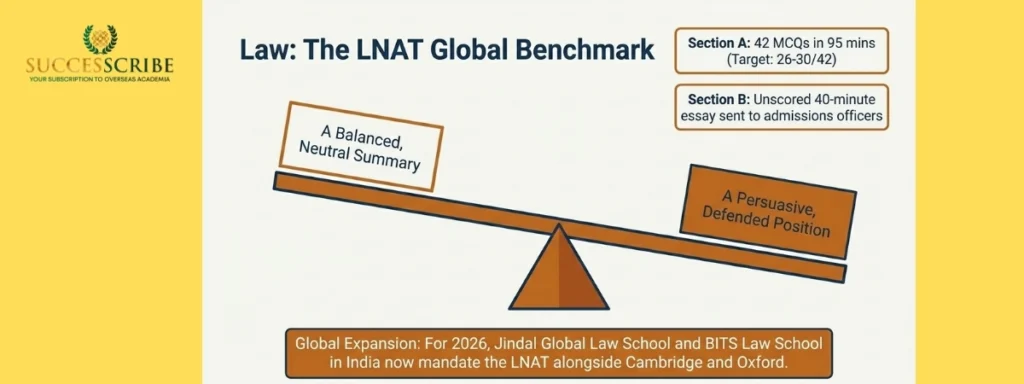
- Section A (MCQs): 42 questions in 95 minutes.
- Section B (Essay): 40 minutes.
- Strategy: Markers seek a clear, defended position. Avoid a “balanced summary”; choose a side and argue it persuasively.
LNAT Structural Breakdown
The LNAT is a 2-hour and 15-minute digital assessment split into two sections:
- Section A (95 Minutes): 42 multiple-choice questions based on 12 passage extracts. Each passage contains 3 to 4 analytical questions evaluating your reading comprehension under pressure.
- Section B (40 Minutes): An essay section where candidates choose one prompt from a list of three topics. The essay does not receive a numerical grade from the LNAT consortium; instead, it is forwarded directly to university admissions officers to judge argumentation clarity and prose styling.
LNAT Institutional Matrix
| LNAT Testing Core |
| University of Oxford (Compulsory for BA in Jurisprudence) |
| University of Cambridge (Replaced internal tests with LNAT) |
| London School of Economics (LSE) (Strict weight on Section A scores) |
| University College London (UCL) (Evaluates essay alongside grades) |
| King’s College London (KCL) (Utilized for early filters) |
For the 2026 admission cycle, the average competitive score in Section A for Russell Group applicants sits between 26 and 30 out of 42.
The LNAT Goes Global: From London to Mumbai
The Law National Aptitude Test (LNAT) is no longer just a UK requirement; it is becoming a global benchmark for critical thinking. In a major shift for 2026, the LNAT consortium has expanded into India, with Jindal Global Law School and BITS Law School now requiring the test for integrated LLB programs.
Furthermore, the University of Cambridge has officially scrapped its internal law test in favor of the LNAT. With a fee of £120 (approx. ₹15,431) for international centers, the LNAT is now the primary filter for top-tier legal minds globally.
Advanced Mathematics Track: The STEP
The Sixth Term Examination Paper (STEP) is an advanced, highly specialized mathematics exam administered at the conclusion of the secondary academic year (typically June). It is used primarily by the University of Cambridge, Imperial College London, and the University of Warwick to issue conditional offers for pure mathematics and data-heavy disciplines.
STEP Structural Architecture (STEP 2 & STEP 3)
Legacy STEP 1 was retired globally in 2020. The modern exam features two advanced variants:
- STEP 2: Grounded firmly in A-Level Mathematics and core components of Further Mathematics.
- STEP 3: Based on the entirety of the complex Further Mathematics syllabus.
Each paper is a rigorous 3-hour essay-style examination containing 12 analytical questions: 8 Pure Mathematics, 2 Mechanics, and 2 Probability/Statistics. Candidates are instructed to select and thoroughly answer up to 6 questions.
The Strategic Loophole: Bypassing STEP via TMUA
Because STEP occurs late in the academic cycle (June), failing to meet its strict grading targets can invalidate an outstanding conditional university offer. To manage this risk, savvy candidates utilize an established path at institutions like the University of Warwick.
If an applicant achieves a sufficiently high score on the TMUA during the early October or January testing windows, certain universities will issue a modified conditional offer that eliminates the STEP requirement entirely. Meeting your target A-Level grades then transforms your application into a fully unconditional offer, bypassing the pressures of the June STEP assessment.
Critical Timeline, Registration Procedures, and Fees for 2026
Failing to register within the strict Pearson VUE windows will instantly derail your application, making timeline tracking the most vital administrative part of taking an Entrance Exam for UK Universities. Missing registration deadlines is one of the most common ways applications are derailed. For the 2026/2027 intake cycle, deadlines are tightly enforced by centralized testing bodies.
Key Admissions Test Calendars
| Key Milestone Date | Action Required / Exam Details |
| June 1, 2026 | UAT-UK Portal opens for Account Creation & Bursary/Access applications. |
| July 20, 2026 | Global Test Booking officially opens via Pearson VUE. |
| September 14, 2026 | Final deadline to submit Access Arrangements/Bursary requests for Sitting 1. |
| September 21, 2026 | Standard test booking closes for the October window. |
| September 28, 2026 | Absolute Late Registration Deadline for October sitting (6:00 PM BST). |
| Oct 12–16, 2026 | Test Window 1: Mandatory for Oxbridge and early UCAS applicants. |
| Nov 16, 2026 | Official results distribution for the October sitting via UAT-UK accounts. |
| Jan 4 – 8, 2027 | Test Window 2: Available for non-Oxbridge tracks (Imperial, LSE, UCL, etc.). |
Comprehensive Fee Metrics
| Exam Board / Classification | Fee for Domestic Candidates (UK & Ireland) | Fee for International Candidates (Rest of World) |
| UAT-UK Suite (ESAT / TMUA / TARA) | £78 | £133 |
| LNAT (Law Admissions Test) | £75 | £120 |
| UCAT (Medical Aptitude Test) | £70 | £115 |
| STEP (Per Individual Paper) | £102.50 | £142.25 ($179.75 USD) Excludes local center markup |
| GMAT Focus Edition (MBA Admissions) | $275 USD (Test Center) | $300 USD (Online Option) + local country taxes |
UAT-UK offers comprehensive financial bursaries and fee-waiver frameworks for domestic candidates who can demonstrate financial hardship. Applications for these waivers must be approved before booking your individual test slot.
University-Wise and Comparative Analysis
To optimize your chances of success, a comparative analysis is necessary to determine which specific pathway or Entrance Exam for UK Universities best aligns with your testing strengths.
IELTS vs. TOEFL vs. PTE
While all three are widely accepted, they cater to very different testing styles and administrative timelines. Choosing the right one depends entirely on your target timeline and computer comfort.
- PTE Academic – The Speed Option: Best if you are up against a tight university deadline. Results are automated via AI and typically delivered within 48 hours.
- IELTS Academic – The Safe Option: The most bulletproof, universally recognized test for UKVI visa compliance across every single tier of UK institution.
- TOEFL iBT – The Integrated Option: Ideal for international students coming from an American international school curriculum who prefer computer-delivered, multi-task testing.
| Feature / Metric | IELTS Academic | TOEFL iBT | PTE Academic |
| Testing Style | Paper or computer-based; human interviewer for speaking. | 100% computer-based; integrated tasks (e.g., read + listen + speak). | 100% computer-based; automated AI scoring for all modules. |
| Turnaround Time | 3 – 5 days (Computer) / 13 days (Paper) | 4 – 8 days | 48 Hours |
| Visa Universality | Absolute; trusted by all UK Visas & Immigration (UKVI). | Highly accepted; requires direct institution sponsor verification. | Highly accepted; must ensure test type matches SELT guidelines. |
GMAT vs. GRE for UK MBA
Virtually all elite UK business schools (LBS, Oxford Saïd, Cambridge Judge) officially state they treat the GRE and GMAT as equals. However, the operational reality under the surface looks a bit different.
- Choose GMAT Focus if: You have a strong background in business data interpretation, excel at mental math (as calculators are banned in the Quantitative section), and want to signal pure analytical readiness to top-tier recruiters.
- Choose GRE if: You have a stellar vocabulary, prefer a test that still features an Analytical Writing essay, and want a score that can easily pivot to non-business MSc graduate programs if you change your mind.
UCAT vs. GAMSAT
These two tests are completely non-interchangeable. The choice here isn’t about preference; it is dictated entirely by your current academic standing and the tier of medicine you are entering.
- UCAT – The Undergraduate Gateway: A high-speed, 2-hour cognitive aptitude test. It does not test science curriculum knowledge; instead, it tests how fast you can process patterns, logic, and ethical scenarios under extreme time pressure. Required for standard Bachelor of Medicine and Bachelor of Surgery (MBBS/BChir) pathways.
- GAMSAT – The Graduate-Entry Filter: A grueling, 5.5-hour marathon exam specifically designed for applicants who already hold a Bachelor’s degree. Unlike the UCAT, it requires advanced, undergraduate-level knowledge of Chemistry, Biology, and Physics, alongside complex essay writing.
| THE MEDICAL FORK IN THE ROAD | |
| Undergraduate Track | Graduate Track |
| Straight out of school/CBSEHigh-speed aptitude testingZERO pure science memory | Already hold a Bachelor’s degreeIntense 5.5-hour science marathonHigh-level Biology/Chemistry/Physics |
| TAKE UCAT | TAKE GAMSAT |
Strategic Preparation: How to Score High in UK Admission Tests
Structured preparation outperforms last-minute cramming.
- 12-18 Months: Focus on English Proficiency and IELTS.
- 6-12 Months: Research department-specific tests (ESAT vs TMUA).
- 3-6 Months: Intensive preparation using official mock tests.
- Common Mistake: Relying on third-party prep books. Always prioritize official materials from the UCAT Consortium, Pearson, or UAT-UK.
The Administrative Link: Student Visas and Alternative Pathways
There is a rigid link between entrance exams and your UK Student Visa. You must verify if your university is a “Higher Education Provider with a track record of compliance.” If not, you must sit for an IELTS UKVI (SELT), or your visa will be rejected regardless of university admission.
Universities in UK Without IELTS
Waivers are possible via a Medium of Instruction (MOI) letter or achieving 70%–75%+ in Grade 12 English (CBSE/ICSE). However, these waivers do not apply to high-stakes courses like Medicine or Law.
Conclusion
Success in 2026 requires more than academic brilliance; it requires a proactive understanding of the testing calendar. Selecting the correct version of your exam – ensuring Academic rather than General and SELT-compliant versions for visas – is the cornerstone of a successful journey. A UK degree is a global asset, but the roadmap begins with securing elite scores in these entrance exams. Ultimately, achieving an elite score on your required Entrance Exam for UK Universities is the ultimate key that unlocks a world-class British education and robust global career prospects. Start early, prioritize official resources, and treat these tests as your opportunity to prove you belong among the global academic elite.
FAQs
Can I retake the ESAT or TMUA if I miss my target score?
No. You are strictly permitted to sit the ESAT, TMUA, or TARA only once per admissions cycle. If you attempt to register for both the October and January sittings within the same academic cycle, your scores will be invalidated and your UCAS application cancelled.
What happens if I am applying to two different courses that require different ESAT modules?
If you apply to two separate courses that require the ESAT, and one has a free elective choice while the other has a compulsory module requirement (e.g., Physics), you must select the compulsory module required by the stricter program. If there is an explicit structural conflict between requirements, you must contact UAT-UK for a custom module arrangement via your registration portal before booking.
Does the GMAT Focus Edition include an essay section?
No. The Analytical Writing Assessment (AWA) has been completely removed from the GMAT Focus Edition. Your entire score profile is calculated based on your performance in Quantitative Reasoning, Verbal Reasoning, and Data Insights.
If I take the LNAT in India, is the test format different from the UK version?
No. The LNAT is identical worldwide. Whether you take it in London, Mumbai, or New York, you will face the exact same digital platform structure consisting of 42 multiple-choice questions (Section A) and one essay prompt (Section B).
Related Post
Masters in Cyber Security in Uk
Entrance exam for masters in UK
Masters in Data Science in UK
Universities for masters in UK