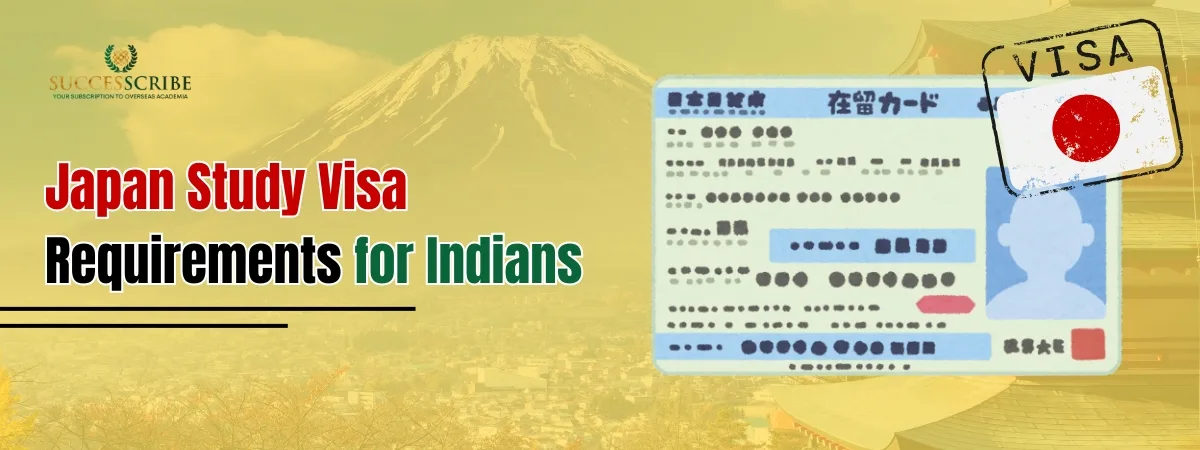
Navigating the application process to pursue higher education in Japan requires clear, up-to-date guidance. Whether enrolling in an undergraduate degree, a master’s program, or an intensive Japanese language course, understanding the Japan Study Visa Requirements for Indians is essential to ensuring a seamless transition to studying abroad. In this topic we are going to tell you about Step-by-Step Certificate of Eligibility (CoE) Workflow, Exact Financial Proof Requirements, Mandatory Document Checklist, Updated Visa Fees & Timelines, Part-Time Work Guidelines & Post-Arrival Steps, and Common Visa Rejection Reasons.
Key Highlights: Japan Study Visa Requirements for Indians
- Mandatory Pre-Approval (CoE): Your Japanese educational institution must first secure a Certificate of Eligibility (CoE) for you from Japanese Immigration before you can apply for a visa in India.
- Bank Balance Requirement: You must show a liquid bank balance of ¥2,000,000 to ¥3,500,000 JPY (₹11 Lakhs to ₹20 Lakhs INR), maintained cleanly over 3 to 6 months.
- Accepted Financial Files: Proof of funds includes bank statements, liquid Fixed Deposits (FDs), official Indian bank Education Loans, or MEXT/JASSO Scholarship letters.
- Language Prerequisites: You need a TOEFL iBT (80+) or IELTS (6.5+) for English programs, or a JLPT N2/N1 certificate (or 150+ hours of Japanese study) for Japanese-taught courses.
- Application Documents: Requires a valid passport, filled application form, standard passport photos, the original or digital e-CoE, acceptance letter, academic records, and sponsor ITRs (2–3 years).
- Fees & Processing Time: The official visa fee is ₹500 INR (plus nominal VFS service fees), with visa stamping taking 5 to 10 working days after CoE submission.
- Post-Arrival & Work Rules: You will receive a Residence Card (Zairyū Card) at the airport and are allowed to work part-time up to 28 hours/week during semesters (40 hours/week during official breaks).
Overview of Japan Study Visa Requirements for Indians
The Japanese Student Visa (Ryūgaku Visa / 留学ビザ) allows international students to legally reside in Japan for the duration of their academic program (ranging from 6 months up to 4 years and 3 months, with options for extension).
Before applying at a Japanese Embassy or Consulate in India (located in New Delhi, Mumbai, Chennai, Kolkata, or Bengaluru), you must first secure a Certificate of Eligibility (CoE) issued by the Ministry of Justice in Japan. Meeting the primary Japan Study Visa Requirements for Indians centers around securing admission to a recognized institution, proving financial viability, and maintaining a clean academic and civil background.
- Step 1: Secure Admission from a Japanese University
- Step 2: University Files Certificate of Eligibility (CoE) in Japan (4 – 8 Weeks)
- Step 3: Receive CoE & Submit Visa Application at VFS / Japan Embassy in India (5 – 10 Days)
- Step 4: Receive Visa & Enter Japan (Receive Zairyū Card)
Suggested Post: Study in Japan Consultancy in India
Eligibility Criteria for Indian Students
To qualify under the official Japan Study Visa Requirements for Indians, applicants must satisfy the following fundamental eligibility criteria:
| Eligibility Area | Requirement Details |
| Academic Qualification | Minimum 12 years of formal education (10+2) for Bachelor’s programs, or a recognized Bachelor’s degree for Postgraduate/Master’s programs. |
| Age Limit | Generally at least 18 years of age at the time of program commencement. |
| Institutional Acceptance | Confirmed offer letter or enrollment certificate from an accredited Japanese university, junior college, vocational school (Senmon Gakkō), or designated language school. |
| Language Proficiency | For English-taught programs: TOEFL iBT (80+) or IELTS (6.5+).For Japanese-taught programs: JLPT N2/N1 certificate or proof of 150+ hours of formal Japanese language study. |
| Financial Independence | Demonstrated ability to cover tuition fees and living expenses without relying on unauthorized employment in Japan. |
Understanding the Certificate of Eligibility (CoE)
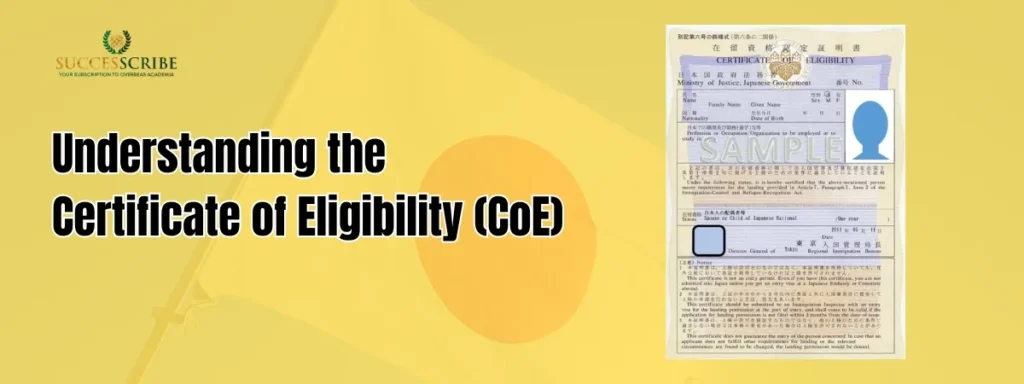
The Certificate of Eligibility (CoE) (Zairyū Shikaku Nintei Shōmeisho) is the foundation of the Japanese visa framework. Issued by the Japanese Immigration Services Agency under the Ministry of Justice, the CoE serves as pre-screening proof that you meet the statutory entry requirements for a student status.
Key Facts About the CoE:
- Who Applies? Your host Japanese educational institution applies directly to regional immigration authorities in Japan on your behalf.
- Processing Time: Usually takes 4 to 8 weeks (1–2 months).
- Validity Period: The CoE is valid for 3 months from the date of issuance. You must apply for your visa and enter Japan within this 3-month window.
- Format: Delivered either as an official paper document via airmail or digitally as an e-CoE (PDF format) via email.
Understanding how the CoE operates is a critical part of meeting the Japan Study Visa Requirements for Indians, as Japanese Embassy officials in India will not accept a student visa application without a valid CoE.
Financial Requirements & Proof of Funds

One of the most scrutinized elements of the Japan Study Visa Requirements for Indians is financial capability. Japanese immigration authorities require proof that you can pay for your tuition and cover your living expenses in Japan.
Bank Balance Thresholds
- 1-Year Program / Standard Maintenance: You must demonstrate a liquid bank balance of at least ¥2,000,000 to ¥3,500,000 JPY (approximately ₹11 Lakhs to ₹20 Lakhs INR).
- Document Freshness: Financial records must be issued within the last 3 months relative to the application date.
Acceptable Proof of Funds
Financial Proof Options for Visa
| Bank Statements | Fixed Deposits | Education Loans | Scholarships |
| (Last 3 -6 Months)Showing Stability | (Maturity/FD Certificates) | (Sanctioned Letter from a Recognized Bank) | (MEXT, JASSO, University Grants) |
- Personal or Sponsor Bank Statements: Official statements for the past 3 to 6 months showing consistent balance history. Unexplained, sudden large deposits right before applying can raise red flags.
- Fixed Deposit (FD) Receipts: Liquid FDs held in scheduled commercial banks.
- Education Loan Sanction Letter: Loan sanction letters issued by recognized Indian public or private banks (e.g., State Bank of India, HDFC Credila, ICICI Bank, Avanse).
- Scholarship Award Letter: Official award letters from prestigious funding bodies such as the MEXT Scholarship (Ministry of Education, Culture, Sports, Science and Technology) or JASSO (Japan Student Services Organization). Receiving a full MEXT scholarship waives the standard bank balance requirement.
Note: The #1 reason for visa rejections in the Indian market is “unexplained financial transactions.” Sudden large deposits into a sponsor’s account immediately prior to application are a major red flag. From a compliance standpoint, ensure all deposits are mapped to a verifiable source of income.
Financial Guarantor / Sponsor Guidelines
If a parent, relative, or guardian acts as your financial sponsor, they must provide:
- Letter of Financial Support / Guarantee confirming their commitment to cover your costs.
- Proof of Income: Income Tax Returns (ITR) for the last 2–3 years, salary slips, or Form 16.
- Annual Income Threshold: Sponsors should show an annual income of at least ¥2,000,000 JPY (approx. ₹11 – 12 Lakhs INR per annum).
Document Checklist for Indian Applicants
All documents submitted to the Japanese Embassy/Consulate or VFS Global application center in India must be in A4 size. Any document not issued in English or Japanese must include a certified translation.
1. Primary Identity & Visa Application Documents
| Document | Format & Quantity | Key Specifications & Guidelines |
| Current Passport | Original + 1 Photocopy | Valid for at least 6 months with at least 2 blank pages. Photocopy bio-data pages (first and last page). |
| Old Passports | Original | Submit all previous/expired passports (if applicable) to prove travel history. |
| Visa Application Form | 1 Copy (Duly Filled) | Must be printed, completely filled, and signed. The signature must match your passport signature. |
| Passport-Sized Photograph | 1–2 Photos | Size: 2 x 2 inches (51mm x 51mm) or 45mm x 35mm depending on center guidelines. Plain white background, taken within the last 6 months, showing 70% face visibility. |
| Certificate of Eligibility (CoE) | Original or Printed e-CoE + 1 Copy | Issued by Japanese Immigration. Print the digital PDF email if issued as an e-CoE. |
| Covering Letter | 1 Original | Addressed to the Embassy/Consulate of Japan in India, stating your purpose of travel, course details, and stay duration. |
| Birth Certificate | 1 Copy | Must be accompanied by a certified English or Japanese translation if the original is in a vernacular language. |
2. Education and Admission Documents
| Document | Format & Quantity | Key Specifications & Guidelines |
| Letter of Acceptance / Admission | Original / Official Copy | Issued by your Japanese host university, college, or vocational school. |
| Academic Marksheets & Certificates | Certified Copies | 10th and 12th passing certificates, plus your Bachelor’s degree/transcripts if applying for Master’s/Ph.D. programs. |
| Language Proficiency Proof | Scorecard Copy | • English Programs: IELTS (6.5+) or TOEFL iBT (80+) scorecards.• Japanese Programs: JLPT certificate (N5 to N1) or proof of minimum 150 hours of language study. |
| Statement of Purpose (SOP) | 1 Printed Document / PDF Form | Clear essay outlining your academic background, why you chose Japan, and future career plans. |
3. Financial Proof & Sponsorship Documents
If sponsored by a parent, guardian, or relative, include these supporting financial files:
| Document | Format & Quantity | Key Specifications & Guidelines |
| Bank Account Statement | Original (Stamped & Signed) | Showing a minimum liquid balance of ₹11L – ₹20L INR (¥2.0M–¥3.5M JPY) over the last 3 to 6 months. |
| Sponsor’s Income Tax Returns (ITR) | Certified Copies | Last 2 to 3 years of official ITR or Form 16. |
| Letter of Guarantee / Sponsorship | 1 Original | Signed statement by your sponsor confirming full financial liability for tuition and living costs. |
| Proof of Kinship / Relationship | Certified Copy | Passport, Birth Certificate, or Ration Card establishing relationship between applicant and financial sponsor. |
| Alternative Financial Proof | Official Certificate | • Loans: Official sanction letter from a scheduled Indian bank.• Scholarships: Award letter from MEXT, JASSO, or university grant provider. |
Visa Fees and Processing Timelines
Fulfilling the Japan Study Visa Requirements for Indians is cost-effective compared to many Western study destinations.
| Item | Details & Cost (INR / JPY) |
| Japan Embassy Visa Fee | ₹500 INR for single/multiple entry visas for Indian nationals (effective 1 April 2026). (¥3,000 standard rate) |
| VFS Service Fee | Approximately ₹650 to ₹1,200 INR (varies slightly by location and logistics services). |
| CoE Issuance Time | 4 to 8 weeks (managed by Japanese university). |
| Embassy Visa Processing Time | 5 to 10 working days after submitting documents to VFS or the Embassy. |
| Total Horizon | Start your preparation 4 to 6 months prior to intake (April or October). |
Post-Arrival Requirements & Work Rights
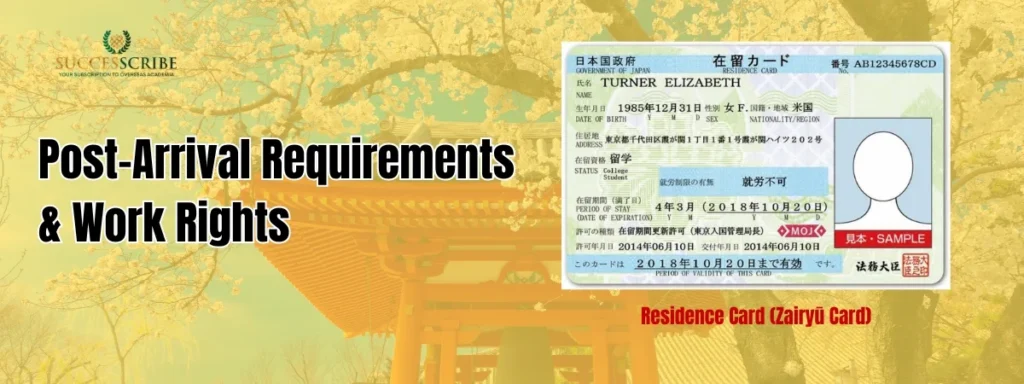
Completing the Japan Study Visa Requirements for Indians goes beyond obtaining the visa stamp in your passport – it also involves key administrative steps upon arrival in Japan.
Residence Card (Zairyū Card) & Ward Office Registration
When landing at major international airports in Japan (such as Tokyo Narita, Tokyo Haneda, Kansai International Airport in Osaka, or Fukuoka Airport), immigration inspectors will issue your Zairyū Card (Residence Card) on the spot.
- Mandatory City Hall Registration: Within 14 days of securing an address in Japan, you must visit the local Ward Office (Kuyakusho) or City Hall to register your residence. This address will be printed on the back of your Zairyū Card.
- National Health Insurance (NHI): You must enroll in Japan’s National Health Insurance scheme at your local ward office. It covers approximately 70% of medical costs, leaving international students with minor out-of-pocket expenses.
Part-Time Work Permission (Shikakugai Katsudō Kyoka)
Holders of a student visa are permitted to engage in part-time work under strict conditions:
| Semester Time | Up to 28 Hours per Week |
| Official School Vacations (Summer / Winter Break) | Up to 8 Hours per day (40 Hrs per week) |
- How to Apply: You can apply for work permission at airport immigration upon initial entry by submitting a simple one-page form.
- Prohibited Employment: Students are strictly banned from working in adult entertainment establishments, bars, gambling venues (such as pachinko parlors), or night clubs. Violation of these laws risks immediate visa revocation and deportation.
Suggested Post: Study in Japan For Indian Students
Common Visa Rejection Reasons & Prevention Tips
While Japanese student visa approval rates are high for applicants holding a valid CoE, visa rejections can happen. Meeting all Japan Study Visa Requirements for Indians requires paying attention to key details to avoid common pitfalls.
| Common Pitfall | Why It Causes Rejection | How to Prevent It |
| Inconsistent Financial Proof | Sudden, unexplained high-value cash deposits into bank accounts right before applying. | Provide clean, stable bank statements for 3 to 6 months. Include source-of-funds documentation for any major transactions. |
| Vague Motivation in SOP | Generic Statement of Purpose that fails to explain why you chose Japan over India or other countries. | Write a clear SOP detailing your specific program, career path, and reasons for studying in Japan. |
| Document Discrepancies | Mismatches in names, dates of birth, or addresses across academic mark sheets and your passport. | Ensure all certificates match your passport exactly. Get formal affidavits for minor spelling variances if necessary. |
| Insufficient Language Proof | Applying for Japanese-medium courses without proof of 150 hours of study or JLPT certification. | Submit formal language certificates (JLPT N5/N4/N3 or recognized university course certificates). |
Conclusion
Japan is a land of disciplined, high-tech opportunity. While the Japan Study Visa Requirements for Indians are structured and rigorous, they are entirely navigable for the well-prepared student. Start the process 8 months early, ensure financial records show 6 months of stability, Use the Visit Japan Web service for a professional landing, and consult the official Embassy of Japan in India or specialized consultants for final document verification.
FAQs
Do I need a CoE before applying for a visa?
Yes. You cannot apply for a student visa without a Certificate of Eligibility (CoE) issued by Japanese Immigration.
How long does the visa process take?
CoE: 1 – 3 months (via university).
Visa Stamping: 5 – 10 working days at VFS/Embassy.
Who can act as my financial sponsor?
Parents or legal guardians are preferred. They must show 2–3 years of ITR and steady income.
Are properties or stocks accepted as proof?
No. Only liquid funds (Savings Accounts, FDs, Loans, or Scholarships) qualify.
Is Japanese language knowledge compulsory?
English Programs: No (TOEFL/IELTS required).
Japanese Programs: Yes (JLPT N5/N2 or 150+ hours study certificate).
Related Post
Best country for Commercial Pilot training
Highest-paying Artificial Intelligence jobs
Highest-paying Finance jobs
SGPA to Percentage calculator