Feeding a growing global population is no longer a matter of simple agriculture; it is a high-stakes technological challenge. While traditional “food studies” might evoke images of test kitchens, the modern reality of Food Science and Technology in Germany is rooted in state-of-the-art laboratories, molecular biogenesis, and complex process engineering. As the world faces a mounting food crisis, Germany has emerged as a premier destination for those looking to master the transformation of raw plant and animal materials into value-added, sustainable, and safe food products.
Key Highlights: Masters in Food Technology in Germany
- The Industry at a Glance
- Top Food Technology Universities in Germany for Masters
- Tuition Fee and Living Cost: Masters in Food Technology in Germany
- Scholarships and Funding Opportunities
- The Curriculum: Modules, Internships, and Research
- Admission Framework: ECTS, Language, and Documentation
- Career Prospects and PR Pathways in the German Food Industry
- Challenges and Strategic Solutions
- Conclusion
- FAQs
The Industry at a Glance
- Market Valuation: A robust €180B industry size, securing Germany’s position as the primary producer within the European Union.
- Innovation Mandate: A surge in demand for resource-efficient production and sustainable “Farm to Fork” methodologies.
- Technological Shift: Widespread implementation of in-line sensor technology, automated production, and molecular-level quality control.
- Economic Stability: One of the lowest unemployment rates in the country, specifically within the life sciences and “Mittelstand” engineering sectors.
This economic strength translates into a fertile ground for international scholars, offering an ecosystem where academic inquiry is directly supported by world-class industrial infrastructure and global market demand.
Top Food Technology Universities in Germany for Masters
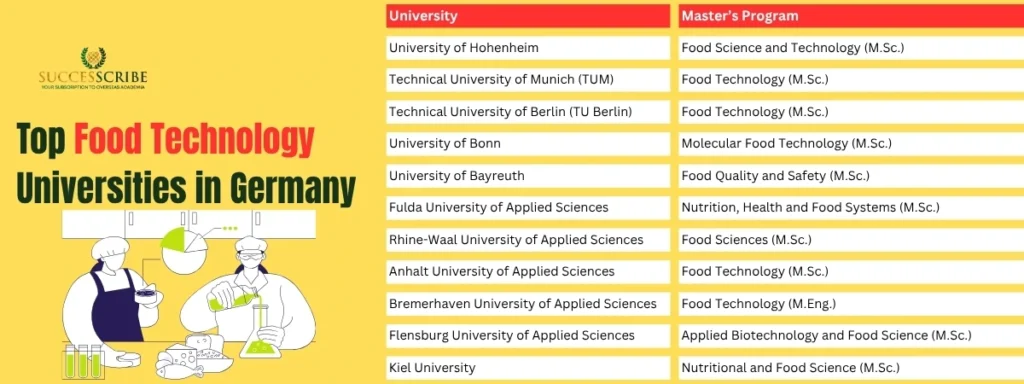
Prospective students must navigate the distinction between “Technical Universities” (TU), which emphasize theoretical research and biogenesis, and “Universities of Applied Sciences” (Fachhochschulen), which focus on practical application and direct industry networking. Selecting the right institution among the various food science germany universities requires a look at their specific niches:
| University | Master’s Program | Location | Language of Instruction |
| University of Hohenheim | Food Science and Technology (M.Sc.) | Stuttgart | English |
| Technical University of Munich (TUM) | Food Technology (M.Sc.) | Weihenstephan (Freising) | German |
| Technical University of Berlin (TU Berlin) | Food Technology (M.Sc.) | Berlin | German |
| University of Bonn | Molecular Food Technology (M.Sc.) | Bonn | German and English |
| University of Bayreuth | Food Quality and Safety (M.Sc.) | Kulmbach | English |
| Fulda University of Applied Sciences | Nutrition, Health and Food Systems (M.Sc.) | Fulda | English and German |
| Rhine-Waal University of Applied Sciences | Food Sciences (M.Sc.) | Kleve | German |
| Anhalt University of Applied Sciences | Food Technology (M.Sc.) | Köthen | German |
| Bremerhaven University of Applied Sciences | Food Technology (M.Eng.) | Bremerhaven | German (75%) and English (25%) |
| Flensburg University of Applied Sciences | Applied Biotechnology and Food Science (M.Sc.) | Flensburg | English |
| Kiel University | Nutritional and Food Science (M.Sc.) | Kiel | German (Implied) |
Suggested Post: MS in Economics in Germany
Key Highlights of Selected Programs
- University of Hohenheim: Ranked as the No. 1 in Germany for this field, it offers research-oriented training focused on the interface between complex food matrices and technical processes
- University of Bayreuth: This program is uniquely interdisciplinary, combining life sciences (like microbiology and toxicology) with legal and economic studies
- Bremerhaven University of Applied Sciences: Focuses heavily on product innovation and leadership skills, benefiting from its location as a major centre for fish processing
- Technical University of Munich (TUM): Trains engineers for industrial food production with deep expertise in packaging technology, rheology, and hygienic processing
- Anhalt University of Applied Sciences: Offers a dual study option, which requires an employment contract with an industry-specific company alongside the academic program
- Flensburg University of Applied Sciences: Focuses on the intersection of biotechnology and food science, acquisition of modern technology knowledge, and project management
Breaking the Language Barrier: English-Taught Programs
The globalization of German higher education has facilitated a surge in 100% English-taught Master’s degrees, allowing international scholars to bypass initial German requirements. Finding a food technology germany in english is now a standard pathway for international applicants.
Flagship English-taught programs for 2026 include:
- University of Hohenheim: M.Sc. Food Science and Technology (100% English).
- Rhine-Waal University: M.Sc. Food Sciences (International focus).
- Flensburg University of Applied Sciences: M.Sc. Applied Bio and Food Sciences.
- University of Bayreuth: M.Sc. Food Quality and Safety.
When searching for food technology germany in english, students should prepare for a proficiency requirement of B2 to C1 (IELTS 6.5–7.5). However, a strategist’s tip: attaining A1/A2 German is vital for social integration and securing local part-time roles. It is highly recommended to seek a food technology germany in english while simultaneously building basic local language skills to enhance your employability.
Tuition Fee and Living Cost: Masters in Food Technology in Germany
Successfully pursuing a masters in food technology in germany requires meticulous financial planning. The primary hurdle for the 2026 student visa is the “Blocked Account” (Sperrkonto). This is a legal requirement designed to ensure students have sufficient liquid capital to support themselves. For 2026, the required amount has been increased to €992 per month, totaling €11,904 per year.
Tuition and Semester Contributions
The food technology germany fees international students pay depend heavily on the federal state (Bundesland). In Baden-Württemberg, the law requires non-EU students to pay €1,500 per semester. Similarly, the Technical University of Munich has implemented a fee of €4,000 per semester for non-EU internationals. However, in states like North Rhine-Westphalia (Bonn/Rhine-Waal) or Saxony-Anhalt (Anhalt), students only pay a “Semester Contribution” of approximately €150 to €350. This contribution is not tuition; it covers administrative costs and often provides a semester-long public transport ticket, which is a massive saving for those studying for a masters in food technology in germany.
Monthly Cost of Living
| Expense Category | Estimated Monthly Cost |
| Rent (Private/Dorm) | €350 – €450 |
| Health Insurance | €85 – €120 |
| Public Transport | €30 – €50 |
| Food & Drink | €150 – €200 |
| Study Materials | €50 – €100 |
| Leisure & Hobbies | €50 – €100 |
| Total Monthly | €950 – €1,050 |
Suggested Post: Masters in Public Health in Germany
While the blocked account requires €992/month, international students are permitted to work part-time (140 full days per year). These “HiWi” (research assistant) positions often pay enough to cover monthly living expenses, effectively making the blocked account a revolving security fund.
Scholarships and Funding Opportunities
While the “Zero Tuition” model is a form of financial aid, competitive scholarships can further reduce the burden. The DAAD is the primary source of funding, but students should also look toward the Deutschlandstipendium, which provides 300 EUR/month.
Specialized scholarships available at many food science germany universities include:
- Adult Learners Scholarship
- Sustainable Energy and Environment Scholarship
- Women’s Scholarship
- Global Access to Medicine Scholarship
The Curriculum: Modules, Internships, and Research
The 2026 curriculum for a masters in food technology in germany focuses on the transition from laboratory science to industrial engineering. Students will master “unit operations,” rheology, and hygienic design.
Core Academic Modules:
- Food Chemistry & Toxicology: Analyzing molecular stability.
- Microbiology & Hygiene: Controlling fermentation and safety.
- Process Engineering: Designing automated production plants.
- Quality Management: Navigating international food law.
A hallmark of the German system is the Project Semester. Students often undertake 6-week to 6-month internships at industry giants such as Danone, Henkel, or Nestlé, often resulting in a Master’s thesis conducted directly within the company’s R&D department.
Suggested Post: Masters in Engineering Management in Germany
Admission Framework: ECTS, Language, and Documentation
The German admissions process is a study in transparency and academic rigor. There are no “shortcuts”; food science germany universities look for specific academic backgrounds that align with their curricula. For the Winter intake (October), preparation should begin in December to meet the typical May/June deadlines.
The ECTS Bridging Strategy (180 vs. 210)
A major hurdle for international students is the ECTS credit gap. Most German Master’s programs require 300 ECTS total for graduation. If your Bachelor’s was 180 ECTS (typical 3-year degree), you are 30 ECTS short for the standard 3-semester Master.
- Strategy A: Choose a 4-semester Master (like Hohenheim or TUM) which awards 120 ECTS, bringing your total to 300.
- Strategy B: Enroll in “adaptation modules” or a “pre-master” bridge. At Anhalt and Bremerhaven, students with 180 ECTS must complete 30 ECTS of additional modules before their thesis colloquium. Understanding this early prevents the common “rejection due to credit deficit” that many international applicants face.
Documentation Checklist
- Academic Degree: Relevant Bachelor’s in Food Technology or Bioengineering. A 7.5 CGPA (German 2.5) is the standard threshold.
- Language Proficiency: For food technology germany in english programs, an IELTS score of 6.5 to 7.5 is standard. Some, like Bayreuth, demand C1.
- Statement of Purpose (SOP): A narrative explaining your research interests.
- Letters of Recommendation (LOR): Two from professors or industrial supervisors.
- Uni-Assist: A third-party service used by food science germany universities to evaluate credentials. This costs approximately ₹7,000–₹8,000 (approx. €75-€85).
Career Prospects and PR Pathways in the German Food Industry
The German food industry seeks generalists with broad knowledge rather than narrow specialists. This is because the “Mittelstand” (SMEs) values employees who can handle quality management, sensory analysis, and production optimization simultaneously.
It’s Not Just About Food – It’s Pharma and Beauty Too
Graduates from programs at the University of Bonn or Hochschule Flensburg find their expertise is essentially “material science for the human body.” Because these programs analyze food at a molecular level – focusing on physical, microbiological, and chemical changes – the skills are highly transferable to unconventional sectors.
In the Beauty and Cosmetics industry, food scientists are recruited to manage product stability, shelf-life, and “skin-interactive” delivery systems. In the Pharmaceutical sector, they develop nutrient formulas and bioactive compounds. The molecular nature of the degree makes these graduates experts in any substance that interacts with human biology.
Graduates are sought after in:
- Pharmaceutical Sector: Bioactive compound development.
- Beauty product industry: Raw material expertise for cosmetics.
- Life Sciences: Researching material impact on physiology.
- Animal Feed Technology: Optimizing the broader agricultural chain.
Career Outcomes and Job Profiles
| Industry Sector | Typical Job Roles | Necessary Competency |
| Food Processing | Product Development Manager | Innovative Food Formulas |
| Pharma/Beauty | Quality Management (QM) | Hygienic Design & Microbiology |
| Supply Chain | Logistics & Plant Manager | Process Modeling & Simulation |
| Research | Food Technologist | Sensory Analysis & Analytics |
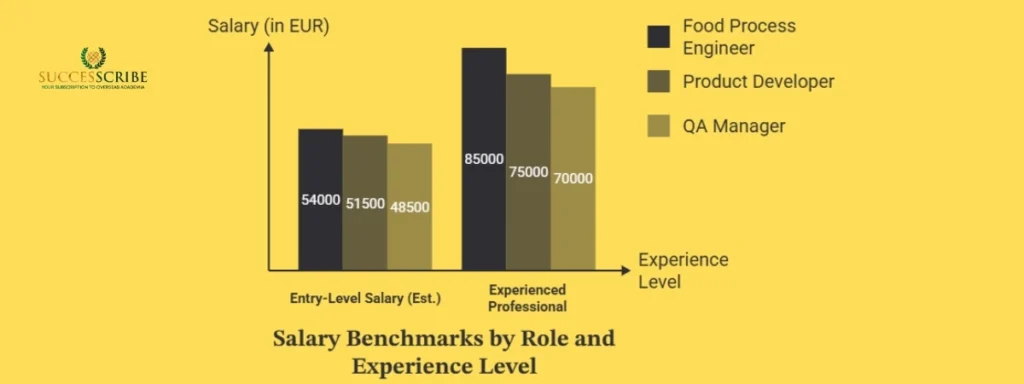
Salary Benchmarks
| Role | Entry-Level Salary (Est.) | Experienced Professional |
| Quality Assurance Manager | 45,000 – 52,000 EUR | 70,000+ EUR |
| Product Developer | 48,000 – 55,000 EUR | 75,000+ EUR |
| Food Process Engineer | 50,000 – 58,000 EUR | 85,000+ EUR |
With a Masters in Food Technology in Germany, graduates are highly sought after by global players and local leaders like the Max Rubner Institute. The 1.5-year stay-back period is a proven pathway to permanent roles and long-term residency in the EU.
Challenges and Strategic Solutions
High reward comes with friction points. Successful students anticipate these hurdles early.
Common Hurdles vs. Expert Solutions
| Hurdle | Expert Strategic Solution |
| Language Barrier | Learn German A1/A2 in your home country to secure better part-time jobs. |
| Housing Crisis | Apply for Studentenwerk (student dorms) the moment you receive admission. |
| Uni-Assist Complexity | Start the VPD process 3 months early to avoid missing deadlines. |
| Financial Liquidity | Use the Sperrkonto as a monthly allowance to manage budgeting. |
Conclusion
By integrating world-class engineering with “Zero Tuition” models and a robust 18-month stay-back option, Germany remains the primary destination for food science professionals. To maximize your success, ensure your undergraduate background aligns with the “consecutive” requirements and begin your research immediately via the DAAD portal. Your journey toward a masters in food technology in germany is the first step toward a globalized, sustainable career in one of the world’s most stable industries. A masters in food technology in germany is truly an investment in future food security.
FAQs
What is the best food technology university germany has for research?
TUM and Hohenheim are the premier research-heavy institutions.
Is a 3-year degree accepted?
Yes, but you may need 30 extra ECTS if your degree is only 180 ECTS.
Why is Germany considered a top destination for Food Technology?
Germany is a global leader in the food industry, which is one of the country’s largest employers and is worth over €180B. The education system is highly research-oriented, focusing on the interface between complex food matrices and technical production processes.
Which university is ranked #1 for the Food Technology field in Germany?
The University of Hohenheim in Stuttgart is currently ranked as the No. 1 university in Germany for Food Science and Technology.
What kind of Bachelor’s degree do I need?
You generally need a degree in Food Technology, Biotechnology, Natural Sciences, or Engineering. Some programs require specific credit points (ECTS) in subjects like math, chemistry, and physics.
Are there really “zero” tuition fees for Masters in Food Technology in Germany?
Most public universities are tuition-free for both domestic and international students. However, there are exceptions: universities in the state of Baden-Württemberg (like Hohenheim) charge €1,500 per semester for non-EU students, and TUM charges €4,000 per semester for international students.
What kind of jobs can I get after graduation?
Graduates are highly sought after for roles in Product Development, Quality Management, Food Safety, and Production Optimization in the food, pharmaceutical, and cosmetic industries
Related Post
Environmental Engineering in Germany
Highest-paying jobs in Germany for engineers
Transportation in Germany for students
Indian food and culture in Germany