The global higher education landscape has shifted significantly. Traditional Western destinations like the US, UK, and Canada face tightening visa regulations, escalating living expenses, and housing shortages. Consequently, Japan has emerged as an accessible alternative for ambitious Indian students. As the world’s fourth-largest economy and a global leader in technological innovation, Japan combines top-tier academic standards with structural pathways toward post-graduation employment.
For Indian students, particularly those planning to study in Japan for Indian students after 12th, the country offers a distinct value proposition: academic excellence at a fraction of Western tuition costs, paired with a safe urban environment.
Key Highlights: Study in Japan for Indian Students
- Why Study in Japan for Indian Students
- Japan at a Glance: Essential 2026 Facts
- Understanding the Japanese Higher Education System
- Study in Japan for Indian Students After 12th (Undergraduate Pathways)
- Academic Eligibility Criteria & Admission Requirements (UG & PG)
- Top Universities in Japan for Indian Students
- Best Courses to Study in Japan in 2026
- Tuition Fees & Cost of Living to Study in Japan for Indian Students
- Scholarships for Indian Students to Study in Japan
- Document Checklist & Application Timelines (Intakes)
- The Japan Student Visa and Document Roadmap
- Working While Studying: Part-Time Regulations & Post-Graduate Work Visas
- Career Outcomes and Residency Pathways
- Strategic Analysis: Advantages and Challenges
- Conclusion
- FAQs
Why Study in Japan for Indian Students
Studying in Japan provides a decisive edge in the global manufacturing and tech-driven economy. Beyond the prestige of the degree, the Japanese “Omotenashi” (hospitality) and the country’s status as a safety benchmark provide a secure environment for first-time travelers.
| Factor | Japanese Competitive Edge |
| Global Rankings | Several universities (top institutions like Tokyo and Kyoto Universities) consistently rank among the world’s best |
| Research Quality | Global leadership in Robotics, Ethical AI, and Climate Solutions. |
| Safety | Ranked consistently among the world’s safest nations with low crime. |
| Innovation | Access to industry giants: Toyota, Sony, Panasonic, and SoftBank. |
| Scholarships | MEXT offers 100% tuition waivers plus monthly stipends. |
| Employment | Massive labor shortage (6.7M by 2040) creates a “seller’s market” for talent. |
| Cost Efficiency | Tuition is significantly lower than in the US, UK, or Australia. |
| Technology Exposure | Direct access to state-of-the-art labs and hands-on R&D. |
| Industry Integration | Universities maintain deep structural links with global conglomerates. |
| The 2026 Regulatory Landscape | Japan has streamlined post-graduation transitions. The introduction of the J-Find Visa (Future Creation Individual Visa) allows graduates from top-ranked global universities up to two years to look for employment or launch a startup in Japan with minimal initial capital requirements. Note: J-Find entry is cheap, but formal transition to a Business Manager visa now requires 30 Million JPY. |
The “So What?” for Indian parents is the unmatched stability of this investment. While Western nations are tightening stay-back rules, Japan is easing them. A degree from Japan represents the most stable, ROI-driven pivot in the 2026 international education market, providing a clear path from graduation to permanent residency.
Japan at a Glance: Essential 2026 Facts
Understanding the socio-economic baseline is essential for navigating financial feasibility and daily life.
| Category | Information |
| Capital | Tokyo |
| Population | 123.25 Million (Focus on urban university hubs) |
| Primary Language | Japanese (English is the medium of instruction for international tracks) |
| 2026 Exchange Rate | 100 JPY = 58 INR (or 1 JPY = 0.58 INR Paise |
| Standard of Living | High; exceptionally efficient public transport and infrastructure. |
This JPY/INR exchange rate is particularly advantageous in 2026, allowing Indian families to leverage their domestic savings for a high-prestige international education that would be cost-prohibitive in Western currencies.
Understanding the Japanese Higher Education System
The structural design of the higher education system allows those who study in Japan for Indian students to select between standardized, budget-friendly National Universities or highly specialized, industry-linked private institutions. The Japanese higher education system is stratified into three distinct tiers, each serving different career trajectories.
Institutional Attributes Comparison
| Attribute | National Universities | Public Universities | Private Universities |
| Fee Structure | Standardized/Fixed | Slightly higher than National | Market-driven/Variable |
| Research Focus | High; government-funded | Regional/Community-led | Industry/Niche-specific |
| Entrance Difficulty | Very High (Competitive) | High | Variable (Moderate to High) |
| Funding Source | Central Government | Local/Prefectural Govt | Private Entities/Tuition |
The strategic insight here lies in the “Fixed Fee” nature of National Universities. Because the government standardizes these fees, a top-ranked institution like the University of Tokyo costs exactly the same as a smaller regional national school. This makes high-tier education in Japan a matter of academic merit rather than financial capacity, a stark contrast to the tiered pricing of Western universities.
Japan’s higher education ecosystem is structured to cater to both deep theoretical research and direct vocational employment. For international applicants, navigating the institutional types and language tracks is essential.
Institutional Classifications
- Universities (Gakubu / Daigaku): These institutions offer 4-year Bachelor’s degrees, 2-year Master’s degrees, and 3-to-5-year Doctoral programs. This category includes the prestigious National Imperial Universities, Public Universities run by local governments, and high-tier Private Universities.
- Junior Colleges (Tanki Daigaku): These offer 2-to-3-year associate degrees, primarily focusing on humanities, home economics, and education.
- Specialized Training Colleges (Senmon Gakko): These are highly practical, 2-year technical and vocational schools. They provide direct pathways to industry certifications in fields like animation, automotive mechanics, robotics, and hospitality. This is an increasingly popular option for students looking to study in Japan for Indian students after 12th who want to enter the workforce quickly.
Language Tracks: English-Medium vs. Japanese-Medium
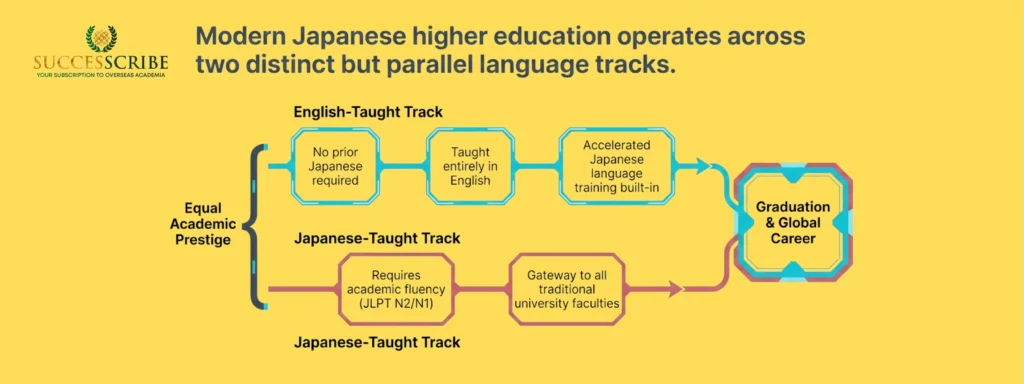
Modern Japanese higher education operates across two parallel tracks:
| JAPANESE HIGHER EDUCATION | |
| ENGLISH-TAUGHT TRACK | JAPANESE-TAUGHT TRACK |
| No prior Japanese required. | Requires academic fluency. |
| Taught entirely in English | JLPT N2 to N1 level needed. |
| Accelerated language training built into the curriculum. | Gateway to all traditional university faculties. |
- The English-Taught Track: Initiated under the historic Global 30 project and expanded into modern international faculties, these programs allow students to complete their entire degree in English. No prior Japanese language skills are required for admission, though intensive Japanese language courses are built into the curriculum to facilitate local employment later.
- The Japanese-Taught Track: This route grants access to all traditional faculties across Japan. It requires high academic fluency in Japanese, typically validated by achieving an N2 or N1 level on the Japanese Language Proficiency Test (JLPT).
Study in Japan for Indian Students After 12th (Undergraduate Pathways)
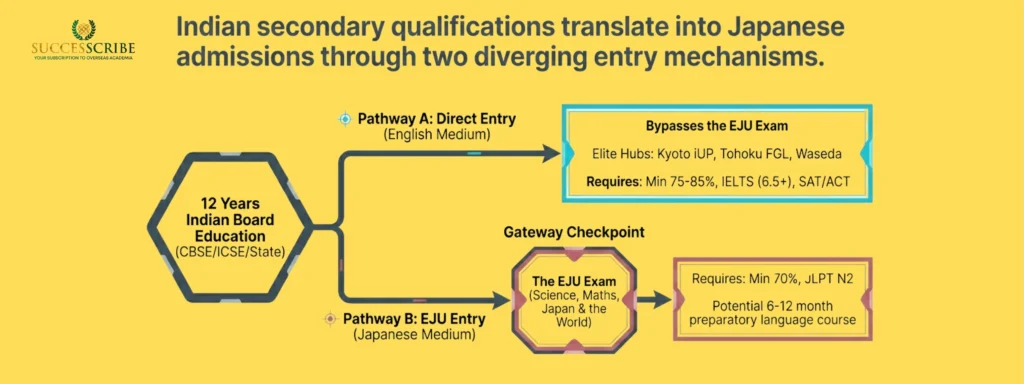
Securing admission directly after high school requires understanding how Japan evaluates the 12-year Indian secondary education system (CBSE, ICSE, and State Boards). Because the Japanese domestic school system leads into a strict application structure, Indian applicants must choose between two distinct pathways.
Pathway A: English-Medium Direct Entry (Bypassing the EJU)
If you do not speak Japanese but want to start your Bachelor’s degree immediately, you can apply directly to specialized English-taught undergraduate programs. Elite choices include:
- Kyoto University’s Kyoto iUP (International Undergraduate Program): A bilateral program providing a 6-month preparatory course followed by a 4-year degree where the language of instruction transitions from English to Japanese as your proficiency grows.
- Tohoku University’s FGL (Future Global Leadership): Offers specialized STEM courses taught entirely in English.
- Waseda University & Keio University: Offer dedicated English tracks in Social Sciences, Political Science, and Economics.
Requirements for this track: Standardized test scores (SAT, ACT, or Advanced Placements), high school transcripts, and English proficiency scores (IELTS or TOEFL). The Examination for Japanese University Admission (EJU) is not required for this pathway.
Pathway B: Japanese-Medium Entry & The Criticality of the EJU
To enter a standard degree program taught in Japanese, Indian students must take the EJU (Examination for Japanese University Admission for International Students).
EJU Mechanics in India: The EJU is conducted twice a year (June and November) under the supervision of the Embassy of Japan. In India, the primary examination center is managed by the Mombusho Scholars Association of India (MOSAI) in New Delhi.
The EJU is a comprehensive evaluation structured around two language options (English or Japanese) and covers the following subjects based on the student’s chosen track:
- Japanese as a Foreign Language: Evaluates reading comprehension, listening, and essay writing.
- Science: Applicants choose two subjects from Physics, Chemistry, or Biology (highly critical for STEM engineering tracks).
- Japan and the World: Tests basic knowledge in history, geography, and modern economics.
- Mathematics: Course 1 for Liberal Arts or Course 2 for advanced Science/Engineering lines.
Academic Eligibility Criteria & Admission Requirements (UG & PG)
Meeting the exact academic benchmarks and compiling robust financial proof are the most critical steps to successfully secure admission and study in Japan for Indian students at both undergraduate and postgraduate levels To maintain absolute transparency during your planning phase, the structural benchmarks required for successful admission into Japanese universities across different tracks are organized below.
| Educational Level & Track | Minimum Academic Score (Indian Scale) | Language Proficiency Benchmark | Standardized Tests Required | Core Prerequisite Conditions |
| Undergraduate (UG) – English Track | Minimum 75% to 85% aggregate in 12th Board Exams. | IELTS: 6.5+ or TOEFL iBT: 85+ (Waived if medium of instruction was entirely English). | SAT (Target: 1350+) or ACT (Target: 30+). AP tests highly recommended for STEM. | Completion of 12 years of formal education from a recognized board (CBSE/ICSE/State). |
| Undergraduate (UG) – Japanese Track | Minimum 70% aggregate in 12th Board Exams. | JLPT N2 level minimum or specific EJU Japanese section score greater than 220 points. | EJU Exam (Subjects customized to the chosen major). | 12 years of formal education; completion of a 6-to-12-month preparatory Japanese course if needed. |
| Postgraduate (PG) – English Track | Minimum 60% or 6.5/10 CGPA in a 3 or 4-year Bachelor’s degree. | IELTS: 6.5+ or TOEFL iBT: 88+. | GRE (Highly recommended for STEM; Target 315+) or GMAT (For MBA; Target 620+). | 16 years of total formal education (12+4 or 12+3+1 structural year equivalent). |
| Postgraduate (PG) – Japanese Track | Minimum 60% or equivalent CGPA in a Bachelor’s degree. | JLPT N1 level strongly preferred (N2 acceptable for technical engineering disciplines). | Institutional Entrance Exams or specialized EJU Graduate evaluation modules. | 16 years of formal education; verified alignment between prior undergraduate thesis and proposed research. |
General Requirements for All Levels
Beyond academic and language-specific criteria, several general documents and requirements apply to all international students:
| Statement of Purpose (SOP) | A personal essay articulating your academic goals, reasons for choosing Japan and the specific university/program, and how this experience aligns with your future aspirations. A strong SOP can significantly boost your application. |
| Letters of Recommendation (LORs) | Typically, two to three letters from academic professors or employers who can attest to your academic abilities, character, and potential for success in a Japanese academic environment. |
| Valid Passport | A passport with sufficient validity (usually at least six months beyond your intended stay) is essential for visa application and international travel. |
| Proof of Financial Means | Applicants must demonstrate that they have sufficient funds to cover their tuition fees and living expenses for at least the first year of study. This is a crucial requirement for obtaining a Certificate of Eligibility (CoE) and subsequently the student visa. The required amount can vary but typically ranges from ₹12–14 lakh for the first year . This can be shown through bank statements, scholarship letters, or sponsorship declarations. |
Demystifying the “Kenkyusei” (Research Student) System
Indian BSc, BCom, and BCA graduates with 15 years of education face a “gap” when applying for Japanese Masters (which require 16 years). The Kenkyusei (Research Student) status serves as a 6-to-12-month bridge. Critically, for MEXT scholars, this preparatory year is fully stipend-funded. This is a vital risk-mitigation strategy; it allows students to adapt to Japanese lab culture and language without financial strain before formally commencing their degree.
| THE POSTGRADUATE ENTRY PATHWAY | |
| Step 1: Kenkyusei Status | Spend 6-24 months auditing classes, working in a professor’s lab, and learning the research methodology. |
| Step 2: Entrance Examination | Sit for the university’s internal Graduate Entrance Exam while living in Japan |
| Step 3: Regular Graduate Student | Formally enroll in the Master’s (Shuishi) or Ph.D. (Hakase) program |
Top Universities in Japan for Indian Students
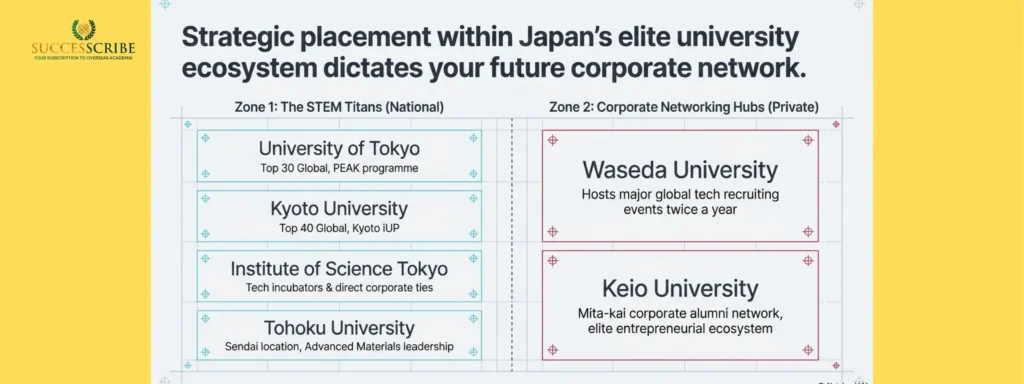
Japan’s higher education system features elite national institutions alongside historic private entities. From elite Imperial institutions like Tokyo and Kyoto Universities to corporate giants like Waseda, the top universities available to study in Japan for Indian students offer unrivaled global prestige and direct recruitment pipeline. The table below details the top ten institutions configured for international student integration.
| University Name | Sector Classification | Global Rank Tier (QS/THE 2026) | Elite English-Taught Programs / Initiatives | Key International & Indian Support Infrastructure |
| University of Tokyo (Todai) | National / Imperial | Top 30 Global | PEAK (Programs in English at Komaba), Global Science Course (GSC). | Dedicated International Support Desk; extensive alumni network within top Indian tech hubs. |
| Kyoto University (Kyodai) | National / Imperial | Top 40 Global | Kyoto iUP, International Management Program (MBA). | Multilingual counseling networks; comprehensive campus housing priority for first-year arrivals. |
| Institute of Science Tokyo (Formerly Tokyo Tech + TMDU) | National / Technical | Top 60 Global | Global Scientists and Engineers Program (GSEP), International Graduate Program (IGP). | Tech incubator labs with direct corporate ties; specialized English administrative tracking. |
| Tohoku University | National / Imperial | Top 80 Global | Future Global Leadership (FGL) Bachelor’s, Advanced Materials Sciences Graduate tracks. | Located in Sendai (lower cost of living); dedicated university housing and peer-mentorship setups. |
| Osaka University | National / Imperial | Top 90 Global | Human Sciences International Undergraduate Degree, Biotechnology Global Course. | English-medium administrative desks; career placement centers paired with Kansai industries. |
| Nagoya University | National / Imperial | Top 110 Global | G30 International Programs (Automotive Engineering, Physics, Chemistry). | Deep integrations with Toyota Motor Corporation network; specialized STEM career tracks. |
| Kyushu University | National / Imperial | Top 130 Global | International Undergraduate Program in Engineering, IUGC Resource Engineering. | Situated in Fukuoka (startup hub); lower cost of living; highly active international community. |
| Waseda University | Elite Private | Top 180 Global | School of Political Science & Economics (SPSE), Transnational Law, ICT Global Programs. | Career placement center that hosts major global tech recruiting events twice a year. |
| Keio University | Elite Private | Top 200 Global | GIGA Program (Environment & Information Studies), Double Degree Master’s frameworks. | Strong entrepreneurial ecosystem; vast corporate alumni network (Mita-kai). |
| Ritsumeikan University | Established Private | Top 600 Global | College of Global Liberal Arts (GLA – Dual Degree with ANU), Information Science and Engineering. | Dedicated international student dormitories; localized job hunting support for English speakers. |
While the national universities are titans of STEM research, private universities like Keio and Waseda are strategic choices for Business and International Relations, offering extensive networking opportunities with the Tokyo-based corporate elite.
Best Courses to Study in Japan in 2026
Japan aligns its curriculum with the “Careers of the Future,” focusing on sectors where it maintains a global technological monopoly.
| Course Field | Reason for Selection | Key Industry Partners |
| Ethical AI & Society | Focus on AI governance and human-centric tech. | SoftBank, Sony AI |
| Climate Solutions Engineering | Research into hydrogen tech and carbon capture. | Mitsubishi, Toyota |
| Robotics (Elderly Care) | Addressing aging demographics with automation. | Panasonic, Fanuc |
| Biotechnology Innovation | Advancing regenerative medicine and longevity. | Takeda, Astellas |
| Global Cultural Heritage | Digital preservation and creative industries. | Nintendo, Studio Ghibli |
These courses are designed to address the specific 2026 challenge: how to choose a career that is yet to come. By focusing on Ethical AI and Climate Engineering, students are not just learning a trade; they are partnering with the Japanese state to solve global existential challenges.
Most In-Demand Courses in Japan
| Field | Demand Level | Career Opportunities |
| Artificial Intelligence | Very High | AI Engineer, Research Scientist |
| Data Science | Very High | Data Analyst, Data Scientist |
| Computer Science | Very High | Software Developer |
| Robotics | Very High | Robotics Engineer |
| Semiconductor Engineering | Very High | Chip Design, Manufacturing |
| Mechanical Engineering | High | Manufacturing, Automotive |
| Automotive Engineering | High | Vehicle Design and Development |
| Biotechnology | High | Research and Healthcare |
| Renewable Energy | High | Sustainability Sector |
| Business Administration | High | Corporate Management |
| International Business | High | Global Trade and Consulting |
| Healthcare | High | Medical Support Industries |
| Nursing | High | Healthcare Service |
| Tourism & Hospitality | Growing | Hotels and Tourism |
| Animation and Game Design | Growing | Creative Industries |
Tuition Fees & Cost of Living to Study in Japan for Indian Students
Understanding the financial aspects of studying in Japan is crucial for Indian students. This section provides a detailed breakdown of tuition fees and living expenses, offering a realistic picture of the investment required.
Tuition Fees
The tuition fees in Japan vary significantly depending on the type of institution (national, public, or private) and the level of study (junior college, undergraduate, or graduate school). Generally, national and public universities have lower fees compared to private institutions.
| University Classification | Phase of Study | Average Fee in Japanese Yen (JPY) | Approximate Equivalent in Indian Rupees (INR) | Additional Mandatory Institutional Expenses |
| National Universities (e.g., Tokyo, Kyoto, Tohoku) | Undergraduate / Graduate | ¥535,800 / year | ₹3,05,000 INR | One-time Admission Fee: ¥282,000 (₹1,60,000 INR). |
| Public Universities (Local Government Administered) | Undergraduate / Graduate | ¥538,000 to ¥600,000 / year | ₹3,06,000 to ₹3,42,000 INR | One-time Admission Fee: ¥280,000 to ¥400,000 (higher for non-residents). |
| Private Universities (STEM / IT Tracks) | Undergraduate / Graduate | ¥1,200,000 to ¥1,600,000 / year | ₹6,84,000 to ₹9,12,000 INR | One-time Admission Fee: ¥200,000 to ¥300,000; Facility/Lab fees: ¥150,000/year. |
| Private Universities (Liberal Arts / Business) | Undergraduate / Graduate | ¥900,000 to ¥1,300,000 / year | ₹5,13,000 to ₹7,41,000 INR | One-time Admission Fee: ¥200,000; Standard registration fees apply. |
Itemized Monthly Cost of Living Matrix
Living costs vary significantly depending on whether you reside in a major metropolitan center or a regional hub.
| Expense Category | Tokyo / Osaka Metropolitan Hubs (JPY) | Regional Cities (Fukuoka/Sendai) (JPY) | Average Cost in INR (Metropolitan) |
| Accommodation / Rent | ¥45,000 (Dorm) to ¥75,000 (Private) | ¥25,000 (Dorm) to ¥45,000 (Private) | ₹25,600 to ₹42,700 INR |
| Food & Monthly Groceries | ¥35,000 to ¥45,000 | ¥25,000 to ¥35,000 | ₹19,900 to ₹25,600 INR |
| Utilities (Gas, Electricity, Water) | ¥10,000 to ¥13,000 | ¥8,000 to ¥10,000 | ₹5,700 to ₹7,400 INR |
| National Health Insurance (NHI) | ¥1,500 to ¥2,500 (Based on student income) | ¥1,500 to ¥2,000 | ₹850 to ₹1,420 INR |
| Mobile Data & High-Speed Internet | ¥4,000 to ¥6,000 | ¥3,500 to ¥5,000 | ₹2,280 to ₹3,420 INR |
| Local Commuting & Transportation | ¥5,000 to ¥10,000 (Student pass discounts) | ¥3,000 to ¥6,000 | ₹2,850 to ₹5,700 INR |
| Total Estimated Monthly Outflow | ¥100,500 to ¥151,500 | ¥66,000 to ¥103,000 | ₹57,180 to ₹86,290 INR |
Scholarships for Indian Students to study in Japan
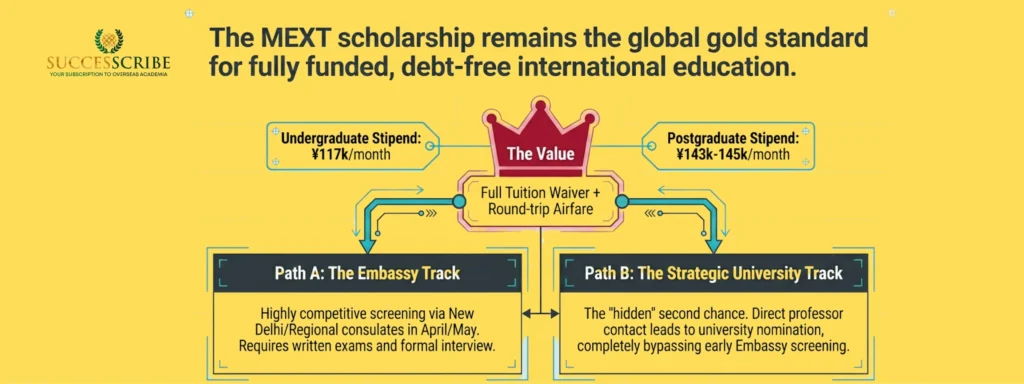
The Japanese Government (MEXT) scholarship is the gold standard of international funding, offering a debt-free education.
MEXT Scholarship Categories (2026/27 Cycle)
| Category | Monthly Stipend | Full Tuition Waiver | Airfare Included |
| Research (Masters/PhD) | JPY 143k – 145k | Yes | Yes |
| Undergraduate | JPY 117k | Yes | Yes |
| KOSEN / Specialized | JPY 117k | Yes | Yes |
| Young Leaders (YLP) | JPY 242k | Yes | Yes |
- Plan A (Embassy Track): Applications open around April/May each year through the Embassy of Japan in New Delhi and regional consulates (Mumbai, Chennai, Kolkata). Selection involves an initial document screening, competitive written examinations (covering English, Mathematics, and Sciences for STEM), and an interview.
- Strategic Plan B (University Track): While the “Embassy Track” is the most famous, it is highly competitive. The University Track is a “hidden” second chance. Students can contact Japanese professors directly; if a professor recommends you, the university can nominate you for the same full MEXT scholarship, bypassing the initial Embassy screening.
JASSO Honors Scholarship
Managed by the Japan Student Services Organization, this scholarship offers ¥48,000 per month (₹27,300 INR) for one calendar year. It is awarded to high-achieving self-financed international students who score well on the EJU or demonstrate strong performance in university courses.
Top Private and Foundation Scholarships
- Honjo International Scholarship Foundation: Provides monthly stipends ranging from ¥150,000 to ¥210,000 for postgraduate researchers, focusing on independent academic potential.
- Asian Development Bank – Japan Scholarship Program (ADB-JSP): Covers full tuition and living costs for development-related Master’s degrees at selected participating universities.
- Panasonic Scholarship: Targets promising engineering and tech applicants from India pursuing postgraduate degrees.
Document Checklist & Application Timelines (Intakes)
Japanese universities operate primarily across two academic intakes:
| Academic Intakes in Japan | |
| SPRING INTAKE (APRIL ENTRY) | AUTUMN INTAKE (OCTOBER ENTRY) |
| The primary domestic intake.Alignment with company hiring.Apply: June to September of the preceding year. | The primary intake for English – taught tracks.Apply: November to February of the same academic year. |
Master Document Checklist for Indian Applicants
Before submitting your application, ensure you have compiled the following essential documents:
- Academic Records: Official transcripts and passing certificates for 10th and 12th standards (for undergraduate applicants) or your Bachelor’s degree ledger (for postgraduate applicants).
- Apostille Verification: Educational certificates may need an Apostille or official notarization from the Ministry of External Affairs (MEA), Government of India.
- Language Proficiency Test Scorecards: Original score certificates for IELTS, TOEFL, or JLPT.
- Academic References: Two letters of recommendation signed by institutional faculty members or department heads on official letterhead.
- Financial Viability Proof: Bank balance certificates showing the primary sponsor has liquid funds of at least ¥2,000,000 (₹11,40,000 INR) to cover initial tuition and living expenses.
- Income Proof of Sponsor: Income tax return statements (ITRs) covering the past two assessment years, along with a signed Letter of Financial Sponsorship.
- Statement of Purpose (SOP): A detailed personal essay outlining your academic goals and explaining why you want to study in Japan.
The Japan Student Visa and Document Roadmap
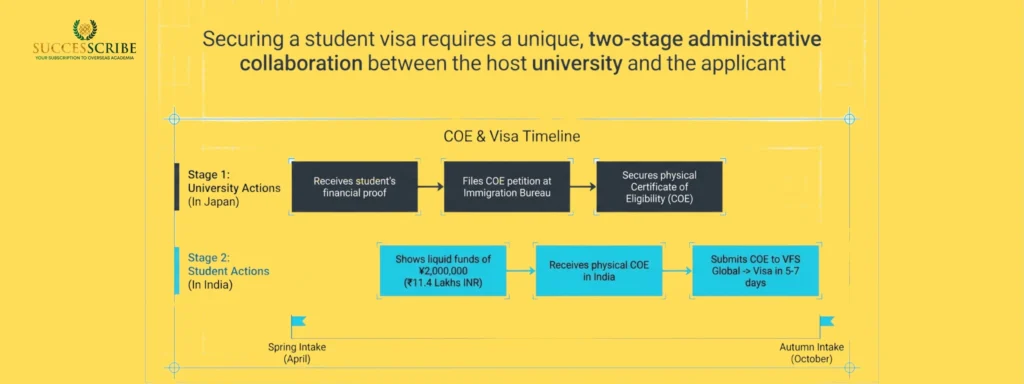
Understanding the two-stage university-driven immigration layout is essential for obtaining a Certificate of Eligibility and smoothly securing the visa required to study in Japan for Indian students. Securing a student visa for Japan involves a unique, two-stage application process. You cannot apply for a visa directly until your host university secures a Certificate of Eligibility (COE) on your behalf.
Stage 1: UNIVERSITY DRIVEN
- Student submits financial proof to the University
- University files COE petition at the Immigration Bureau in Japan
- Japan Immigration approves and issues the physical COE.
STAGE 2: STUDENT DRIVEN
- University sends physical COE to the student in India
- Student submits COE + passport to VFS Global / Japan Embassy.
- Passport stamped with Student Visa within 5-7 working days.
Mandatory Document Checklist
| Document Type | Specific Requirement |
| Passport | Valid for at least 6 months beyond stay. |
| Transcripts | Attested 10th, 12th, and Degree mark sheets. |
| SOP | Clear narrative on “Why Japan” and career goals. |
| Financial Proof | Bank statement showing JPY 1.5M+ (if not on MEXT). |
| Health Certificate | Medical clearance from a recognized Indian clinic. |
Critical Rejection Pitfalls and Prevention Strategies
- Mismatched Financial Documentation: If the balance certificate figures do not align with your sponsor’s declared annual income tax files, immigration authorities may request additional clarification. Ensure all financial declarations are transparent and consistent.
- Unclear Academic Progression: If you are transitioning between unrelated academic fields (such as switching from a Bachelor’s in Commerce to a Master’s in Data Science), your Statement of Purpose must clearly explain your motivations and academic bridge work.
Stop Mentioning Anime: Cracking the Embassy Interview
The most common mistake Indian students make is focusing on cultural consumption during their Embassy interviews. While loving anime is fine, it won’t get you a scholarship. The Embassy is looking for “Ambassadors of Industry” – individuals who can act as a “bridge” between India and Japan.
To succeed, you must demonstrate a “Bridge Mindset.” Don’t just say you want to study robotics because Japan is advanced. Instead, frame your goal strategically: “I intend to master Japanese robotics for elderly care to help Japan navigate its aging crisis, and then adapt those ethical AI frameworks to solve the healthcare delivery challenges in rural India.”
Whether your niche is Biotechnology, Climate Engineering, or Ethical AI, you must show how your presence in Japan creates a win-win scenario for both nations.
What is a Certificate of Eligibility (COE)?
The Certificate of Eligibility (COE) is one of the most important documents in the Japanese immigration process.
Before a student can apply for a visa, the sponsoring institution in Japan typically applies for the COE on behalf of the student.
The COE confirms that:
- The student has received admission.
- The institution is recognized.
- The student satisfies immigration requirements.
- Financial capability has been demonstrated.
Without a valid COE, the student visa process cannot proceed.
Working While Studying: Part-Time Regulations & Post-Graduate Work Visas
Self-financed international students can offset their living costs by taking advantage of part-time employment opportunities.
Legal Framework: The Part-Time Work Permit
To work part-time, you must obtain a permit called Shikakugai Katsudo Kyoka (Permission to Engage in Activity Other Than That Permitted Under the Status of Residence Previously Granted). This can be requested directly at immigration desks upon landing at major international airports like Haneda, Narita, or Kansai.
- Hourly Limitation: Students are legally permitted to work up to 28 hours per week while classes are in session, and up to 8 hours per day during official university semester breaks.
- Prohibited Sectors: International students are strictly legally barred from working in adult entertainment establishments, bars, gambling halls, or pachinko parlors, even in non-customer-facing roles like cleaning or dishwashing.
- The Winning Formula: In interviews for internships or part-time roles, Indian students should frame their value as a bridge. For example: “Using Indian software expertise to fuel Japanese Elderly Care Robotics.” This synthesis of Indian technical agility and Japanese hardware precision is exactly what Japanese employers seek to solve their domestic labor shortages.
Common Part-Time Work Options for International Students
| Job Designation | Language Requirement | Average Hourly Wage (JPY) | Earning Potential (28 Hours/Week) | Earning Potential in INR (Monthly) |
| English Language Tutor | Native/Fluent English; Basic Japanese. | ¥1,500 to ¥2,500 | ¥168,000 to ¥280,000 / month | ₹95,700 to ₹1,59,600 INR |
| IT Assistance / Coding Intern | Coding proficiency; English environment. | ¥1,400 to ¥2,000 | ¥156,800 to ¥224,000 / month | ₹89,300 to ₹1,27,600 INR |
| Convenience Store Clerk (e.g., 7-Eleven, Lawson) | Intermediate Japanese (JLPT N3 minimum). | ¥1,100 to ¥1,300 | ¥123,200 to ¥145,600 INR / month | ₹70,200 to ₹83,000 INR |
| Hotel / Hospitality Help | Basic conversational Japanese + English. | ¥1,150 to ¥1,400 | ¥128,800 to ¥156,800 / month | ₹73,400 to ₹89,300 INR |
| Food Prep / Kitchen Support | Minimal Japanese required. | ¥1,050 to ¥1,250 | ¥117,600 to ¥140,000 / month | ₹67,000 to ₹79,800 INR |
Stricter Work Visa Screening (2026 Updates)
As of 2026, the screening process for work visas, particularly the Gijinkoku visa (which encompasses Engineer/Specialist in Humanities/International Services) and the Specified Skilled Worker visa, has become increasingly stringent [6]. The era of automatically qualifying for a work visa after graduating from a Japanese language school is over. Immigration authorities are now scrutinizing applications more rigorously, focusing on:
- Relevance of Study to Work: There is a greater emphasis on “what you studied and what expertise you gained” and how it directly relates to the job you are applying for [6]. Applicants must clearly demonstrate how their academic background aligns with their prospective employment.
- Japanese Language Requirement for Gijinkoku Visa: A significant change effective April 15, 2026, is the addition of a formal Japanese language requirement for the Gijinkoku visa . While the specific level may vary, this indicates that a certain level of Japanese proficiency (e.g., N2 for some roles) is now expected for many professional positions, even if the primary work language is English. This change underscores the importance of acquiring strong Japanese language skills during one’s study period.
Note: The new rule only targets overseas applicants applying for a Certificate of Eligibility (COE) from outside Japan who are joining Tier 3 or Tier 4 companies (SMEs) for a role that explicitly requires Japanese. If an Indian student graduates from a Japanese university or vocational school, they are entirely exempt from this test requirement, as their local diploma serves as proof of integration. Furthermore, IT engineers hired from abroad for English-only environments remain largely unaffected.
These stricter measures aim to ensure that international graduates contribute meaningfully to the Japanese economy with relevant skills and language abilities. Therefore, students are strongly advised to not only excel academically but also to actively develop their Japanese language proficiency and clearly define their career vision while studying in Japan.
Career Outcomes and Residency Pathways
As the country transitions its macro-immigration policy toward active talent recruitment to solve its historic labor deficit, the decision to study in Japan for Indian students offers a direct, predictable fast-track to permanent residency. Japan is shifting its immigration policy from “selection” to “recruitment,” seeking 6.7 million workers by 2040.
Entry-Level Salary Benchmarks
| Profession | Annual JPY | Approx. Annual INR |
| IT/Software Engineer | 4.5M – 6.5M | 26.1L – 37.7L |
| Automotive Engineer | 4.0M – 6.0M | 23.2L – 34.8L |
| Data Scientist | 5.0M – 7.5M | 29.0L – 43.5L |
| Business Manager | 4.0M – 5.5M | 23.2L – 31.9L |
Residency Transformation Pathways
| Visa Type | Duration / Purpose |
| Designated Activities | 1-year stay-back for job hunting after graduation. |
| J-Find Visa | 2-year stay-back for top grads (job hunting/startup). |
| Pathway | Highly Skilled Professional track allows PR in as little as 1 year. |
Strategic Analysis: Advantages and Challenges
A balanced view is necessary to ensure that the “Pivot to the East” is a calculated decision.
| Strategic Advantages (Pros) | Critical Challenges (Risks) |
| 100% Scholarship potential (MEXT). | Social language barrier (outside campus). |
| Zero tuition volatility (Fixed Fees). | Highly structured societal norms/discipline. |
| Massive residency demand (Talent crunch). | Rigorous lab culture and expectations. |
| Strategic proximity to Indian growth. | Initial cultural shock (Omotenashi). |
The Kenkyusei bridge serves here as a critical risk-mitigation tool, allowing students to test the “cultural fit” of a laboratory environment before committing to a full degree.
Conclusion
Japan is successfully shifting its identity from a traditional study destination to a dedicated career development partner. We are entering an era where careers in Biotechnology, Space Technologies, and Advanced Manufacturing will define the global economy. Japanese universities are not just teaching these subjects; they are the labs where these industries are being born. “Study in Japan for Indian Students” is no longer just a tagline; it is a strategic response to the volatility of Western education markets. Japan offers the most stable, high-ROI career launchpad for 2026, combining 100% funding opportunities with a direct pathway to permanent residency in a top-tier global economy.
FAQs
Question. Is it possible to study in Japan for Indian students after 12th without knowing any Japanese?
Answer. Yes, absolutely. You can apply directly to specific English-medium Bachelor’s tracks (such as Kyoto University’s Kyoto iUP, Tohoku University’s FGL, or Waseda’s specialized ICT programs). These elite programs do not require prior Japanese language proficiency for your initial admission.
Instead, they feature intensive, accelerated Japanese language modules built directly into the first two years of the degree. However, if you want to enter a standard, traditional Japanese-taught program right after high school, you will be required to pass the EJU (Examination for Japanese University Admission) and typically demonstrate a JLPT N2 level of proficiency before your first day of class.
Question. How much money do I need to show in my bank account to secure a Japanese Student Visa / COE?
Answer. To receive a seamless approval for your Certificate of Eligibility (COE) and subsequent student visa, immigration authorities expect proof of financial capacity showing at least ¥2,000,000 (₹11,40,000 INR) for a one-year academic stay.
This total must be shown as liquid funds maintained within an accessible savings account, fixed deposits (FDs), or an official education loan sanction letter from a recognized Indian bank. The amount should also align transparently with the past two assessment years of your primary sponsor’s Income Tax Returns (ITRs).
Question. Is a gap year acceptable when applying to study in Japan after the 12th standard?
Answer. Yes, within a reasonable timeframe. A gap of 1 to 2 years – often used for entrance exam preparation, engineering entrance coaching, or foundational language learning – is widely accepted by Japanese university admissions boards.
However, you must clearly document your activities during this time within your Statement of Purpose (SOP). Substantial, unexplained gaps with no proof of productivity or study can cause friction when your documents undergo review by the Immigration Services Agency of Japan.
Question. Can I get a job in Japan if my entire university degree was taught exclusively in English?
Answer. Yes, you can. Global technology and corporate enterprises headquartered in Japan (such as Rakuten, Mercari, Line, and Fast Retailing/Uniqlo) have transitioned to using English as their official internal corporate operating language. They actively recruit international tech, engineering, and global management talent.
That being said, while an English-taught degree provides an entry point into these global companies, acquiring conversational or business-level Japanese (JLPT N3 to N2) will open up a significantly wider spectrum of long-term career growth and lateral mobility within traditional Japanese industries.
Related Post
Highest Paying MBA Specialization
Toughest exams in the world
Hardest degrees in the world
Highest paying jobs in World