Europe has long been a global leader in management education, attracting thousands of ambitious professionals from across the world every year. From the bustling financial hubs of London and Paris to the innovation-driven economies of Germany, Switzerland, and the Netherlands, Europe offers a diverse and world-class environment for pursuing an MBA.
What makes the European MBA experience stand out is its global perspective, shorter duration, high ROI (Return on Investment), and post-graduation career opportunities across multinational industries. Europe has earned its place as one of the most sought-after destinations for business education, with the Top MBA Colleges in Europe consistently ranking among the world’s best. According to the Financial Times Global MBA Rankings, nearly 35% of the world’s top 100 business schools are located in Europe – highlighting the continent’s strong educational ecosystem. With institutions like HEC Paris, London Business School, INSEAD, IESE, and SDA Bocconi, Europe continues to set benchmarks in management education, research, and leadership development.
Key Highlights: Top MBA Colleges in Europe
- Overview of the top 30 MBA colleges in Europe with global recognition.
- Reasons why Europe is a leading destination for MBA aspirants.
- Admission requirements and acceptance rates at leading business schools.
- Details on tuition fees and living costs
- Career prospects and salary opportunities after an MBA in Europe.
- Conclusion
FAQs
Top 30 MBA Colleges in Europe
This comprehensive list of the Top MBA Colleges in Europe highlights institutions that combine academic excellence, international exposure, and strong post-MBA employment outcomes. Whether it’s HEC Paris, INSEAD, or London Business School, these universities represent the pinnacle of management education across the continent.
| University Name (Business School Name) | Country | Average Salary After MBA (EUR/USD) | Duration (Months) |
| HEC Paris | France | €130,000 / $140,000 | 16 months |
| London Business School (LBS) | United Kingdom | €125,000 / $135,000 | 15–21 months |
| INSEAD | France / Singapore | €115,000 / $125,000 | 10 months |
| University of Cambridge (Judge) | United Kingdom | €110,000 / $120,000 | 12 months |
| University of Oxford (Said) | United Kingdom | €108,000 / $118,000 | 12 months |
| IESE Business School | Spain | €105,000 / $115,000 | 15–19 months |
| IE Business School | Spain | €100,000 / $110,000 | 11 months |
| Esade Business School | Spain | €98,000 / $107,000 | 12–18 months |
| SDA Bocconi School of Management | Italy | €95,000 / $104,000 | 12 months |
| IMD Business School | Switzerland | €130,000 / $140,000 | 12 months |
| ESCP Business School | France | €92,000 / $100,000 | 12 months |
| ESSEC Business School | France | €90,000 / $98,000 | 12–15 months |
| Copenhagen Business School | Denmark | €88,000 / $95,000 | 12 months |
| Imperial College Business School | United Kingdom | €102,000 / $110,000 | 12 months |
| Warwick Business School | United Kingdom | €90,000 / $100,000 | 12 months |
| Mannheim Business School | Germany | €92,000 / $98,000 | 12 months |
| University of St. Gallen | Switzerland | €120,000 / $130,000 | 12 months |
| EMLyon Business School | France | €85,000 / $92,000 | 12 months |
| Frankfurt School of Finance & Management | Germany | €90,000 / $97,000 | 15 months |
| Rotterdam School of Management (Erasmus) | Netherlands | €88,000 / $94,000 | 12 months |
| Alliance Manchester Business School | United Kingdom | €95,000 / $102,000 | 15–18 months |
| Amsterdam Business School | Netherlands | €90,000 / $98,000 | 12 months |
| POLIMI Graduate School of Management | Italy | €80,000 / $87,000 | 12 months |
| Grenoble Ecole de Management | France | €84,000 / $90,000 | 12–15 months |
| University of Edinburgh Business School | United Kingdom | €88,000 / $94,000 | 12 months |
| Cranfield School of Management | United Kingdom | €92,000 / $98,000 | 12 months |
| WHU – Otto Beisheim School of Management | Germany | €100,000 / $108,000 | 12 months |
| Leeds University Business School | United Kingdom | €82,000 / $88,000 | 12 months |
| EDHEC Business School | France | €92,000 / $99,000 | 10–12 months |
Apply to Top European Universities
Make your application simple and stress-free with Successcribe
Get Expert Help NowKey Observations from the Rankings
When analyzing the Top MBA Colleges in Europe, it’s evident that each region offers unique strengths – the UK dominates in finance and consulting, France leads in luxury and innovation, and Spain excels in entrepreneurship and leadership. These insights demonstrate why Europe continues to attract top global MBA talent.
- UK Dominance: The United Kingdom hosts 8 of the top 30 schools, reflecting its historical strength in business education and London’s position as a global financial center. Despite Brexit uncertainties, UK business schools maintain strong appeal due to academic rigor, corporate connections, and the Graduate Route visa allowing two years of post-study work.
- French Excellence: France claims 7 positions in the top 30, showcasing its grandes écoles tradition of elite business education. French schools excel particularly in luxury brand management, consulting preparation, and entrepreneurship, leveraging France’s position as Europe’s second-largest economy.
- Spanish Innovation: Spain’s strong showing with 3 top-tier schools (IE, IESE, ESADE) reflects investments in innovative teaching methods, international orientation, and entrepreneurship ecosystems in Madrid and Barcelona.
- Value Propositions: German schools (Frankfurt, Mannheim, WHU) and some Dutch and Italian programs offer excellent value with lower tuition fees (€35,000-€60,000) while maintaining strong employment outcomes and solid international reputations.
- Switzerland’s Premium Positioning: IMD and St. Gallen command premium positions with exceptional salary outcomes reflecting Switzerland’s high-cost, high-salary economy and the schools’ focus on experienced professionals and executive education.
How Europe Became the Global Hub for MBA
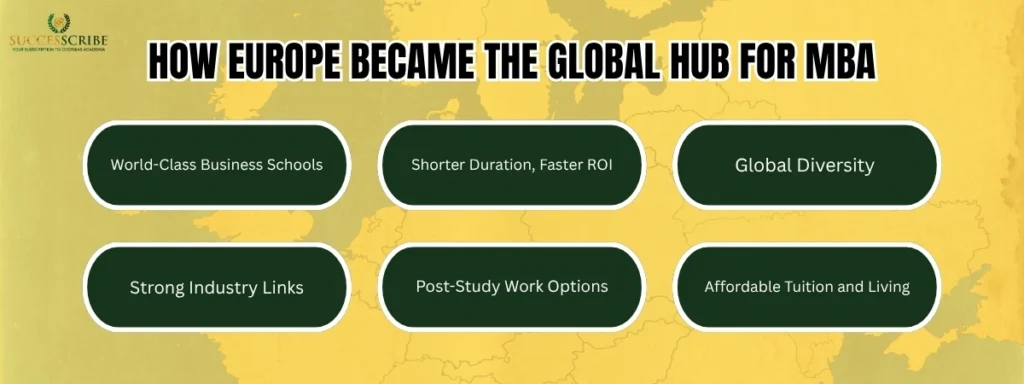
The Top MBA Colleges in Europe have transformed the continent into a global hub for management education. Their focus on cultural diversity, global mobility, and industry partnerships makes Europe an unparalleled destination for aspiring business leaders.
1. World-Class Business Schools
Europe hosts many globally recognized institutions – HEC Paris, INSEAD, and London Business School consistently rank in the top 10 worldwide for MBA programs.
2. Shorter Duration, Faster ROI
Most European MBAs are 12 to 18 months long, compared to the traditional 2-year programs in the U.S. This not only saves time but also reduces tuition and living costs – giving graduates a faster return on investment.
3. Global Diversity
European MBA cohorts are known for their international mix of students, with 80–95% of participants coming from outside the host country. This multicultural exposure builds global leadership skills and enhances networking opportunities.
4. Strong Industry Links
Europe is home to the headquarters of many top firms – including L’Oréal, Unilever, BMW, UBS, and Accenture – offering students direct access to global recruiters and internships.
5. Post-Study Work Options
Countries like Germany, France, and the Netherlands provide up to 18–24 months of post-study work visa to MBA graduates, enabling them to build careers in the European market.
6. Affordable Tuition and Living
In contrast to the U.S., many European countries offer MBA programs at 20–40% lower tuition costs, with some public universities providing partial funding or scholarships for international students.
Want to Study in Europe?
Start your journey with Successcribe’s free expert guidance
Book a Free Session NowAdmission Requirements for MBA Colleges in Europe
Admission criteria at the best European business schools vary slightly between institutions, but most European business schools share the following criteria:
| Admission Component | Description | Details / Range / Notes | Example / Top Universities Following |
| Academic Qualification | Minimum requirement for MBA eligibility | A Bachelor’s degree (3–4 years) from a recognized university in any discipline. Some programs prefer degrees in business, economics, or engineering. | HEC Paris, INSEAD, London Business School, Oxford (Said), IE Business School |
| Work Experience | Professional experience prior to applying | Generally 2–5 years of full-time work experience is required. Elite schools prefer 5–7 years for global exposure. | INSEAD (6 years avg.), LBS (5 years), IESE (4.5 years) |
| GMAT / GRE Score | Standardized test for management aptitude | GMAT: 650–730 average range; GRE: Quant 160+, Verbal 155+. Some schools accept GMAT waivers for exceptional profiles. | London Business School (avg. GMAT 710), HEC Paris (690), SDA Bocconi (650) |
| English Language Proficiency | For non-native English speakers | IELTS: 6.5–7.5 band overall; TOEFL iBT: 90–110; PTE: 65–75. Some waive this if prior education was in English. | Cambridge Judge, Esade, Mannheim, Imperial College Business School |
| Letters of Recommendation (LORs) | Validation of academic and professional competence | Usually 1–2 LORs required from current or former supervisors, professors, or mentors. Should highlight leadership, teamwork, and problem-solving ability. | IE, INSEAD, EMLyon, Frankfurt School of Finance |
| Statement of Purpose (SOP) / Personal Essays | Written essays to assess motivation and career goals | 2–4 detailed essays covering career aspirations, leadership examples, and why you’re choosing the particular school. | HEC Paris, Esade, SDA Bocconi, Oxford (Said) |
| Resume / CV | Professional summary of achievements | 1–2 page professional CV showcasing educational background, roles, responsibilities, measurable impact, and skills. | Required by all top European schools |
| Interview Round | Assessment of fit and personality | Conducted after shortlisting; can be in-person, video, or virtual. Evaluates leadership potential, clarity of goals, and interpersonal skills. | LBS, IESE, INSEAD, Esade |
| Application Fee | Non-refundable fee for processing applications | Usually between €100–€250 depending on school. | LBS (€200), INSEAD (€250), IE (€150) |
| GPA / Academic Performance | Overall undergraduate academic standing | Strong academic record (minimum GPA of 3.0/4.0 or equivalent). Some schools require transcripts evaluated if degree is from outside the EU. | St. Gallen, Rotterdam (RSM), Warwick, Imperial |
| Professional Certifications (Optional) | Adds strength to technical or finance backgrounds | Certifications like CFA, CPA, PMP or digital marketing credentials can strengthen your profile. | Frankfurt School, EDHEC, Mannheim |
| Diversity / International Exposure | Added value for global MBA programs | Preference for applicants with cross-cultural experience or international assignments. | INSEAD, Esade, IMD, HEC Paris |
| Application Deadlines | Typically multiple rounds of application | Most schools have 3–5 rounds between September and May each year. Early applications improve scholarship chances. | Oxford (Said), Cambridge (Judge), Esade |
| Age Range (Typical) | Not a strict criterion but indicates average class profile | European MBA cohorts generally range from 26–33 years. | IMD (32 avg.), LBS (29 avg.), HEC (30 avg.) |
| Scholarship Consideration | Merit- or need-based financial support | Automatic consideration in many cases; separate applications needed for certain named scholarships. | Erasmus+, HEC Foundation, INSEAD Women’s Scholarship |
MBA acceptance rate in Europe’s top universities
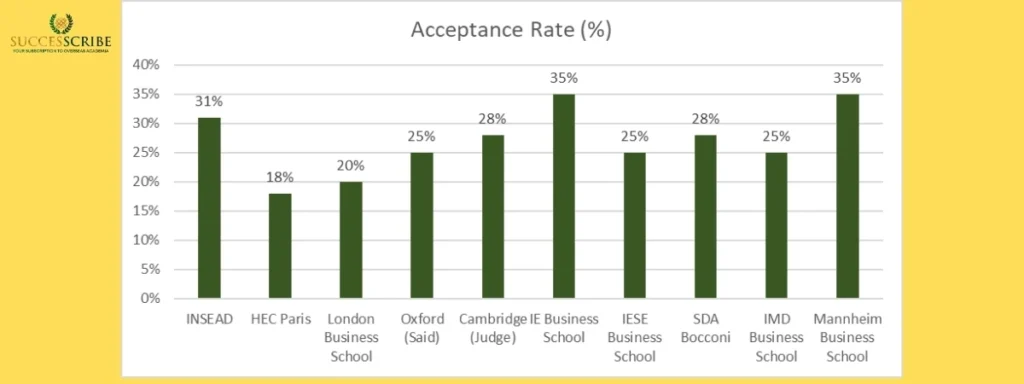
European MBA programs are highly competitive, with acceptance rates ranging from 10% to 35%. Below is a comparative table:
| University | Acceptance Rate (%) |
| INSEAD | 31% |
| HEC Paris | 18% |
| London Business School | 20% |
| Oxford (Said) | 25% |
| Cambridge (Judge) | 28% |
| IE Business School | 35% |
| IESE Business School | 25% |
| SDA Bocconi | 28% |
| IMD Business School | 25% |
| Mannheim Business School | 35% |
Visa Requirements for Studying MBA in Europe
Students admitted to the Top MBA Colleges in Europe benefit from supportive visa policies and generous post-study work opportunities, enabling them to gain valuable international experience and build global careers. Post-Brexit, the UK has its own process, while the rest of Europe operates under the Schengen Area rules.
For the UK
The UK has implemented a points-based immigration system. To succeed, you must accumulate 70 points, which are broken down as follows:
You will need to prove
- A Confirmation of Acceptance for Studies (CAS) from your university (50 points): This is the most important document. Your business school will issue this electronic certificate once you have met all their conditions and paid any required deposit. It has a unique reference number you will use in your application.
- Financial Requirements (10 points): You must demonstrate you can support yourself and pay for your course. You’ll need to show:
- Tuition Fees: Enough to cover the first year of your tuition fees (as stated on your CAS).
- Living Costs: £1,334 per month for up to 9 months for studies in London (total £12,006), or £1,023 per month outside London (total £9,207).
- You must have this money in your account for a consecutive 28-day period (ending no more than 31 days before your application date).
- English Language Proficiency (10 points): This is typically automatically satisfied if you are studying at a degree level (MBA) at a licensed student sponsor (your university). Your CAS will confirm this.
Key Features of the UK Student Visa:
- Healthcare Surcharge: You must pay the Immigration Health Surcharge (IHS) as part of your application, which gives you access to the UK’s National Health Service (NHS).
- The Graduate Route (Post-Study Work): This is a major benefit. Upon successful completion of your MBA, you can apply to stay in the UK for 2 years (3 years for PhD graduates) to work, or look for work, at any skill level without needing a sponsor.
For the Schengen Area (e.g., France, Spain, Germany, Netherlands):
The Schengen Area comprises most EU countries (e.g., France, Spain, Germany, Italy, Netherlands) and allows for border-free travel between them. You will apply for a national visa from the specific country where you will be studying.
The core requirements are generally consistent, though specifics can vary:
- Proof of Admission: An unconditional acceptance letter from your accredited European business school.
- Proof of Financial Means: You must demonstrate you have sufficient funds to cover your living expenses without needing employment. This can be proven through:
- Bank statements.
- A formal sponsorship letter.
- A blocked account (e.g., in Germany, a Sperrkonto with over €12,000 is often required).
- A grant or scholarship confirmation.
- Valid Health Insurance: You must have comprehensive health insurance coverage that is valid in the host country for the entire duration of your stay. This is non-negotiable.
- Accommodation Proof: A rental contract or a formal letter from a resident confirming your accommodation arrangements.
- Clean Criminal Record: A police clearance certificate from your country of residence.
Post-Study Opportunities in the Schengen Area:
Most countries offer a dedicated post-study work permit, allowing you to stay and seek employment. This is a critical factor in your decision-making.
- France: Graduates can apply for a 12-month temporary residence permit (APS – Autorisation Provisoire de Séjour) to seek employment or start a business. Once you secure a job meeting a certain salary threshold, you can apply for a multi-year “Talent Passport” residence permit.
- Germany: You can apply for an 18-month residence permit to look for a job related to your qualification. Once you find a job, you can convert this into a standard EU Blue Card or work permit.
- Spain: After graduation, you can apply for a “Stay Permit for Job Search” for 12 months.
- Netherlands: Non-EU graduates can apply for an orientation year permit (“Zoekjaar”) for 12 months to seek employment under less restrictive conditions.
Tuition Fees and Cost of Living for MBA Students in Europe
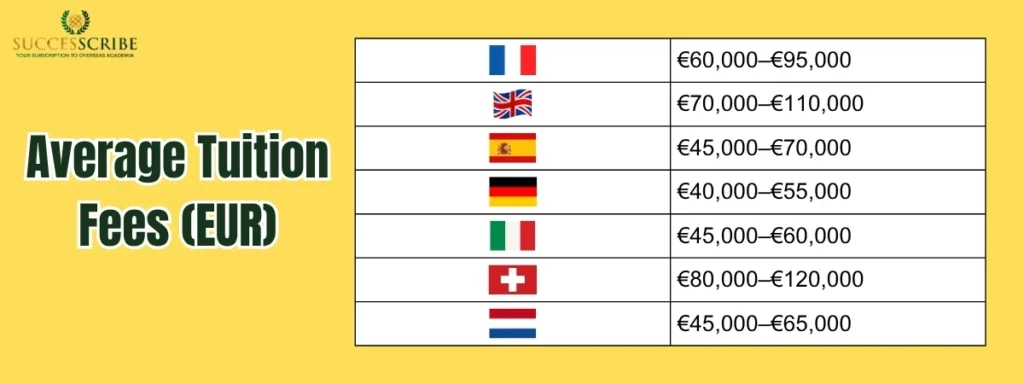
European MBA fees depend on the program’s prestige and duration. Here’s a country-wise estimate:
| Country | Average Tuition Fees (EUR) | Average Living Costs (EUR/year) |
| France | €60,000–€95,000 | €12,000–€18,000 |
| United Kingdom | €70,000–€110,000 | €15,000–€20,000 |
| Spain | €45,000–€70,000 | €10,000–€14,000 |
| Germany | €40,000–€55,000 | €9,000–€12,000 |
| Italy | €45,000–€60,000 | €10,000–€13,000 |
| Switzerland | €80,000–€120,000 | €20,000–€25,000 |
| Netherlands | €45,000–€65,000 | €12,000–€16,000 |
Salary and Career Opportunities After an MBA in Europe
Completing an MBA in Europe opens up a broad range of career possibilities – from consulting and finance to tech, luxury management and operations. The exact path, salary and growth will depend on your pre-MBA work experience, specialisation, geographic location, and the business school’s brand. Graduating from one of the Top MBA Colleges in Europe opens doors to lucrative global careers, with alumni excelling in consulting, finance, technology, and entrepreneurship across multinational companies. Here’s a breakdown of what you can expect, and how to maximise your return on investment.
Typical Post-MBA Roles and Salary Ranges in Europe
| Role / Job Title | Approximate Salary Range (EUR/year) | Notes / Factors |
| Management Consultant | €100,000 – €140,000+ | Top consulting firms (e.g., MBB) pay higher; role often demanding. |
| Investment Banking / Finance Director | €110,000 – €160,000+ | Big-city roles (London, Frankfurt, Zurich) and bonuses drive the high end. |
| Product Manager (Tech) | €90,000 – €130,000 | Particularly in tech hubs or global companies, salary + equity varies. |
| Strategy & Operations Manager | €85,000 – €120,000 | Managing large teams or business units lifts the upper part of the range. |
| Marketing / Brand Manager (Luxury, FMCG) | €80,000 – €110,000 | Luxury or global brands often pay more; experience matters. |
| General Operations / Supply Chain Manager | €75,000 – €100,000 | Manufacturing/industry roles in Europe with MBA + experience. |
Conclusion
In essence, earning your MBA from one of the Top Colleges for MBA in Europe means joining a global community of visionary leaders, innovative thinkers, and high achievers shaping the future of business. For anyone seeking world-class education combined with cultural immersion and strong career outcomes, Europe remains the ultimate destination for MBA aspirants. For those with global ambitions, the Top MBA Colleges in Europe open the doors to a future filled with learning, leadership, and limitless opportunities.
FAQs
Which are the top colleges for MBA in Europe?
Some of the top colleges for MBA in Europe include HEC Paris, London Business School, INSEAD, IESE Business School, IE Business School, SDA Bocconi, Esade, Oxford (Saïd), Cambridge (Judge), and IMD Switzerland. These institutions are globally ranked for their academic excellence, ROI, and post-MBA employment opportunities.
How long does an MBA in Europe usually take?
Most European MBA programs are 1 year long, making them shorter than the typical 2-year programs in the U.S. Some schools, like London Business School or IESE, also offer flexible durations ranging from 12 to 21 months.
What is the average cost of studying an MBA in Europe?
The tuition fees for an MBA in Europe typically range between €40,000 and €100,000, depending on the university. Additional living expenses can average €10,000–€20,000 per year, varying by country and city.
Do European MBA colleges require the GMAT?
Yes, most top MBA colleges in Europe require a GMAT or GRE score. However, a few business schools such as IE Business School and ESCP Europe may offer waivers for candidates with strong academic or professional profiles.
What is the average salary after completing an MBA in Europe?
MBA graduates from top European business schools earn an average starting salary of €70,000–€120,000 per year. At elite institutions such as HEC Paris, INSEAD, and London Business School, salaries (including bonuses) can reach €140,000–€160,000+.
Related Post
Oldest universities in the World
Toughest exams in the world
Hardest degrees in the world
Highest paying jobs in Austria