Japan is an attractive option for students who want to build advanced skills in computer science while studying in a country known for technology, research and engineering. An MS in Computer Science Engineering in Japan can cover areas such as artificial intelligence, data science, robotics, software engineering, information security and computer systems.
Japanese universities also offer graduate programmes designed for international students, including programmes where courses and academic supervision are available in English. For Indian students, the choice usually comes down to the university, research area, language of instruction, total cost and admission requirements.
Why Study MS in Computer Science Engineering in Japan?
Japan provides more than just a tech-centered educational setting. Its universities have research connections with companies involved in robotics, electronics, automobiles, telecommunications, artificial intelligence and software. Here are some reasons students consider Japan for a master’s in computer science:
- Strong focus on research and technology: computer science masters programs in Japan often have a research component. The students get the opportunity to work along with the faculty members and research facilities in the areas like machine learning, computer vision, cybersecurity, robotics, etc. This may be very helpful for those students who want to pursue research, a PhD or a specialised technical career.
- English-taught study options: Japanese universities have increased the number of graduate courses offered in English. According to the Study in Japan website, some graduate schools provide degrees through programs where students can complete their course in English language. For example, Kyoto University’s Graduate School of Informatics has an International Program covering areas including Intelligence Science and Technology and Communications and Computer Engineering. These programmes provide instruction and academic supervision in English.
- Exposure to advanced industries: Japan has a large technology ecosystem covering robotics, automobiles, electronics, gaming, manufacturing and information technology. Studying in this environment can give computer science students opportunities to understand how technical concepts are applied outside the classroom.
- Relatively manageable university fees: In comparison to other countries that attract students as overseas study destinations, the fees for graduate schools in Japan may be considered moderately low. According to the official Study in Japan website, the average tuition fee in Japanese graduate schools is about ¥820,000 per year, although individual programmes can have different fees.
- Research-based learning: Instead of focusing only on classroom teaching, many Japanese master’s programmes involve laboratory work, research projects, seminars and a thesis. This makes Japan worth considering for students who already have a clear technical area they want to explore.
Requirements for MS in Computer Science Engineering in Japan
The requirements vary between universities and even between departments. A student applying for an MS in Computer Science Engineering in Japan should therefore check the admission guide of the specific graduate school before applying.
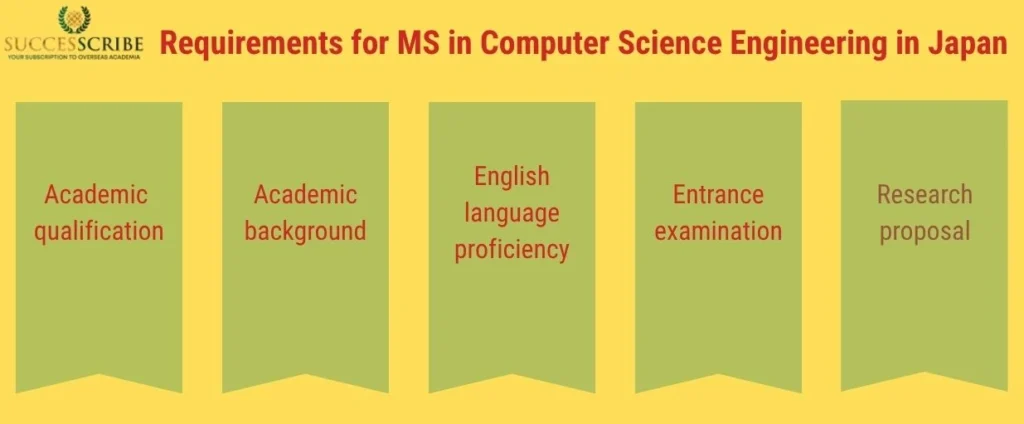
- Academic qualification: In order to qualify for a master’s programme, a general requirement is the bachelor’s degree or an equal level of higher education attained. According to Study in Japan Portal, the general condition for master’s programme applicants is to have completed a minimum of 16 years of formal education or be eligible through some other means. For students from India, bachelor’s degree in the relevant subject like BTech in Computer Science Engineering, BTech in Information Technology, BE in Computer Engineering, BSc Computer Science, BCA or other similar qualifications may be considered.
- Academic background: Universities may look at subjects studied during the bachelor’s degree, particularly mathematics, programming, algorithms, computer systems and other core computer science subjects. A strong academic record can be useful, particularly for research-oriented programmes.
- English language proficiency: English-taught courses will require the demonstration of English proficiency through English tests such as IELTS and TOEFL. According to the Study in Japan website, the standard requirement is 6.0 on IELTS or 75-80 on TOEFL iBT, but each university may have their own requirement. For example, the University of Tokyo’s Graduate School of Information Science and Technology states that TOEFL scores are used for its computer science admission.
- Entrance examination: Some universities in Japan make entrance examinations an important part of the selection process. Depending on the course, students may have to sit for written examinations, interviews, oral examinations or subject-based tests. According to the study in Japan guide, graduate school selection can involve document review, academic test, interview, essay and oral examinations.
- Research proposal: A research proposal can be an important part of applications to research-oriented master’s programmes. It is supposed to outline the field for research as well as the link between the applicant’s educational background and the chosen research. For example, a student interested in AI could propose research related to computer vision, natural language processing or machine learning.
Documents required
Depending on the university, applicants may need:
- Bachelor’s degree certificate
- Academic transcripts
- Passport
- CV or resume
- Statement of purpose
- Research proposal
- Letters of recommendation
- IELTS/TOEFL score
- Application form
- Application fee
Some universities may ask for additional documents or specific formats.
Top universities in Japan for Masters in Computer Science
There are many universities in Japan that offer programs in computer science, information science, and various engineering disciplines. Rather than just considering the name of the university, students should compare the specific department, curriculum and research laboratories.
| University | Relevant areas/programmes |
| University of Tokyo | Computer Science and Information Science |
| Kyoto University | Informatics, Intelligence Science, Communications and Computer Engineering |
| Tohoku University | Information sciences, computer science and engineering |
| Osaka University | Information and computer science-related graduate study |
| Tokyo Institute of Science | Information and Communications Engineering, Computer Science-related research |
| University of Tsukuba | Computer Science and information-related graduate programmes |
| University of Aizu | Computer Science and related specialised fields |
- University of Tokyo
The University of Tokyo, Graduate School of Information Science and Technology has a separate department which specializes in Computer Science. The admission requirements for the master’s program may involve specialized tests, and the university provides admission guides and sample tests for the applicants.
- Kyoto University
Kyoto University’s Graduate School of Informatics provides an International Program with specialization in Intelligence Science and Technology and Communications & Computer Engineering. These courses provide options for students to earn their masters and doctorates degrees through English.
- Tohoku University
Tohoku University is another university Indian students can consider for information science and engineering-related master’s study. Applicants should compare individual laboratories and research areas because Japanese graduate admissions can be closely connected to research interests and faculty.
- Osaka University
Osaka University has graduate-level study across information and computer-related fields. Students should check the individual graduate school’s current programme structure and international admission requirements before shortlisting it.
- Tokyo Institute of Science
Tokyo Institute of Science, formed through the integration of Tokyo Institute of Technology and Tokyo Medical and Dental University, offers graduate-level study in science and engineering fields, including information and communications-related areas.
The best university for a particular student will depend on factors such as specialisation, research laboratory, teaching language, tuition, location and admission format.
Cost of MS in Computer Science in Japan for Indian Students
The cost of MS in Computer Science in Japan for Indian students includes more than tuition. Students should prepare a budget for admission fees, examination fees, accommodation, food, transport, insurance and other daily expenses.
Tuition Fees
According to the official Study in Japan website, the average first-year academic fees for graduate schools are approximately:
| University type | Approx. first-year academic fees |
| National universities | ¥820,000 |
| Local public universities | ¥900,000 |
| Private universities | ¥1,100,000 |
These figures are general averages and can vary by university and programme. Examination fees and other expenses may also be charged separately. For an Indian student, ¥820,000 is roughly around ₹4.8 lakh, while ¥1,100,000 is around ₹6.4 lakh, depending on the exchange rate at the time of payment.
Living expenses
According to official information from Study in Japan, the approximate costs of living for foreign students per month are about ¥105,000 without tuition fees. The cost of living is higher in Tokyo since the cited monthly cost of living there is about ¥130,000.
A typical monthly budget can include:
| Expense | Approx. monthly amount |
| Rent | ¥41,000 average |
| Food | ¥32,000 |
| Utilities | ¥8,000 |
| Transport | ¥4,000 |
| Entertainment | ¥8,000 |
| Insurance/medical | ¥3,000 |
| Other expenses | ¥9,000 |
These are national averages based on JASSO’s survey and should be treated as a planning reference rather than a fixed budget. Tokyo and other major cities can cost more.
Other expenses
Indian students should also plan for:
- Visa-related expenses
- Flight tickets
- Health insurance
- Study materials
- Laptop and other academic equipment
- Initial accommodation costs
- Residence-related expenses
Therefore, when calculating the cost of MS in Computer Science in Japan for Indian students, it is better to consider the complete yearly budget instead of comparing tuition fees alone.
Admission Process for MS in Computer Science in Japan
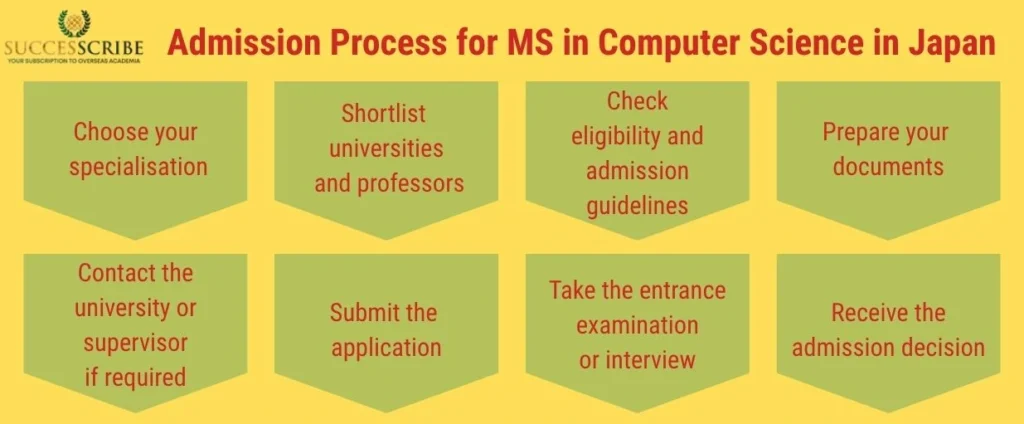
The admission process may vary widely among different universities in Japan. Some programs allow for direct admission whereas others require a research-student route first.The admission process is as follows:
- Choose your specialisation: Decide whether you want to focus on areas such as Artificial intelligence, Machine learning, Data science, Cybersecurity, Software engineering, Computer vision, Robotics, Networks or Human-computer interaction. This will help you identify suitable universities and research laboratories.
- Shortlist universities and professors: Study the department, faculty members, and labs at the university. In research-based institutions, locating a faculty member that works in an area of interest is crucial in making an application. At Kyoto University, for example, international graduate students are directed to first locate an appropriate course and supervisor before the application procedure begins.
- Check eligibility and admission guidelines: Read the latest admission guide carefully. Check academic requirements, language scores, entrance examinations, application deadlines and required documents. Do not assume that requirements are identical across universities.
- Prepare your documents: Get your academic transcripts, degree certificate, CV, reference letter, research proposal/SOP and language test results ready in accordance with the requirements of the university.
- Contact the university or supervisor if required: Some departments require students to communicate with a potential supervisor before applying. Others have a more direct application process.
- Submit the application: Complete the online or paper application, upload the required documents and pay the application or examination fee where applicable.For example, the University of Tokyo’s Graduate School of Information Science and Technology provides a specific online application process and document-upload procedure for master’s applicants.
- Take the entrance examination or interview: Depending on the programme, applicants may need to take a written examination, interview, oral examination or other assessment.
- Receive the admission decision: Once selected, students complete the university’s enrolment procedures and prepare for their move to Japan.
Scholarships for MS in Computer Science in Japan
Scholarships can reduce the financial pressure of studying in Japan. However, eligibility, application timing and award amounts differ considerably between scholarships.
The Japanese Government’s MEXT Scholarship is one of the major funding options for international students. For master’s-level scholarship recipients, the official Study in Japan information lists a monthly stipend of ¥144,000, with tuition exemption and travel support subject to the applicable scholarship conditions.
Students may apply through an embassy recommendation route or, where available, a university recommendation route.
- JASSO scholarships
JASSO also provides financial support for privately financed international students. The Monbukagakusho Honors Scholarship for privately financed students at graduate level is listed at ¥48,000 per month, subject to the applicable year’s rules and selection conditions.`8
- University scholarships and tuition reductions
Individual universities may offer scholarships, tuition waivers or fee reductions. The official Study in Japan scholarship database currently lists programmes for master’s students from universities and private organisations. Students should check whether a scholarship is Available before arrival, available only after enrolment, based on academic performance, Based on financial need, open to international students and applicable to master’s students, Applying early is important because some scholarships have separate deadlines from the university application.
Career Opportunities After MS in Computer Science in Japan
An MS in Computer Science can prepare graduates for technical and research-oriented careers in Japan and other international markets. The actual career path depends on the student’s specialisation, skills, Japanese-language ability, work experience and employer requirements. Some possible roles include:
| Career | Typical Work Area |
| Software Engineer | Software development and application systems |
| Data Scientist | Data analysis, modelling and business intelligence |
| Machine Learning Engineer | ML models and intelligent applications |
| AI Engineer | AI systems and automation |
| Cybersecurity Analyst | Security monitoring and risk management |
| Cloud Engineer | Cloud infrastructure and services |
| Systems Engineer | Enterprise IT and system architecture |
| Research Engineer | Technology research and development |
| Computer Vision Engineer | Image and video-based AI systems |
| Robotics Engineer | Robotic systems and automation |
For Indian students, learning Japanese can also be useful when looking for jobs in Japan, particularly where employers expect communication with Japanese teams or customers. However, language requirements vary by company and role. A master’s degree can also be a pathway towards doctoral research for students who want to continue in academia or specialised R&D.
Conclusion
MS in Computer Science Engineering from Japan can prove to be an interesting choice for the students having interest in the domain of technology and research in specialized computing. Apart from the issues of fees and choosing the university, there are other factors like the research climate, language requirement, and exposure to the industry that the students must consider. Students from India can prepare a focused application for the specialization they wish to pursue and the universities that offer it.
FAQs
Is a thesis compulsory for an MS in Computer Science in Japan?
It depends on the programme. Research-based master’s programmes commonly include a thesis or research projects
Can MS students in Japan access university research laboratories?
Yes. Graduate students usually belong to or are attached to research laboratories according to their area and advisor.
Are internships available for computer science students in Japan?
Some universities and companies offer internships, although availability depends on the programme, employer and student’s eligibility.
Can I apply to multiple Japanese universities at the same time?
Yes, there are options for applying to several colleges, yet each college has its specific process of application, exams, and costs.
Can an MS in Japan lead to a PhD?
Yes. Students who meet the requirements can apply for doctoral programmes after completing their master’s degree.
Related Post
Part-time jobs for students in Japan
MEXT scholarship for Indian students
Japan study visa requirements for Indians
Study in Japan For Indian Students