
Japan is becoming an interesting option for Indian students looking to pursue their higher studies in an international environment while not sticking to the conventional MBA options. Japanese institutes provide business programs in English, interaction with Japanese firms, and the chance to explore the auto industry, tech industry, manufacturing, financial services, and international business.
For Indian applicants, the main questions are usually about tuition fees, work experience, English-language requirements and whether an MBA from Japan can lead to a career there. These depend upon the institution as well as the particular programme being offered. There are both – one year programmes and two year programmes at different universities and admission requirements are not identical across institutions.
This post covers the MBA colleges in Japan for Indian students, their fees, requirements, admission process and work opportunities after graduation.
Why Consider MBA in Japan?
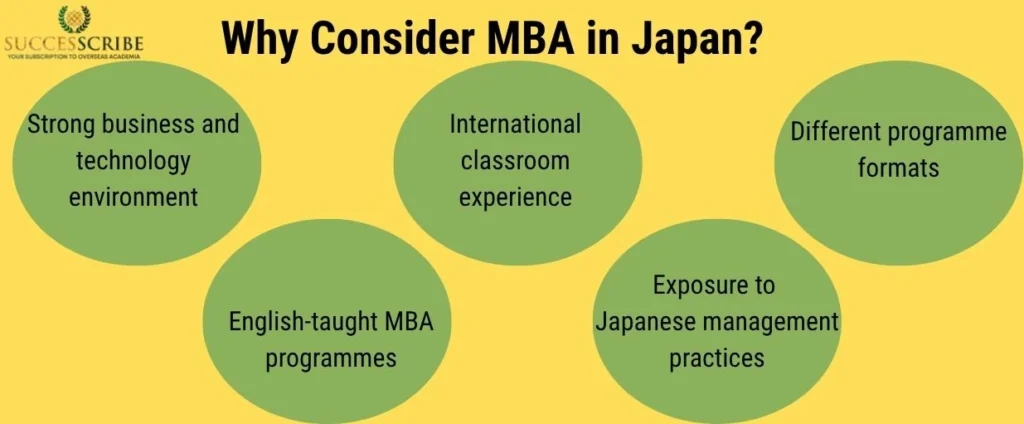
Japan offers Indian students a chance to study business in a country that is recognized for its excellent manufacturing capabilities and technologically advanced global corporations. In addition to English-medium MBA courses, students get a firsthand experience of the Japanese business environment as well as an international setting. This country could be especially useful for students interested in areas such as technology, operations, finance and international business.
- Strong business and technology environment: There are various areas of expertise within Japan like automobiles, electronics, manufacturing, finance and technology. An MBA program in this environment can give students a closer look into the operations and product development in established companies. If you are interested in areas like logistics, operations or technology management, then this environment will be useful for you.
- English-taught MBA programmes: Indian students do not necessarily need to study an MBA in Japanese. Several Japanese universities and business schools offer programmes taught in English for international students. However, there are different requirements of language of instruction and the English test for each program. It is important to know the specific requirements before applying.
- International classroom experience:The majority of the MBA programs tend to attract students from a variety of nations. This is likely to ensure that the debates in class are more diverse and give the students an opportunity to analyze business cases with people from different viewpoints. For an Indian student, this can be useful when learning communication and teamwork skills.
- Exposure to Japanese management practices: Japan is known for its established manufacturing and business systems. An MBA can provide students with an opportunity to understand areas such as quality management, operations, innovation and long-term business strategy from a Japanese perspective.
- Different programme formats: MBA programmes in Japan are not identical. Depending on the university, students may find one-year, two-year, full-time, part-time or other programme formats. This gives students some flexibility when looking for a course that fits their professional experience and career plans.
Best Universities for MBA in Japan of Indian students
Students who want to know about the best universities for MBA in Japan need to compare various programs in terms of their curriculum, tuition fees, location, admission criteria, language of instruction and employment support services rather than ranking the universities only.
1. Hitotsubashi University Business School – ICS
ICS at Hitotsubashi University located in Tokyo provides an English-taught MBA program with an international business focus. This university can be appropriate for those students who are concerned about subjects like strategy, leadership and management. Applicants should carefully review its current academic, professional and entrance-test requirements before applying.
2. Waseda Business School
Waseda Business School offers an International MBA in Tokyo. The programme provides an international approach to management education and is one of the options Indian students can consider when looking for an MBA in Japan. Students should compare its curriculum, tuition, admission requirements and programme format with other Tokyo-based business schools
3. NUCB Business School
NUCB Business School offers a Global MBA in Nagoya. Its case-based approach gives students opportunities to examine business situations and discuss management decisions. Its location can also be relevant to students interested in Japan’s manufacturing and automotive industries.
4. GLOBIS University
GLOBIS University offers MBA programmes with an emphasis on practical business education, leadership and entrepreneurship. Students interested in applied business learning can explore its different MBA formats and check which option is suitable for their academic and professional background.
5. International University of Japan
The International University of Japan offers MBA programmes through its Graduate School of International Management. It can be considered by students interested in international management and business across different markets. Its location in Niigata Prefecture also gives students a different living environment from major cities such as Tokyo.
6. Doshisha University
There is a Global MBA offered by Doshisha Business School in Kyoto. This university will attract those students who seek business studies alongside a life in Kyoto, which is famous for its universities. It is advised to make inquiries regarding the program-specific requirements before submitting an application.
7. Ritsumeikan Asia Pacific University
Ritsumeikan Asia Pacific University in Beppu offers an MBA through its graduate school of management. Its international student environment makes it another option for students comparing MBA colleges in Japan outside Tokyo.
Fee structure for MBA Colleges in Japan
The MBA colleges in Japan fees vary significantly depending on the university, programme duration and additional institutional charges. Instead of looking only at tuition, Indian students should calculate the complete study budget, including accommodation, food, transportation, insurance and other personal expenses.
| University | MBA programme | Approximate total tuition |
| Hitotsubashi ICS | MBA | ¥642,960 per year + ¥282,000 admission fee |
| Waseda Business School | International MBA | ¥4,176,000 total |
| NUCB Business School | Global MBA | Around ¥1.59 million per year + ¥270,000 admission fee |
| GLOBIS University | Full-time MBA | ¥4,725,000 total |
| International University of Japan (IUJ) | MBA | Around ¥3,200,000 per year |
| Doshisha University | Global MBA | ¥918,000 in the first year |
| Ritsumeikan Asia Pacific University (APU) | MBA | Around ¥2–3 million+, depending on the applicable fee schedule |
MBA fees in Japan vary by university, programme duration and intake. The costs given above are approximate numbers since they could include various amounts of tuition or admission charges. Students should check the latest fee schedule of their chosen university before applying.
Other expenses
Apart from tuition, students should budget for:
- Accommodation
- Transportation
- Health insurance
- Study materials
- Food and groceries
- Visa-related costs
- Flights
- Personal expenses
Cost of living also varies significantly from one city to another. The budget needed to live in Tokyo, for instance, could be very different from that needed in another city in Japan.
Scholarships
Indian students can also explore scholarships and tuition-support options offered by Japanese universities and external organisations.
The MEXT Scholarship is one option international students can research, while individual universities may have their own scholarships or tuition reductions. Eligibility and coverage depend on the specific scholarship.
Requirements for MBA in Japan
The MBA in Japan requirements vary depending on the university and programme. Indian students should always check the current admission criteria of their chosen business school before applying.
- Academic qualification: Most MBA programmes require applicants to hold a recognised bachelor’s degree or equivalent qualification.Indian students may apply with degrees such as-
- BBA
- BCom
- BA
- BE or BTech
- Other recognised bachelor’s degrees
A business-related bachelor’s degree is not necessarily compulsory for every MBA. However, individual universities may have specific academic requirements.
- Work Experience: Work experience is an important factor for an MBA program, though the required number may differ. Some schools are designed for individuals with considerable work experience, while others will admit students with minimal work experience. Students should be aware of:
- Whether work experience is compulsory
- Minimum years of experience
- Whether internships are considered
- Whether fresh graduates are eligible
Do not assume that having the same number of years of work experience will make you eligible for every MBA programme.
- GMAT or GRE: GMAT or GRE requirements differ between Japanese business schools. Some programmes require a test score, while others may provide alternative routes or exemptions under specific conditions. This means Indian students should check the individual university rather than assume that GMAT is compulsory for every MBA in Japan.
- English Language Proficiency: There are many MBA courses conducted in English language and these courses might have certain English proficiency tests like IELTS or TOEFL among others.
Some universities may provide exemptions to applicants who had their prior education in English language and meet the institution’s conditions.Thus, you should first find out whether your previous medium of education is acceptable as proof before assuming that you can apply without IELTS or TOEFL.
- Other documents: Common application documents include-
- Academic transcripts
- Bachelor’s degree certificate
- CV or resume
- Statement of purpose or application essays
- Letters of recommendation
- GMAT/GRE score, if required
- IELTS/TOEFL score, if required
- Passport
- Work-experience documents, where applicable
Some universities may also require an interview as part of the selection process.
Admission Process for MBA in Japan
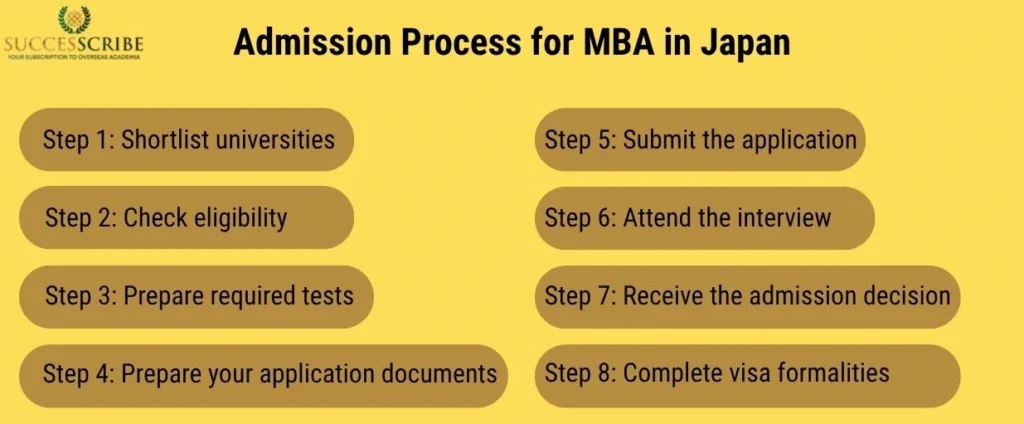
The MBA Japan admission process usually starts with selecting suitable universities and ends with enrolment and visa preparation.
Step 1: Shortlist universities
Compare MBA programmes based on:
- Course duration
- Tuition fees
- Language of instruction
- Work-experience requirements
- GMAT/GRE requirements
- Location
- Career interests
This helps you avoid applying to programmes that do not match your profile.
Step 2: Check eligibility
Read the university’s official admission requirements carefully. Verify your bachelor’s qualification, work experience, English language skills, and other entrance test eligibility requirements before filling out the application form.
Step 3: Prepare required tests
If your chosen programme requires GMAT, GRE, IELTS or TOEFL, complete the relevant tests before the application deadline. If you are applying for an English-test exemption, confirm what documents the university accepts.
Step 4: Prepare your application documents
Prepare your:
- Academic transcripts
- Degree certificate
- CV
- SOP or essays
- LORs
- Test scores
- Passport
- Work-experience documents
Your SOP should explain why you want to pursue an MBA, why you selected that particular programme and how it fits your career plans.
Step 5: Submit the application
Submit your application through the university’s designated application system. Some universities have multiple application rounds, so check the relevant intake and deadline instead of relying on a general Japan MBA deadline.
Step 6: Attend the interview
If the programme includes an interview, be prepared to discuss your education, professional experience, career goals and reasons for choosing the MBA.
Step 7: Receive the admission decision
After your application has been evaluated, the admission decision and further details will be conveyed to you. In case of acceptance, ensure that you check the offer carefully for the payment of tuition fees and enrollment process.
Step 8: Complete visa formalities
After admission, foreign students have to complete the necessary immigration and student visa formalities. Your institution will provide instructions about documentation and the Certificate of Eligibility procedure if required.
MBA in Japan for Indian Students
When choosing MBA in Japan for Indian students, the choice should not be based only on the university offering good tuition charges. It should depend on how well the course suits the student’s educational and professional background and career aspirations.
Can Indian students study MBA in Japan without IELTS?
Some English-taught programmes may allow an English-language test exemption if applicants satisfy the university’s conditions. However, there is no single IELTS rule for all Japanese MBA colleges. Indian students should check the individual university’s requirements and keep appropriate proof of English-medium education if an exemption is available.
What should Indian students check before applying?
Before submitting an application, check:
- Programme language
- Tuition fees
- Living costs
- Academic requirements
- Work-experience requirements
- GMAT/GRE requirements
- IELTS/TOEFL requirements
- Application deadlines
- Scholarships
- Career support
- Post-study work options
A programme that looks affordable on tuition alone may have a very different overall cost once living expenses are included.
Work Opportunities in Japan After MBA
MBA education can help students get jobs in various fields such as management, finance, marketing, operations, consultancy, and international business. However, availability of job opportunities after MBA will depend on different factors such as past experience, Japanese fluency and employer requirements.
| Career area | Possible roles |
| Consulting | Business consultant, strategy analyst |
| Finance | Financial analyst, corporate finance associate |
| Marketing | Marketing manager, brand strategist |
| Operations | Operations manager, supply chain analyst |
| Technology | Business analyst, product manager |
| International business | Business development, international sales |
These are potential career paths rather than guaranteed job outcomes.
Working for Japanese companies
The students may consider working in companies that have businesses in sectors such as technology, manufacturing, automobile, finance and consumer goods.
Past educational qualifications also play a big part in determining what you do within the organization. An engineer will be able to use their expertise along with the MBA program in technology, operations and manufacturing, while a commerce graduate may explore finance, marketing and business development.
Does Japanese language ability matter?
Japanese-language skills may prove helpful if students are going to apply for jobs requiring communication with Japanese customers, colleagues, or business partners.
English speaking positions are available at some companies; however, students need to find out the language requirement of each job position instead of thinking that English-taught MBA will guarantee English jobs.
Conclusion
Selecting MBA Colleges in Japan for Indian Students cannot be done only by judging the name of the college and the cost of the program. Things like the mode of teaching, the location of the college, industrial exposure, linguistic environment, and what you plan to do after the program could all play a role in your experience. The choice of Japan would be ideal for those interested in the Asian business market as well as an international education.
FAQs
1. Is an MBA from Japan recognised in India?
A degree from a recognized university in Japan may be acceptable in India, but students need to check the recognition or equivalence requirements applicable to their specific purpose.
2. Can MBA students in Japan work part-time?
International students may be permitted to work part-time subject to Japanese immigration rules and the required permission. The permitted hours and conditions should be checked before starting employment.
3. What is the academic calendar for Japanese MBA programmes?
Many Japanese universities have an April intake, while some English-taught MBA programmes also offer September or October intakes.
4. Is Japan appropriate for candidates who have not studied business before?
Yes, there are some MBA programs that accept candidates from engineering, sciences, humanities and other subjects. However, individual universities may require different academic or professional prerequisites.
5. Which sectors do well in Japan with regards to MBA graduates?
There are many industrial sectors in Japan such as automotive, electronics, manufacturing, technology, finance, logistics and consumer goods, offering various directions to MBA graduates.
Related Post
Part-time jobs for international students in Japan
Fully funded scholarships to study in Japan
MEXT scholarship for Indian students
Study in Japan Consultancy in India