If you are planning to study Medicine and Surgery in English at a public university in Italy, the IMAT Exam is the one test that decides everything: whether you get admitted, and which university you get into. Every year, this single 100-minute paper replaces interviews, personal statements, and grade cut-offs – your rank on the IMAT Exam is the only criterion that matters. This topic is built around what students actually search for before appearing for the IMAT Exam: the confirmed 2026 exam date, the registration process, fees, syllabus, exam pattern, participating universities, and realistic cut-off expectations.
Key Highlights: IMAT Exam
| Feature | Key Fact / Figure |
| Full Name | International Medical Admissions Test |
| Conducting Authority | Ministry of Universities and Research (MUR), Italy |
| Language of Test | English |
| Format | Paper-based, multiple-choice (PBT) |
| Total Questions | 60 questions |
| Exam Duration | 100 minutes (1 min 40 sec per question) |
| Maximum Marks | 90 Points |
| Marking scheme | +1.5 for correct, −0.4 for incorrect, 0 for unattempted |
| Standard Exam Fee | €130 EUR (Approx. ₹11,500 – ₹12,500 INR / $140 USD) |
| Registration Portal | Universitaly (universitaly.it) |
| Programmes covered | Medicine and Surgery, Dentistry, and (at select universities) Veterinary Medicine |
What Is the IMAT Exam?
The IMAT Exam (International Medical Admissions Test) is the official, centralised entrance test used by Italian public universities to select students for English-taught, single-cycle degree programmes in Medicine and Surgery. A small number of universities – Bologna and Naples Federico II among them – now also use the same test framework to admit students into English-taught Veterinary Medicine, while several universities use it for Dentistry as well.
Until 2023, the IMAT Exam was designed and delivered in partnership with Cambridge Assessment Admissions Testing. Since 2023, the Ministry of University and Research runs the entire exam independently, from setting the syllabus to publishing results. This matters for anyone comparing older prep material: content and structure discussions dated before 2023 may not reflect the current IMAT Exam format.
Both EU and non-EU students can sit the IMAT Exam, though universities maintain separate ranking lists and separate seat quotas for the two groups, which is why cut-off scores differ sharply between EU and non-EU applicants at the same university.
IMAT Exam 2026: Important Dates
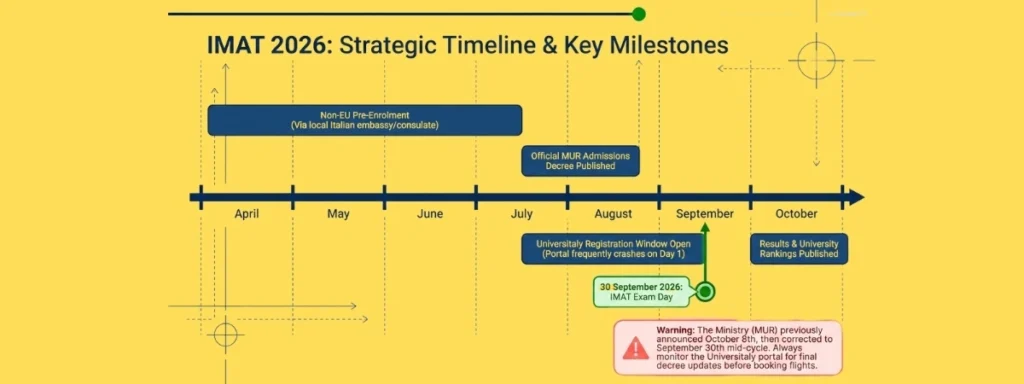
The IMAT Exam 2026 date has been revised once already, so it is worth tracking the timeline carefully. MUR first announced 8 October 2026 in a notice dated 3 July 2026, then issued a correction the very next day confirming Wednesday, 30 September 2026 as the official date. Because the ministry has changed this date mid-cycle before, always cross-check the final date on the Universitaly portal or the MUR website a few days before you finalise travel plans.
| Milestone | Expected Window (2026 cycle) |
| Non-EU pre-enrolment (via Italian embassy/consulate) | April – July 2026 |
| Official MUR admissions decree published | Late July – August 2026 |
| Universitaly registration opens | Late August 2026 |
| Universitaly registration closes | Early-to-mid September 2026 |
| IMAT Exam day | 30 September 2026 |
| Results and university rankings published | Early-to-mid October 2026 |
Mandatory Compliance for Indian Students
The NMC Eligibility Certificate: This is a non-negotiable step. Indian students must obtain an Eligibility Certificate from the National Medical Commission (NMC) before confirming their enrollment in Italy. Failure to do so will disqualify you from practicing in India (FMGE/NExT) upon your return.
IMAT Exam Eligibility Criteria
Eligibility for the IMAT Exam is intentionally simple compared to many national entrance tests:
- Educational qualification: You need a high school diploma or equivalent, earned after at least 12 years of global schooling. If your education system runs on an 11-year school cycle, you must complete one additional recognised year (a foundation year or one year of university) before you qualify.
- Age: Most universities expect candidates to be at least 17–18 years old by the time of enrolment; check the specific requirement of your first-choice university.
- Subject background: There is no ministry-mandated minimum percentage in Physics, Chemistry, and Biology to register for the IMAT Exam itself. However, since roughly 63% of the paper (Biology, Chemistry, Physics and Mathematics combined) tests science content, a strong secondary-level science background is effectively essential to score competitively.
- English proficiency: An IELTS or TOEFL certificate is not mandatory to register for or sit the IMAT Exam, since the entire test is conducted in English and itself serves as evidence of language ability for most universities. Some universities or your local Italian consulate may still ask for a separate English certificate at the visa stage, so check this independently.
- Nationality: Both EU and non-EU candidates are eligible, but non-EU applicants must also complete pre-enrolment through their local Italian embassy or consulate before they can register for the exam.
- The DoV/CIMEA Process: You must obtain a Declaration of Value (DoV) or a CIMEA Statement of Comparability to prove your high school degree is equivalent to the Italian Maturità.
- NEET-UG Status: A qualifying NEET score is essential for the “India-return” pathway.
How to Register for the IMAT Exam
Registration for the IMAT Exam happens entirely online, through the Universitaly portal (universitaly.it) – there is no offline application route. The process typically follows these steps:
- Pre-enrolment (non-EU candidates only): Apply through the Italian embassy or consulate in your home country and get your academic documents evaluated.
- Create a Universitaly account: Once MUR opens registration, sign up on universitaly.it using a valid email ID.
- Fill the application form: Enter your academic and personal details, then select your test centre.
- Choose your university preference: Non-EU candidates can list only one first-choice university at registration; EU candidates can rank several. Choose carefully – the order generally cannot be changed once registration closes.
- Upload documents: Passport/ID and your high school diploma or a certificate of anticipated graduation.
- Pay the exam fee: Complete payment online to confirm your seat; registration is only valid once payment is received.
- Download your admit card/confirmation: Save the confirmation email – you will need it, along with a valid photo ID, at the test centre.
Because thousands of applicants log in the moment registration opens, the Universitaly portal frequently slows down or crashes in the first hour – this is normal, and the site typically stabilises within a day. Test centres outside Italy, such as New Delhi in India, have limited seats and fill up quickly, so registering on day one is strongly advised.
IMAT Exam Fees and Registration Walkthrough
Navigating imat exam fees and the registration portal requires strict adherence to timelines.
| Expense Category | Cost in EUR (€) | Approx. Cost in USD ($) | Approx. Cost in INR (₹) |
| IMAT Registration Fee | €130 | ~$140 | ₹11,500 – ₹12,500 |
| Pre-Enrolment Application | Free / Nominal | $0 | ₹0 |
| Dichiarazione di Valore (DoV) / CIMEA | €0 – €150 | $0 – $165 | ₹0 – ₹13,500 |
| Annual Public University Tuition | €1,000 – €4,000 | $1,100 – $4,350 | ₹90,000 – ₹3,60,000 |
IMAT Exam Pattern
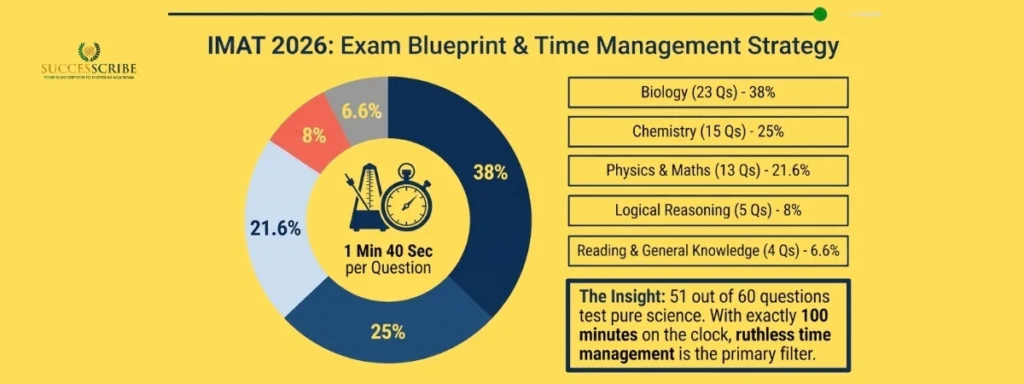
Understanding the IMAT Exam pattern is central to scoring well, because the negative marking makes guesswork genuinely risky. The exam is a single 100-minute, 60-question multiple-choice paper, split across five sections:
| Section | Number of Questions | Focus Area |
| Logical Reasoning | 5 | Deductive/inductive reasoning, syllogisms, drawing valid conclusions |
| Reading Comprehension & General Knowledge | 4 | English reading skills, world affairs, history, EU institutions |
| Biology | 23 | Cell biology, genetics, human physiology, evolution, biomolecules |
| Chemistry | 15 | Atomic structure, bonding, organic chemistry basics, reactions |
| Physics & Mathematics | 13 | Mechanics, thermodynamics, basic algebra and problem-solving |
| Total | 60 | 100 minutes, 90 marks maximum |
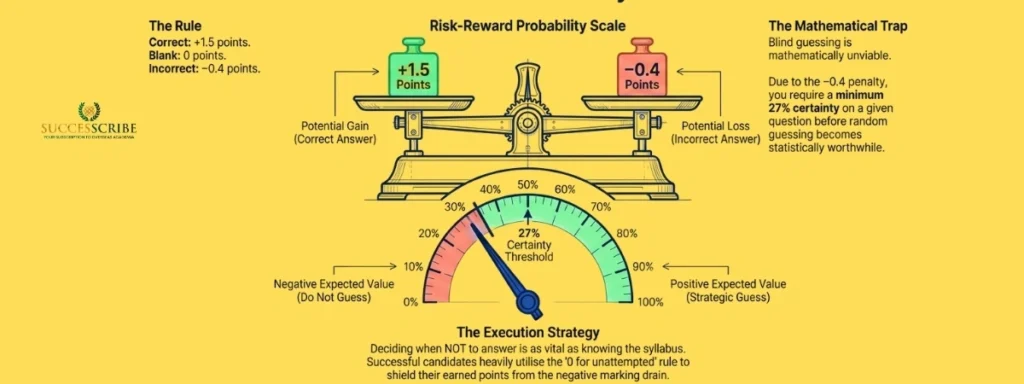
Scoring: Each correct answer earns +1.5 marks, each incorrect answer costs −0.4 marks, and unattempted questions score zero. This means guessing blindly is a losing strategy in the long run – you need roughly a 27% chance of being right on a given question before random guessing becomes mathematically worthwhile, so most successful candidates only attempt questions they can genuinely narrow down.
Note: the specific 2026 ministerial decree confirming this exact structure was still pending publication at the time of writing, though the format above (unchanged since the 2024 restructuring) is expected to carry over. Always verify the finalised IMAT Exam pattern against the official decree once MUR publishes it, usually a few weeks before the exam.
IMAT Exam Syllabus

The IMAT Exam syllabus is drawn from standard Class 11–12 (secondary school) level science, but questions are application-based rather than pure recall, which is what makes timing the biggest challenge for most candidates.
| Subject | Key Topics |
| Biology (23 Q) | Cell theory, prokaryotic vs eukaryotic cells, membrane transport, biomolecules (carbohydrates, lipids, proteins, nucleic acids), enzymes, cellular respiration, genetics and inheritance, human anatomy and physiology, evolution, basic biotechnology |
| Chemistry (15 Q) | Atomic structure and periodic trends, chemical bonding (ionic, covalent, metallic), states of matter, solutions, acids and bases, redox reactions, an introduction to organic chemistry |
| Physics & Mathematics (13 Q) | Kinematics and mechanics, energy and work, thermodynamics basics, electricity fundamentals, algebra, and basic problem-solving/data interpretation |
| Logical Reasoning (5 Q) | Deductive and inductive reasoning, syllogisms, analogies, identifying assumptions and flawed arguments |
| Reading & General Knowledge (4 Q) | English comprehension of scientific and general texts, current affairs, history, geography, and international institutions |
A useful comparison for Indian students: the IMAT Exam syllabus overlaps considerably with the NEET syllabus in Biology, Chemistry, and Physics, but adds logical reasoning and general knowledge sections that NEET does not test, while going slightly lighter on rote memorisation and heavier on applied reasoning.
Universities That Accept IMAT Exam Scores
More than 13 Italian public universities currently offer English-taught medical degrees through the IMAT Exam, collectively reserving over 1,000 seats for non-EU candidates each year. Some of the most sought-after names include:
University of Bologna, Sapienza University of Rome, University of Milan, University of Milan-Bicocca, University of Pavia, University of Padua, University of Turin, University of Naples Federico II, University of Messina, University of Parma, University of Bari, University of Catania, University of Siena, University of Rome Tor Vergata, Marche Polytechnic University (Ancona), and Università della Campania “Luigi Vanvitelli.”
Seat numbers change every year based on ministry decree and university capacity, so treat the figures below as an illustrative reference rather than a fixed number for 2026 – always confirm the current year’s allocation on Universitaly:
| University | EU Seats (recent cycle) | Non-EU Seats (recent cycle) |
| University of Pavia | 103 | 40 |
| University of Bologna | 97–130 | 20 |
| University of Parma | 75 | 45 |
| University of Padua | 75 | 25 |
| University of Turin | 70 | 32 |
| University of Campania “Vanvitelli” | 60 | 50 |
| University of Milan | 55 | 15 |
| University of Messina | 55 | 56 |
| Sapienza University of Rome | 45 | 13 |
| University of Rome Tor Vergata | 40 | 15 |
| University of Milan-Bicocca | 30 | 18 |
| University of Naples Federico II | 25 | 45 |
The University of Florence has also opened a new English-taught Medicine and Surgery programme for the 2026/27 academic year with 50 total seats, and the University of Padua is introducing a separate, engineering-integrated “MedTech” track – both are worth watching if you are shortlisting universities for the IMAT Exam this cycle.
IMAT Exam Cut-Off Trends
Cut-offs for the IMAT Exam vary significantly by university, seat quota, and year, since your rank depends on how everyone else in your candidate pool performed. Based on recent non-EU cycles, a rough guide looks like this:
| Score Band (out of 90) | Realistic Chances |
| 50–60 | Competitive at higher-seat, lower-demand universities (e.g., Bari, Cagliari, Messina) |
| 65–70 | Competitive at mid-tier universities (e.g., Parma, Padua) |
| 70–75+ | Required for high-demand universities (e.g., Milan, Bologna, Pavia) |
Treat this as directional, not a guarantee – cut-offs move up or down every year depending on how many non-EU seats each university offers and how many students apply. Always check the official rankings published after the IMAT Exam results for the most reliable benchmark.
Why Students Choose the IMAT Exam
The IMAT Exam route to a medical degree has become popular with Indian and other international students for a few concrete reasons:
- Affordable tuition: Public university fees are calculated on the ISEE (income-based) system, typically ranging from €150 to €4,000 per year, with many students qualifying for partial or full fee waivers.
- EU-recognised degree: The Laurea Magistrale in Medicine and Surgery is automatically recognised across all 27 EU member states under Directive 2005/36/EC, and graduates can pursue licensing pathways such as FMGE (India), USMLE (USA), or PLAB (UK) after graduation.
- No interviews or essays: Unlike many Western medical admissions systems, the IMAT Exam is the sole and final criterion – there is no interview, personal statement, or extracurricular review.
- English-medium instruction: Coursework is delivered fully in English, though most students pick up conversational Italian by their clinical years, since patients in hospital rotations speak Italian.
How to Prepare for the IMAT Exam
Because Biology, Chemistry, Physics, and Mathematics together make up 51 of the 60 questions, most successful candidates structure their preparation as follows:
- Months 1–3 (concept building): Work systematically through the official syllabus topic by topic, prioritising Biology and Chemistry, which carry the most marks.
- Months 4- 5 (practice and revision): Solve previous years’ IMAT Exam papers under timed conditions and revise weak topics identified from your mistakes.
- Final 3- 4 weeks (mock marathon): Take full-length, 100-minute mock tests to build speed and get comfortable with the negative-marking scoring system, since deciding when not to answer a question is as important as knowing the content.
Given the exam’s strict negative marking, a disciplined “attempt only what you’re reasonably confident about” strategy generally outperforms attempting every question.
Post-Exam Logistics: From Ranking to the Italian Visa
Following the results, admitted students have a narrow 4-day window to enroll. The process then moves to the Type D National Visa.
The Scorrimento Reality: For non-EU students, the “scorrimento” (ranking shift) only happens within your first-choice university. If an admitted student at your chosen school declines their seat, the rank moves down locally.
Mandatory Visa Documents for Indian Students:
- Universitaly Summary Document.
- Apostilled Academic Records: India is a member of the Hague Apostille Convention, which simplifies this process.
- Financial Proof: Evidence of approximately €7,128/year (approx. ₹6.4 Lakh) via bank statements or loan letters.
- Accommodation Proof: Housing confirmation or a rental agreement.
The Clinical Reality: The Italian Language Barrier
While the first two years of pre-clinical studies are in English, the wards are not. Patients in Italian hospitals speak Italian.
The B2 Proficiency Mandate: Universities such as Milan Statale require students to reach a B2 level of Italian by the end of Year 2. If you do not hit this proficiency level, you cannot progress to the third year (clinical rotations). Students who start learning Italian in Year 1 have significantly higher success rates in their clinical years.
IMAT vs NEET UG

For Indian students, the IMAT (International Medical Admissions Test) and NEET (National Eligibility cum Entrance Test) differ significantly in their testing philosophy, competition levels, and required skill sets. While the subjects tested overlap, the exams reward different approaches to learning.
| Feature | IMAT (International Medical Admissions Test) | NEET-UG (National Eligibility cum Entrance Test) |
| Testing Philosophy | Logic-based; focuses on conceptual speed, critical thinking, and problem-solving | Memorisation-heavy; deeply anchored in rote learning and NCERT-level recall |
| Global Competition | 15,000–20,000 global applicants | 2 million+ applicants in India |
| Difficulty Level | Scientific questions are often perceived as easier for those with a strong NEET foundation, but the logic section is challenging | Widely considered more difficult due to extreme competition and the massive volume of content to memorise |
| Subject Coverage | Biology, Chemistry, Physics, Mathematics, Logical Reasoning, and General Knowledge | Physics, Chemistry, and Biology (Botany & Zoology) only |
| Negative Marking | -0.4 points per incorrect answer (less punishing) | -1 point per incorrect answer |
| Admission Basis | Score/Rank alone determines entry; no interviews or weightage for Class 12 board marks | Rank decides everything, often influenced by various state and category reservation quotas |
| Syllabus Focus | Application-focused questions; aligns well with high school science but requires logical agility | Heavily anchored in the NCERT Class 11 & 12 textbooks |
| Return to India | Requires clearing FMGE/NExT and a qualifying NEET score obtained prior to enrollment | Direct path to practice in India after internship; no additional licensing exam for local graduates |
Returning to Practice in India: NMC Compliance and NExT
Graduates wishing to return to India must strictly adhere to the FMGL Regulations.
NMC Compliance Checklist:
- NEET Qualification: Must be obtained before enrolling in Italy.
- NMC Eligibility Certificate: Must be secured before admission is confirmed.
- Course Duration: Minimum 54 months of training.
- Internship: A 12-month internship must be completed at the same institution in Italy.
- NExT: Graduates must clear the National Exit Test (NExT) to practice in India.
Conclusion
The IMAT Exam remains one of the most transparent and merit-based pathways into a European medical degree – a single, internationally standardised test with no interviews or subjective evaluation involved. Success comes down to genuine command of the IMAT Exam syllabus, disciplined practice against the exam pattern’s negative marking, and staying current with MUR’s official announcements, since dates and seat numbers can shift closer to the exam. Start early, build your Biology and Chemistry foundation first, and track the Universitaly portal closely once registration for the IMAT Exam 2026 opens.
FAQs
How many times can I take the IMAT Exam?
There is no lifetime limit on IMAT attempts. The exam is held once per year, and you can re-apply in subsequent admission cycles as many times as you like. However, an IMAT score is valid for one academic year only and cannot be saved or carried over to future years.
Can I take the IMAT Exam in my home country, or do I have to travel to Italy?
You do not have to travel to Italy to sit the exam unless you want to. MUR sets up official international test centres in cities worldwide—including New Delhi (India), Dubai (UAE), London (UK), and New York (USA). However, international seats are limited and allocated on a first-come, first-served basis, so registering the day slots open is critical.
Is there a minimum passing score for the IMAT?
Technically, the statutory minimum score to enter the ranking list is 20 points for EU applicants. However, for Non-EU applicants, there is no official minimum, but because seats are strictly capped per university, the effective pass mark is the cut-off score of the last admitted student (usually ranging between 50 and 70+ points depending on the university).
Do private Italian universities accept IMAT scores?
No. Private medical universities in Italy – such as Humanitas University, UniCamillus, Università Cattolica, and San Raffaele – do not accept IMAT scores. They conduct their own independent entrance exams (held earlier in the year between January and April). IMAT is exclusively for public Italian universities.
Is NEET mandatory for Indian students taking the IMAT?
NEET is not required by Italian universities to register for or take the IMAT Exam. However, NEET qualification is MANDATORY under NMC (National Medical Commission) guidelines if you intend to return to India to practice medicine after graduation. You must qualify for NEET-UG before enrolling in Italy.
Suggested Post
Best country for commercial pilot training
How to study abroad for free
Best medical courses in the world
Toughest exams in the world