If you are planning to study abroad, the TOEFL (Test of English as a Foreign Language) is one of the most important exams you will come across. Accepted by more than 11,500 universities across 160+ countries, TOEFL plays a crucial role in your admission journey.
In 2026, the TOEFL exam has become shorter, more efficient, and student-friendly, making it easier for candidates to demonstrate their English proficiency without unnecessary stress.
This guide will help you understand the TOEFL exam pattern 2026, along with updated details about TOEFL exam fees in India and the TOEFL exam registration process – all explained in a simple and clear manner.
Key Highlights: TOEFL Exam Pattern
- Introduction to TOEFL Exam
- TOEFL Exam Pattern 2026: Section-by-Section Breakdown
- Understanding the 2026 TOEFL Scoring System
- TOEFL Exam Fees in India
- TOEFL Exam Registration (Step-by-Step)
- Comparison: Home Edition vs. Test Center
- TOEFL Score Validity and Sending Scores
- TOEFL Slot Booking and Important Guidelines
- Practical TOEFL Preparation Tips for 2026
- Common Mistakes Students Make
- Conclusion
- FAQs
Introduction to TOEFL Exam
The TOEFL exam is conducted by ETS (Educational Testing Service) and measures your ability to use and understand English in an academic setting. Understanding the TOEFL Exam Pattern is the first step toward building a strong preparation strategy and achieving a high score.
Key Changes at a Glance
- Total Duration: Reduced from 2 hours to approximately 90 minutes.
- Scoring System: Introduction of a 1.0 – 6.0 Band Scale (alongside the traditional 0 – 120 score) to align with CEFR standards.
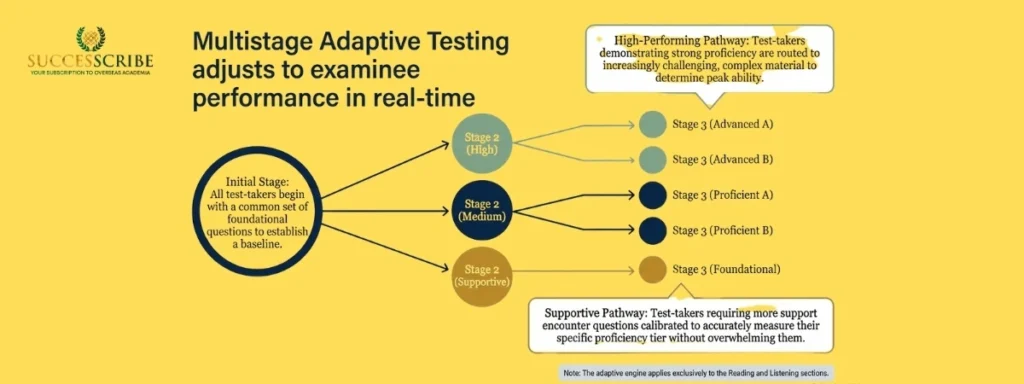
- Adaptive Nature: The Reading and Listening sections now adjust their difficulty based on your performance in the initial questions.
- Content: A shift from 100% academic content to a mix of Academic and Real-Life scenarios (e.g., emails, student announcements).
- Faster Results: Unofficial Reading and Listening scores are instant, and official reports are now available within 72 hours.
| Feature | Details |
| Exam Name | TOEFL iBT |
| Conducting Body | ETS |
| Duration | 116 minutes |
| Sections | 4 (Reading, Listening, Speaking, Writing) |
| Score Range | 0 – 120 |
| Mode | Online / Home Edition |
| Results | 4 – 8 days |
| Accepted Countries | 160+ |
| Test Attempts | Unlimited (12-day gap required) |
TOEFL Exam Pattern 2026: Section-by-Section Breakdown
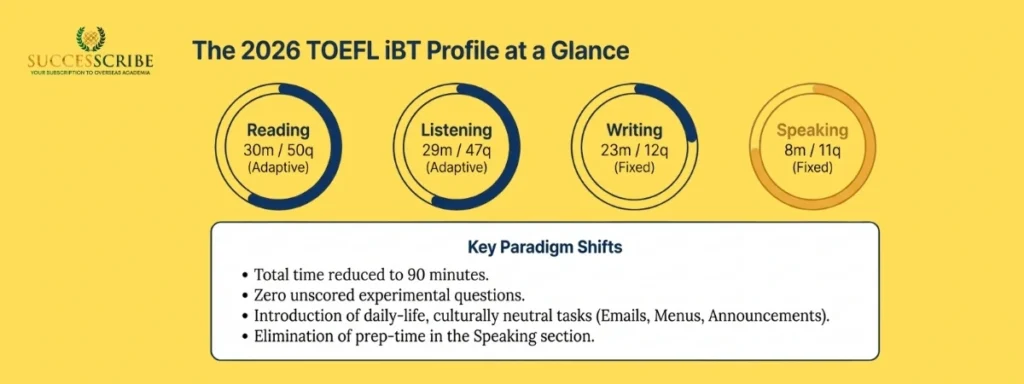
The updated TOEFL Exam Pattern 2026 focuses on efficiency and accuracy, ensuring that students are tested on practical English skills while also giving them enough flexibility during the TOEFL exam registration process and clarity regarding the TOEFL exam fees in India.
| Section | Time Limit | Tasks/Questions | Task Description |
| Reading | 18–27 Minutes | 2 Passages (approx. 10 Qs each) | Reading shorter academic and “daily life” texts and answering questions. |
| Listening | 18–27 Minutes | 3 Lectures, 2 Conversations | Listening to lectures and campus-based chats; adaptive difficulty. |
| Speaking | 8 Minutes | 4 Tasks | 1 Independent task; 3 Integrated tasks (Read/Listen then Speak). |
| Writing | 23 Minutes | 2 Tasks | 1 Integrated task; 1 Writing for an Academic Discussion task. |
1. The Reading Section (Adaptive)
The 2026 Reading section is significantly more concise. You will face two passages: one purely academic and one “Daily Life” passage (such as a university policy change or a campus notice).
| Component | Detail |
| Number of Passages | 2 academic passages |
| Words per Passage | 700 words each |
| Questions per Passage | 10 questions |
| Total Questions | 20 questions |
| Time Allotted | 35 minutes |
| Question Types | Factual, Inference, Vocabulary, Reference, Sentence Simplification, Insert Text, Prose Summary, Fill a Table |
| Score Range | 0 – 30 |
- Adaptive Mechanism: If you perform exceptionally well on the first few questions, the subsequent questions will be more challenging but carry a higher weight toward your final band score.
- Question Types: Multiple choice, “Insert a Sentence,” and “Reading to Learn” (organizing data into a table).
2. The Listening Section (Adaptive)
Gone are the days of 60-minute listening marathons. The new 2026 format focuses on high-impact comprehension.
| Component | Detail |
| Lectures | 3 academic lectures (3–5 minutes each) |
| Conversations | 2 campus conversations (3 minutes each) |
| Questions after Lectures | 6 questions per lecture |
| Questions after Conversations | 5 questions per conversation |
| Total Questions | 28 questions |
| Time Allotted | 36 minutes |
| Can you take notes? | Yes – scratch paper is provided |
| Score Range | 0 – 30 |
- Academic Lectures: 3 lectures (3–5 minutes each) with 6 questions each.
- Campus Conversations: 2 conversations (3 minutes each) with 5 questions each.
- Focus: You are tested on understanding the speaker’s attitude, function of speech, and the relationship between ideas.
3. The Speaking Section (High Fidelity)
The speaking section remains the shortest but most intense. ETS has upgraded the audio equipment in centers for 2026 to ensure “High Fidelity” recording, reducing background noise interference. The Speaking section of the TOEFL Exam Pattern is designed to test your clarity, fluency, and ability to express ideas confidently.
| Task | Task Type | Preparation Time | Response Time | What You Do |
| Task 1 | Independent Speaking | 15 seconds | 45 seconds | Express your personal opinion on a familiar topic |
| Task 2 | Integrated (Read + Listen + Speak) | 30 seconds | 60 seconds | Read a passage, listen to a lecture, then speak about both |
| Task 3 | Integrated (Listen + Speak) | 20 seconds | 60 seconds | Listen to a lecture and summarise the information |
| Task 4 | Integrated (Listen + Speak) | 20 seconds | 60 seconds | Listen to an academic lecture and explain the concept discussed |
- Task 1 (Independent): State an opinion on a familiar topic (15s prep, 45s speak).
- Task 2 – 4 (Integrated): Combine reading and listening to summarize or argue a point (20-30s prep, 60s speak).
4. The Writing Section (Modernized)
The traditional “Independent Essay” is replaced by the Writing for an Academic Discussion task.
| Task | Task Type | Time | Word Count Recommended | What You Do |
| Task 1 | Integrated Writing (Read + Listen + Write) | 20 minutes | 150 – 225 words | Read a passage (3 mins), listen to a lecture, then write how the lecture relates to or challenges the reading |
| Task 2 | Writing for an Academic Discussion | 10 minutes | At least 100 words | Read an online academic discussion prompt and the professor’s framing, then post a meaningful contribution to the discussion |
- Integrated Task (20 mins): Read a passage, listen to a lecture, and write how the lecture challenges the reading.
- Academic Discussion (10 mins): You join a simulated online classroom forum. You must read a professor’s question and other students’ responses, then contribute your own 100+ word post.
Understanding the 2026 TOEFL Scoring System
In 2026, ETS introduced the 6-Band Scale to make the scores more intuitive for global recruiters and universities.
| Band Score | Skill Level | Traditional Score Equivalent (0-120) |
| Band 6.0 | Expert | 110–120 |
| Band 5.5 | Very Good | 95–109 |
| Band 5.0 | Good | 79–94 |
| Band 4.0 | Competent | 60–78 |
| Band 3.0 | Modest | 46–59 |
| Band 1-2 | Limited/Extremely Limited | Below 46 |
TOEFL Exam Fees in India
In India, the cost of the TOEFL iBT is subject to the exchange rate and a mandatory 18% GST. A clear understanding of the TOEFL exam fees in India helps students plan their study abroad budget effectively while aligning their preparation strategy with the latest TOEFL Exam Pattern and completing their TOEFL exam registration without delays.
| Service Type | Fee in INR (Base) | Fee in INR (Inc. GST) |
| Standard Registration | ₹15,254 | ₹18,000 |
| Late Registration (within 4 days) | + ₹3,305 | ₹3,900 additional |
| Rescheduling Fee | ₹5,000 | ₹5,900 |
| Score Review (Speaking or Writing) | ₹6,695 | ₹7,900 |
| Additional Score Report (per uni) | ₹2,300 | ₹2,714 |
Your registration fee includes four free official score reports that can be sent to universities. However, you must select these institutions before you take the test.
TOEFL Exam Registration (Step-by-Step)
Registration for 2026 is entirely digital, though you can still register via phone or mail.
Step 1: Create an ETS Account
Visit the official ETS website. Use the name exactly as it appears on your Passport. In India, a valid Passport is the only accepted form of identification for the test center.
Step 2: Choose Your Format
TOEFL iBT (Test Center): Taken at a secure location.TOEFL Home Edition: Taken on your laptop with 24/7 proctoring. Note: In 2026, the Home Edition requires a secondary camera (your smartphone) to view your keyboard and side profile.
Step 3: Slot Booking
Select your city and date. It is recommended to book 2–3 months in advance, especially for peak periods like September and January.
Step 4: Payment
Payments can be made via:
- Credit card (Visa, Mastercard, Amex, Diners Club)
- Debit card (with international transactions enabled)
- PayPal (linked to Indian bank account)
- Voucher (buy from ETS India store)
- UPI – Pay via Google Pay, PhonePe, or BHIM UPI directly on ETS website.
Step 5: Confirmation
Once paid, you will receive a Registration Number and a confirmation email. Print this out; you will need it as your “Admission Ticket” on test day.
Comparison: Home Edition vs. Test Center
Indian students often ask: Which is better? Here’s a comparison.
| Feature | Test Center | Home Edition |
| Environment | Controlled, professional center. | Your own room; very strict setup rules. |
| Equipment | Provided by the center. | Must have a PC/Mac + Smartphone as 2nd cam. |
| Distractions | Background noise from other speakers. | Complete silence; risk of technical issues. |
| Availability | Specific dates (mostly weekends). | Available 24 hours a day, 4 days a week. |
TOEFL Score Validity and Sending Scores
TOEFL scores are valid for 2 years from the date of the test. If you took the test in March 2024, your scores are valid until March 2026. Most universities will only accept scores within this 2-year validity window.
After test day, if you want to send scores to additional institutions (beyond your initial 4 free recipients), you can do so through your ETS account at USD 20 per institution.
You also have the option to cancel your scores on test day (before viewing them) or request a score review (rescoring) if you believe there is an error.
TOEFL Slot Booking and Important Guidelines
Slots in metropolitan hubs like Mumbai, Delhi, and Bangalore fill up 2–3 months in advance. Early booking is not just a suggestion; it is a strategic necessity.
- Test Center: Arrive 30 minutes early. You will be provided with custom-designed Koss stereophones.
- Home Edition: This requires a private room with a stable internet connection. You must use computer speakers and a built-in/external microphone. Headphones are strictly prohibited for the Home Edition. A live human proctor will monitor your session via webcam.
Practical TOEFL Preparation Tips for 2026
Success in the 2026 format requires a psychological shift. You are being tested on how you think in English, not just what you know. A strong grasp of the TOEFL Exam Pattern allows students to prepare smartly and focus on the most important areas.
- Practice with Adaptive Mock Tests: You must experience the “difficulty spike.” Do not panic if questions get harder; it means you are performing well.
- Master Sentence-Level Accuracy: The “Build a Sentence” and “Complete the Words” tasks leave no room for grammatical “guessing.”
- Note-Taking Mastery: Because you hear audio clips only once (excluding Replay questions), your scratch paper is your most valuable tool.
- Touch Typing: With only 23 minutes for Writing, a typing speed of 35+ WPM is essential to finish all tasks.
Common Mistakes Students Make
Here are the common mistakes students make during their TOEFL Test preparation:
- Mismanaging the Adaptive Reading Timer: Spending too much time on early questions can leave you with only seconds for the harder, subsequent stages.
- Ignoring Tone/Attitude: In Listening, the “Pragmatic Understanding” questions focus on how someone speaks. Missing the tone often leads to incorrect “purpose” answers.
- Overlooking Replay Clues: On Replay questions, the answer is always in the replayed clip. Don’t rely on your notes for the whole lecture; focus on that specific snippet.
- Informal Email Writing: The “Write an Email” task requires a professional, academic register. Using “slang” or overly casual language will lower your score.
Conclusion
The TOEFL Exam Pattern 2026 is designed to respect your time while accurately measuring your potential. By mastering the adaptive mechanics and focusing on sentence-level precision, you position yourself as a top-tier candidate for global opportunities. Ensure you prioritize early TOEFL exam registration and account for the full TOEFL exam fees in India to keep your focus where it belongs: on your preparation. Start practicing with 2026 simulation tests today to turn these updates into your ultimate competitive advantage.
FAQs
Is the 120-point score still valid in 2026?
Yes. While ETS has introduced the 1.0 – 6.0 Band Scale, they are maintaining a “Transition Period” from 2026 to 2028. During this time, your official score report will show both the new Band score and the traditional 0 – 120 score to ensure universities worldwide can process your application without confusion.
Can I use my Aadhaar Card for TOEFL registration in India?
No. For the Test Center experience in India, a valid Indian Passport is the only primary ID accepted. While some remote proctors for the Home Edition may occasionally accept other government IDs, it is highly risky. Always use your Passport to avoid being turned away from the center and forfeiting your ₹18,000 fee.
Why is the 10-minute break removed in the 2026 pattern?
Because the total test time has been slashed from 2 hours to 90 minutes, ETS determined that a scheduled break was no longer necessary. The test is now a continuous, “sprint-style” exam. You are advised to use the restroom before the exam begins.
How quickly can I get my results in 2026?
The 2026 updates have streamlined the AI-human hybrid scoring. You will see unofficial Reading and Listening scores immediately after the test. Your official score report (with Speaking and Writing) will be available in your ETS account within 72 hours (3 days)
Is the TOEFL Home Edition fee different from the Test Center fee in India?
No. The fee for both versions remains the same at ₹15,254 (Base) + 18% GST, totaling approximately ₹18,000. The only difference is the equipment you need to provide yourself for the Home Edition (including the new 2026 requirement of a secondary smartphone camera for proctoring).
Related Post
One-year master’s in Germany
Best courses to study in Germany
Is IELTS required for Germany
Germany university entrance exam