
Japan is one of Asia’s most attractive study destinations for international students because of its globally recognised universities, advanced technology, safe cities and strong research ecosystem. However, tuition fees and living expenses can be a concern for students. The good news is that several government, university and international scholarships can significantly reduce or completely cover the cost of studying in Japan.
This topic explains the best Fully Funded Scholarships to Study in Japan, eligibility requirements, benefits, application procedures, required documents, deadlines, selection process and important points that international students should know before applying.
Important: Scholarship benefits, application dates, age limits and eligible countries may change every year. Always verify the final details from the official scholarship provider, Japanese embassy or university before submitting an application.
Key Highlights: Fully Funded Scholarships to Study in Japan
- What Covered Means: Includes full tuition waivers, entrance fee exemptions, airfare, and monthly stipends (¥143,000–¥145,000 for MEXT graduate students). Excludes visa fees and family expenses.
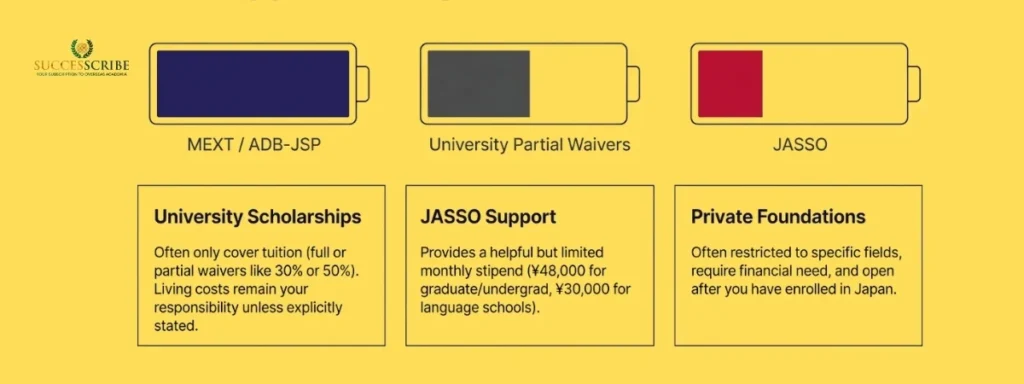
- Main Programs: MEXT (all degree levels), ADB – JSP (master’s, age equal to or less than 35, requires work experience and home return), JSPS (doctoral/postdoc research, ¥200,000 – ¥362,000/mo), and JASSO (supplementary, ¥30,000–¥48,000/mo).
- Two MEXT Routes: Embassy Recommendation (via local Japanese embassy with written tests and interviews) or University Recommendation (direct application to a Japanese university).
- Core Requirements: Strong academic record, age and nationality eligibility, solid recommendation letters, statement of purpose, and a tailored research proposal for graduate applicants.
- Language Rules: IELTS/TOEFL for English-taught degrees; JLPT or entrance exams for Japanese-taught programs. Some MEXT categories include preparatory language training.
- Timeline & Self-Funding: Apply 8 – 12 months in advance. Unfunded university tuition ranges from ¥820,000 (national) to ¥1,300,000+ (private) annually, making early preparation essential.
What Do Fully Funded Scholarships Cover?
A fully funded scholarship generally covers most or all major study-related expenses. However, the exact benefits depend on the programme. “Fully funded” does not always mean that every personal expense will be paid.
| Expense | Usually covered by fully funded scholarships? |
| Tuition fees | Usually fully covered or waived |
| Admission and examination fees | Covered by some programmes, but not all |
| Monthly living allowance | Usually provided |
| Airfare | Included in major government scholarships |
| Accommodation | May be included, subsidised or paid from the monthly allowance |
| Health insurance | Included in some programmes |
| Books and research expenses | Available under selected scholarships |
| Visa and document costs | Usually paid by the student |
| Family or dependent expenses | Generally not covered |
For example, the Japanese Government MEXT Scholarship waives university tuition and provides a monthly stipend and round-trip travel support. The exact monthly allowance depends on the study category and programme level.
Students should therefore read the official guidelines carefully instead of assuming that every scholarship provides identical financial support.
Best Fully Funded Scholarships to Study in Japan
The following are some of the most important scholarship options for international students in Some are available for undergraduate study, while others focus on master’s, doctoral or research programmes.
| Scholarship | Study level | Main funding support | Application route |
| MEXT Scholarship | Undergraduate, master’s, doctoral, research and specialised programmes | Tuition waiver, monthly allowance and airfare | Embassy or university recommendation |
| ADB–Japan Scholarship Programme | Master’s | Tuition, living support, books, insurance, travel and research support | Through designated institutions |
| JSPS International Fellowships | Doctoral research and postdoctoral research | Monthly allowance and research-related support | Host researcher or institutional route |
| University scholarships | Bachelor’s, master’s and doctoral | Tuition waiver, grants or stipend | Directly through the university |
| JASSO support | Mainly privately financed students | Monthly stipend or exchange support | Through the educational institution |
| Private foundation scholarships | Mostly graduate and research students | Stipend or partial financial support | University or foundation route |
Not all scholarships in this table are fully funded in every case. Some university and private foundation awards cover tuition or living expenses but not both. Students must compare the actual award package before accepting admission.
MEXT Scholarship
The MEXT Scholarship is the most widely known Japanese government scholarship for international students. MEXT stands for the Ministry of Education, Culture, Sports, Science and Technology of Japan. The programme supports students from different countries who wish to study at Japanese universities and other approved institutions.
The official Study in Japan website lists several MEXT categories, including research students, teacher-training students, undergraduate students, Japanese studies students, college of technology students, specialised training college students and Young Leaders’ Programme students.
MEXT scholarship benefits
Depending on the category, MEXT generally provides:
- Exemption from entrance examination, matriculation and tuition fees.
- A monthly scholarship allowance.
- Round-trip airfare under the applicable conditions.
- Preparatory education for selected students where required.
- Placement at a Japanese university or institution.
- Support for research or degree study during the approved scholarship period.
For the 2027 research-student guidelines, the monthly allowance is listed as ¥143,000 for preparatory or non-regular students, ¥144,000 for students enrolled in master’s or professional degree courses, and ¥145,000 for doctoral students.
The amounts for undergraduate and other categories may differ. Students should use the guideline for their own category rather than relying on figures published on third-party websites.
MEXT scholarship categories
| Category | Suitable for | Typical study purpose |
| Research Students | Graduates and prospective master’s or doctoral students | Research leading to a graduate degree |
| Undergraduate Students | Students who have completed secondary education | Bachelor’s-level study |
| Teacher Training Students | Teachers and education professionals | Teacher training and education research |
| Japanese Studies Students | Current university students studying Japanese language or culture | Short-term academic study |
| College of Technology Students | Students interested in technical education | Engineering and technology programmes |
| Specialised Training College Students | Students seeking vocational education | Professional and technical training |
| Young Leaders’ Programme | Selected professionals and public-sector candidates | Public policy, business or governance-related study |
MEXT application routes
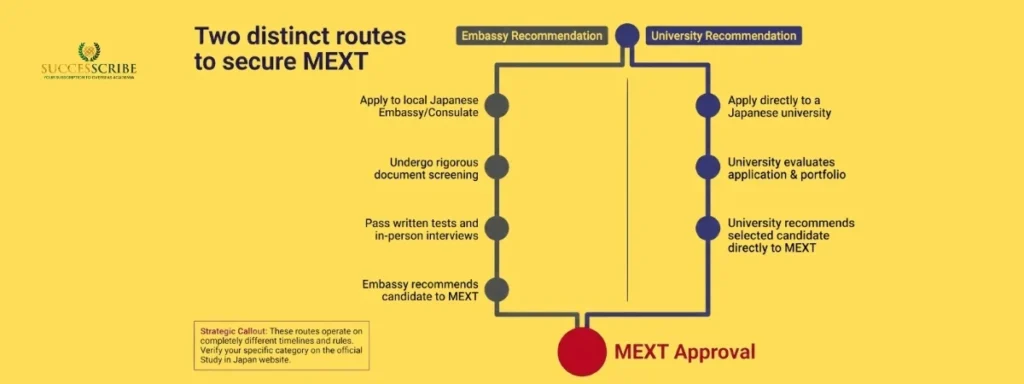
There are two main ways to apply for MEXT:
- Embassy recommendation: The applicant submits documents to the Japanese embassy or consulate responsible for their country or region. The embassy conducts document screening, written tests and interviews before recommending candidates.
- University recommendation: The applicant applies to a Japanese university or responds to a university’s scholarship call. The university recommends selected candidates to MEXT.
The available categories, timeline and submission process can differ between the embassy and university routes. The official Study in Japan website confirms that students can apply through either embassy recommendation or university recommendation.
MEXT eligibility requirements
Eligibility varies by category, but applicants generally need to meet requirements related to:
- Nationality.
- Age.
- Academic qualifications.
- Academic performance.
- Health.
- Field of study.
- Language ability.
- Availability for travel and enrolment.
- Previous scholarship or study status in Japan.
For example, undergraduate applicants generally need to complete the required level of secondary education, while research applicants normally need a relevant bachelor’s degree or equivalent qualification for master’s-level study. Some applicants may need to complete a Japanese-language or preparatory period before beginning their degree.
Applicants from India should check the MEXT notices published by the Embassy of Japan in India and the relevant consulate. The responsible office can depend on the applicant’s state or union territory. The official Indian mission pages publish category-specific instructions and submission details.
ADB–Japan Scholarship Programme
The ADB–Japan Scholarship Programme, commonly known as ADB–JSP, supports students from eligible developing member countries of the Asian Development Bank. It is designed mainly for postgraduate study in fields connected with development, including economics, management, science, technology, public policy and other relevant areas.
The programme is not open to every nationality and is not available at every Japanese university. Applicants must apply to an approved master’s programme at a designated institution.
ADB – JSP benefits
The official Asian Development Bank states that ADB–JSP may cover:
- Full tuition fees.
- Subsistence allowance, including housing support.
- Book allowance.
- Medical insurance.
- Airfare or travel expenses.
- Research or thesis-related support where applicable.
The scholarship is intended for students who will contribute to the development of their home country after completing their studies. Applicants normally need a bachelor’s degree or equivalent qualification, a strong academic record, relevant professional experience and admission to an approved programme.
The ADB states that candidates should generally be no more than 35 years old at the time of application, although exceptions may apply in special circumstances. The programme also requires scholars to return to their home country after completing their studies.
ADB – JSP eligibility overview
| Requirement | General expectation |
| Nationality | Citizen of an eligible ADB borrowing member country |
| Academic qualification | Bachelor’s degree or equivalent |
| Study level | Approved master’s programme |
| Academic performance | Strong academic record |
| Work experience | Relevant professional experience may be required |
| Age | Generally 35 or below, subject to programme rules |
| Admission | Admission to an approved institution or programme |
| Post-study condition | Return to the home country after completion |
Students should not confuse ADB – JSP with a general scholarship for all Japanese universities. They must first identify participating institutions and eligible programmes.
JSPS Fellowships for Research in Japan
The Japan Society for the Promotion of Science, or JSPS, offers fellowships for researchers who wish to conduct research in Japan. These opportunities are more suitable for doctoral researchers, postdoctoral scholars and established academic researchers than for students seeking a standard bachelor’s or taught master’s degree.
The JSPS International Fellowships for Research in Japan provide financial support to selected researchers. For the 2026 programme guidelines, the monthly allowance is listed as ¥362,000 for fellows who submit a PhD diploma or doctoral degree certificate in the prescribed period, while the allowance may be ¥200,000 for eligible fellows without a PhD at the start of the fellowship.
JSPS opportunities can also include research grants, depending on the fellowship category and applicable rules. The application generally requires a Japanese host researcher or host institution. A strong research proposal, academic record, publications and a suitable research plan can be important factors.
Who should consider JSPS?
JSPS is suitable for applicants who:
- Have a clear and advanced research proposal.
- Possess research experience in their academic field.
- Can identify a suitable Japanese host researcher.
- Meet the degree and career-stage requirements.
- Wish to conduct research rather than enrol in a conventional taught programme.
Applicants should carefully distinguish between a JSPS research fellowship and a degree scholarship. A fellowship may support research but may not function as a standard admission award for a full academic degree.
University Scholarships and Tuition Waivers
Many Japanese universities offer scholarships, tuition reductions and fee exemptions for international students. These awards may be available before admission or after enrolment.
University funding can include:
- Full or partial tuition exemption.
- Entrance fee reduction.
- Monthly research grants.
- Graduate assistantships.
- Teaching or research assistant positions.
- Housing support.
- University-specific international student awards.
The official Study in Japan scholarship database includes university scholarships and tuition reduction or exemption systems. However, the terms differ significantly by institution
Examples of university funding structures
| Funding type | What it may cover |
| Full tuition waiver | Entire tuition fee for a specified period |
| Partial tuition waiver | A fixed percentage, such as 30%, 50% or another amount |
| Entrance fee exemption | One-time admission or matriculation fee |
| Graduate research grant | Monthly support for eligible graduate students |
| University dormitory support | Reduced accommodation cost or housing allocation |
| Assistantship | Payment in exchange for approved academic or research duties |
A university scholarship may be described as “fully funded” by an institution only when tuition, living support and other major expenses are included. In other cases, the university may offer only a tuition waiver. Students should request a written breakdown of the award.
JASSO Scholarships
The Japan Student Services Organization, or JASSO, provides several forms of support for international students. One important option is the Monbukagakusho Honors Scholarship for Privately Financed International Students.
This support is intended for privately financed international students who demonstrate strong academic performance and character and who face financial difficulty. The official Study in Japan website lists a monthly amount of ¥48,000 for graduate and undergraduate-level students and ¥30,000 for students at Japanese language schools, subject to change by fiscal year.
JASSO support is valuable, but it should not automatically be called a fully funded scholarship. A monthly stipend of ¥48,000 may not cover total living costs, tuition and travel. Students should treat it as supplementary financial assistance unless the institution provides additional funding.
Private Foundation Scholarships
Several private foundations in Japan support international students and researchers. These scholarships can be offered by charitable foundations, corporations, professional associations or local organisations.
Common features include:
- Applications submitted through the university.
- Selection based on academic performance.
- A requirement to demonstrate financial need.
- Interviews or recommendation letters.
- A fixed monthly stipend.
- Restrictions on holding multiple scholarships.
- Limited awards for students from specific countries or academic fields.
Private foundation scholarships frequently open after students have received admission or have already enrolled in Japan. Therefore, students should not depend on them as their only source of funding before travelling.
Eligibility Requirements for Fully Funded Scholarships to Study in Japan
Although every scholarship has separate rules, successful applicants commonly demonstrate the following:
- Excellent or consistently strong academic results.
- A clearly defined study or research objective.
- Relevance between previous education and the proposed programme.
- Strong recommendation letters.
- A convincing statement of purpose.
- Evidence of leadership, projects, work experience or community involvement.
- English or Japanese language proficiency where required.
- Good health and readiness to study in Japan.
- Compliance with nationality and age rules.
For undergraduate scholarships, academic results, written tests and subject knowledge can be especially important. For graduate scholarships, the research proposal, academic fit and potential supervisor relationship may carry greater weight.
Language Requirements for Fully Funded Scholarships to Study in Japan
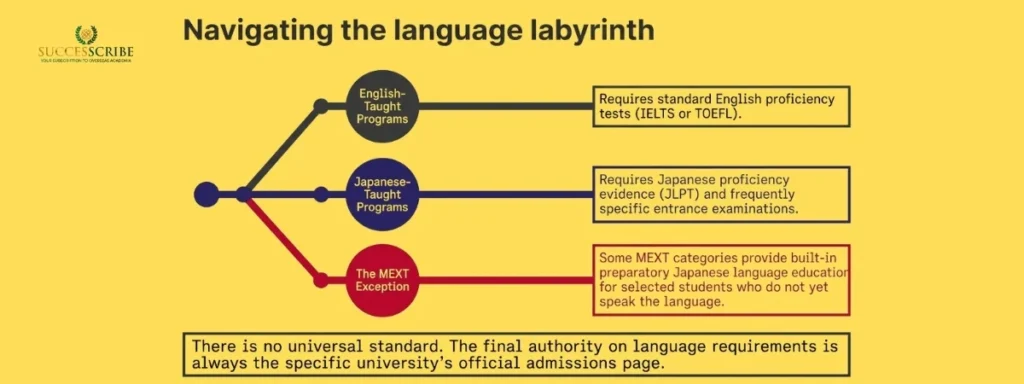
Japan offers programmes taught in Japanese, English and a combination of both. Applicants should check the language requirements of the specific course.
| Programme type | Possible language requirement |
| English-taught master’s programme | English proficiency test may be required |
| Japanese-taught bachelor’s programme | Japanese proficiency and entrance examination may be required |
| Research programme | English or Japanese, depending on supervisor and field |
| Japanese studies programme | Japanese language background may be essential |
| MEXT embassy route | Written tests may include language and subject papers |
There is no single language score accepted by every Japanese university. Some institutions accept IELTS or TOEFL, while others may accept alternative evidence or waive a test for applicants educated in English. The university’s official admissions page should be treated as the final authority.
Documents Required for Fully Funded Scholarships for Study in Japan
Applicants should prepare documents well before the application window opens.
| Document | Purpose |
| Academic transcripts | Demonstrate previous academic performance |
| Degree or graduation certificate | Confirm educational qualification |
| Passport | Verify identity and nationality |
| Statement of purpose | Explain academic goals and motivation |
| Research proposal | Required for many graduate and research applications |
| Letters of recommendation | Provide academic or professional assessment |
| Language test result | Demonstrate English or Japanese ability |
| Curriculum vitae | Summarise education, experience and achievements |
| Medical certificate | Required by selected scholarship programmes |
| Proof of nationality | Confirm eligibility |
| Financial documents | May be needed for admission or visa procedures |
| Portfolio or publications | Useful for creative, technical and research fields |
Documents may need translation into English or Japanese and may require notarisation, attestation or a specific institutional format.
How to Apply for the Scholarship
The application process for Fully Funded Scholarships to Study in Japan usually follows these steps:
- Identify a suitable degree programme and scholarship category.
- Check nationality, academic, age and language requirements.
- Confirm whether the award is available through an embassy, university or external organisation.
- Prepare transcripts, certificates, recommendations and personal statements.
- Contact potential supervisors if required.
- Write a focused research proposal for graduate or research applications.
- Submit the application through the correct route before the stated deadline.
- Attend written tests, interviews or university evaluations.
- Wait for the final recommendation and scholarship approval.
- Complete admission, Certificate of Eligibility and visa procedures.
Applicants should not submit the same documents without adapting them to the selected university and programme. A strong application explains why Japan, why the chosen institution, why the subject and how the study will contribute to the applicant’s future goals.
Application Timeline
There is no single nationwide deadline for all scholarships. Embassy-recommended MEXT applications are often announced many months before the intended academic year, while university-recommended scholarships may have separate schedules.
| Period | Recommended activity |
| 12 = 18 months before enrolment | Research universities, programmes and scholarship categories |
| 10 – 14 months before enrolment | Prepare language tests, references and research proposal |
| 8 – 12 months before enrolment | Monitor embassy and university announcements |
| During the application window | Submit documents in the prescribed format |
| After initial screening | Attend tests or interviews |
| After nomination | Complete university admission and immigration documents |
| Before departure | Arrange accommodation, travel and financial planning |
Students should never rely on an old deadline found in a blog or social media post. The 2026 cycle may already be closed for some categories, while applications for the following intake may open at different times.
Student Visa and Financial Proof
Scholarship recipients generally need to complete Japan’s immigration process. Depending on the case, the university or sponsor may assist with the Certificate of Eligibility. Students may still be asked to provide financial records or supporting documents.
The official Study in Japan immigration guidance states that applicants may be asked for documents such as a bank balance certificate, income certificate for the previous year and documents proving the source of funds.
Even students with scholarships should keep copies of:
- Scholarship award letter.
- University admission letter.
- Passport.
- Financial documents.
- Academic certificates.
- Certificate of Eligibility.
- Health and insurance documents.
A scholarship does not automatically guarantee visa approval. The applicant must satisfy the relevant immigration and university requirements.
Cost of Studying in Japan Without a Scholarship
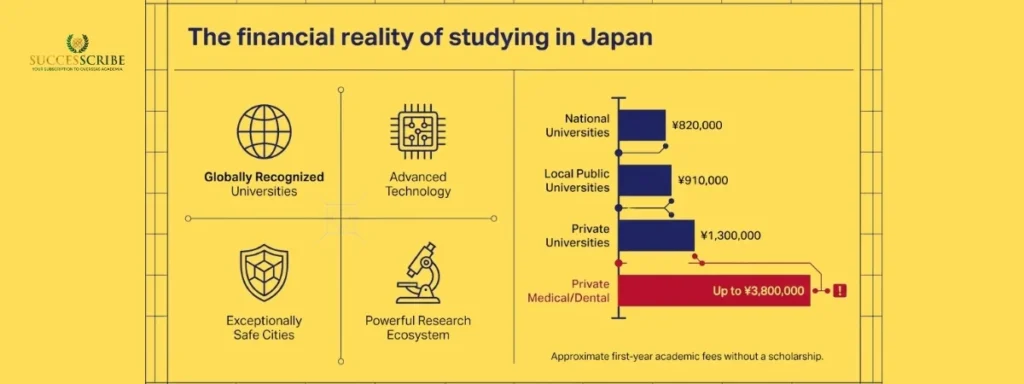
Understanding the potential cost helps students evaluate whether a scholarship is genuinely sufficient. The official Study in Japan website lists approximate first-year academic fees for undergraduate programmes at national universities at around ¥820,000, local public universities at around ¥910,000 and private universities, excluding medical, dental and pharmaceutical programmes, at around ¥1,300,000. Private medical, dental and pharmaceutical programmes can be considerably more expensive.
| Institution type | Approximate undergraduate academic fees |
| National university | ¥820,000 |
| Local public university | ¥910,000 |
| Private university, excluding selected medical fields | ¥1,300,000 |
| Private medical, dental and pharmaceutical programmes | ¥3,800,000 |
How to Improve Your Chances
Applicants seeking Fully Funded Scholarships to Study in Japan should focus on quality rather than applying randomly to a large number of programmes.
- Select a field that matches your previous education and long-term plans.
- Research the university, department and potential supervisor.
- Prepare a specific and realistic research proposal.
- Explain the practical value of your proposed study.
- Use measurable academic or professional achievements.
- Request recommendation letters from people who know your work well.
- Check every form for inconsistencies.
- Follow the required document order and format.
- Prepare for subject tests and interviews.
- Apply only through official channels.
Avoid exaggerated claims, copied statements of purpose, false work experience and unverifiable certificates. Scholarship committees may verify academic and professional information.
Conclusion
Before applying for Fully Funded Scholarships to Study in Japan, confirm:
- The scholarship is listed on an official website.
- Your nationality is eligible.
- Your age and academic qualifications meet the rules.
- The programme matches your educational background.
- You understand what “fully funded” actually covers.
- Your documents are complete and correctly formatted.
- Your research proposal is specific and original.
- You know the correct application route.
- You have checked the latest deadline.
- You can explain your academic goals clearly in an interview.
Japan offers excellent funding opportunities, but competition is high. The strongest applicants combine academic preparation, a well-planned study objective, carefully selected universities and accurate documentation. For the most comprehensive support, the MEXT Scholarship should usually be the first option to investigate, followed by ADB–JSP, university awards and research fellowships that match the applicant’s academic profile.
FAQs
Can Indian students apply for fully funded scholarships in Japan?
Yes. Indian students can apply for scholarships for which India is an eligible country, including relevant MEXT categories. However, eligibility and submission procedures depend on the specific scholarship and the applicant’s study level.
Is MEXT available for bachelor’s, master’s and PhD study?
MEXT has different categories for undergraduate, research and other study routes. The conditions, tests, documents and monthly allowance vary by category.
Do I need Japanese language proficiency?
Not always. Some programmes are taught entirely in English, while Japanese-taught courses generally require Japanese ability. MEXT applicants may also be assigned preparatory education where applicable.
Can I apply for more than one scholarship?
Sometimes, but many scholarships restrict simultaneous receipt of other government or institutional awards. Applicants must read the rules and disclose existing funding.
Does a scholarship cover airfare?
MEXT generally provides round-trip travel support under its guidelines. ADB–JSP also includes travel support among its listed benefits. University and private foundation scholarships may not cover airfare.
Related Post
Best universities in Japan for Indian students
MEXT scholarship for Indian students
Japan study visa requirements for Indians
Study in Japan For Indian Students