If you are planning to study in Japan, one of the first questions you may have is: Can international students work part-time in Japan? How many hours can they work, and how much can they earn?
The answer is yes. International students holding a Student status of residence can generally work part-time after obtaining the required Permission to Engage in Activity Other Than That Permitted under the Status of Residence Previously Granted. During periods when classes are being held, the standard limit is 28 hours per week. During long school vacations, students can work up to 8 hours per day, subject to the applicable conditions.
For students considering Part-time Jobs for International Students in Japan, the financial reality is equally important. The official Study in Japan website reports that approximately 65% of privately financed international students engage in part-time work, with average monthly earnings of approximately ¥81,000 based on the JASSO Lifestyle Survey. The same official source warns that part-time employment should not be treated as a way to finance all tuition and living expenses.
So, part-time work can be a useful way to support daily expenses, gain Japanese workplace experience and improve communication skills – but it should supplement, rather than replace, your primary financial plan.
Key Highlights: Part-time Jobs for International Students in Japan
| Key Point | Current Information |
| Can international students work? | Yes, with the required permission |
| Permission required | Permission to Engage in Activity Other Than That Permitted under the Status of Residence Previously Granted |
| Normal working limit | Up to 28 hours per week |
| Long school vacations | Up to 8 hours per day |
| Average monthly earnings | About ¥81,000 |
| Common job sectors | Restaurants, sales, factory work, teaching/research assistance, hotels, language teaching, administration and warehouse/translation work |
| Can part-time work pay all expenses? | No; official Study in Japan guidance specifically warns against relying on it for all tuition and living costs |
| Prohibited work | Adult entertainment-related businesses and other prohibited activities |
| Important condition | Work must not interfere with studies |
Part-time Work Rules for International Students in Japan

Before accepting any job, students need to understand that a Student status of residence does not automatically give unrestricted permission to work.
International students generally need to obtain permission to engage in activities outside the scope of their Student status. The official Study in Japan website refers to this as “Permission to Engage in Activity Other Than That Permitted under the Status of Residence Previously Granted.” Students can apply through the relevant Regional Immigration Services Bureau. Certain newly arriving students whose period of stay exceeds three months can also apply at an airport or other port of entry when receiving landing permission.
The basic rules are:
- Obtain the required work permission.
- Work only within the permitted working-hour limits.
- Ensure employment does not interfere with your studies.
- Do not work in prohibited adult entertainment businesses.
- Work while you continue to hold Student status and remain enrolled at an educational institution.
- Treat the income as supplementary support for study and necessary expenses rather than as a guaranteed source of full financial support.
- Maintain at least 80% class attendance: Immigration bureaus strictly monitor school attendance. Falling below 80% attendance can lead to the revocation of your work permission and refusal of student visa renewal.
- Be aware of digital tax/income monitoring: Japan’s My Number system links payroll, tax records, and immigration files digitally. Employers report all earnings under this system, making it impossible to hide excessive working hours across multiple jobs.
For students looking for Part-time Jobs for International Students in Japan, understanding these rules is more important than simply finding a high-paying job.
How Many Hours Can International Students Work in Japan?
This is probably the most important rule to understand.
During the normal academic period, international students with the appropriate permission can work up to 28 hours per week.
During long school vacations, the limit changes to up to 8 hours per day. JASSO guidance also explains this as up to 40 hours per week during spring, summer or winter vacation when the applicable vacation conditions are met.
| Period | Maximum Working Time |
| Regular academic period | Up to 28 hours/week |
| Long school vacation | Up to 8 hours/day |
| Vacation equivalent described by JASSO | Up to 40 hours/week |
What if you have two part-time jobs?
Having more than one job does not mean you get a separate 28-hour allowance for every employer. Students need to keep track of their combined working hours and remain within the applicable legal limit.
For example, if you work:
- 15 hours at a restaurant
- 10 hours at a convenience store
your combined total is 25 hours, not 25 hours for each employer.
This is why students should maintain a simple weekly record of every shift.
Do International Students Need a Work Permit in Japan?
Yes, in general, students need the appropriate permission before undertaking paid part-time work outside the activities covered by their Student status.
The permission is commonly known as 資格外活動許可 (Shikakugai Katsudo Kyoka), or Permission to Engage in Activity Other Than That Permitted under the Status of Residence Previously Granted.
The official Study in Japan website specifically states that international students can work part-time when they apply to the relevant immigration authority and receive this permission.
Students should not assume that receiving a Student visa by itself means they can immediately start working.
When can you apply?
According to official immigration guidance, eligible new international students with a Student status valid for more than three months can submit their application directly at passport control upon arrival at major entry airports (including Narita, Haneda, Kansai, Chubu, Fukuoka, Hiroshima, and New Chitose). Applying at the airport allows you to receive the work permission stamp on your Residence Card immediately, taking only a few minutes.
If you do not apply upon arrival at the airport, you must submit your application separately through the Regional Immigration Services Bureau after registering your address in Japan, which can take several weeks to process.
Best Part-time Jobs for International Students in Japan
There is no single “best” job for every student. The right option depends on your Japanese-language ability, location, schedule, previous experience and employer requirements.
Official Study in Japan data based on the JASSO Lifestyle Survey shows that restaurants and sales are among the most common sectors in which international students work. Other categories include factory work, teaching/research assistance, hotel work, language teaching, administration, warehouse work, translation and interpretation.
| Job Type | Japanese Requirement | Flexibility | Suitable For |
| Restaurant staff | Basic–Intermediate | High | Students comfortable with customer interaction |
| Convenience store | Basic–Intermediate | Medium | Students developing Japanese skills |
| Retail/Sales | Intermediate | Medium | Students comfortable speaking Japanese |
| Factory/assembly work | Basic–Intermediate | Medium | Students seeking less customer-facing work |
| Hotel work | Intermediate–Advanced | Medium | Students interested in hospitality |
| Teaching/Research Assistant | Depends on role | Medium–High | University students with relevant skills |
| Language teaching | Depends on employer | Medium | Students with strong language ability |
| Administration | Intermediate–Advanced | Medium | Students with office skills |
| Warehouse work | Basic–Intermediate | Medium | Students looking for operational roles |
| Translation/Interpretation | Advanced | Varies | Students with strong language skills |
These categories are based on the types of jobs reported through official Study in Japan information; actual availability and requirements vary by employer and location.
How Much Can International Students Earn in Japan?
This is where students need to be particularly careful because online advertisements sometimes promise unrealistic earnings.
The official Study in Japan website reports that the average monthly earnings from part-time employment among privately financed international students are approximately ¥81,000, based on the Lifestyle Survey. The same source gives an approximate hourly wage distribution in which 50.2% of respondents were earning between ¥1,000 and ¥1,200 per hour, while 20.5% were earning between ¥1,200 and ¥1,400.
| Reported Hourly Wage | Share of Survey Respondents |
| Less than ¥1,000 | 20.5% |
| ¥1,000–¥1,200 | 50.2% |
| ¥1,200–¥1,400 | 20.5% |
| ¥1,400–¥1,600 | 5.0% |
| More than ¥1,600 | 3.6% |
These figures should not be interpreted as a guaranteed salary. Your actual wage depends on your prefecture, employer, job type, Japanese ability, shift timing and experience.
Japan Minimum Wage for International Students
Japan does not have one identical minimum wage for every prefecture.
The Ministry of Health, Labour and Welfare sets out a system of regional minimum wages, meaning the applicable minimum wage differs across Japan.
What about the 2026 minimum wage?
This is an important 2026 update.
As of August 10, 2026, Japan’s 2026 regional minimum-wage process had progressed to the recommendation stage, but the final prefectural rates were not yet established everywhere.
On July 28, 2026, the Central Minimum Wage Council recommended increases of:
- ¥54 for A-rank prefectures
- ¥56 for B-rank prefectures
- ¥56 for C-rank prefectures
If implemented according to the recommendation, the national weighted average would become approximately ¥1,176 per hour. However, the Ministry of Health, Labour and Welfare stated that local minimum-wage councils would subsequently deliberate and prefectural labour bureau directors would make the final decisions.
Therefore, it would be inaccurate to present ¥1,176 as the final 2026 minimum wage for every student. Students should check the applicable prefectural rate once the 2026 revisions become effective.
How Much Can a Student Earn From a Part-time Job?
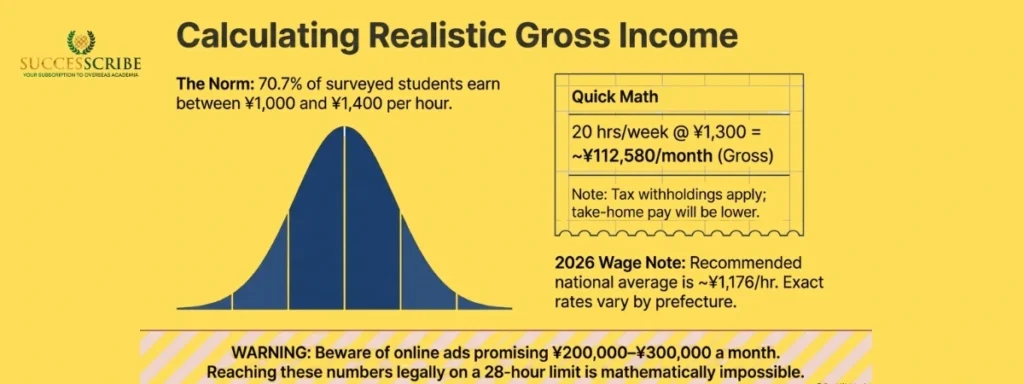
A simple way to understand potential gross earnings is:
Hourly wage × hours worked = gross earnings
For example, using an illustrative hourly wage of ¥1,300:
| Working Pattern | Calculation | Gross Earnings |
| 10 hours/week | ¥1,300 × 10 × 4.33 | Approx. ¥56,290/month |
| 15 hours/week | ¥1,300 × 15 × 4.33 | Approx. ¥84,435/month |
| 20 hours/week | ¥1,300 × 20 × 4.33 | Approx. ¥112,580/month |
| 28 hours/week | ¥1,300 × 28 × 4.33 | Approx. ¥157,612/month |
These are illustrative gross-income calculations, not guaranteed student salaries.
The actual amount can be lower after applicable deductions, and students may not consistently receive the maximum permitted hours every week.
This is also why the official JASSO average of around ¥81,000 per month is a more useful reality check than advertisements promising ¥200,000–¥300,000 every month.
Japanese Language Requirements for Student Jobs
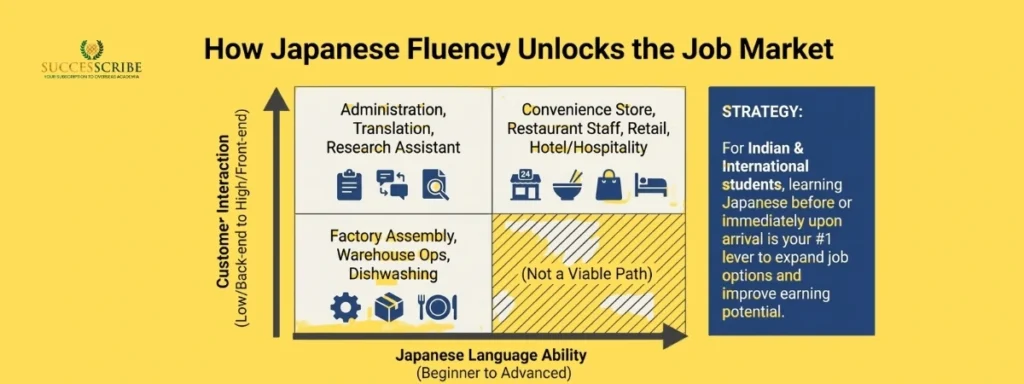
Japanese language ability can have a major impact on your employment options.
A student who speaks little or no Japanese may find fewer customer-facing jobs, while someone with intermediate or advanced Japanese can potentially access a broader range of positions.
However, there is no universal rule such as “JLPT N3 guarantees a part-time job.” Employers set their own requirements.
| Japanese Ability | Potential Opportunities |
| Beginner | Limited options; some back-end or language-related opportunities |
| Basic conversational | Some kitchens, warehouses and selected service jobs |
| Intermediate | Retail, convenience stores, restaurants and hospitality |
| Advanced | Office work, tutoring, translation and more customer-facing roles |
Japanese ability is particularly valuable for jobs involving customers because employees need to understand instructions, respond politely and handle workplace communication.
For Indian students, learning Japanese before or after arriving in Japan can therefore be one of the most practical ways to improve access to Part-time Jobs for International Students in Japan.
Part-time Jobs for Indian Students in Japan
Indian students generally follow the same immigration rules applicable to international students with the relevant Student status. There is no separate 28-hour allowance simply because a student is Indian.
For Indian students, some of the most practical considerations are:
1. Learn Japanese
English may help in selected jobs, but Japanese significantly expands the number of positions you can consider.
2. Choose a job close to your accommodation
Long commuting times can reduce both your earnings and study time.
3. Understand Japanese workplace culture
Punctuality, communication, responsibility and following workplace procedures are important.
4. Protect your attendance (The 80% Rule)
Your primary goal in Japan is education. Japan’s Immigration Services Agency closely evaluates academic performance and attendance when reviewing student status renewal applications. Maintaining 80% attendance or higher is a strict non-negotiable threshold; falling below this due to part-time work fatigue frequently results in visa renewal denials or forced return.
5. Do not rely on part-time work for your entire budget
Part-time income is supplementary. Your financial plan should cover tuition and essential living costs independently.
How to Find Part-time Jobs in Japan
Finding Part-time Jobs for International Students in Japan becomes easier when you use multiple channels rather than depending on one website.
Step 1: Get your work permission
Do this before undertaking paid employment.
Step 2: Prepare your documents
You may need documents such as:
- Residence card
- Student ID
- Passport where required
- Japanese resume, known as 履歴書 (Rirekisho)
- Bank details where required
- Contact information
Step 3: Search through your institution
Universities, language schools and other educational institutions may provide job information or referrals. The official Study in Japan website itself recommends asking your school about part-time job introductions.
Step 4: Search online and locally
Students can explore Japanese job-search platforms, recruitment services, local businesses and employment notices.
Useful Japanese words include:
| Japanese Term | Meaning |
| アルバイト (Arubaito) | Part-time job |
| 求人 (Kyūjin) | Job vacancy |
| 面接 (Mensetsu) | Interview |
| 履歴書 (Rirekisho) | Resume |
| 時給 (Jikyū) | Hourly wage |
Step 5: Attend the interview
Be prepared to explain:
- Your availability
- Your Japanese ability
- Your student status
- Previous experience
- Your expected working schedule
Cost of Living vs Part-time Income in Japan
One of the biggest misconceptions about Part-time Jobs for International Students in Japan is that students can simply work enough hours to pay for everything.
Official Study in Japan information based on the JASSO Lifestyle Survey places average monthly living expenses for international students at approximately ¥105,000, excluding study and research costs. Average housing costs were around ¥41,000 nationally and approximately ¥57,000 in Tokyo.
| Expense Category | Important Point |
| Accommodation | National average around ¥41,000; Tokyo around ¥57,000 |
| Food | Depends heavily on cooking and eating habits |
| Transportation | Can be higher in metropolitan areas |
| Utilities | Varies according to accommodation and usage |
| Communication | Depends on mobile/internet plan |
| Personal expenses | Highly individual |
| Average living cost | About ¥105,000/month excluding study/research costs |
This makes the financial picture clear.
If a student earns the official survey average of approximately ¥81,000 per month, that income alone does not cover the reported average monthly living cost of approximately ¥105,000, even before tuition and study-related expenses are considered.
Therefore, students should arrive in Japan with sufficient financial resources instead of planning their entire budget around part-time employment.
Taxes and Deductions on Part-time Income
Part-time workers in Japan can be subject to taxation and payroll deductions depending on their circumstances.
The National Tax Agency explains that wages from part-time employment are generally treated as employment income and that withholding arrangements can apply to part-time and temporary workers.
Your actual take-home pay may therefore differ from your advertised gross hourly wage.
Students should:
- Check their payslip regularly.
- Understand whether tax is being withheld.
- Keep employment documents.
- Ask their employer when they do not understand a deduction.
- Seek professional tax advice when their circumstances become complicated.
Do not assume that every student earning below a particular amount automatically has identical tax treatment. Japanese tax rules depend on income, deductions and individual circumstances.
Jobs International Students Cannot Do
Students must pay close attention to prohibited employment.
The official Study in Japan guidance states that part-time work in adult entertainment businesses is prohibited by law.
This means students should not accept employment simply because an employer says the job is “easy” or “high-paying.”
Before accepting a job, check:
- The nature of the business
- Your exact duties
- Working hours
- Wage
- Contract conditions
- Whether the employment is compatible with your permission
If an offer appears unusually attractive – for example, extremely high hourly pay for little work – treat it cautiously.
What Happens If You Break the Work Rules?
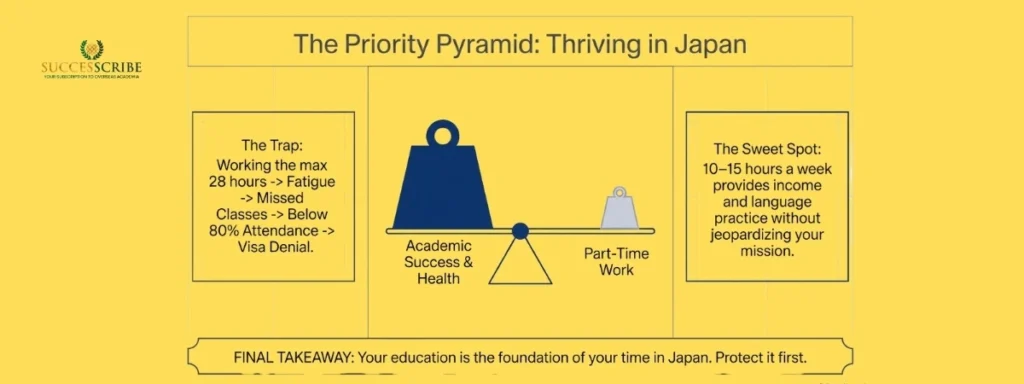
Violating immigration or employment conditions can have serious consequences.
The official Study in Japan website warns that violating the conditions governing student part-time work can result in punishment and potentially deportation.
Common mistakes that lead to immigration penalties or visa revocation include:
- Falling below 80% academic attendance: Overworking is one of the leading reasons student attendance drops, which triggers automatic notifications to immigration authorities.
- Working without the required permit stamp: Starting a job before receiving the official Shikakugai Katsudo Kyoka stamp on your Residence Card.
- Exceeding the 28-hour weekly limit: Failing to track total hours across combined jobs. Under the digital My Number payroll reporting system, tax agencies and immigration automatically cross-reference income records.
- Working in prohibited adult entertainment businesses: This includes not only direct entertainment but also cleaning or dishwashing roles at hostess bars, pachinko parlors, or cabarets.
- Working full-time hours (up to 40 hrs/week) outside official vacation periods: Full-time summer/winter work limits apply only during designated school breaks confirmed by your academic institution, not self-declared vacations.
For international students, following the rules is far more important than earning a few extra thousand yen.
How to Balance Studies and Part-time Work
A part-time job can provide more than money. It can help students develop:
- Communication skills
- Japanese-language ability
- Workplace confidence
- Time-management skills
- Understanding of Japanese business culture
- Professional networks
However, studies should remain the priority.
A practical weekly approach could be:
| Activity | Suggested Priority |
| Classes and attendance | Highest |
| Assignments and examinations | Highest |
| Sleep and health | Highest |
| Part-time work | Secondary |
| Social activities | Flexible |
Do not automatically target the maximum 28 hours every week. A student with a demanding academic schedule may be better off working 10–15 hours.
The official Study in Japan guidance specifically encourages students not to let part-time employment interfere with their studies or health.
Advantages and Disadvantages of Part-time Work
| Advantages | Disadvantages |
| Provides supplementary income | Reduces free time |
| Develops Japanese communication skills | Can cause fatigue |
| Builds workplace experience | May affect studies if poorly managed |
| Improves confidence | Language barriers can be challenging |
| Introduces Japanese workplace culture | Commuting can consume time |
| Can build professional contacts | Rules must be followed carefully |
For students who can manage their schedule responsibly, the experience can be valuable. But the objective should be balanced employment, not maximum working hours.
Conclusion
Part-time Jobs for International Students in Japan can be an excellent way to gain practical experience, improve Japanese communication skills, and reduce some day-to-day financial pressure. The biggest takeaway is simple: use part-time employment as supplementary financial support, not as your complete financial plan for studying in Japan. For Indian and other international students, the strongest approach is to arrive with adequate funds, obtain the correct work permission, learn Japanese, choose a manageable job, and keep studies as the first priority.
When managed responsibly, Part-time Jobs for International Students in Japan can become much more than a source of income – they can provide valuable exposure to Japanese society, workplace culture, and professional life.
FAQs
How many hours can international students work?
The standard limit during academic periods is 28 hours per week. During long school vacations, students can work up to 8 hours per day, subject to the applicable rules.
Do I need permission to work on a Japan Student Visa?
Yes. A Student status by itself does not provide unrestricted permission for paid work. Students generally need Permission to Engage in Activity Other Than That Permitted under the Status of Residence Previously Granted.
How much can students earn?
The latest official Study in Japan information reports average monthly part-time earnings of approximately ¥81,000
What are the best part-time jobs for international students?
Restaurants, sales, factory work, teaching/research assistance, hotels, language teaching, administration, warehouses, and translation/interpreting are among the job categories reported by international students.
Is Japanese required?
Not for every job, but Japanese ability can significantly increase the number of available opportunities. Customer-facing positions generally require stronger communication skills.
Related Post
Highest paying jobs in World
MEXT scholarship for Indian students
Study in Japan For Indian Students
Japan study visa requirements for Indians