
If you are planning to study abroad after Class 12, one of the biggest questions on your mind is likely: Is Japan Good for Indian Students After 12th? The short answer is yes. Japan has emerged as one of the most attractive study destinations for Indian students because of its world-class universities, affordable tuition fees compared to many Western countries, excellent scholarship opportunities, strong job market, and reputation for safety.
Japan is home to some of the world’s leading universities and is known for innovation in fields such as engineering, robotics, artificial intelligence, computer science, biotechnology, and business. With increasing collaboration between India and Japan, more Indian students are choosing Japan for undergraduate education than ever before.
In this comprehensive topic, we will answer every major question students and parents have regarding studying in Japan after Class 12.
Key Highlights: Is Japan Good for Indian Students After 12th
- Low Tuition: National universities start around ₹3.0–3.5 Lakh/year – far cheaper than the US, UK, or Canada.
- English Degrees: Top universities offer full 4-year Bachelor’s programs taught entirely in English (no prior Japanese required).
- Full Scholarships: Government MEXT scholarships cover 100% of tuition, round-trip flights, and a monthly stipend.
- 98% Job Placement: A severe national labor shortage creates massive career opportunities for foreign graduates.
- Part-Time Work: Students can work legally up to 28 hours/week, earning ₹56,000–80,000 monthly to cover living expenses.
- Fast-Track PR: Tech and engineering graduates can qualify for Permanent Residency in as little as 1 to 3 years.
- Tech Leadership: Unmatched exposure to world-class programs in AI, robotics, engineering, and computer science.
Is Japan Good for Indian Students After 12th?
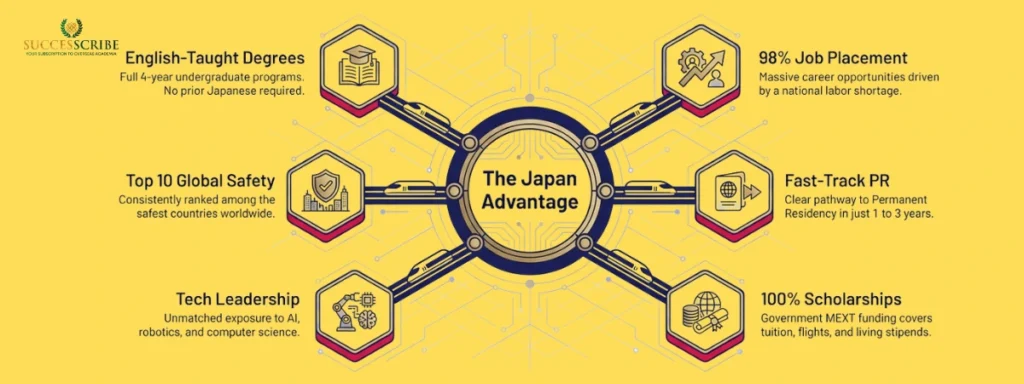
When evaluating whether Is Japan Good for Indian Students After 12th, several factors stand out:
- Globally recognized universities
- Affordable tuition fees
- Numerous scholarships
- Safe environment
- Strong economy
- Advanced technology ecosystem
- Growing demand for international talent
According to official data from the Japan Student Services Organization (JASSO), Japan hosts more than 330,000 international students, making it one of Asia’s leading destinations for higher education.
Indian student enrollment in Japan has also witnessed steady growth due to increasing awareness of Japanese universities and scholarship opportunities.
Why Japan Is Becoming Popular Among Indian Students
| Factor | Benefit |
| High-quality education | Globally recognized degrees |
| Affordable tuition | Lower than USA and UK |
| Scholarhips | MEXT and JASSO support |
| Technology leadership | AI, Robotics, Engineering |
| Safety | Among safest countries globally |
| Career opportunities | Growing demand for skilled professionals |
| Cultural experience | Unique international exposure |
Why Indian Students Are Choosing Japan After 12th
The answer to Is Japan Good for Indian Students After 12th lies in the opportunities Japan offers.
1. World-Class Education
Japan consistently ranks among the top countries for higher education quality. Universities focus heavily on research, innovation, and practical learning.
2. Affordable Study Destination
Compared to countries like the USA, UK, and Australia, Japan offers quality education at a relatively affordable cost.
3. Strong India-Japan Relations
The strategic partnership between India and Japan has resulted in increased academic and employment opportunities for Indian students.
4. Growing Demand for Global Talent
Japan faces workforce shortages due to its aging population. As a result, companies are increasingly hiring international graduates.
Direct Comparison: Japan vs. USA, UK, Canada & Australia
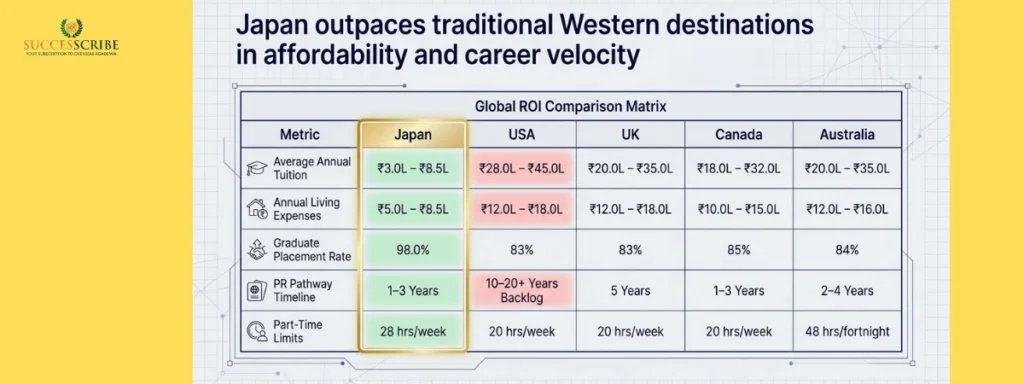
Japan offers one of the strongest balances between affordability and quality.
| Feature / Metric | Japan | USA | UK | Canada | Australia |
| Average Annual Tuition | ₹3.0L – ₹8.5L ($3,500 – $9,500) | ₹28.0L – ₹45.0L ($33,000 – $55,000) | ₹20.0L – ₹35.0L (£18,000 – £32,000) | ₹18.0L – ₹32.0L (CAD 28,000 – 50,000) | ₹20.0L – ₹35.0L (AUD 35,000 – 60,000) |
| Degree Duration (UG) | 4 Years | 4 Years | 3 Years | 4 Years | 3 Years |
| Annual Living Expenses | ₹5.0L – ₹8.5L | ₹12.0L – ₹18.0L | ₹12.0L – ₹18.0L | ₹10.0L – ₹15.0L | ₹12.0L – ₹16.0L |
| Post-Study Work Visa | 1–2 Years (Designated Activities) direct work visa | 1–3 Years (OPT / STEM OPT) | 2 Years (Graduate Route) | 1–3 Years (PGWP) | 2–3 Years (Subclass 485) |
| Graduate Placement Rate | 98.0% (Severe labor shortage) | Highly Competitive (83%) | Competitive (83%) | Tightening Market (85%) | Selective Market (84%) |
| PR Pathway Timeline | 1–3 Years (via Highly Skilled Points) | 10–20+ Years (H-1B / EB Backlog) | 5 Years (Skilled Worker Visa) | 1–3 Years (Express Entry / PNP) | 2–4 Years (Points System) |
| Part-Time Work Limits | 28 hrs/week (40 hrs during breaks) | 20 hrs/week (On-campus only) | 20 hrs/week | 20 hrs/week | 48 hrs/fortnight |
| Safety Rank (Global) | Top 10 Worldwide | Moderate | Moderate | High | High |
Top Benefits of Studying in Japan After 12th
Understanding these benefits helps answer the question: Is Japan Good for Indian Students After 12th?
Excellent Academic Standards
Japanese universities emphasize:
- Research
- Innovation
- Industry collaboration
- Practical learning
Advanced Technology Environment
Japan is globally recognized for:
- Robotics
- Artificial Intelligence
- Semiconductor Technology
- Manufacturing
- Automation
Global Recognition
Degrees from top Japanese universities are respected worldwide.
Safe Student Environment
Japan consistently ranks among the safest countries globally with low crime rates and efficient public services.
Key Advantages
| Advantage | Impact on Students |
| Quality Education | Better career prospects |
| Innovation Ecosystem | Industry exposure |
| Affordable Fees | Lower financial burden |
| Scholarships | Reduced education cost |
| Safe Society | Comfortable student life |
| Global Recognition | International opportunities |
Best Courses in Japan for Indian Students After 12th
One reason why Is Japan Good for Indian Students After 12th is frequently answered positively is the availability of future-focused courses.
| Course | Demand Level | Career Opportunities |
| Computer Science | Very High | Software Engineer, Developer |
| Artificial Intelligence | Very High | AI Engineer, Data Scientist |
| Robotics | Extremely High | Robotics Specialist |
| Mechanical Engineering | High | Manufacturing Engineer |
| Electrical Engineering | High | Electronics Industry |
| Biotechnology | High | Research & Healthcare |
| Data Science | Very High | Data Scientist & Data Analyst |
| Business Management | High | Management Roles |
| Game Design | Growing | Gaming Sector |
| Hospitality Management | High | Tourism Industry |
| Animation | Growing | Creative Industry |
| International Business | High | Global Companies |
Top Universities in Japan for Indian Students
Another major reason why Is Japan Good for Indian Students After 12th is the presence of globally ranked institutions.
| University | QS Ranking 2026 | Popular Courses | English Programs |
| University of Tokyo | Top 40 Globally | Engineering, Science | Yes |
| Kyoto University | Top 60 Globally | Research, Technology | Yes |
| Osaka University | Top 100 Globally | Engineering, Business | Yes |
| Tohoku University | Top 120 Globally | Science, Technology | Yes |
| Waseda University | Top 200 Globally | Business, Economics | Yes |
| Keio University | Top 250 Globally | Management, Technology | Yes |
| Nagoya University | Top 200 Globally | Engineering | Yes |
Rankings may vary slightly based on annual updates.
Academic Pathways After 12th Grade – Admission Requirements for Indian Students After 12th
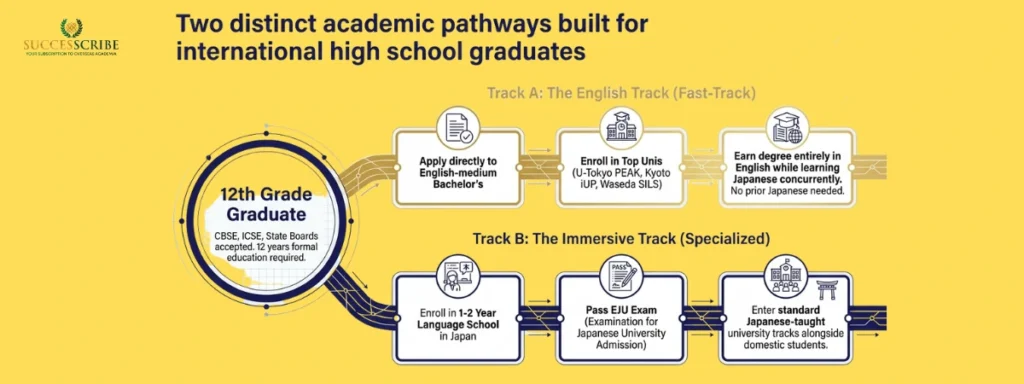
When asking is Japan good for Indian students after 12th, it is crucial to understand the two main academic pathways available to high school graduates.
| English-Taught Programs | Japanese-Taught Programs |
| No Japanese required at entry | Requires EJU + N2/N1 Japanese |
| Earn degree in English | 1 year language school first |
| Learn Japanese concurrently | Broader choice of universities |
Pathway 1: English-Taught Undergraduate Programs
Under Japan’s Global 30 initiative and subsequent internationalization programs, top universities offer full 4-year Bachelor’s degrees taught entirely in English. You do not need prior Japanese proficiency to gain admission.
Popular English Degree Programs:
- University of Tokyo: PEAK (Programs in English at Komaba) – Environmental Sciences & Global Society.
- Kyoto University: iUP (International Undergraduate Program) – Civil Engineering & Science.
- Waseda University: School of International Liberal Studies (SILS) & School of Political Science/Economics.
- Ritsumeikan Asia Pacific University (APU): Dual-language campus (50% international students).
- Tohoku University: Future Global Leadership (FGL) program in Science & Engineering.
Pathway 2: Japanese-Taught Undergraduate Programs
Students aiming for specialized non-English courses enter a Japanese Language Institute (1 to 2 years) upon arriving in Japan, pass the EJU (Examination for Japanese University Admission for International Students), and enroll in standard university tracks alongside Japanese peers.
Tuition Fees and Living Expenses (2026 Rates)
Understanding the actual financial requirement helps answer whether Japan is good for Indian students after 12th.
| Category | National University | Private University |
| Tuition Fees (Annual) | ₹3,00,000 – ₹3,50,000 | ₹5,50,000 – ₹9,50,000 |
| Admission Fee (One-Time) | ₹1,60,000 | ₹1,80,000 |
| Living Costs (Annual) | ₹5,00,000 – ₹7,50,000 | ₹6,00,000 – ₹8,50,000 |
| Total First-Year Cost | ₹9,60,000 – ₹12,60,000 | ₹13,30,000 – ₹19,80,000 |
Estimated Monthly Living Breakdown (Tokyo / Osaka Region)
- Rent (Dormitory/Shared Apartment): ¥35,000 – ¥60,000 (₹20,000 – ₹34,000)
- Food & Groceries: ¥25,000 – ¥35,000 (₹14,000 – ₹20,000)
- Utilities (Electricity, Water, Internet): ¥10,000 – ¥15,000 (₹5,600 – ₹8,500)
- National Health Insurance (NHI): ¥2,000 – ¥3,000 (₹1,100 – ₹1,700)
- Personal & Transport: ¥10,000 – ¥15,000 (₹5,600 – ₹8,500)
- Total Monthly Cost: ¥82,000 – ¥123,000 (approx. ₹46,000 – ₹70,000)
Fully Funded Scholarships for Indian Students
Scholarships can drastically reduce the financial burden, making the answer to “Is Japan Good for Indian Students after 12th?” an even more positive one.
1. MEXT Undergraduate Scholarship (Government of Japan)
The MEXT (Ministry of Education, Culture, Sports, Science and Technology) Scholarship is the gold standard for studying abroad.
- Eligibility: Indian citizens aged 17–24 who have completed 12th grade.
- Coverage: 100% tuition waiver, round-trip flight tickets, and a monthly stipend of ¥117,000 (approx. ₹66,000).
- Duration: 5 years (includes 1 year of intensive Japanese training + 4 years Bachelor’s degree).
- Application Window: April–May through the Embassy of Japan in New Delhi.
2. JASSO Reservation Program
The Japan Student Services Organization (JASSO) offers monthly stipends of ¥48,000/month (approx. ₹27,000) to privately funded international students showing strong academic standing upon admission.
3. Institutional Scholarships
Top universities like Kyoto (iUP) and Waseda offer 20%, 50%, and 100% internal tuition reduction scholarships specifically targeted at international applicants.
Visa Process: What You Need to Know
The Japanese student visa process is unique and structured, centering on the Certificate of Eligibility (COE). This process is generally considered straightforward with a high success rate for Indian students if all requirements are met.
The Two-Step Process
- Certificate of Eligibility (COE): This is the most critical step. Your university applies for the COE on your behalf to the Japanese Immigration Services Agency. This proves you meet all conditions for entry. Processing takes 6 to 8 weeks.
- Visa Application: Once you have the COE, you apply for the student visa at the Japanese Embassy or Consulate in India through VFS Global. This takes a further 5 to 10 working days.
Key Financial Requirement: You must show proof of funds, typically JPY 1.6 to 2 million (approx. ₹9.5 to 13 lakh) to cover your first year’s living expenses.
Part-Time Work Opportunities & Income Potential
Japan explicitly permits international students to work part-time to help cover living costs.
| Parameter | Details / Limits |
| Work Permit Name | Permit to Engage in Activity Other Than Status |
| Hourly Wage | ¥1,113 – ¥1,500 / hour (approx. ₹630 – ₹850/hr) |
| Term-Time Weekly Limit | Max 28 hours per week |
| Vacation Weekly Limit | Max 40 hours per week (Summer/Winter breaks) |
| Monthly Earning Potential | ¥100,000 – ¥140,000 (approx. ₹56,000 – ₹80,000) |
| Common Student Jobs | Convenience stores, English teaching, Cafes, IT operations |
Career Opportunities & Post-Study Work Visas
For students evaluating whether Japan is good for Indian students after 12th, the long-term career outlook is a major deciding factor.
Post-Graduation Job Placement Rate
According to the Ministry of Health, Labour and Welfare, university graduate placement rates stand at 98.0%. Japan faces acute talent shortages in engineering, IT, data science, manufacturing, and healthcare.
Transitioning from Student to Work Visa
- Designated Activities Visa: If you do not have a job offer immediately upon graduation, Japan grants a 1-year extendable job-search visa (up to 2 years total).
- Engineer / Specialist in Humanities / International Services Visa: Once hired, universities and employers convert your student visa directly into a full work visa.
- Fast-Track Permanent Residency: Through the Highly Skilled Professional (HSP) points system, IT and engineering professionals can qualify for Permanent Residency in as little as 1 to 3 years.
Average Starting Salaries in Japan
| Field / Industry | Annual Salary Range (JPY) | INR Equivalent |
| Software & IT Engineering | ¥3.8 Million – ¥5.5 Million | ₹21.5 – ₹31.0 Lakhs |
| Mechanical & Robotics Engg | ¥3.6 Million – ¥5.0 Million | ₹20.3 – ₹28.2 Lakhs |
| Global Business / Marketing | ¥3.2 Million – ¥4.5 Million | ₹18.0 – ₹25.4 Lakhs |
| Healthcare & Life Sciences | ¥3.5 Million – ¥4.8 Million | ₹19.7 – ₹27.1 Lakhs |
Language Requirements: The N2 Threshold Explained
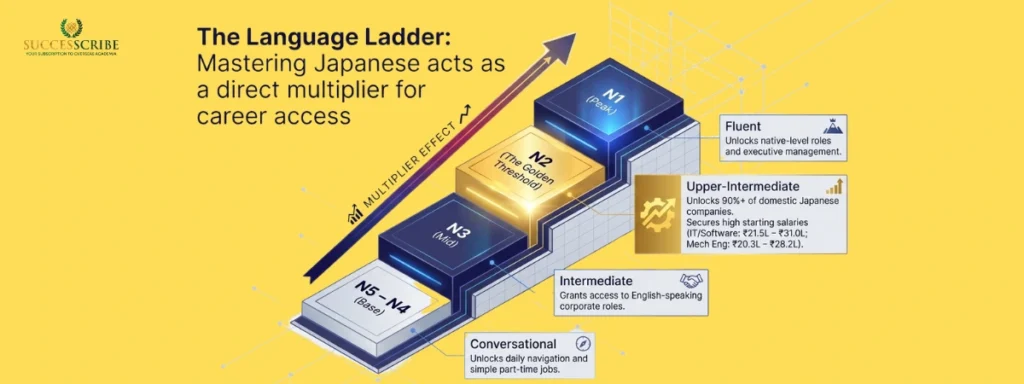
While you can gain admission to English-medium Bachelor’s degrees without prior Japanese, achieving language proficiency is vital for post-graduation career success in Japan.
| JLPT Level | Proficiency Stage | Career & Practical Application |
| N5 – N4 | Basic / Conversational | Daily navigation, simple part-time jobs |
| N3 | Intermediate | English-speaking corporate roles |
| N2 | Upper-Intermediate | Unlocks 90%+ of domestic Japanese companies |
| N1 | Advanced / Fluent | Native-level roles, legal, executive management |
Culture, Safety, and Living in Japan for Indian Students
Major metro areas like Tokyo, Yokohama, Osaka, and Nagoya host growing Indian communities. Cities like Tokyo (specifically Nishi-Kasai) have dedicated Indian groceries, authentic restaurants, temples, and cultural associations.
Challenges to Keep in Mind
- Workplace Norms: Japanese corporate culture values punctuality, teamwork, and structured communication (Hou-Ren-So).
- Initial Cultural Adjustment: Japan is a high-courtesy, low-noise society; adapting to recycling rules and social etiquette takes a few weeks.
- Earthquake Preparedness: Japan features high seismic activity, but its modern buildings use advanced earthquake-resistant engineering, alongside regular national drills and early-warning systems.
Conclusion
Japan is an exceptional choice for Indian students after 12th who want an affordable, world-class education paired with clear post-graduation job prospects. If you prioritize low student debt, safe living conditions, high graduate employment rates, and fast-track PR options, Japan offers strong advantages over traditional Western study destinations
FAQs
Do Japanese universities accept Indian high school boards like CBSE, ICSE, and State Boards?
Yes. All major Japanese universities recognize 12th-grade qualification certificates issued by CBSE, ICSE, IB, and state secondary boards. Japanese immigration requires international applicants to have completed 12 years of formal education prior to entering an undergraduate program. If you hold a 3-year post-10th vocational diploma, you may need a 1-year preparatory foundation course in Japan to meet the 12-year requirement.
Can I study in Japan after 12th if I don’t speak Japanese?
Yes, through English-taught degree programs. Universities like the University of Tokyo (PEAK), Kyoto University (iUP), Waseda University (SILS), and Ritsumeikan APU offer 4-year Bachelor’s degrees entirely in English. However, while you can survive academically without Japanese, learning basic conversational Japanese (JLPT N5/N4) is strongly recommended for daily tasks, part-time jobs, and integrating into local life.
How much bank balance is required to get a Japanese Student Visa?
When applying for your Certificate of Eligibility (COE) and Student Visa, Japanese immigration typically requires proof of funds showing at least ¥2,000,000 to ¥2,500,000 (approx. ₹11 Lakhs to ₹14 Lakhs) for 1 year of study and living expenses. Parents or direct guardians can serve as official financial sponsors by submitting 6-month bank statements and Income Tax Returns (ITR).
Can I fund my complete tuition and living expenses through a part-time job?
No. While international students can legally work up to 28 hours per week (and 40 hours during official university breaks), part-time income usually yields ¥100,000 to ¥130,000 per month (approx. ₹56,000 to ₹73,000). This is enough to pay for rent, food, transport, and pocket money, but it will not cover tuition fees. Part-time work should be viewed as living allowance support, not total degree funding.
Is healthcare expensive for international students in Japan?
No, healthcare is very affordable. As a student visa holder, you are legally obligated to enroll in Japan’s National Health Insurance (NHI). Because students have minimal or no local taxable income, monthly insurance premiums are heavily subsidized—costing roughly ¥2,000/month (approx. ₹1,100). The insurance automatically covers 70% of all medical bills, including doctor visits, dentist care, prescription drugs, and hospitalizations.
Related Post
Top universities in Japan for Indian students
MEXT scholarship for Indian students
Japan study visa requirements for Indians
Study in Japan For Indian Students