Japan has rapidly emerged as a top-tier destination for international education, moving beyond its traditional reputation for language studies to become a global hub for science, technology, and innovation. For Indian students, it offers a unique combination of world-class academic standards, safe living environments, and high-tech career prospects. With the Japanese government actively recruiting South Asian talent to address its aging population, there has never been a better time to explore the Best Universities in Japan for Indian Students.
Key Highlights: Best Universities in Japan for Indian Students
- Top-Ranked Global Institutions: Home to elite QS World Top-100 universities like UTokyo, Kyoto, Osaka, and Science Tokyo, leading global innovation in STEM, AI, and Robotics.
- Standardized & Affordable Tuition: All top national universities offer world-class education at a fixed, government-regulated tuition fee of ~₹3.2 Lakhs/year—a fraction of Western costs.
- Flagship English-Taught Programs: Premier tracks like UTokyo’s GSC, Science Tokyo’s GSEP, Kyoto iUP, and Waseda’s SILS allow Indian students to study entirely in English without initial Japanese fluency.
- Full-Ride Government Scholarships: Applicants at top universities qualify for prestigious MEXT and institutional grants, covering 100% tuition, airfare, and a monthly stipend (up to ₹83,000).
- Direct Recruitment to Global MNCs: Graduating from top-tier Japanese universities provides strong career pipelines to global giants like Sony, Toyota, SoftBank, and Rakuten.
Why Japan is Becoming the Top Destination for Indian Students
Japan has emerged as one of the most attractive study-abroad destinations for Indian students in Asia. Driven by Japan’s global technology initiatives, a shortage of skilled STEM professionals, and an active government effort to recruit over 15,000 Indian students over five years, the country provides high-value degrees at a fraction of Western costs.
- Affordable Tuition: National universities charge a uniform ¥535,800/year (approx. ₹3.0–3.2 Lakhs INR), making higher education far more accessible than in the US, UK, or Canada.
- MEXT Full Ride Scholarships: The Japanese government provides full tuition waivers plus monthly stipends ranging from ¥119,000 to ¥147,000/month (approx. ₹67,000 to ₹83,000 INR).
- Global Safety: Consistently ranked in the top tier for public order and healthcare, providing a reassuring environment for international residents.
- The G30 Initiative: A government-backed framework ensuring full degree programs are conducted in English, removing the immediate linguistic barrier for STEM and Business cohorts.
- High Post-Study Employment Rate: Over 85% of international graduates who wish to work in Japan secure full-time employment, supported by the Specified Skilled Worker and Designated Activities (Job Hunting) visas.
- Part-Time Work Rights: International students on a Student Visa are legally permitted to work up to 28 hours per week during semester terms and up to 40 hours per week during designated holiday breaks.
Top Universities in Japan for Indian Students
Japan has rapidly emerged as a top-tier destination for international education, moving beyond its traditional reputation for language studies to become a global hub for science, technology, and innovation. For Indian students, it offers a unique combination of world-class academic standards, safe living environments, and high-tech career prospects. With the Japanese government actively recruiting South Asian talent to address its aging population, there has never been a better time to explore the Best Universities in Japan for Indian Students
| University Name | QS World Rank (2027) | Institutional Type | Est. Annual Tuition (JPY) | Location |
| University of Tokyo | #39 | National | 535,800 | Tokyo |
| Kyoto University | #64 | National | 535,800 | Kyoto |
| Osaka University | #95 | National | 535,800 | Osaka |
| Institute of Science Tokyo | #97 | National | 635,400 | Tokyo |
| Tohoku University | #102 | National | 535,800 | Sendai |
| Nagoya University | #156 | National | 535,800 | Nagoya |
| Kyushu University | #171 | National | 535,800 | Fukuoka |
| Hokkaido University | #179 | National | 535,800 | Sapporo |
| Waseda University | #201 | Private | 1,473,000+ | Tokyo |
| Keio University | #213 | Private | 924,125+ | Tokyo |
Popular English-Taught Programs
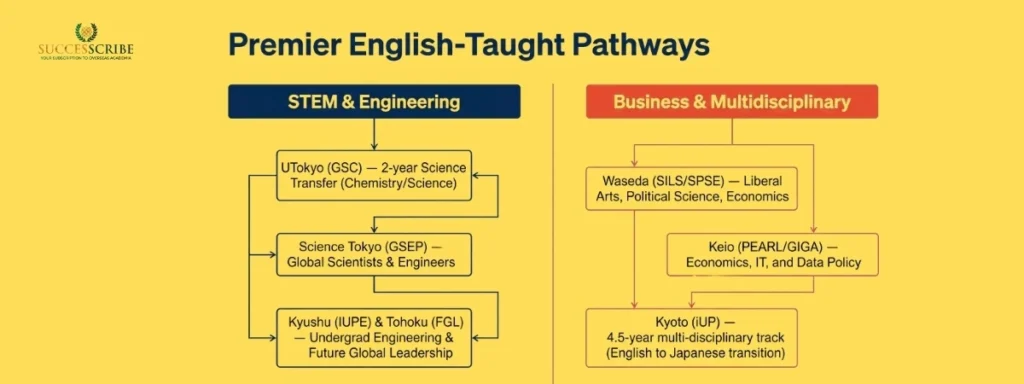
For Indian students looking to study without prior Japanese fluency, these are the flagship programs highlighted in the sources:
| University | Flagship English-Taught Program | Field of Study |
| UTokyo | Global Science Course (GSC) | Chemistry/Science Transfer |
| Kyoto U | Kyoto iUP | Multi-disciplinary (English to Japanese) |
| Science Tokyo | GSEP | Global Scientists & Engineers |
| Tohoku U | FGL Program | Future Global Leadership (Undergrad) |
| Osaka U | Human Sciences/Robotics | Specialized Science & Tech |
| Kyushu U | IUPE | International Undergrad Engineering |
| Waseda | SILS / SPSE | Liberal Arts, Political Science, Economics |
| Keio | PEARL / GIGA | Economics, IT, and Policy |
Best Universities in Japan for Indian Students: In-Depth Campus Profiles
Below are the detailed profiles for the top-tier institutions in Japan, specifically curated for the Best Universities in Japan for Indian Students. These profiles highlight academic prestige, English-taught pathways, and career advantages based on the latest 2026–2027 data.
1. The University of Tokyo (UTokyo)
| Category | Details |
| Global Rankings (2026–2027) | QS World Ranking: #36 (2026), #39 (2027) THE World Ranking: #26 (2026) |
| Location | Three main campuses in Hongo, Komaba, and Kashiwa (Tokyo). |
| Popular English Programs | Undergraduate: The Global Science Course (GSC) is now the primary undergraduate route for science students. It is a 2-year transfer program where students complete their first two years in India and transfer to UTokyo for years 3 and 4. (Note: The PEAK program is permanently closed to new applicants as of September 2026.) Graduate: International Multidisciplinary Engineering, Data Science, AI, and Robotics. |
| Tuition Fees | Standardised at approx. JPY 535,800 (INR 3.25 Lakhs) annually. |
| Industry Ties | Located in Tokyo’s tech hub, offering proximity to Sony, SoftBank, and Hitachi. |
| Admission Requirements | GSC requires university transcripts and an online interview (no SAT/ACT). Master’s programs usually require the GRE. |
2. Kyoto University
| Category | Details |
| Global Rankings (2026–2027) | QS World Ranking: #57 (2026), #64 (2027)THE World Ranking: #61 (2026) |
| Location | Historic Yoshida Campus (Kyoto) and the advanced Uji research campus. |
| Popular English Programs | Kyoto iUP: A 4.5-year undergraduate program where students start in English and transition to Japanese. Graduate: International Business Administration (iMBA), Civil Engineering, and Agricultural Sciences. |
| Tuition Fees | Approx. JPY 535,800 (INR 3.25 Lakhs) annually. |
| Industry Ties | Direct links to Kyoto-based global giants like Nintendo, Kyocera, and Omron. |
| Admission Requirements | Most graduate departments require GRE or GMAT scores. |
3. Osaka University
| Category | Details |
| Global Rankings (2026–2027) | QS World Ranking: #91 (2026), #95 (2027)THE World Ranking: #151 (2026) |
| Location | Three campuses in Suita, Toyonaka, and Minoh (Osaka). |
| Popular English Programs | Undergraduate: Offers 100% English-taught 4-year Bachelor’s degrees. Specialisations: Global leader in Robotics (Androids), Immunology, Biotechnology, and Human Sciences. |
| Tuition Fees | Approx. JPY 535,800 (INR 3.25 Lakhs) annually. |
| Industry Ties / Career Prospects | Science students benefit from corporate-sponsored labs and practical internships in Japan’s industrial heartbeat. |
| Admission Requirements | Highly recommends JEE, NEET, SAT, or ACT scores for undergraduate screening. |
4. Institute of Science Tokyo (Science Tokyo)
| Category | Details |
| Global Rankings (2026–2027) | QS World Ranking: #85 (2026), #97 (2027) THE World Ranking: #166 (2026) |
| Location | Meguro-ku, Tokyo. |
| Popular English Programs | GSEP (Global Scientists and Engineers Program): A flagship undergraduate engineering track. IGP (International Graduate Program): Allows for 100% English research at the Master’s and PhD levels. |
| Tuition Fees | Approx. JPY 635,400 (INR 3.25 Lakhs) annually. |
| Industry Ties / Career Prospects | Renowned for an exceptionally high employment rate for technical graduates in robotics and medical sciences. |
| Admission Requirements | Application via institutional portal; evaluate strong background in STEM subjects. |
5. Tohoku University
| Category | Details |
| Global Rankings (2026–2027) | QS World Ranking: #109 (2026), #102 (2027) THE World Ranking: #103 (2026) |
| Location | Sendai City, which offers a lower cost of living than Tokyo. |
| Popular English Programs | FGL (Future Global Leadership): Offers three full undergraduate degrees in English. Master’s: Specialized tracks in Metallurgy, Aerospace Engineering, and Information Sciences. |
| Tuition Fees | Approx. JPY 535,800 (INR 3.25 Lakhs) annually. |
| Industry Ties / Research Exposure | Access to world-class semiconductor cleanrooms and advanced materials testing facilities. |
| Admission Requirements | Direct application; strong performance in secondary school math and sciences required. |
6. Nagoya University
| Category | Details |
| Global Rankings (2026–2027) | QS World Ranking: #164 (2026), #156 (2027) THE World Ranking: #201–250 (2026) |
| Location | Nagoya City, Aichi Prefecture. |
| Popular English Programs | Undergraduate: Automotive Engineering, Physics, Chemistry, and Biological Science. Graduate: Aerospace Engineering and International Development. |
| Tuition Fees | Approx. JPY 535,800 (INR 3.25 Lakhs) annually. |
| Industry Ties | Surrounded by the global headquarters of Toyota Motor Corporation and major aerospace manufacturers. |
| Admission Requirements | Document screening followed by subject-specific tests/interviews. |
7. Kyushu University
| Category | Details |
| Global Rankings (2026–2027) | QS World Ranking: #170 (2026), #171 (2027) THE World Ranking: #301–350 (2026) |
| Location / Cost of Living | Fukuoka (highly affordable city, with exceptionally cheap university dormitories). |
| Popular English Programs | IUPE (International Undergraduate Program in Engineering): Tracks in Electrical Engineering, Computer Science, and Applied Chemistry. Graduate: Automotive Science and Sustainable Environmental Engineering. |
| Tuition Fees | Approx. JPY 535,800 (INR 3.25 Lakhs) annually. |
| Industry Ties | Ties with Fukuoka’s growing tech startup hub and green technology industries. |
| Admission Requirements | Academic transcripts, standardized test submissions, and online interview evaluations. |
8. Hokkaido University
| Category | Details |
| Global Rankings (2026–2027) | QS World Ranking: #170 (2026), #179 (2027) THE World Ranking: #351–400 (2026) |
| Location | Sapporo, Hokkaido. |
| Popular English Programs | ISP (Integrated Science Program): A 4-year Bachelor’s spanning Physics, Chemistry, and Biology before choosing a major. Graduate: Chemical Sciences, Engineering, and Life Science. |
| Tuition Fees | Approx. JPY 535,800 (INR 3.25 Lakhs) annually. |
| Industry Ties / Field Opportunities | Research expeditions on marine vessels and studies in specialized sub-zero labs. |
| Admission Requirements | High school academic screening and interview process focused on basic science capability. |
9. Waseda University (Private)
| Category | Details |
| Global Rankings (2026–2027) | QS World Ranking: #196 (2026), #201 (2027)THE World Ranking: #801–1000 (2026) |
| Location | Shinjuku, central Tokyo. |
| Popular English Programs | Undergraduate: International Liberal Studies (SILS), Political Science and Economics (SPSE). Graduate: Global Media Studies and the top-ranked International MBA (iMBA). |
| Tuition Fees | Approx. INR 5.73 Lakhs to 6.70 Lakhs annually. |
| Industry Ties / Scholarships | Internal tuition reduction grants ranging from 30% to 100%. Famous for its elite political and business alumni networks. |
| Admission Requirements | Admission Tip: IELTS/TOEFL can be waived if the student provides a Medium of Instruction certificate from their Indian school. |
10. Keio University (Private)
| Category | Details |
| Global Rankings (2026–2027) | QS World Ranking: #215 (2026), #213 (2027) THE World Ranking: #601–800 (2026) |
| Location | Tokyo. |
| Popular English Programs | PEARL: An advanced 4-year Bachelor’s in Economics. GIGA: A multi-disciplinary track blending IT, Policy, and Data Technology. |
| Tuition Fees | Approx. INR 6.70 Lakhs annually. |
| Industry Ties / Career Prospects | Access to the ‘Mita Kai’ alumni network, which consists of executives leading Japan’s top banks and corporations. |
| Admission Requirements / Scholarships | Offers the “Design the Future Award,” which covers full tuition plus a stipend. Standardized test score screening required. |
High-Demand Specializations: Best Courses in Japan
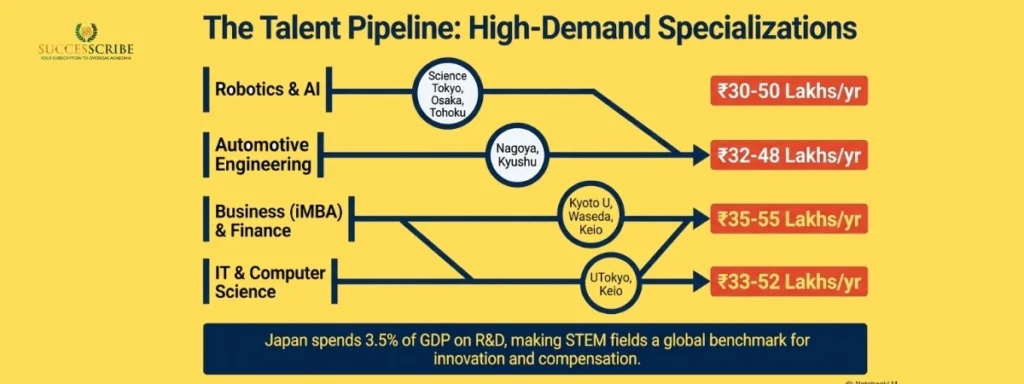
Choosing the right major is a strategic decision linked to the “Highly Skilled Professional” visa pathway. In 2026, the demand for STEM and specialized business graduates remains at an all-time high.
- STEM (Robotics, AI, Materials): With Japan spending 3.5% of GDP on R&D, fields like Materials Science at Tohoku and Robotics at Science Tokyo are global benchmarks.
- Business (iMBA): Programs at Kyoto and Waseda are designed for those looking to manage cross-border operations within Asian markets.
- Global Liberal Arts: Schools like SILS (Waseda) produce graduates who are adaptable and multilingual, highly sought by MNCs.
| Discipline | Specialization | Key Universities | Starting Salary (INR Approx.) |
| STEM | AI, Materials Science | Tohoku, Science Tokyo | 30 – 50 Lakhs |
| Engineering | Robotics, Automotive | Osaka, Nagoya | 32 – 48 Lakhs |
| Business | iMBA, Finance | Kyoto U, Keio | 35 – 55 Lakhs |
| IT | Computer Science, CS&E | UoA, UTokyo | 33 – 52 Lakhs |
Scholarship & Funding Ecosystem

The Japanese government is currently executing an aggressive strategy to recruit Indian and South Asian talent through high-value financial incentives. These grants often make the cost of studying abroad in Japan lower than domestic private education.
- MEXT (Monbukagakusho): The “Full Ride.” Covers 100% tuition, monthly stipends up to ₹80,000, and round-trip airfare.
- JASSO Scholarship: A settlement stipend of ¥48,000 (₹27,000) per month for 6-12 months to cover initial relocation.
- University-Specific Awards: Keio’s “Design the Future” and Waseda’s tuition reductions (30-100%) leverage massive alumni funding from the “Mita Kai” to support global leaders.
Post-Study Work/Visa Options for Graduates
Japan’s demographic crisis has turned foreign talent recruitment into a national priority, leading to some of the most flexible post-study work policies in the G7.
- J-Find Visa: Graduates from top universities can stay for 2 years to job hunt or launch a startup.
- Designated Activities Visa: A 1-year extension for those seeking employment post-graduation.
- Part-Time Rights: All students can work 28 hours per week (40 during holidays), a vital lifeline for those looking to self-fund their study abroad in Japan.
- Top Recruiters: SoftBank, Rakuten, Sony, and Toyota Motor Corporation.
- PR Pathway: Using the “Highly Skilled Professional” points system, graduates from top-tier universities can fast-track their Permanent Residency to as little as 1 to 3 years.
Conclusion
Choosing to study at the Best Universities in Japan for Indian Students is a strategic move that combines top-tier academic standards with exceptional economic value. While Western destinations face rising tuition and stricter post-study visas, Japan offers an unmatched return on investment through affordable national university fees (around ₹3.2 Lakhs/year) and generous MEXT full-ride scholarships. With over 85% of international graduates securing full-time employment at global giants like Sony, Toyota, and SoftBank, Japan actively opens its doors to South Asian talent.
Furthermore, graduating from these premier institutions awards bonus points under the Highly Skilled Professional system, putting you on a fast track to Permanent Residency in as little as 1 to 3 years. By planning applications early and learning Japanese during your studies, choosing from the Best Universities in Japan for Indian Students provides a safe, vibrant, and high-tech launchpad for a global career.
FAQs
Do I need to know Japanese to study at top universities in Japan?
No, prior Japanese language proficiency is not mandatory for admission to English-taught degree programs (such as the GSC at UTokyo, GSEP at Science Tokyo, or SILS at Waseda). These degrees are delivered 100% in English. However, learning Japanese during your studies up to JLPT N3/N2 level is strongly recommended if you plan to secure a full-time job at a Japanese corporation after graduation.
What is the J-Find Visa, and who qualifies for it?
The J-Find Visa (Japan System for Future Creation Individual) allows foreign graduates from top-ranked global universities to stay in Japan for up to 2 years to search for a job or launch a startup. To qualify, you must have graduated within the last 5 years from a university ranked in the top 100 of at least two designated world university rankings (QS, THE, or ARWU) and hold minimum proof of savings.
How do Indian academic credentials (CBSE, ISC, State Boards) convert for admission in Japan?
Japanese universities widely accept 12th-grade board qualifications from recognised Indian boards (CBSE, ISC, and major State Boards).
Grade Expectations: Top-tier national universities usually expect a minimum aggregate score of 80%–85%, especially in relevant subject fields like Mathematics, Physics, or Chemistry.
MOI Certificate: For English requirements, many private universities (e.g., Waseda) allow applicants to submit a Medium of Instruction (MOI) Certificate from their school to waive TOEFL/IELTS requirements.
Which Japanese universities are best for Indian students interested in Automotive Engineering and Robotics?
For Automotive Engineering: Nagoya University is located in the heart of Japan’s automotive industrial zone, maintaining direct research partnerships with Toyota Motor Corporation, Mitsubishi, and Denso.
For Robotics and AI: Osaka University and Tohoku University are world leaders. Osaka University is famous for its Intelligent Robotics Laboratory (android development) and offers English-taught undergraduate engineering tracks with direct industry internships.
Which public universities in Japan offer the lowest cost of living for Indian students?
While all national universities charge the exact same tuition (¥535,800/year), living costs vary significantly by region:
Tohoku University (Sendai): Sendai is a peaceful university town where monthly living costs are 20% to 30% lower than in Tokyo.
Kyushu University (Fukuoka): Fukuoka offers cheap housing, dynamic startup ecosystems, and lower overall living expenses while remaining a major metropolitan hub.
Hokkaido University (Sapporo): Offers affordable campus housing and extensive research opportunities in environmental science, marine biology, and agriculture.
Related Post
MEXT scholarship for Indian students
Japan study visa requirements for Indians
Study in Japan Consultancy in India
Study in Japan For Indian Students