
The demand for data professionals in India has reached an all-time high in 2026. From startups and fintech companies to healthcare giants and global MNCs, organizations are investing heavily in data-driven decision-making. As a result, the Data Analyst salary in India has seen massive growth over the last few years.
Today, businesses are no longer relying solely on instinct. Every customer interaction, transaction, marketing campaign, and operational process generates data. Companies now need skilled professionals who can analyze that data and turn it into actionable business insights. This increasing dependency on analytics has made Data Analytics one of the fastest-growing career fields in India. According to recent industry estimates, India’s analytics market is expected to cross USD 25 billion by 2027, while the number of analytics job openings has increased by nearly 35 – 40% year-over-year. Whether it is e-commerce, banking, healthcare, SaaS, consulting, or AI-driven businesses, the hiring demand for Data Analysts continues to rise rapidly.
Data Analyst Salary In India by City
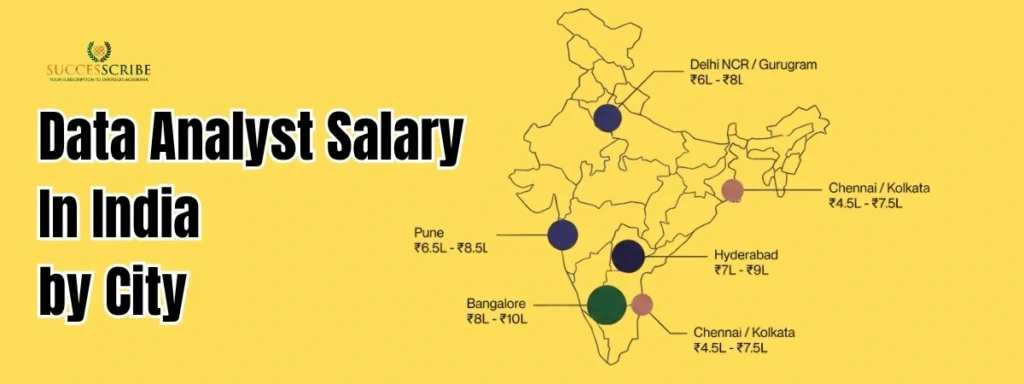
Geography remains a dominant factor in determining the real value of an analyst’s compensation. There is a complex relationship between “nominal pay” and “purchasing power parity” across India’s major metros. While a high salary in Bangalore is desirable, the rising cost of living, particularly in prime tech corridors like Bellandur or Indiranagar, must be factored into the equation. However, the sheer density of opportunities in tier-1 cities often outweighs the higher expenses in the long run.
| City | Average Annual Salary (LPA) | Market Premium |
| Bangalore | ₹8.0L – ₹10.0L | 20–25% Above National Avg |
| Hyderabad | ₹7.8L – ₹9.0L | Strong Growth / Tech Infrastructure |
| Gurgaon / Delhi NCR | ₹6.5L – ₹8.5L | MNC Headquarters / Consulting Hub |
| Mumbai | ₹6.5L – ₹8.0L | Finance & Fintech Premium |
| Pune | ₹6.0L – ₹8.0L | IT & Automotive Synergy |
| Chennai | ₹5.5L – ₹7.5L | SaaS & Product Development |
The “Weird Market” and the Myth of the Average
The Indian data market is currently “bimodal”—it has two distinct souls. On one hand, Payscale reports a conservative average of ₹5.77 lakhs. On the other, 6figr’s database of verified profiles suggests an average of ₹13.8 lakhs. To find the truth, look at the median: ₹11.4 lakhs.
The “average” is skewed by a stratosphere of high earners. While the bottom 43% of the market earns less than ₹10 lakhs, the Top 10% earn more than ₹24.9 lakhs, and the Top 1% cross a whopping ₹51.4 lakhs. Nothing illustrates this “weird market” better than the outliers: while the highest reported salary reached a staggering ₹385.9 lakhs, a two-year experience intern at Paypal reported a CTC of ₹37.1 lakhs.
As one contributor on Reddit aptly summarized:
“It’s the weirdest market and no number is right or wrong.”
Experience-Based Compensation Hierarchy: Market-Clearing Rates

The “experience curve” in data analytics remains significantly steeper than in traditional software development. In this “weird market,” compensation is dictated less by years of service and more by niche technical proficiency.
Data Analyst Salary for Freshers (0–1 Years)
Standard entry-level market-clearing rates range from ₹3.5L to ₹5L (Monthly in-hand: ₹29,000–₹42,000). However, elite benchmarks show a different reality. High-performing “Data Analyst” freshers can command ₹9L, while those in specialized “Data Scientist” entry roles reach ₹14L. The absolute ceiling for freshers is evidenced by outliers like the PayPal Data Analyst Intern role, which reported a CTC of ₹37.1L.
Early Career & Mid-Career (2–5 Years)
Between years two and five, analysts typically transition into “Senior” titles. Salaries for those with 2 years of experience jump to the ₹4L – ₹7L range. By the 5-year mark, professionals mastering the technical stack can command ₹6L – ₹12L, with senior analysts at top-tier firms comfortably hitting ₹20L – ₹25L.
Late Career & Leadership (10+ Years)
Professionals in this bracket move into high-responsibility positions where the pay floor is significantly elevated:
- Principal Data Analyst: ₹48.0 Lakhs
- Data Science Manager: ₹37.0 Lakhs
- Senior Analyst: ₹28.0 Lakhs
Experience vs. Compensation Matrix
| Experience Level | Annual CTC Range (INR) | Estimated Monthly In-Hand (INR) |
| Fresher (Elite/Tier-1) | ₹9.0L – ₹14.0L | ₹68,000 – ₹1,05,000 |
| Early Career (1-3 Years) | ₹4.0L – ₹9.0L | ₹33,000 – ₹70,000 |
| Mid-Career (3-6 Years) | ₹6.0L – ₹15.0L | ₹50,000 – ₹1,15,000 |
| Senior (7-10 Years) | ₹12.0L – ₹20.0L+ | ₹1,00,000 – ₹1,66,000 |
| Leadership (10+ Years) | ₹28.0L – ₹48.0L+ | ₹2,10,000+ |
CTC vs In-Hand Salary
Many candidates confuse CTC with actual monthly salary.
| Salary Component | Amount |
| Annual CTC | ₹8,00,000 |
| Monthly Gross Salary | ₹66,666 |
| Approx In-Hand Salary | ₹52,000 – ₹58,000 |
Factors affecting in-hand salary:
- PF deductions
- Taxes
- Bonuses
- ESOPs
- Insurance
Suggested Post: Profile Building for Imperial College London
Data Analyst Salary in India for 2 Years Experience
The Data Analyst Salary in India for 2 years experience is significantly higher compared to entry-level salaries.
At this stage, professionals are expected to:
- Handle dashboards independently
- Write complex SQL queries
- Work with stakeholders
- Analyze business data
Salary Range for 2 Years of Experience
| Company Type | Salary Range |
| IT Services | ₹6 – ₹9 LPA |
| Product Companies | ₹10 – ₹16 LPA |
| Consulting Firms | ₹8 – ₹14 LPA |
| Startups | ₹9 – ₹18 LPA |
Data Analyst Salary in India for 5 Years Experience
The Data Analyst salary in India for 5 years experience reflects mid-level expertise and domain specialization.
At this stage, professionals often move into:
- Senior Data Analyst roles
- Analytics Consultant roles
- BI Developer roles
- Product Analytics roles
Average Salary for 5 Years of Experience
| Company Type | Salary Range |
| Service Companies | ₹10 – ₹15 LPA |
| Product-Based Companies | ₹18 – ₹30 LPA |
| Big 4 Firms | ₹14 – ₹24 LPA |
| Fintech Startups | ₹20 – ₹35 LPA |
Data Analyst Salary in India After 10 Years Experience
The Data Analyst salary in India after 10 years of experience can become exceptionally high, especially in leadership or product-driven roles.
By this stage, professionals may become:
- Analytics Manager
- Data Strategy Consultant
- BI Director
- Head of Analytics
Senior-Level Salary Range
| Role | Salary Range |
| Senior Data Analyst | ₹20 – ₹35 LPA |
| Analytics Manager | ₹30 – ₹50 LPA |
| Director of Analytics | ₹45 – ₹80 LPA |
| Head of Business Intelligence | ₹50 LPA+ |
Suggested Post: Profile Building for Stanford
Data Analyst Salary by Industry/Sector
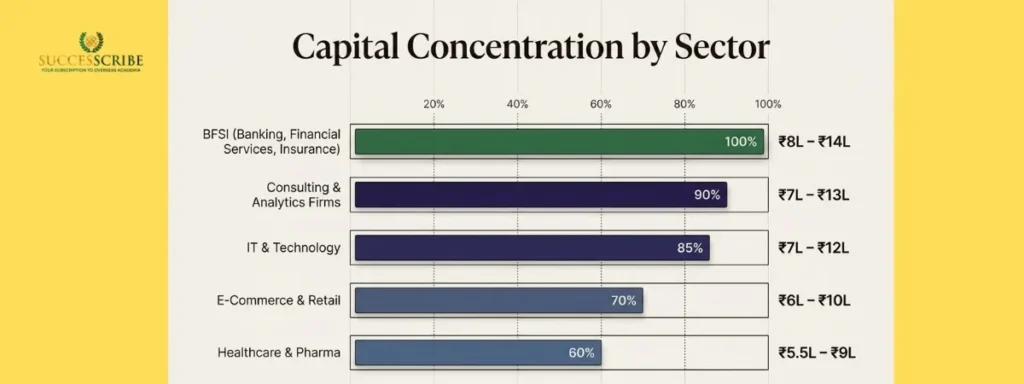
The industry in which an analyst operates determines whether they are viewed as a operational necessity or a strategic weapon. Some sectors, like traditional manufacturing, may still view data as a secondary concern. Others, such as Banking, Financial Services, and Insurance (BFSI) and pure-play IT, treat data as their most valuable asset. This difference in perception is directly reflected in the budgetary allocation for data teams and the resulting salary structures.
Salary Distribution by Industry Sector
| Industry Sector | Salary Range (LPA) | Key Value Drivers |
| BFSI (Finance/Banking) | ₹8.0L – ₹14.0L | Risk Mitigation / Alpha Generation |
| IT & Product Technology | ₹7.0L – ₹12.0L | User Retention / Growth Hacking |
| E-Commerce & Retail | ₹6.0L – ₹10.0L | Supply Chain / Consumer Insights |
| Consulting & Strategy | ₹7.0L – ₹13.0L | Client ROI / Market Forecasting |
| Healthcare & Pharma | ₹5.5L – ₹9.5L | Drug Discovery / Patient Data |
The BFSI and IT sectors consistently lead the market, often offering salaries 15% to 20% higher than the median. In the world of high-frequency trading or algorithmic lending, a data analyst’s work is directly tied to revenue. This results in a “performance-driven” compensation model where bonuses can make up a significant portion of the total package. In contrast, sectors like healthcare offer slightly lower base pay but provide high stability and the opportunity to work on deeply impactful, long-term research projects.
Data Analyst Salary by Company Tier (MAANG vs Mid-size vs Startups)
The compensation philosophy of an organization is often a reflection of its business model. Tier-1 multinational tech firms, often referred to as MAANG, focus on a “Total Reward Strategy” that includes high base pay and significant equity. In contrast, high-growth startups may offer a lower base salary but provide “wealth multipliers” in the form of Employee Stock Ownership Plans (ESOPs). Service-based firms typically offer more modest packages but provide a breadth of exposure to different client environments.
The following table breaks down the compensation architecture across these tiers.
Company Tier Compensation Structure
| Company Tier | Representative Companies | Salary Range (LPA) |
| Tier 1 (MAANG / Elite Tech) | Amazon, Google, META, Walmart, Microsoft | ₹20L – ₹38L+ |
| Tier 2 (Product / MNCs) | PayPal, Flipkart, Uber, Amex | ₹12L – ₹25L |
| Tier 3 (Service / Consulting) | Accenture, TCS, Cognizant, Genpact | ₹6L – ₹12L |
| High-Growth Startups | Zupee, Innovaccer, Ottimate | ₹10L – ₹18L + ESOPs |
Elite tier compensation is best understood through the lens of specific CTC breakdowns. A Senior Data Analyst at Walmart Global Tech in Bangalore earns a CTC of ₹30.4 lakhs, which consists of a ₹20.8 lakh base, ₹5.5 lakh in stocks, and a ₹4.1 lakh bonus. This structure is designed to align the professional’s interests with the company’s long-term stock performance. For the 21 to 35 demographic, understanding the difference between “liquid cash” (base pay) and “long-term wealth” (stocks) is essential for effective financial planning.
Skills That Directly Impact Your Salary as a Data Analyst
The 2026 labor market is governed by the principle of “Skill Stacking.” Foundational tools like Microsoft Excel and basic SQL are now considered the bare minimum for entry: they no longer command a premium. To reach the higher echelons of the pay scale, analysts must master accelerators like Python, Cloud Computing, and Machine Learning. The market rewards scarcity. When a specific skill is both high-impact and rare, the professional possessing it can command a significant market premium.
The measurable impact of specific skills on an analyst’s earning potential is outlined below.
Skill-Based Salary Premium
| Skill Set | Verified Prevalence | Average Salary Impact |
| SQL | 14% | 14% Increase |
| Python | 13% | 13% Increase |
| Tableau / Power BI | 8% | 8–10% Increase |
| Machine Learning | 5% | 20–25% Increase |
| Cloud (AWS/Azure/GCP) | 4% | 15–18% Increase |
The data reveals a critical insight: while 14% of professionals know SQL, only 5% have verified skills in Machine Learning. This scarcity is exactly why ML expertise results in a 20% to 25% salary premium. This “scarcity premium” is the fastest way for an early-career analyst to jump from a ₹6 lakh package to a ₹12 lakh package. Furthermore, the 6figr data suggests that professionals who combine SQL with niche tools like Google BigQuery or KQL (Kusto Query Language) are often the ones who find themselves in “high-responsibility” roles paying upwards of ₹20 lakhs.
Suggested Post: Profile Building for Oxford
Data Analyst Salary vs. Related Roles (Data Scientist, BI Analyst, ML Engineer)
It is vital to understand the professional hierarchy of the data science lifecycle to navigate your career path effectively. While the Data Analyst role is the foundation, the path to the highest compensation often involves transitioning into specialized roles that involve deeper mathematical modeling or infrastructure engineering. However, the “ceiling” for a data analyst is higher than many realize, particularly for those who move into management or principal positions.
The following table compares the market benchmarks for related data roles:
| Job Title | Median Market Pay (INR) | Elite Verified Ceiling (INR) |
| Data Analyst | ₹11.4L | ₹51.4L |
| Data Scientist | ₹12.2L | ₹25.0L – ₹38.0L |
| Data Engineer | ₹10.1L | ₹22.0L |
| ML Engineer | ₹12.0L | ₹30.0L |
| Principal Data Analyst | ₹28.0L | ₹48.0L |
| Data Science Manager | ₹22.0L | ₹37.0L |
There is a clear “bridge” between being a standard Data Analyst and moving into Data Science or Analytics Management. This transition typically results in a 50% to 70% pay jump. However, the 6figr data highlights an interesting trend: a Principal Data Analyst (₹48L) often earns significantly more than a mid-level Data Scientist. This suggests that “mastery of domain” can be just as lucrative as “transitioning to a new title.” For those who prefer insights over algorithm development, staying in the analyst track and reaching the Principal level is a highly viable financial strategy.
How to Negotiate a Higher Data Analyst Salary in India
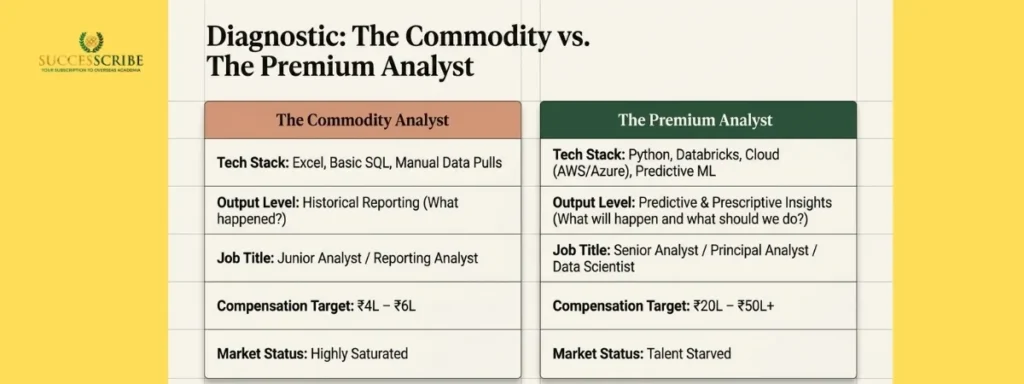
Negotiation in a 2026 “seller’s market” requires more than just confidence: it requires hard data and an understanding of “Total Rewards.” Companies are increasingly using complex compensation structures to retain talent, and if you only negotiate your base salary, you are leaving money on the table.
- Benchmarking with Verified Data: Use platforms like 6figr or Payscale to find the “elite ceiling” for your specific city and skill set. Do not rely on “average” figures. If you have Machine Learning skills, you should be targeting the top 10% of the pay bracket (over ₹24.9L).
- Quantify Your Impact: In the data world, your resume should be an analytical report of your own performance. Instead of saying you “built dashboards,” say you “reduced reporting latency by 40%, saving the operations team 500 man-hours per month.” This is the only evidence that justifies a premium.
- Leverage the “Wealth Multipliers”: Pay close attention to the stock and bonus components. In companies like Walmart or PayPal, stocks can account for 15% to 30% of your total CTC. If a company cannot meet your base salary requirement, ask for a higher equity grant or a sign-on bonus.
- The Certification Leverage: If you hold a credential from a top-tier institution like IIT Jodhpur or a specialized program from Futurense, use it as a signal of “reduced risk” for the employer. Companies are willing to pay a premium for “AI-ready” talent that does not require extensive internal training.
- Timing the Market: The “2-year switch” remains the most powerful tool in your arsenal. The data shows that the highest hikes occur during external moves. If your internal growth has stalled below the 45% mid-career jump benchmark, it is time to test your market value.
Future Outlook: Will Data Analyst Salaries Rise in the Next 2 – 3 Years?
The forward-looking trajectory for data analyst salaries in India remains aggressively positive. While there is a common fear that Generative AI will automate entry-level roles, the market reality is the opposite. AI is serving as a “force multiplier.” It allows a single analyst to process more data, faster. This makes the analyst more valuable to the business, not less.
Future Market Outlook (2026–2027)
The following table highlights the key growth indicators that will influence salary trends over the next two years:
| Market Metric | Projected Impact / Data Point |
| Job Creation | 11 million+ new roles in data & analytics by 2026 |
| Current Vacancy | 97,000 unfilled data analyst positions in India |
| Big Data Adoption | 80%+ of companies to adopt big data by 2025/2026 |
| Salary Growth | Sustained increases for those with “trifecta skills” |
Key Trends Driving Salary Hikes
- Explosive Demand Across Industries: It is no longer just a “tech” role; industries like BFSI, Healthcare, E-commerce, and Manufacturing are now heavily dependent on data insights, leading to a broader bidding war for talent.
- The AI & Generative AI Shift: The integration of AI means that analysts who can use Agentic AI and Machine Learning to automate complex workflows will command significantly higher premiums than traditional analysts.
- Skill Saturation vs. Specialization: While some community discussions suggest the entry-level market is becoming crowded, sources indicate that “good” data analysts with specialized certifications (like those from IITs or industry leaders) continue to see rapid career progression.
- Shift Toward Data Engineering: By 2027, the line between data analysis and data engineering is expected to blur. Professionals who transition into Data Engineering or Business Intelligence Leads can see salaries exceeding ₹25 LPA.
Conclusion
The Data Analyst Salary in India is a direct reflection of the professional’s ability to navigate the new data-driven hierarchy. With an average CTC of ₹14 lakhs and the potential to reach the top 1% of earners at ₹51.4 lakhs, the financial path is one of the most robust in the tech world. However, reaching these milestones requires a strategic approach.
For the 21 to 35 age demographic, success depends on three factors: geographic placement in hubs like Bangalore or Hyderabad, “skill-stacking” into high-premium areas like Machine Learning, and an understanding of total compensation structures. The 2-year experience mark remains the most critical pivot point for salary acceleration. In an economy where data has become the ultimate resource, those who can interpret, optimize, and lead will always find themselves in a position of immense financial and professional strength.
FAQs
What is the highest salary for a Data Analyst in India?
While the median is ₹11.4L, the top 1% earn more than ₹51.4L. The highest outlier reported in 2026 is ₹385.9L for a global remote profile. Within Indian tech firms, Principal Data Analysts earn the top benchmark at ₹48L.
Can a fresher earn more than ₹10 LPA in India?
Yes. The market is “weirdly” bifurcated. While a standard DA might start at ₹3.5L, a fresher with niche skills (e.g., Python selenium web-scraping) can earn ₹22L. Candidates from Tier-1 schools (IIT/NIT) typically see starting offers between ₹9L and ₹12L.
Is a data analyst a high-paying job in India?
Yes, it is currently one of the most lucrative paths in tech. The average salary of ₹13.8L to ₹14L is significantly higher than the national average across all occupations (₹3.87L). Top earners in the 90th percentile exceed ₹24.9L per year.
What is the starting salary for a data analyst in India?
Freshers typically start between ₹3L and ₹5L. However, “elite” freshers in top-tier product companies command starting packages of ₹9L per year, often including bonuses and performance incentives.
Which city in India pays data analysts the most?
Bangalore remains the leader with average salaries between ₹8L and ₹10L. Hyderabad and Pune are emerging as strong competitors, offering high premiums and a growing concentration of global technology centers.
Related Post
Highest paying jobs in Germany
Executive MBA in Germany
MBA salary in USA
Highest paying MBA specialization