Did you know that pursuing an MBA abroad can cost anywhere between ₹40–80 lakhs in countries like the USA or UK, while in Germany, you can complete your MBA for as low as ₹10–25 lakhs – or even FREE with scholarships?
Yes, Germany has rapidly emerged as one of the most affordable and high-ROI destinations for MBA aspirants, especially for Indian students. With world-class education, globally ranked universities, and strong industry connections, Germany offers a unique combination of quality + affordability.
An MBA Scholarship in Germany can transform your study abroad journey by reducing costs drastically while giving you access to globally ranked universities and high-paying career opportunities.
Key Highlights: MBA Scholarships in Germany
- Market Overview: The German MBA Landscape
- Why Study MBA in Germany?
- Categorization of MBA Scholarships
- Top 10 MBA Scholarships in Germany
- Premier Government & National Scholarships: The DAAD and Beyond
- Elite Business School Scholarships: Targeted Tuition Relief
- Niche Funding: Diversity, LGBTQ+, and Women in Business
- Application Masterclass: Strategic Execution
- Mastering the Eligibility Matrix
- The Documentation Vault: Crafting a Winning Portfolio
- Life After the MBA: Careers and Salaries in Germany
- Post-Scholarship: The “18-Month” Opportunity
- Conclusion
- FAQs
Market Overview: The German MBA Landscape
In 2026, the German MBA market has matured. While public universities remain largely tuition-free (charging only a semester fee of €100 to €400), specialized MBA programs – even at public institutions – often carry fees. Top-tier private business schools have also adjusted their pricing to reflect their global standing.
Average Tuition Costs
| Institution Type | Typical Tuition (Total Program) | Examples |
| Top Private Schools | €38,000 – €55,000 | Mannheim, ESMT Berlin, WHU, Frankfurt School |
| Public Universities | €0 – €6,000 | TUM, RWTH Aachen, University of Cologne |
Why Study MBA in Germany?
Germany is not just known for engineering – its MBA programs are gaining global recognition due to affordability and strong job outcomes. Choosing an MBA Scholarship in Germany is not just about affordability – it’s about gaining international exposure, strong ROI, and access to Europe’s largest economy.
Key Reasons to Choose Germany for MBA:
- Low Tuition Fees
- Public universities: Often €0–€5,000/year
- Private universities: €10,000–€50,000 total
- High Return on Investment (ROI)
- Average MBA salary: €55,000–€100,000/year
- Top roles in consulting, finance, and tech
- Strong Economy
- Europe’s largest economy
- Home to companies like BMW, Siemens, SAP
- Post-Study Work Opportunities
- 18-month post-study work visa
- Scholarship Availability
- Government + university + EU-funded scholarships
- Foreign Exposure:
- A diverse, multicultural classroom environment that builds the “soft power” required for 21st-century global management.
- Linguistic Dividend:
- A unique market where linguistic investment in the local language translates directly into tuition discounts and salary premiums.
Want to Study in Germany?
Start your journey with Successcribe’s free expert guidance
Book a Free Session NowGermany vs USA vs UK (MBA Cost Comparison)
| Country | Average MBA Cost | Living Cost/Year | Total Cost |
| Germany | €10,000 – €50,000 | €10,000 – €14,000 | €20,000 – €60,000 |
| USA | €60,000 – €120,000 | €15,000 – €20,000 | €80,000 – €140,000 |
| UK | €40,000 – €80,000 | €12,000 – €18,000 | €55,000 – €100,000 |
Clearly, Germany offers up to 70% cost savings compared to other top destinations.
Categorization of MBA Scholarships
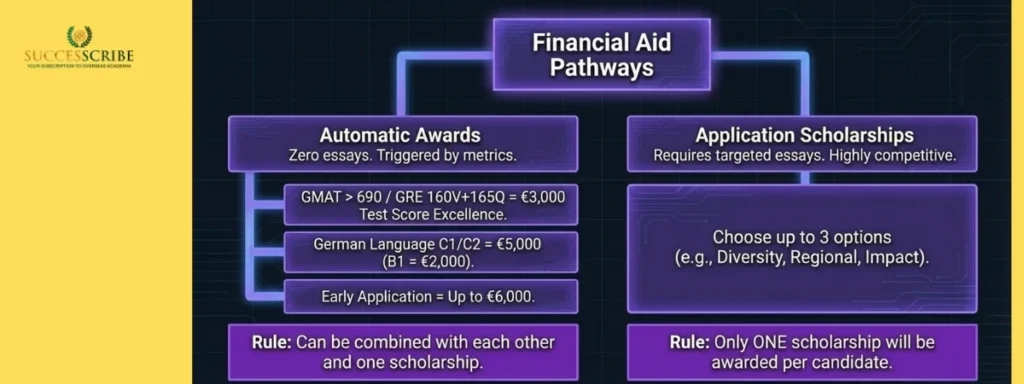
Understanding the different types of MBA Scholarship in Germany options – government, foundation, and university-based – is key to maximizing your chances of funding. Scholarships in Germany are generally divided into three “pillars.” Understanding which pillar fits your profile is key to a successful application.
Pillar I: Government-Funded Scholarships (DAAD)
The Deutscher Akademischer Austauschdienst (DAAD) is the world’s largest funding organization for international exchange.
- DAAD EPOS (Development-Related Postgraduate Courses): Specifically for professionals from developing countries with at least two years of work experience.
- Value: A monthly stipend of €934 to €992, plus health insurance and travel allowances.
- Eligibility: Focuses on leadership potential and the “multiplier effect” (how you will improve your home country).
Pillar II: Non-Governmental Foundations (Begabtenförderungswerke)
These are often tied to political, social, or religious organizations. They look for “Value Fit” over just high GMAT scores.
- Heinrich Böll Foundation: Focuses on ecology, sustainability, and human rights. Requires B2/C1 German proficiency.
- Konrad-Adenauer-Stiftung (KAS): For students with a focus on social market economy and democratic values.
- Friedrich Ebert Foundation: Supports those committed to social democracy.
Pillar III: University-Specific Merit & Need-Based Awards
Most private business schools use scholarships as a tool to ensure class diversity.
- Early Bird Discounts: Applying by the first deadline (usually November for a September intake) can shave €3,000 – €5,000 off tuition.
- Social Impact/Entrepreneurship Awards: Schools like ESMT Berlin and Frankfurt School offer specific pots for “Founders” or “NGO Leaders.”
Top 10 MBA Scholarships in Germany
The availability of top-tier options makes securing an MBA Scholarship in Germany highly competitive but extremely rewarding for deserving candidates.
| Scholarship Name | Provider | Typical Value | Primary Eligibility |
| DAAD EPOS | Government | Full Tuition + €992/mo | 2+ years exp, Developing Countries |
| Kofi Annan Fellowship | ESMT Berlin | Full Tuition + Stipend | Developing Country, High Merit |
| Deutschlandstipendium | Federal/Private | €300/month | High GPA, Social Commitment |
| Women in Leadership | Various (WHU/Frankfurt) | €5,000 – €15,000 | Female candidates, proven leadership |
| Global Excellence | Mannheim BS | Up to 50% Tuition | High GMAT/GRE (700+ equivalent) |
| Entrepreneurship Award | HHL Leipzig | Up to €10,000 | Candidates with startup experience |
| Heinrich Böll | Foundation | €934/mo + Allowances | Political/Social alignment, German B2 |
| KAS Scholarship | Foundation | €861 – €1,200/mo | Leadership, Academic Excellence |
| Early Bird Grant | Most Business Schools | €3,000 – €6,000 | Application before Round 1 deadline |
Premier Government & National Scholarships: The DAAD and Beyond
A government-backed MBA Scholarship in Germany, especially through DAAD, offers one of the most comprehensive funding packages covering tuition, living costs, and travel.
Top National Scholarships
| Scholarship Name | Target Group | Monthly Amount/Benefit | Core Requirement |
| DAAD | Developing nations / High Merit | €992/mo + Insurance + Travel | 2+ years work experience |
| Deutschlandstipendium | High achievers (All nations) | €300/mo (12 months) | Merit + Social Engagement |
| Erasmus+ | Exchange/Non-EU Partners | Up to €1,000/mo + tuition | Partner Uni enrollment |
| Heinrich Böll | Socially engaged / Green focus | €992/mo (Non-EU) | Commitment to “Green” values |
| KAS (Konrad Adenauer) | Future leaders / Democracy | €992/mo (Graduates) | B2 German + Under age 30 |
The “Fully Funded” Reality: In the German context, a DAAD award is more than just a tuition check. It covers the monthly stipend (€992), a one-time travel allowance (approx. €1,000), and a contribution toward health insurance. For an Indian student, this represents a total value of over ₹25 Lakhs over a two-year period, covering nearly 100% of the TCOA.
Elite Business School Scholarships: Targeted Tuition Relief
Private business schools leverage scholarships to attract “Triple Crown” candidates. These awards are often “stacked” with early-bird discounts.
Top Business School Awards
| University | Scholarship Name | Value (€ and INR) | Eligibility Focus |
| ESMT Berlin | Dean’s Excellence | €15,000 (₹13.5 Lakhs) | Academic/Leadership peak |
| ESMT Berlin | Gender Pay Gap | €8,000 (₹7.2 Lakhs) | Women in Leadership |
| ESMT Berlin | e-fellows.net | €10,000 | Membership + Essay |
| HHL Leipzig | Dean’s List | 50% Tuition Waiver | GMAT 700+ / Focus 645+ |
| HHL Leipzig | Young Leader | Partial (up to 25%) | “LLM” Model alignment |
| WHU | Emerging Market | Varies (up to €15,000) | Regional Diversity |
| Frankfurt School | MBA Scholarship | 25% – 50% Waiver | Merit/GMAT Performance |
| Mannheim BS | Outstanding Candidate | Up to €20,000 (₹18 Lakhs) | Holistic Excellence |
| MBS (Munich) | MBS Network | €5,000 (₹4.5 Lakhs) | Network Values/Fit |
Apply to Top German Universities
Make your application simple and stress-free with Successcribe
Get Expert Help NowNiche Funding: Diversity, LGBTQ+, and Women in Business
German schools recognize that “Diversity ROI” leads to better leadership. These awards often include access to exclusive networks like Women@HHL or the ESMT Women in Leadership network.
- Women in Leadership: ESMT Berlin offers 10 Gender Pay Gap Scholarships at €8,000 each to address systemic disparities. HHL offers the Women in Business Scholarship (25% reduction), emphasizing personal development and coaching.
- Global Impact: The Kofi Annan MBA Scholarship is the market leader for candidates from developing countries, valued at €39,883.
- LGBTQIA+ & STEM: The Rainbow Scholarship at ESMT (€5,000) targets candidates contributing to LGBTQIA+ causes. For tech-focused candidates, the TUM Linde/MDSI scholarship provides €1,000 per month for those in Data Science or Mathematics tracks.
- Regional Excellence: ESMT provides regional awards for Africa and the Middle East (up to €25,000) and Asia (up to €8,000).
Application Masterclass: Strategic Execution
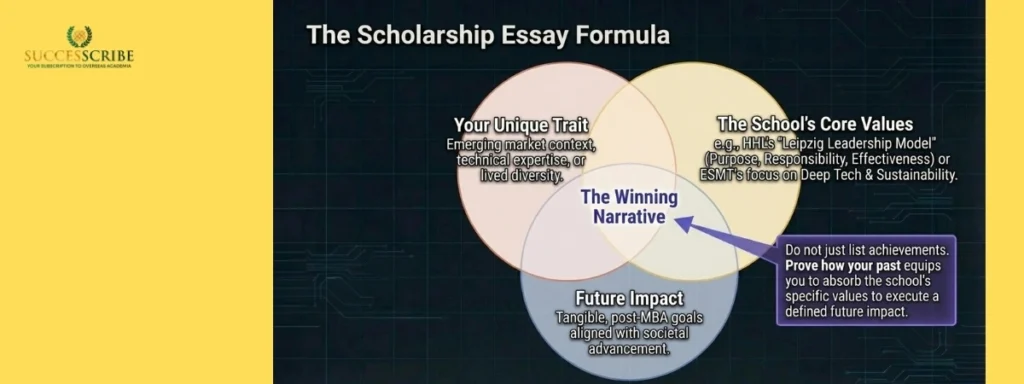
Winning an MBA Scholarship in Germany requires a strategic application approach that highlights leadership, purpose, and long-term impact.
The SOP Architecture (A 3-Step Methodology):
- Audit & Align: Catalog your social engagement and map your career path to the UN Sustainable Development Goals.
- Draft the Narrative: Focus on “Leadership Potential” and “Entrepreneurial Mindset.” Do not just state your goals; explain how your German MBA will solve a specific industrial or social problem.
- The Cultural Context: For German schools, emphasis is placed on responsibility and Effectiveness (the pillars of the Leipzig Leadership Model).
- The Language Strategy (Post-Acceptance Bonus): Unique to ESMT Berlin, language awards are tiered by level (A1: €500 to C1/C2: €5,000). Strategist Tip: You can claim this award even if you prove your level after acceptance but before the program starts. This allows you to “earn” up to €5,000 by studying German in the months leading up to your departure.
Mastering the Eligibility Matrix
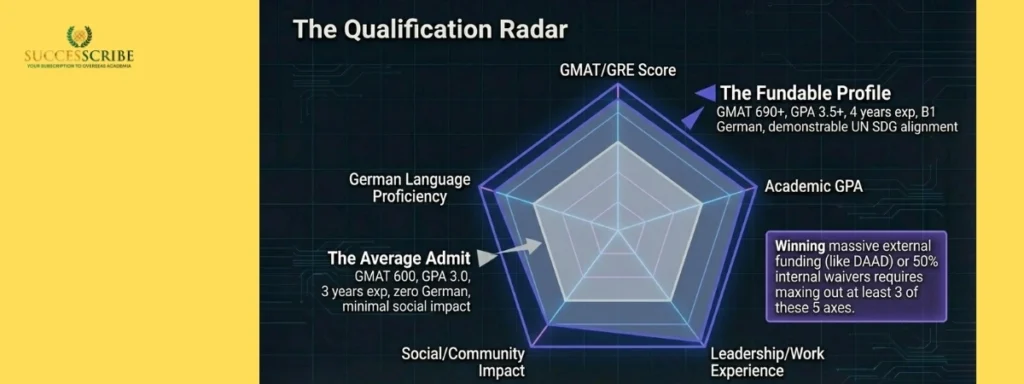
Securing funding for an MBA Scholarship in Germany requires a shift from “academic excellence” to “holistic contribution.” Schools are no longer just looking for the smartest student; they are looking for the most impactful peer.
The Successful Candidate Profile
- Academic Excellence: Undergraduate GPA of 3.5+ (German equivalent 1.5 or better).
- Standardized Rigor: A GMAT score of 700+ (or GMAT Focus Edition 645+). Quantitative percentiles above the 80th are essential for merit waivers.
- Professional Footprint: Minimum 3 years of leadership experience. The DAAD strictly requires 2 years of relevant professional work post-graduation.
- Social Capital: Demonstrable commitment to social causes. For foundations like the FES, this is non-negotiable; they seek candidates who “live” the values of social democracy (equality, justice, and solidarity).
- Language Leverage: While the MBA is in English, proving A1-C1 German ability can trigger specific awards. ESMT Berlin provides up to €5,000 for C1/C2 proficiency.
The Documentation Vault: Crafting a Winning Portfolio
A well-prepared documentation portfolio can strengthen your MBA Scholarship in Germany application by showcasing measurable achievements and impact. Documentation is not a formality; it is a business case. German admissions committees value clarity, precision, and the “So What?” layer of an application.
| Document | Standard Focus | Strategic “Scholarship” Layer |
| SOP / Essay | Career goals. | “So What?” Layer: How do you enrich the German cohort? |
| Curriculum Vitae | Responsibilities. | Impact Layer: Quantifiable achievements and leadership. |
| Letters of Recommendation | Capability. | Potential Layer: Validation of future leadership growth. |
| Language Proof | Eligibility | Integration Layer: Proof of commitment to German culture. |
The “Enrichment Factor” and Specific Essays
Committees ask: “How will this student contribute to the German socio-economic fabric?”
- ESMT Gender Pay Gap Essay: You must answer: “What are the biggest systemic barriers preventing women from reaching senior leadership? How might businesses innovate beyond traditional diversity?” This requires a structural analysis, not just a personal story.
- HHL Regional Question: “What qualifies you for this scholarship and how will you leverage your skills in your home country after completion?” This tests your commitment to “brain circulation” rather than “brain drain.”
Life After the MBA: Careers and Salaries in Germany
One of the strongest arguments for pursuing an MBA in Germany is the extraordinary career return on investment (ROI). Germany’s unemployment rate as of early 2026 stands at approximately 3.0%, one of the lowest in the European Union. The demand for business-educated, internationally mobile professionals has never been higher, driven by Germany’s acute skilled-labour shortage – estimated at over 1.2 million unfilled positions across sectors. Pursuing an MBA Scholarship in Germany leads to high-paying career opportunities across consulting, finance, technology, and engineering sectors.
| Industry Sector | Entry-Level Salary | Mid-Level (3–5 yrs) | Senior Level |
| Consulting | €60,000–€75,000 | €85,000–€110,000 | €120,000–€160,000 |
| Finance & Banking | €55,000–€70,000 | €80,000–€100,000 | €110,000–€150,000 |
| Technology (IT/Software) | €58,000–€72,000 | €78,000–€95,000 | €100,000–€140,000 |
| Automotive / Engineering | €52,000–€65,000 | €72,000–€88,000 | €95,000–€130,000 |
| Healthcare / Pharma | €50,000–€62,000 | €68,000–€85,000 | €90,000–€125,000 |
| Logistics / Supply Chain | €48,000–€58,000 | €62,000–€78,000 | €85,000–€110,000 |
Post-Scholarship: The “18-Month” Opportunity
Winning a scholarship is the first step. Staying in Germany is the second. Under the current 2026 laws:
- Job-Seeker Visa: Upon graduation, you get 18 months to find a job.
- EU Blue Card: Once you secure a job with a salary of approx. €45,000 – €50,000 (thresholds vary by sector), you can switch to an EU Blue Card, which leads to permanent residency in as little as 21–27 months.
Conclusion
Securing an MBA scholarship in Germany is an exercise in profile alignment. It is not enough to be a high-achiever; you must be a high-achiever with a purpose that resonates with German institutional values. Whether you are leveraging the “purpose-over-profit” philosophy of HHL, the “social democracy” values of the FES, or the “unlimited” network awards of WHU/ESMT, your goal is to present a professional business case. View the application not as a request for help, but as an invitation for Germany to invest in a future leader of its economy.
FAQs
Does a scholarship affect my right to work part-time?
Generally, no. Student visa holders in 2026 are allowed to work 140 full days or 280 half days per year. However, some high-value scholarships (like certain private foundations) may have “exclusivity clauses” that limit how many hours you can work to ensure you focus on your studies. Always check the fine print of your scholarship contract.
Can I apply for scholarships if my GMAT/GRE score is low?
Yes. While “Merit Scholarships” at schools like Mannheim or WHU often look for a GMAT of 650+, many Foundation Scholarships (Heinrich Böll, Friedrich Ebert) prioritize social engagement, political alignment, or “overcoming adversity” over standardized test scores. Additionally, some schools offer “Diversity” or “Women in Business” awards where leadership experience carries more weight than the GMAT.
Are there specific MBA scholarships for STEM backgrounds?
Absolutely. In 2026, Germany is heavily subsidizing the “Manager-Engineer” hybrid. Programs like the MBA&E at HTW Berlin or RWTH Aachen offer specific grants for candidates with technical degrees. There are also private fellowships like the Kurt Hansen Fellowship for those pursuing science-based management.
What is the difference between a “Scholarship” and a “Tuition Waiver”?
A scholarship often provides cash (a stipend) directly to you for living costs, whereas a tuition waiver (common in private business schools) simply reduces the amount you owe the university. In Germany, “Scholarship” is often used as an umbrella term for both, but for visa purposes, only a cash stipend counts toward your “proof of funds.”
Is it possible to get a “Full Ride” (100% Tuition + Living Expenses) for an MBA in Germany?
Yes, but it is highly competitive. Full funding usually comes from the DAAD EPOS program or elite fellowships like the Kofi Annan Fellowship (offered at ESMT Berlin and MoT). These typically require at least two years of professional experience and a strong commitment to returning to or helping your home region. Most other “full” scholarships cover tuition only, requiring you to fund your own living costs via a blocked account.
Related Post
Best courses to study in Germany
Minimum wage in Germany
Benefits of doing masters in Germany
One year masters in Germany