Securing admission to the University of Cambridge is a dream for thousands of ambitious students around the world. However, the admission process is far more competitive and intellectually demanding than most students initially expect. With an acceptance rate that typically ranges between 15% and 18% overall (and often much lower for international applicants), gaining a place at Cambridge requires far more than just excellent grades.
This is where Profile Building for University of Cambridge becomes essential.
Your goal is not just to be “good,” but to be “unmissable.” This topic details the exact components you need to build a profile that demonstrates the academic potential Cambridge demands in 2026 and beyond.
Key Highlights: Profile Building for University of Cambridge
- Understanding the Admission Philosophy
- Academic Excellence: The Foundation of a Cambridge Profile
- Navigating the New Assessment Landscape
- Supercurricular Activities: What Cambridge Truly Values
- The “My Cambridge Application” (MCA) Mastery
- College Selection: Strategic Positioning
- Academic Competitions and Olympiads
- Research Projects and Independent Exploration
- Cambridge Summer Programs
- Importance of Reading Beyond the School Curriculum
- Building a Strong Personal Statement for Cambridge
- Your Profile Building Timeline – A Year-by-Year Roadmap
- Successcribe Profile Building Services
- Conclusion
- FAQs
Understanding the Admission Philosophy
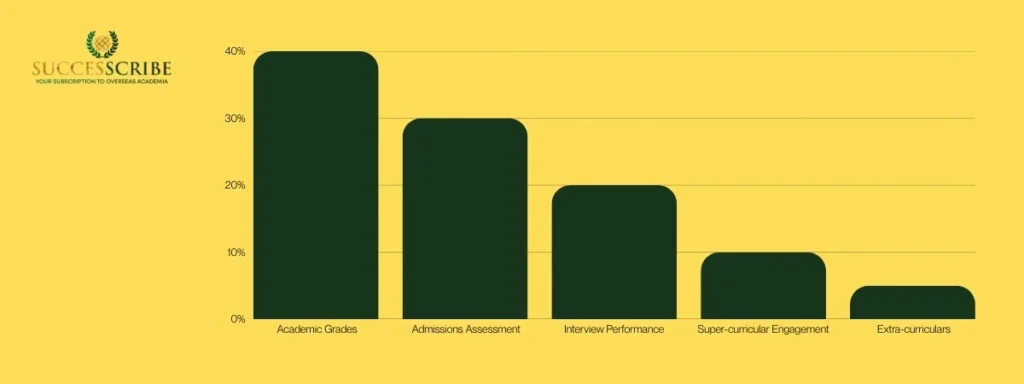
Understanding the admission philosophy is the first and most important step in Profile Building for University of Cambridge, as the university prioritizes intellectual curiosity, academic depth, and subject mastery over general extracurricular achievements. Cambridge’s selection criteria are focused almost exclusively on academic potential. While US Ivy League schools value “well-rounded” individuals (sports, music, leadership), Cambridge seeks “super-rounded” individuals – those who have gone deep into their specific field of study.
The Cambridge Hierarchy of Importance
| Priority | Factor | Weightage (Estimated) |
| High | Academic Grades (Predicted/Final) | 40% |
| High | Admissions Assessment (ESAT/TMUA/UCAT) | 30% |
| Medium | Interview Performance | 20% |
| Medium | Super-curricular Engagement | 10% |
| Low | Extra-curriculars (Hobbies/Sports) | <5% |
Academic Excellence: The Foundation of a Cambridge Profile
The first and most important component of Profile Building for University of Cambridge is academic performance.
Cambridge expects students to demonstrate exceptional academic consistency in subjects related to their intended course.
Typical Academic Expectations
| Curriculum | Expected Grades |
| IB Diploma | 40–42+ overall with 7s in Higher Level subjects |
| A-Levels | AAA or higher |
| CBSE / ISC | 95%+ overall with strong subject scores |
| IGCSE | Mostly A* grades |
Admissions tutors closely review predicted grades, but they also examine subject depth. For example:
- A Physics applicant must show strong mathematics preparation.
- An Economics applicant should demonstrate quantitative reasoning ability.
- A Computer Science applicant should have strong logical thinking.
Therefore, maintaining consistent academic excellence from Class 9 onward plays a major role in Cambridge preparation.
Navigating the New Assessment Landscape
The most significant change for the 2026 cycle is the full integration of the UAT-UK (University Admissions Tests) digital platform. Paper-based tests are largely a thing of the past. A crucial part of Profile Building for University of Cambridge is understanding the evolving admissions testing system, including exams such as TMUA, ESAT, LNAT, and UCAT, which play a major role in assessing a student’s academic aptitude.
Common Cambridge Admissions Tests
| Test | Courses |
| TMUA | Economics, Computer Science |
| ESAT | Engineering and Physical Sciences |
| LNAT | Law |
| BMAT / UCAT (depending on changes) | Medicine |
Strong performance in these tests significantly improves admission chances.
Preparation should begin at least 6–12 months before the application deadline.
The ESAT (Engineering and Science Admissions Test)
If you are applying for Engineering, Natural Sciences, or Chemical Engineering & Biotechnology, the ESAT is your gatekeeper.
- Structure: It is a modular test. Everyone takes the Mathematics 1 module.
- The Profile Boost: To excel here, your profile should show participation in Physics or Chemistry Olympiads. The ESAT tests your ability to apply basic principles to unfamiliar, complex scenarios – exactly what Olympiad training provides.
The TMUA (Test of Mathematics for University Admission)
Required for Computer Science and Economics.
- The Shift: In 2026, the TMUA focuses heavily on Formal Logic.
- Tactical Advice: Don’t just “do math.” Build your profile by studying symbolic logic or introductory philosophy of mathematics. Tutors want to see that you understand why a mathematical proof works, not just how to compute an answer.
Supercurricular Activities: What Cambridge Truly Values
“Super-curricular” activities are academic pursuits that go beyond your school syllabus. This is the heart of your personal statement.
One of the most misunderstood aspects of profile building for University of Cambridge is the distinction between extracurricular activities and supercurricular activities. Cambridge makes this distinction explicitly.
Supercurriculars vs. Extracurriculars
Extracurricular activities are hobbies and pursuits outside the classroom – sports, music, drama, and volunteering. These have personal value and reflect your character, but they carry limited weight in a Cambridge application. Supercurricular activities, by contrast, are academic pursuits that go beyond the school syllabus, directly related to the subject you intend to study. These are what Cambridge values most.
| Type | Examples | Weight in Cambridge Application |
| Supercurricular | MOOCs, research projects, academic competitions, and reading journals | HIGH – directly relevant |
| Supercurricular | Olympiads (Maths, Chemistry, Physics, Biology) | VERY HIGH – nationally recognised |
| Supercurricular | Published essays, independent research, and lab work experience | HIGH – shows initiative and depth |
| Extracurricular | Team sports, music performance, volunteering | LOW to MODERATE – character evidence only |
| Extracurricular | Student council, school prefect, drama productions | LOW – background context only |
Recommended Supercurricular Activities by Subject
Below are targeted supercurricular activities to pursue, organised by popular Cambridge subject areas:
Natural Sciences / Medicine
- Participate in the Biology, Chemistry, or Physics Olympiad – UK students can compete nationally
- Complete a research project through programmes like the Nuffield Research Placements
- Study university-level textbooks (e.g., Atkins’ Physical Chemistry for Chemistry applicants)
- Follow journals such as Nature, Science, or The Lancet and summarise papers
- Attend open lectures or public science talks at universities.
Mathematics
- Participate in the UK Mathematics Trust (UKMT) competitions – aim for Senior Mathematical Challenge Gold
- Attempt the British Mathematical Olympiad (BMO) papers
- Work through STEP past papers as exam preparation and intellectual exercise
- Engage with mathematical puzzle platforms like Project Euler or Advent of Code
- Read texts like ‘A Mathematician’s Apology’ by G.H. Hardy or ‘The Art and Craft of Problem Solving’
Law
- Complete the MOOC ‘Introduction to Legal Theory’ or equivalent on Coursera / edX
- Read landmark judgements and legal case analyses
- Participate in mooting competitions or Model United Nations (MUN)
- Read books such as ‘Bad Law’ by Dexter Dias or ‘Just Law’ by Helena Kennedy
- Follow current legal affairs in publications like The Law Society Gazette
Computer Science
- Learn Python, Java, or C++ through structured courses – go beyond school-level coding
- Complete programming challenge platforms: Project Euler, LeetCode, Advent of Code
- Contribute to open-source projects on GitHub
- Build a personal project and be prepared to discuss its design and challenges
- Engage with topics in theoretical computer science – algorithms, complexity theory
The “My Cambridge Application” (MCA) Mastery
After you submit your UCAS application by the October 15, 2026 deadline, you will receive the MCA form.
- The Extra Personal Statement: This is a 1,200-character space. Use it to explain why the Cambridge Tripos system specifically fits you. For example, if you are applying for Natural Sciences, explain why you want the breadth of the first year rather than the immediate specialization offered at Oxford or Imperial.
- Transcripts: Ensure your high school transcripts are modular and detailed. Cambridge loves to see “upward trajectories” in grades.
College Selection: Strategic Positioning
Cambridge has 31 colleges. While the “Pool” system ensures the best students get in somewhere, choosing strategically can help.
| College Type | Examples | Best For |
| Large/Famous | Trinity, St. John’s, King’s | Students with world-class Olympiad medals/awards. |
| Medium/Central | Jesus, Pembroke, Emmanuel | Students looking for a traditional, balanced experience. |
| Quiet/Modern | Fitzwilliam, Churchill, Girton | Churchill is excellent for STEM; Girton offers a peaceful, focused environment. |
Strategy: Don’t make an “Open Application.” It doesn’t hurt your chances, but choosing a college shows you’ve done your research on the collegiate system – a small but vital part of “fitting” the Cambridge profile.
Academic Competitions and Olympiads
Competitions are powerful evidence of academic ability.
Many successful Cambridge applicants have participated in national or international Olympiads.
Recommended Academic Competitions
| Competition | Relevant Subjects |
| International Mathematical Olympiad | Mathematics |
| British Physics Olympiad | Physics |
| Informatics Olympiad | Computer Science |
| Economics Essay Competitions | Economics |
| Debate and Critical Thinking Competitions | Law / Humanities |
Research Projects and Independent Exploration
Another powerful element in Profile Building for University of Cambridge is independent research.
Students who explore topics independently show the intellectual maturity Cambridge values.
Examples of Research Projects
| Course | Research Topic Example |
| Economics | Impact of inflation on emerging economies |
| Physics | Quantum computing applications |
| Engineering | Renewable energy innovations |
| Computer Science | Artificial intelligence algorithms |
| Psychology | Behavioural decision making |
Students can publish articles, write research papers, or create analytical reports.
Such projects demonstrate deep thinking and problem-solving ability, which Cambridge highly values.
Cambridge Summer Programs

Some students also participate in academic summer programs to explore their subject further.
These programs expose students to university-style learning.
Benefits of Summer Programs
- Experience Cambridge-style academic discussions
- Learn advanced subject concepts
- Build academic confidence
- Demonstrate intellectual curiosity
However, admissions tutors often emphasize that summer programs alone do not guarantee admission. What matters more is how students reflect on what they learned.
Importance of Reading Beyond the School Curriculum
The “Suggested Reading List” provided by Cambridge departments is the most underutilized tool in Profile Building for University of Cambridge. Reading specialist journals and books allows students to form the “original thoughts” required at the interview stage. It is through deep reading that a student moves from knowing the facts to understanding the arguments.
Subject-Specific Reading Guide
| Subject | Essential Books from Faculty Lists | Strategic Rationale |
| Economics | The Health Gap (Marmot); Prosperity Without Growth (Jackson). | Contrast individual health outcomes with macro-economic growth theories. |
| English | The Name of the Rose (Eco); Renaissance Self-Fashioning (Greenblatt). | Explore the intersection of semiotics, history, and literary identity. |
| History | Waves Across the South (Sivasundaram); Devil-Land (Jackson). | Shift focus from Eurocentric narratives to global perspectives and internal strife. |
| Architecture | Architecture: From Prehistory to Climate Emergency (Calder); The Eyes of the Skin (Pallasmaa). | Evaluate the transition from historical form to modern, sensory-driven sustainability. |
Building a Strong Personal Statement for Cambridge
The Personal Statement is the narrative arc of your profile. For Cambridge, you must adhere to the 80/20 rule: at least 80% of your statement must be dedicated to your academic and super-curricular engagement. The remaining 20% (or less) can be used for unrelated extracurriculars, but even these should highlight transferable skills like discipline or time management. Crafting a compelling personal statement is a critical step in Profile Building for University of Cambridge, as it allows students to demonstrate their intellectual curiosity, academic engagement, and passion for their chosen subject.
Personal Statement Essentials Checklist:
- Evidence of Critical Thinking: Do you analyze what you have read rather than just listing titles?
- Argument Consideration: Do you show an awareness of different scholarly points of view?
- Subject Passion: Is your enthusiasm for the niche areas of the subject evident?
- Authentic Voice: Does the statement feel like it was written by an aspiring scholar?
Your Profile Building Timeline – A Year-by-Year Roadmap
Profile building for Cambridge is not something that can be rushed into the final year before application. The most competitive applicants begin laying the groundwork two to three years in advance. Use the following roadmap as your guide:
| Grade Level | Focus Area | Key Activities |
| Grade 9 | Academic Exploration | Discover academic interests, start reading subject-related books, explore basic competitions and academic discussions |
| Grade 10 | Building Intellectual Curiosity | Participate in academic competitions, attend webinars and lectures, begin subject-focused reading |
| Grade 11 | Deep Academic Engagement | Start research projects, participate in Olympiads, attend summer schools, develop analytical thinking |
| Grade 12 | Application Preparation | Finalize personal statement, prepare for admissions tests, practice Cambridge-style interviews |
Successcribe Profile Building Services
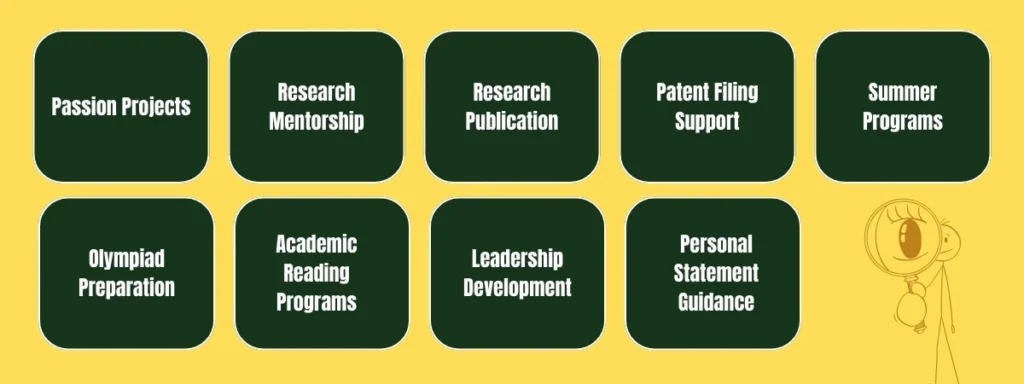
For many students, building a strong academic profile for top universities can be challenging without the right guidance. This is where Successcribe Profile Building Services help students create structured, meaningful, and academically strong profiles.
Successcribe focuses on developing intellectually driven profiles tailored for elite universities like Cambridge.
How Successcribe Helps Students
| Service | How It Helps Students |
| Passion Projects | Students work on subject-specific projects that demonstrate creativity, independent thinking, and intellectual curiosity. |
| Research Mentorship | Students receive guidance from mentors to conduct academic research and develop analytical thinking skills. |
| Research Publication | Support for writing and publishing research papers in student journals or academic platforms, showcasing academic depth. |
| Patent Filing Support | For students working on innovative ideas or technical projects, guidance is provided on how to file a patent and present their innovation professionally. |
| Summer Programs | Students get access to prestigious summer schools and academic programs that expose them to university-level learning experiences. |
| Internship Opportunities | Subject-related internships help students gain practical exposure and real-world understanding of their field of interest. |
| Olympiad Preparation | Training and guidance for national and international academic competitions to strengthen analytical and problem-solving abilities. |
| Academic Reading Programs | Curated reading lists and discussion sessions that encourage deeper exploration of academic topics. |
| Leadership Development | Students build leadership skills by initiating projects, leading teams, and organizing academic initiatives. |
| Personal Statement Guidance | Expert mentorship to craft a compelling personal statement that highlights intellectual growth and subject passion. |
Unlike generic counseling services, Successcribe focuses on academic depth and intellectual exploration, which are essential for universities like Cambridge.
Conclusion
Profile Building for University of Cambridge should not be approached as a last-minute effort. Instead, it should be a thoughtful and gradual journey where students consistently develop their academic interests, challenge themselves intellectually, and demonstrate a deep commitment to their chosen field of study. Activities such as supercurricular exploration, research projects, academic competitions, internships, and summer programs can significantly strengthen a student’s profile when pursued with genuine interest and dedication.
FAQs
Is it true that Cambridge now accepts Indian Class XII Board marks directly?
Yes, for 2026 entry, Cambridge has updated its stance to be more inclusive of the Indian Class XII (CBSE/ISC/State Boards). However, the requirements are exceptionally high – typically requiring 95% or above in five relevant subjects. Most competitive applicants still supplement these with APs or high scores in the STEP (for Math/Engineering) to prove quantitative readiness.
Can I apply to both Oxford and Cambridge in the same year?
No. Under the current UCAS regulations (valid through 2026), you can only apply to either the University of Oxford or the University of Cambridge in the same application cycle. The only exception is if you are applying for a second undergraduate degree as an organ scholar, but for 99% of applicants, you must choose one.
Does Cambridge care about my extracurricular activities like sports or music?
Cambridge is transparent about its “Academic First” policy. While hobbies like Grade 8 Piano or being a Football Captain show character and time management, they carry very little weight in the selection process. Tutors prioritize Super-curriculars – activities that show you have explored your subject beyond the classroom. If you have limited space in your Personal Statement, prioritize your research projects over your sports trophies.
Can I use a calculator in the TMUA or ESAT?
No. For the 2026 cycle, both the TMUA and the ESAT remain non-calculator exams. This is a deliberate design to test your mental arithmetic, estimation skills, and ability to manipulate algebraic variables. Your “Profile Building” should include practicing multi-step calculations by hand to ensure speed during the test.
Does Cambridge accept the JEE Advanced rank for Engineering applicants?
While not an official requirement, Cambridge recognizes the rigor of the JEE Advanced (India). A rank under 2,000 is considered a very strong “super-curricular” indicator. If you have a high JEE rank, it should be mentioned in the “Education” section of your My Cambridge Application (MCA) to provide context to your academic standing.
Related Post
Profile Building for LSE
Profile Building for Stanford
Profile Building for Harvard
Profile Building for Oxford