Planning to study pharmacy in the USA can be confusing, especially if you are coming from the Indian education system. The biggest difference appears right at the degree level. While B.Pharm is a common route in India, the US professional pathway is centred around the Doctor of Pharmacy (PharmD). Studying Pharmacy in usa for Indian Students who already have a pharmacy degree from India, the process can be different again, with foreign-educated pharmacists needing to look into the applicable equivalency and licensing requirements.
This post walks through it in the order it actually needs to be understood: why the US is even worth considering, what degree you’re really signing up for, whether you qualify, where to study, what it costs, and how licensing works once you’re done.
Why Study Pharmacy in USA
The short answer is money and mobility. Pharmacy in USA is not a support job the way it is sometimes seen in places. Pharmacists do patient counseling, give immunizations and in some states they have the ability to prescribe for health issues and that level of responsibility leads to salaries that are often in the six figures, on average.
There is also the research side: American pharmacy schools are connected to pharmaceutical research and development on a scale that’s hard to find elsewhere, which is important if you are looking to work in pharmaceutical sciences or drug development instead of working behind a retail counter. And a US license, once earned, is portable. It opens the door to OPT work after graduation and eventually sponsorship, something a domestic Indian degree doesn’t offer.
None of this makes the US an automatic choice. It’s expensive, and the licensing process for foreign-trained pharmacists is demanding, but for clinical practice or industry work inside the US healthcare system, it’s the path that leads there.
Pharmacy vs PharmD USA Difference
Here’s the part most Indian students get wrong: the US doesn’t offer a standalone Bachelor of Pharmacy anymore. It was phased out back in 2006. What exists now is the PharmD- Doctor of Pharmacy, and it’s the only entry-level degree that lets you practice as a licensed pharmacist in the US. That’s a genuinely different track from what Indian pharmacy education offers, so here’s how the two compare:
| – | US PharmD | Indian B.Pharm | Indian pharmD |
| Duration | 2 (pre-pharmacy) + 4 years | 4 years | 6 years |
| Degree Level | Doctoral | Bachelor’s | Doctoral |
| Still offered? | Yes (only entry-level option) | Yes, in India | Yes, in India (PCI) |
| Lets you practise in the US? | Yes, after licensing (NAPLEX/MPJE) | No, on its own | Possibly, via FPGEC equivalency |
If you’ve already finished a B.Pharm in India, you generally can’t just “transfer” into a US PharmD program halfway through. Most US schools will either have you start a new PharmD largely from scratch (a small number give partial credit for a 4-year Indian B.Pharm), or route you toward the Foreign Pharmacy Graduate Equivalency pathway instead, which assesses whether your existing Indian degree can be certified as equivalent, skipping a second full degree entirely if you already hold an Indian Pharm.D.
Which path fits depends heavily on what you’ve already completed and which state you eventually want to be licensed in. This is something worth keeping in mind before you spend money on applications, because it changes your entire eligibility picture, which is the next thing to sort out.
Important for Indian B.Pharm graduates: FPGEC eligibility depends on the pharmacy degree and graduation requirements set by NABP. Under the current requirements, applicants who graduated on or after January 1, 2003 generally need to have completed at least a five-year pharmacy program. Check the latest NABP requirements before choosing the FPGEC route.
Eligibility for Pharmacy in USA After 12th
If you’re coming straight out of 12th grade rather than after a B.Pharm, here’s what actually gets you into a PharmD program – a strong science background (Physics, Chemistry, Biology or Math at 10+2, generally 60%+ for competitive programs), followed by 2 years of pre-pharmacy coursework before you’re eligible for the professional PharmD phase. Students applying after Class 12 generally need to complete the prerequisite college-level coursework required by their chosen PharmD program before entering the professional PharmD curriculum. The exact prerequisites and admission structure vary by university.
Beyond academics, PCAT requirements vary by program, and applicants should check the current admission requirements of each PharmD school before applying. Applications for programs go through PharmCAS, a central portal like the Common App. PharmD admissions are competitive for international applicants so starting coursework, tests and shortlisting at least a year ahead of enrollment is worth it for PharmD students.
Top Pharmacy Colleges in USA For International Student
Not every pharmacy school treats international and Indian applicants the same way, so “best” here isn’t just about prestige, it’s about which schools actually have a track record of admitting and supporting Indian students.
When it comes to rankings, the US is truly blessed with depth. Many Pharmacy Colleges in USA feature on world subject rankings for Pharmacy & Pharmacology, and a large number rank among the best 100 in the world. Some universities that you may want to know about include:
| University | Known for |
| University of Michigan, UNC, University of Florida, Ohio State | Consistently ranked, strong research output, highly competitive for international students |
| Western University of Health Sciences (California) | Track record of recognizing Indian pharmacy degrees, shortened PharmD track for B.Pharm holders, PCAT not always required |
| State schools in Texas, Massachusetts, New Jersey | Often overlooked, but strong pharma industry presence helps with job placement after graduation |
| St. John’s University (New York) | Large international student population, established pipeline for students coming from Indian pharmacy programs |
| MCPHS University (Boston) | One of the higher international-enrollment pharmacy schools in the US, strong industry ties in the Boston biotech/pharma corridor |
- University of Michigan, UNC, University of Florida, Ohio State – Large public research universities that have pharmacy schools and are always in the top 10 to 20 nationally. These universities have strong research funding and excellent faculty. However, international seats are very few and very hard to get because these universities prioritize domestic students first.
- Western University of Health Sciences – A smaller, private health sciences focused university in Pomona, California. It specifically built relationships with international pharmacy programs, which is why it comes up so often in advice aimed at Indian B.Pharm holders.
- State schools in Texas, Massachusetts, and New Jersey -These schools are often overlooked when compared to the bigger-name rankings. Yet these schools have a presence in the pharma industry serving as major manufacturing and research hubs. For international students, it is useful to consider accreditation, admission requirements, international-student support, location, tuition and career opportunities alongside rankings.
- St. John’s University – located in Queens, New York City, which has one of the oldest and largest colleges of pharmacy in the United States (College of Pharmacy and Health Sciences). It has a relatively diverse and international student population, and is located near major pharmaceutical centers on the East Coast.
- MCPHS University – formerly Massachusetts College of Pharmacy and Health Sciences, based in Boston. It’s pharmacy-focused as an institution rather than a general university with a pharmacy department, and Boston’s dense biotech/pharma corridor (Pfizer, Moderna, Takeda) makes it strong for internships and post-grad placement.
When you’re comparing programs, ranking is one input, not the whole decision. Two things matter just as much: whether the school has ACPE accreditation (non-negotiable, an unaccredited PharmD won’t let you sit for licensing exams later), and whether the school has an established pattern of admitting students with Indian degrees, since that tells you how your credits and prior coursework are likely to be evaluated.
Cost of Pharmacy Education in USA
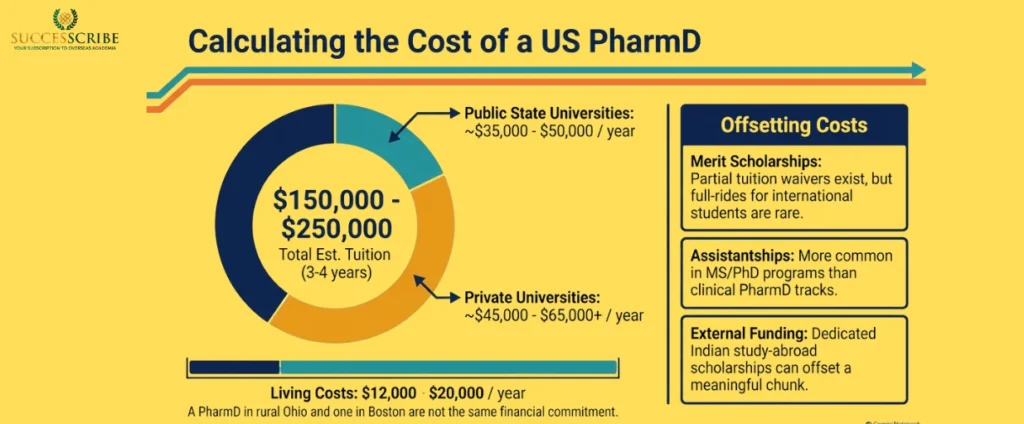
This is usually where the enthusiasm meets reality. The cost of Pharmacy Education in USA is not cheap, and the total cost swings enormously depending on the type of institution.Tuition ranges roughly like this:
- Public state universities (out-of-state/international rate): commonly in the $35,000 – $50,000 per year range
- Private universities: often $45,000 – $65,000+ per year
- Across a 3 – 4 year professional program, total tuition alone frequently lands between $150,000 and $250,000
That’s before living costs, which add another $12,000–$20,000 a year depending on the city. A PharmD in rural Ohio and one in Boston are not the same financial commitment.
Where the money can come from:
- Merit-based scholarships from the university itself – some schools offer partial tuition waivers for strong academic profiles, though full-ride scholarships for international PharmD students are rare
- Assistantships tied to research or teaching, more common at the master’s/PhD level in pharmaceutical sciences than in the clinical PharmD track
- External scholarships aimed specifically at Indian students studying abroad are worth researching separately, since these aren’t pharmacy-specific but can offset a meaningful chunk of cost.
Pharmacy in USA for Indian Students: Which Route Should You Take?
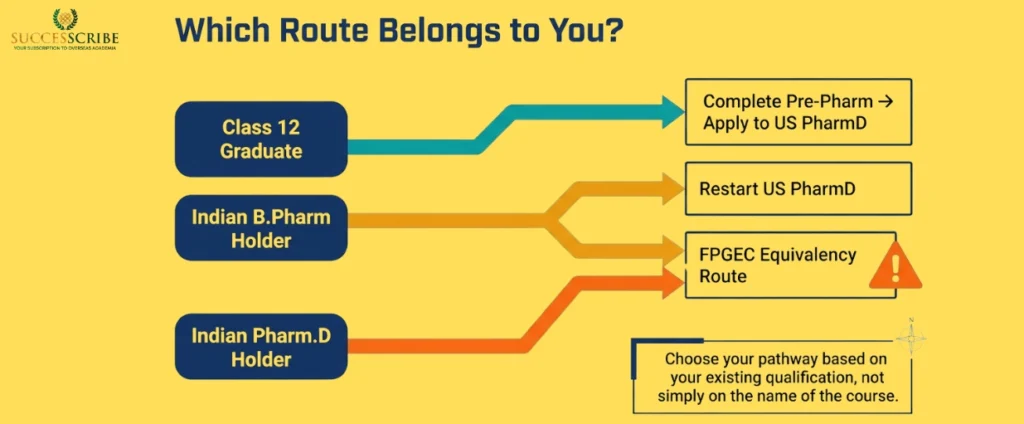
The correct path depends mostly on where you are in your pharmacy studies. The student from India who has just finished his or her Class 12 education will take a completely different path compared to a person who has completed his or her B.Pharm or Pharm.D program in India.. It is vital to know your path before beginning the application process at a university or obtaining a license.
| Your Current Qualification | Route to Consider |
| Class 12 completed | Apply for a US PharmD program after completing the required prerequisite coursework for your chosen university. |
| Indian B.Pharm | First check whether your degree meets the current FPGEC education requirements. You can also explore US PharmD programs where applicable |
| Indian Pharm.D | Check whether you meet the current FPGEC requirements before proceeding with the foreign-trained pharmacist pathway. |
| Pharmacy degree + foreign pharmacist experience | Review FPGEC eligibility and the additional licensing requirements of the state where you want to practise. |
The key point: choose your pathway based on your existing qualification, not simply on the name of the course. Checking your eligibility before applying can help you avoid spending money on a route that does not fit your academic background.
Career Options After Pharmacy in the USA
A pharmacy degree in the USA does not lock graduates into a job at a pharmacy. Depending on the level of qualification, personal interests, past experience and whether a pharmacist license has been earned. Pharmacy graduates can look at jobs in fields such as health care, hospitals, pharmaceutical companies, research and academia.
- Clinical Pharmacist: Clinical pharmacists collaborate with doctors, nurses and other health care workers to help patients manage their medicines. Their duties may include reviewing prescriptions, watching how drugs work, spotting medication problems and giving patients advice. A pharmacist license is needed to practice as a pharmacist.
- Community or Retail Pharmacist: Community pharmacists work in pharmacies and drugstores. They give out medicines, explain how to take them and answer questions about prescriptions. In some places pharmacists can also give shots, such as vaccinations if state rules allow and they have the authorization.
- Hospital Pharmacist: Hospital pharmacists operate inside hospitals. They help manage medicines for patients who are admitted. They check medication orders, prepare or oversee the use of drugs and work with doctors and nurses to make sure patients get the drug treatment.
- Pharmaceutical Industry: Students who like the business and research side of pharmacy can find jobs in pharmaceutical and biotechnology companies. Possible roles include drug development, regulatory affairs, pharmacovigilance, clinical research, medical affairs and quality‑related work. Some industry jobs do not need a pharmacist license depending on the position and the employer.
- Research and Pharmaceutical Sciences: Graduates who want research can work in fields like drug discovery, formulation, pharmacology and other pharmaceutical sciences. A master’s degree or a PhD can be helpful or even necessary for jobs that focus heavily on research.
- Academia and Teaching: Pharmacy graduates who go on to study can also look at teaching and academic research. Universities and pharmacy schools may have openings for teaching, research and academic administration depending on the qualifications and experience of the candidate.
NAPLEX and MPJE Exam
Finishing a PharmD or having your Indian pharmacy degree certified as equivalent doesn’t automatically make you a licensed pharmacist. There’s a distinct exam sequence you go through afterward, and for Indian applicants coming in through the foreign-equivalency route, there’s an extra step before you even get to the exams everyone else takes.
Step 1 – Foreign Pharmacy Graduate Equivalency. It is a program designed for students who already hold a pharmacy degree and want to have that degree recognized as equivalent to a US PharmD. Instead of enrolling in the PharmD program in America, such individuals take a test that is associated with the pharmaceutical and clinical sciences. The test is organized by the NABP (National Association of Boards of Pharmacy).
Step 2 – NAPLEX (North American Pharmacist Licensure Examination). It is the basic exam that all pharmacists in the US have to take, irrespective of whether they have an American or non-American degree. It tests clinical judgment, drug knowledge, and patient safety scenarios.
Step 3 – MPJE (Multistate Pharmacy Jurisprudence Examination). This is a state-law exam. In the United States, pharmacy licensing is handled by the states. That means passing the NAPLEX by itself is not enough to practice pharmacy. You also have to pass the MPJE for the state where you plan to work. Each state has its rules so the MPJE makes sure you understand the laws where you will be practicing.
Along with the exams most states call for practical hours before licensure. Usually you need between 500 – 1500 hours. The exact number depends on the state board. It can change if your FPGEE score is high or low. Putting all this together the realistic timeline from finished PharmD to licensed practicing pharmacist usually takes between six and eighteen months. This time is mainly set by how you can log internship hours and secure exam slots.
Conclusion
Pharmacy in USA for Indian Students is a genuinely strong path, but it rewards people who plan the whole sequence rather than just the first step. Understanding early that the US runs on PharmD rather than B.Pharm, and figuring out whether you’re better off starting a full PharmD or pursuing foreign equivalency for a degree you already hold changes almost every decision that follows, from which schools to shortlist to how much you’ll actually spend.
Once you’re through NAPLEX and MPJE, though, the payoff is real. US-licensed pharmacists are well compensated, and international graduates on OPT get up to three years of authorized work in the US afterward, often the runway needed to pursue longer-term sponsorship. It’s a long road, realistically 6 to 8 years from a standing start to a license, but it’s one with a clear, well-documented set of milestones, which is more than what a lot of study-abroad paths offer.
FAQs
Can I do PharmD in USA after B.Pharm from India?
Yes, though most students either restart the PharmD from the beginning at a US school or pursue the Foreign Pharmacy Graduate Equivalency pathway instead of restarting, depending on the school and how much of your Indian coursework they’re willing to credit.
Is PCAT compulsory for PharmD admission in USA?
It depends on each school. Many PharmD programs no longer require the PCAT. Some competitive PharmD programs still require the PCAT so check the admission policy of each school directly.
How much does it cost to study PharmD in USA as an international student?
Tuition alone typically runs $150,000 to $250,000 for the program. This does not include living expenses. Costs can vary a lot between private universities.
What is the difference between NAPLEX and MPJE?
NAPLEX evaluates knowledge of clinical pharmacy and is consistent throughout the country, whereas MPJE is a state-specific legislation test. You have to pass both of them, and MPJE individually for every state you want to work in.
Can pharmacists from India get sponsorship for H1B visas in the USA?
Yes, after getting their license. International students may be eligible for post-completion OPT after graduation, while the possibility of a STEM OPT extension depends on the specific degree/program and applicable immigration requirements.
Related Post
Bachelor of Nursing in USA
Best place to study in USA
Top 10 medical colleges in USA
MBBS in USA for Indian students