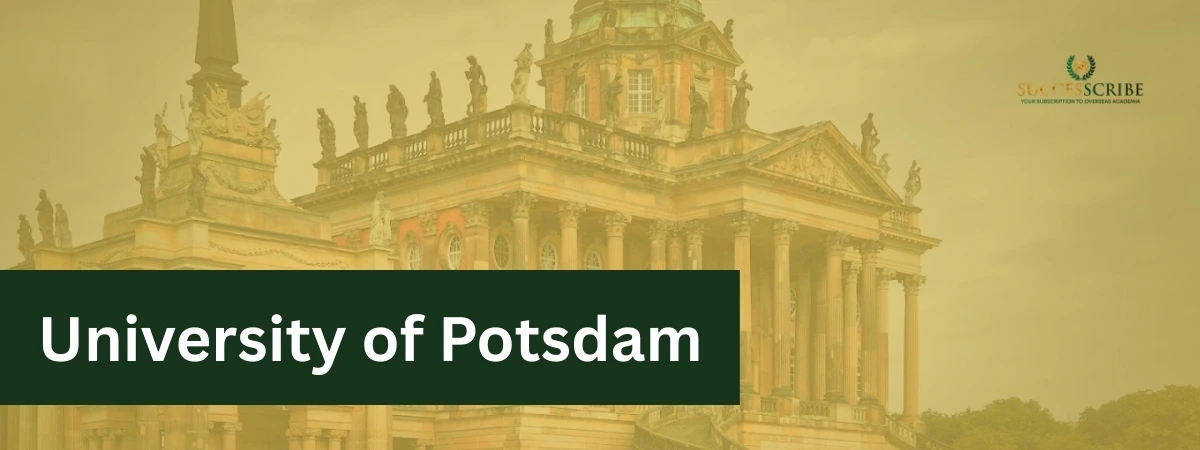
The University of Potsdam is one of Germany’s leading public research universities, strategically located in the federal state of Brandenburg, adjacent to Berlin. Established after German reunification, the university has rapidly developed into a modern, research-driven institution with strong international orientation.
As of 2026, the University of Potsdam hosts approximately 22,000+ students, including around 15 – 18% international students from over 100 countries. With more than 180 degree programs, cutting-edge research centers, and strong collaborations with prestigious institutes such as the Max Planck Society and Fraunhofer Society, the university is recognized for academic excellence and innovation.
Key Highlights: University of Potsdam
- History and Evolution
- Ranking and Reputation: University of Potsdam
- Campus Overview: University of Potsdam
- Schools, Departments & Faculties – University of Potsdam
- Top Programs (Bachelor’s and Master’s)
- Tuition Fees & Cost of Living: University of Potsdam
- Scholarships – University of Potsdam
- Admission Requirements & Application Roadmap: University of Potsdam
- Research, Innovation & Industry Collaboration
- Career Prospects & Employment Outcomes: University of Postdam
- Notable Alumni
- Conclusion
- FAQs
Want to Study in Germany?
Start your journey with Successcribe’s free expert guidance
Book a Free Session NowHistory and Evolution
The University of Potsdam was officially founded in 1991, following German reunification. However, its academic roots date back to the 18th and 19th centuries, particularly through teacher training colleges and military academies in the region.
Key Milestones
| Year | Milestone |
| 1991 | Official establishment after reunification |
| 1994 | Expansion into Griebnitzsee Campus |
| 2000s | Major research collaborations with Max Planck Institutes |
| 2012 | Recognized for excellence in teacher education |
| 2020–2026 | Expansion in AI, Data Science, and Cognitive Sciences |
The university emerged from former institutions in Brandenburg and was designed to reflect modern Germany’s emphasis on research excellence and international cooperation.
Today, it is one of the largest universities in Brandenburg and plays a central role in the Berlin-Brandenburg academic hub.
Ranking and Reputation: University of Potsdam
Potsdam’s trajectory indicates a significant maturation of its global brand, particularly within the “Young University” segment. Its research-strong status is verified by its top-tier positions in linguistics and digital sciences.
Global & National Rankings
| Ranking Body | Global Rank | National Rank (Germany) |
| QS World University Rankings | Top 500–550 | Top 35–40 |
| Times Higher Education (THE) | Top 400–500 | Top 30–35 |
| CWTS Leiden Ranking | Top 300 (Research Impact) | Top 25 |
Subject Strengths:
- Cognitive Sciences
- Earth Sciences
- Data Science
- Teacher Education
- Climate Research
Campus Overview: University of Potsdam
The university operates across three major campuses in Potsdam:
- Am Neuen Palais Campus
- Main campus
- Humanities and teacher education
- Located near Sanssouci Palace
- Golm Campus
- Science and research-focused
- Houses Mathematics, Natural Sciences, and Human Sciences
- Close to major research institutes
- Griebnitzsee Campus
- Law, Economics, and Social Sciences
- Close proximity to Berlin
| Feature | Details |
| Total Campuses | 3 |
| Total Students | 22,000+ |
| International Students | 3,500+ |
| Degree Programs | 180+ |
| Research Institutes Nearby | 40+ |
| Student-to-Faculty Ratio | Approx. 1:18 |
The Golm Campus is the university’s largest and most modern, home to cutting-edge laboratories in chemistry, physics, biology, and computer science. Facilities at Golm include several research centers, modern lecture halls, and the Digital Engineering Faculty that operates in partnership with the Hasso Plattner Institute.
The Am Neuen Palais Campus is arguably the most striking campus of any German university. Part of it sits within the UNESCO World Heritage-listed Sanssouci Park, the legendary summer residence of Frederick the Great. The university library and historical institutes are housed in what were once royal stables and palace outbuildings – a setting that is genuinely unmatched in European academia.
An excellent public transport network serves every campus. The semester contribution students pay automatically includes a VBB (Verkehrsverbund Berlin-Brandenburg) transport card, giving free access to buses, trams, regional trains, and the Berlin U-Bahn and S-Bahn systems. This extraordinary perk effectively covers commuting between all campuses and into central Berlin.
The campuses combine historic architecture with modern laboratories and digital learning infrastructure.
Schools, Departments & Faculties – University of Potsdam
The University of Potsdam is organized into seven faculties, each encompassing multiple departments, research centers, and degree programs.
| Faculty | Key Department / Fields |
| Faculty of Human Sciences | Psychology, Education, Sports Science, Linguistics, Cognitive Science |
| Faculty of Arts | History, Philosophy, Literature, Media Studies, Cultural Studies |
| Faculty of Law | German Law, European Law, Public Law, Private Law, International Law |
| Faculty of Economics & Social Sciences | Business Administration, Political Science, Sociology, Public Policy |
| Faculty of Science | Biology, Chemistry, Physics, Geosciences, Biochemistry |
| Faculty of Health Sciences | Public Health, Nutrition Science, Digital Health, Nursing Science |
| Digital Engineering Faculty (HPI) | IT Systems Engineering, Cybersecurity, Data Engineering, AI |
A particularly notable structure is the Digital Engineering Faculty, which is a joint venture between the University of Potsdam and the Hasso Plattner Institute (HPI) – a privately funded, world-class computer science and IT center founded by SAP co-founder Hasso Plattner. This partnership gives Potsdam students in technology fields access to industry-grade infrastructure, real-world project supervision, and strong pathways into Germany’s thriving tech industry.
The Faculty of Human Sciences is the university’s largest, reflecting the institution’s heritage as a college of education. It covers a vast range of disciplines from cognitive psychology and neurolinguistics to sports management and special education.
The Faculty of Health Sciences, which emerged as a formal faculty relatively recently, has grown rapidly in response to global demand. Programs in Public Health, Digital Health, and Nursing Science attract international applicants who recognize Germany’s advanced healthcare system as an ideal academic environment.
Top Programs (Bachelor’s and Master’s)
Potsdam offers over 170-degree programs. In 2026, there is a significant shift toward interdisciplinary and English-taught Master’s degrees.
Top Bachelor’s Programs
At the undergraduate level, the university balances traditional German pedagogy with high-demand STEM tracks. These programs serve as the primary feeder for Potsdam’s elite Master’s and PhD pipelines.
| Program Name | Duration (Sem) | Language | Primary Eligibility |
| IT-Systems Engineering | 6 | German | Hochschulzugangsberechtigung |
| Psychology | 6 | German | Hochschulzugangsberechtigung |
| Geoecology | 6 | German | Hochschulzugangsberechtigung |
| Business Administration | 6 | German | Hochschulzugangsberechtigung |
| Cognitive Science | 6 | German | Hochschulzugangsberechtigung |
Top Master’s Programs
The university has executed a strategic pivot toward English-language Master’s degrees to capture global talent, particularly in fields where the “Science City” infrastructure offers direct research utility.
| Program Name | Duration (Sem) | Language | Primary Eligibility |
| Astrophysics | 24 Months | English | Physics & Space Science |
| Data Science | 24 Months | English | Mathematics & AI |
| Digital Health | 24 Months | English | IT & Health Systems |
| Public Management (MPM) | 24 Months | English | Governance & Policy |
| Climate, Earth, Water, Sustainability (CEWS) | 24 Months | English | Environmental Science |
Tuition Fees & Cost of Living: University of Potsdam
One of the University of Potsdam’s most significant advantages is its zero-tuition model. Unlike many top European universities that charge significant fees to international students, Potsdam charges no tuition fees for standard Bachelor’s and Master’s programs – for both EU and non-EU students alike. This makes it an extraordinary value proposition.
Semester Contribution
| Fee Component | Amount (EUR) |
| Enrollment Fee | Included |
| Student Services (Studentenwerk) | Included |
| Student Parliament (AStA) | Included |
| VBB Public Transport Ticket | Included |
| Total Semester Contribution | €354.80 per semester |
This means the total academic cost per year is approximately €709.60 – covering not just enrollment but also public transport across the entire Berlin-Brandenburg region.
Estimated Monthly Living Costs in Potsdam
| Expense Category | Estimated Cost (EUR/month) |
| Student Dormitory / Shared Housing | €250 – €450 |
| Private Rental (single room) | €400 – €700 |
| Food & Groceries | €200 – €300 |
| Public Transport | Covered by semester fee |
| Health Insurance (statutory) | €110 – €120 |
| Books, Materials, Miscellaneous | €50 – €100 |
| Total Monthly Estimate | €610 – €1,150 |
Student accommodation managed by the Studentenwerk Potsdam ranges from €270 to €450 per month for cooperative rooms in shared flats. Dining halls (Mensen) on every campus offer main courses starting at just €2.15 – among the most affordable subsidized meals in any German university city.
Scholarships – University of Potsdam
While the University of Potsdam does not charge tuition, various scholarship programs exist to help students cover living costs, travel, and other academic expenses.
| Scholarship | Provider | Amount | Eligibility |
| University Scholarship Potsdam | University of Potsdam | €300/month | 100 high-performing students/year; merit-based |
| DAAD Scholarship | German Academic Exchange Service | €861 – €1,200/month (varies) | International students; field & country specific |
| Deutschlandstipendium | Federal Government + Private Sponsors | €300/month | Merit + social criteria; open to all nationalities |
| Erasmus+ Scholarships | European Union | Varies by destination | EU exchange students and outgoing Potsdam students |
| Friedrich Ebert Foundation | SPD-affiliated foundation | Up to €850/month | Social engagement + academic excellence |
| Konrad Adenauer Foundation | CDU-affiliated foundation | Up to €850/month | Conservative-leaning; merit and character-based |
Admission Requirements & Application Roadmap: University of Potsdam
Navigating the German admission system can be complex, but the University of Potsdam (UP) utilizes a streamlined process divided by degree level and “Admission Restriction” (NC) status.
Bachelor’s Programs
- Higher Education Entrance Qualification (HZB): You must hold a certificate equivalent to the German Abitur. If your secondary school diploma is not recognized as equivalent, you may need to attend a Studienkolleg (preparatory course) and pass the Feststellungsprüfung (FSP).
- Aptitude Tests: Certain subjects (e.g., Sports Science, Arts, and Music) require an entrance examination or a portfolio submission.
- English-Taught Bachelors: While rare, if the program is in English, a B2/C1 level (IELTS 6.5+ or equivalent) is required.
Master’s Programs
- Qualifying Degree: A Bachelor’s degree from a recognized university with at least 180 ECTS (3 years) or 240 ECTS (4 years) depending on the program.
- Subject Specificity: Master’s at UP are “consecutive,” meaning your Bachelor’s must be in a related field. For example, a Master’s in Data Science requires a minimum number of credits in Mathematics and Computer Science.
- GPA (Numerus Clausus): While there is no universal “cutoff,” a GPA equivalent to 2.5 or better on the German scale is highly competitive for restricted programs.
Related Post: TU Dresden Master’s Program
Language Proficiency Standards
Unless you are a native speaker or have completed your prior degree in that language, you must provide one of the following:
| Language | Levels | Accepted Certificates |
| German | C1 | Goethe-Zertifikat C2, telc C1 Hochschule, DSH-2, TestDaF (4×4) |
| English | B2 / C1 | IELTS (6.5 – 7.0), TOEFL iBT (95+), CAE/CPE |
Application Windows & Deadlines
It is critical to observe the distinction between NC (Restricted) and Non-NC (Free Admission) programs.
- Winter Semester (Starts October)
- NC Programs: June 1 – July 15,
- Non-NC Programs: June 1 – August 15, (for some Master’s, it may be earlier).
- Summer Semester (Starts April)
- NC Programs: Dec 1 – Jan 15
- Non-NC Programs: Dec 1 – Feb 15
International students requiring a VPD (Preliminary Review Documentation) from uni-assist should start at least 8 weeks before these deadlines.
Step-by-Step Application Process
- Check Recognition: Use the Anabin database or the DAAD admission database to see if your high school or university degree is recognized in Germany.
- The VPD Process (via uni-assist): If you have a foreign degree, you must first apply for a VPD (Vorprüfungsdokumentation). Uni-assist evaluates your grades and converts them to the German system.
- PULS Portal: Once you have your VPD, you submit your formal application through the University of Potsdam’s internal portal (PULS).
- APS Certificate: For students from India, China, and Vietnam, a valid APS Certificate is mandatory before the application can be processed.
- Admission Offer & Enrollment: If successful, you will receive an “Electronic Letter of Admission.” You must then pay the semester contribution (approx. €315) and provide proof of health insurance to finalize enrollment.
Essential Document Checklist
- Certified copies of High School/Degree Certificates.
- Complete Transcript of Records (in English or German).
- Updated CV in tabular format.
- Module Catalog: (For Master’s) A description of all courses taken in your Bachelor’s.
- Proof of Language Proficiency.
- Copy of Passport
Research, Innovation & Industry Collaboration
The University of Potsdam is part of the Berlin-Brandenburg Science Region, one of Europe’s strongest research hubs.
Research Strength Indicators
| Indicator | Data |
| Research Centers | 40+ |
| Third-party Funding | €80+ million annually |
| International Partnerships | 250+ institutions |
| Doctoral Candidates | 2,000+ |
Major research collaboration partners include:
- Max Planck Institute for Gravitational Physics
- Helmholtz Association
Key research areas:
- Artificial Intelligence
- Climate Change
- Neuroscience
- Quantum Physics
- Political Science
Career Prospects & Employment Outcomes: University of Postdam

The University of Potsdam (UP) has transitioned from being a regional academic center to a global powerhouse for employability, particularly in the tech, research, and sustainability sectors. Its unique location within the Potsdam Science Park and its proximity to Berlin’s “Silicon Allee” give graduates a distinct competitive edge.
Top Employment Sectors for Graduates
UP graduates are highly sought after by a mix of multinational corporations, research institutes, and public sector organizations. The following table highlights the primary employment landscape.
| Industry Sector | Key Employer Examples | Average Entry Salary |
| Digital Engineering & IT | SAP, Oracle, Tesla, HPI Startups | €58,000 – €72,000 |
| Life Sciences & Biotech | Bayer, BASF, Max Planck Institutes | €52,000 – €64,000 |
| Public Admin & Policy | Federal Ministries (Berlin), NGOs, EU | €48,000 – €56,000 |
| Media & Creative Industries | UFA, Studio Babelsberg, Netflix DE | €42,000 – €55,000 |
| Geosciences & Climate | GFZ Potsdam, PIK (Climate Research) | €50,000 – €60,000 |
Notable Alumni: University of Potsdam
The University of Potsdam, founded in 1991, has developed a strong reputation in politics, academia, science, media, and public administration. Below is an updated and well-structured 2026 table highlighting distinguished alumni who have made national and international impact.
| Name | Field | Notable Achievement / Role (as of 2026) |
| Hasso Plattner | Business & Tech | Co-founder of SAP and major benefactor of the Hasso Plattner Institute (HPI) at UP. |
| Klara Geywitz | Politics | German Federal Minister for Housing, Urban Development, and Construction. |
| Dr. Manja Schüle | Politics | Minister for Science, Research, and Culture of the State of Brandenburg. |
| Antje Boetius | Science | Renowned Marine Biologist and Director of the Alfred Wegener Institute (AWI). |
| Mai Thi Nguyen-Kim | Science Comm. | Famous Chemist and Science Journalist (creator of maiLab). |
| Hubertus Heil | Politics | Long-standing German Federal Minister of Labour and Social Affairs. |
| Isabell Werth | Sports | Most decorated German equestrian athlete and multiple Olympic Gold medalist. |
| Christian Schertz | Law | One of Germany’s most prominent media lawyers (represented numerous celebrities). |
| Felix Lobrecht | Arts & Media | Popular German stand-up comedian and author of Sonne und Beton. |
| Alina Treiger | Religion | The first female rabbi to be ordained in Germany since the Holocaust. |
| Benjamin Weber | Sports Mgmt. | Current Sporting Director at Hertha BSC (Berlin-based football club). |
| Ghazaleh Madani | Entrepreneurship | Founder of CanChip (2026 “Newcomer of the Year” in Biotech). |
Conclusion
The University of Potsdam stands as a modern, research-oriented public university offering tuition-free education, strong global partnerships, and excellent employment prospects. With over 22,000 students, 180+ programs, strong industry connections, and a strategic location near Berlin, it represents an outstanding option for international students seeking high-quality German education in 2026.
FAQs
Is the University of Potsdam free for international students?
Yes. The University of Potsdam is a public university in Germany and does not charge tuition fees for most Bachelor’s and Master’s programs.
Students only pay a semester contribution fee of approximately €300–€350 per semester, which includes administrative costs and a public transportation ticket.
How many programs does the University of Potsdam offer?
As of 2026, the university offers:
1. 180+ degree programs
2. 5 major faculties
3. Multiple interdisciplinary research programs
The institution is particularly strong in Cognitive Sciences, Climate Research, Data Science, Law, and Political Science.
How many international students study at the University of Potsdam?
Approximately 15–18% of the 22,000+ students are international, representing over 100 nationalities.
Which University of Potsdam campus has the best food?
While subjective, the Mensa Griebnitzsee is often rated highest for its variety and modern seating. However, if you want the best “vibe,” the Am Neuen Palais canteen allows you to eat your lunch right next to a Prussian Palace. In 2026, all canteens have a “Climate-Friendly” line with 100% vegan/vegetarian options daily.
I see the university has three campuses. Will I have to travel between them every day?
Generally, no. Each faculty is centered on a specific campus. If you study Humanities, you will mostly be at Am Neuen Palais. If you are in Science, you’ll be at Golm. Law and Economics students are at Griebnitzsee. However, for elective modules or university-wide sports, you might occasionally travel. The “Semesterticket” makes this free and easy; the train between Golm and Griebnitzsee takes about 10 – 15 minutes.
Related Post
University of Cologne QS ranking
Humboldt University of Berlin QS ranking
University of Bonn qs ranking
Clausthal University of Technology