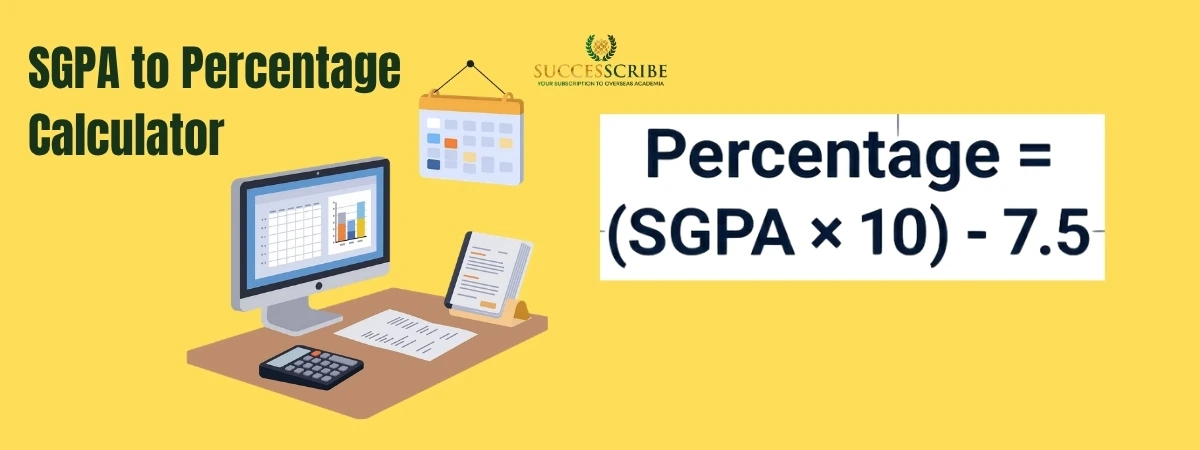
In the evolving landscape of global education, particularly under the framework of the National Education Policy (NEP) and the standardized Choice-Based Credit System (CBCS), the transition from Semester Grade Point Average (SGPA) to a percentage format remains a critical hurdle for students. Whether you are applying to a top international university or preparing for competitive job placements, the SGPA to Percentage Calculator helps translate your academic performance into the universally accepted language of percentage.
Key Highlights: SGPA to Percentage Calculator
- Understanding SGPA: Beyond the Abbreviation
- Understanding the Fundamentals: SGPA vs. CGPA vs. Percentage
- The Standardized 2026 Conversion Formula
- University-Specific Formulas
- Step-by-Step Calculation Tutorials
- SGPA to Percentage Conversion Chart
- The 2026 Shift: Why Precision Matters Now
- Global Mapping: Indian SGPA vs. International Scales
- The Role of ‘Credit Weightage’ in 2026 Calculations
- Solved Case Study: Converting a Semester Marksheet
- SGPA vs. CGPA: The Cumulative Transition
- Conclusion
- FAQs
Understanding SGPA: Beyond the Abbreviation
To fully utilize an SGPA to Percentage Calculator, it is crucial to first understand the concept of SGPA as a weighted academic indicator rather than just a simple average. In the contemporary educational era, SGPA (Semester Grade Point Average) serves as the primary pulse-check for a student’s semester-wise progress. It is not merely an average of marks; it is a weighted numerical index that reflects the complexity, workload, and relative importance of each course undertaken within a specific six-month academic window.
The Formal Definition
SGPA is the weighted average of the grade points obtained in all courses registered by a student during a single semester. It is calculated by multiplying the grade point earned in each subject by its credit value, summing these products, and then dividing the total by the total number of credits assigned to that semester.
Elements of SGPA: A Detailed Breakdown
To master the conversion process, one must first deconstruct the variables that constitute the SGPA formula:
- The Semester: The fundamental academic unit, typically spanning a 6-month period. In 2026, the shift toward shorter, high-intensity learning modules makes the SGPA a highly sensitive indicator of a student’s current academic health.
- Grade Points: Numerical representations of a student’s qualitative performance. Under the standard 10-point scale, an ‘O’ (Outstanding) corresponds to a 10.0, while an ‘A+’ (Excellent) corresponds to a 9.0. These points act as the raw material for the SGPA calculation.
- Credit Points: These represent the “effort-hours” or the dedication required for a specific subject. A subject with 4 credits implies a higher workload and greater depth than a 2-credit elective.
- Grade Point Average (GPA): The resultant index that provides a standardized score for that specific term, allowing for comparison across different subject specializations.
The mathematical representation is:
SGPA = Σ(Credit × Grade Points) / ΣCredits
Where, Ci = Credits assigned to a specific course.
Gi = Grade points earned in that course.
Why Credit Points Matter?
Credit points act as a weightage factor, meaning your performance is not evaluated in a vacuum. Strategically, if you have a 4-credit Core Mathematics course and a 2-credit Humanities elective, a drop in your Math grade is twice as damaging to your SGPA as a drop in the elective.
Understanding the Fundamentals: SGPA vs. CGPA vs. Percentage
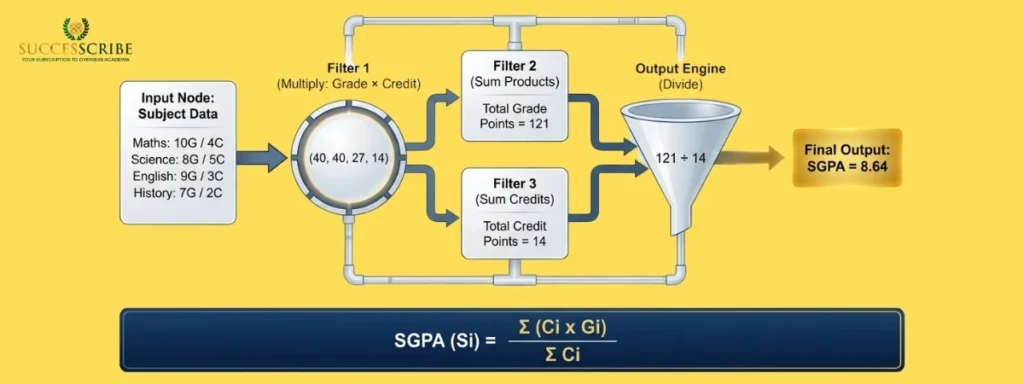
When using an SGPA to Percentage Calculator, it is important to distinguish between SGPA, CGPA, and percentage, as each represents a different scope of academic evaluation.As of 2026, the academic world has almost entirely moved toward “Credit-Based” evaluation.
What is SGPA?
The Semester Grade Point Average (SGPA) is a measure of a student’s performance in a single semester. It is calculated by taking the sum of the product of credits and grade points earned in all courses, divided by the total credits taken.
The mathematical representation is:
SGPA = Σ(Credit × Grade Points) / ΣCredits

Where,Ci = Credits assigned to a specific course.
Gi = Grade points earned in that course.
Example
| Subject | Credits | Grade | Grade Points | Credit × Grade |
| Math | 4 | A | 9 | 36 |
| Physics | 3 | B | 8 | 24 |
| English | 2 | A+ | 10 | 20 |
| Total | 9 | – | – | 80 |
SGPA = 80 / 9 = 8.89
The Percentage Pivot
While SGPA provides a localized view of performance, the Percentage system offers an absolute value out of 100. This is still the primary metric used by government recruitment boards (like the UPSC or SSC) and private sector HR filters to ensure a “level playing field” among candidates from different grading backgrounds.
A recurring pitfall for students is the confusion between these three metrics. In the 2026 job market, entering an SGPA in a field meant for CGPA can lead to immediate disqualification by AI-driven Applicant Tracking Systems (ATS).
SGPA vs. CGPA vs. Percentage
| Metric | Full Form | Scope of Evaluation | Primary Use Case | Strategic Value |
| SGPA | Semester Grade Point Average | A single academic semester (6 months). | Tracking short-term progress and strengths. | High-resolution feedback on current semester performance. |
| CGPA | Cumulative Grade Point Average | The entire program duration (all semesters). | Final degree classification and honors. | Reflects long-term academic stamina and consistency. |
| Percentage | Percentage | Individual subjects or the total degree. | Standardized eligibility for jobs/exams. | Universal benchmark for cross-institutional comparison. |
The Standardized Conversion Formula For SGPA to Percentage
Modern academic frameworks have standardized the working of the SGPA to Percentage Calculator by introducing widely accepted formulas such as subtracting 0.75 and multiplying by 10. This ensures that the SGPA to Percentage Calculator produces results aligned with national academic guidelines. While different universities have historically used different multipliers, the most widely accepted “General Standard” in 2026 – endorsed by the AICTE and UGC – follows the “0.75 deduction” rule.
The Master Formula:
Percentage (%) = (SGPA – 0.75) * 10
Why the -0.75? This constant is used to account for the “ceiling effect” in grading. In a 10-point SGPA system, achieving a perfect 10.0 is statistically more difficult than achieving 100% in a traditional raw-mark system. The 0.75 deduction aligns the SGPA curve with historical percentage distributions.
University-Specific Formulas
In 2026, several premier Indian universities maintain their own specific conversion constants based on their unique rigor and internal assessment weightage.
| University Name | Official Conversion Formula | Example (For 8.0 SGPA) |
| VTU (Visvesvaraya Technological University) | (SGPA – 0.75) *10 | 72.5% |
| Mumbai University (MU) | (7.1 * SGPA) + 11 | 67.8% |
| Savitribai Phule Pune University (SPPU) | (SGPA * 8.8) + 5 | 75.4% |
| AKTU (Dr. A.P.J. Abdul Kalam Tech Univ) | (SGPA – 0.75) *10 | 72.5% |
| Anna University | SGPA*10 | 80.0% |
| Delhi University (DU) | SGPA*9.5 | 76.0% |
Note: Always refer to the reverse side of your official 2026 marksheet. Most universities now print their specific conversion formula there to avoid legal discrepancies during document verification.
Step-by-Step Calculation Tutorials
A well-designed SGPA to Percentage Calculator simplifies complex calculations into easy steps, allowing students to convert their SGPA into percentage within seconds. By understanding the step-by-step logic behind the SGPA to Percentage Calculator, users can also perform manual verification when needed. To ensure accuracy, let’s walk through three distinct scenarios using the most common mathematical models.
Scenario A: The AICTE/UGC Standard
Problem: A student secures an SGPA of 8.45 in their 4th semester. Calculate the percentage.
- Identify Formula: Percentage = (SGPA – 0.75)*10
- Substitute Value: (8.45 – 0.75)*10
- Subtract: 7.70*10
- Final Result: 77%
Scenario B: The 9.5 Multiplier (CBSE/DU Style)
Some institutions prefer a direct multiplier without a deduction constant.
- Identify Formula: Percentage = (SGPA *9.5)
- Substitute Value: 8.45*9.5
- Final Result: 80.27%
SGPA to Percentage Conversion Chart
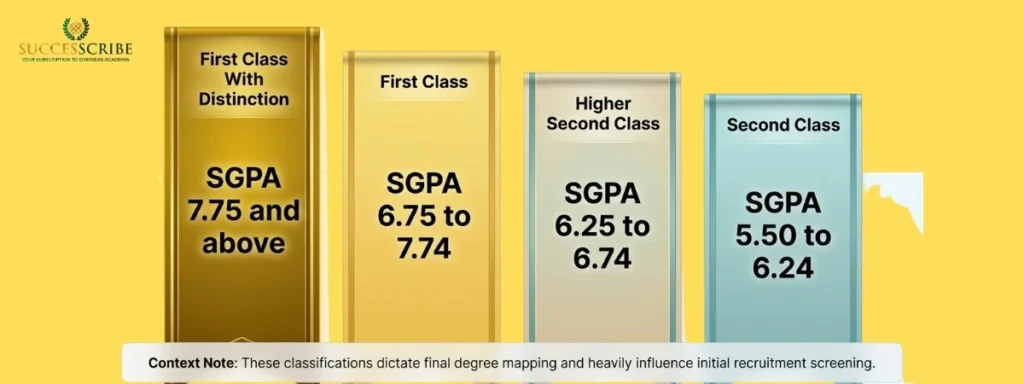
A reliable SGPA to Percentage Calculator is often supported by conversion charts that provide quick reference values for different SGPA scores. These charts complement the SGPA to Percentage Calculator by offering instant insights into performance classification. For quick reference, the following table uses the standard (SGPA – 0.75)*10 formula
| SGPA (10-Point Scale) | Equivalent Percentage (%) | Performance Classification |
| 10.0 | 92.5% | Outstanding |
| 9.5 | 87.5% | Excellent |
| 9.0 | 82.5% | Exceptional |
| 8.5 | 77.5% | Very Good |
| 8.0 | 72.5% | Good |
| 7.5 | 67.5% | Fair |
| 7.0 | 62.5% | Above Average |
| 6.5 | 57.5% | Average |
| 6.0 | 52.5% | Pass |
The 2026 Shift: Why Precision Matters Now
In 2026, the integration of Academic Bank of Credits (ABC) means your SGPA is no longer just a number on a paper; it is a digital asset. Errors in conversion during form-filling can lead to:
- Automatic Disqualification: Many AI-driven recruitment bots (ATS) automatically reject candidates if the converted percentage doesn’t match the threshold (often 60% or 70%).
- Visa Complications: For students heading to Germany, Canada, or the USA, the “WES Evaluation” or “Uni-assist” processes require highly precise conversions to the 4.0 or 1.0 (Bavarian) scales.
Global Mapping: Indian SGPA vs. International Scales
One of the biggest misconceptions in 2026 is that a simple division (e.g. SGPA / 2.5) will give you a US GPA. International evaluators like WES (World Education Services) and ECE use “Grade Mapping,” which considers the prestige of the institution and the difficulty of the curriculum.
Comparative Grading Matrix
| Indian 10-Point SGPA | US 4.0 Scale (Approx.) | German Scale (1.0 – 5.0) | UK Classification |
| 9.5 – 10.0 | 3.9 – 4.0 | 1.0 – 1.2 (Excellent) | First Class with Distinction |
| 8.5 – 9.4 | 3.6 – 3.8 | 1.3 – 1.8 (Very Good) | First Class (1:1) |
| 7.5 – 8.4 | 3.3 – 3.5 | 1.9 – 2.5 (Good) | Upper Second Class (2:1) |
| 6.5 – 7.4 | 3.0 – 3.2 | 2.6 – 3.0 (Satisfactory) | Lower Second Class (2:2) |
| 5.5 – 6.4 | 2.5 – 2.9 | 3.1 – 4.0 (Sufficient) | Third Class / Pass |
Leading German TUs (Technical Universities) have tightened their “Bavarian Formula” requirements. Most now require an Indian equivalent of 2.0 or better on the German scale for Robotics and AI programs, which translates to an Indian SGPA of roughly 8.2+.
The Role of ‘Credit Weightage’ in 2026 Calculations
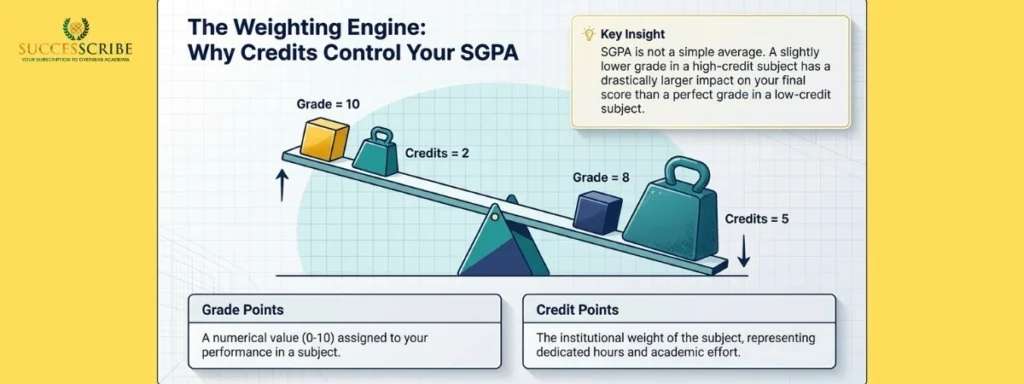
In the 2026 academic climate, many students fail to realize that not all subjects are created equal. Your SGPA is a “Weighted Average.
Why a ‘B’ in a Core Subject hurts more than a ‘B’ in an Elective:
Imagine two subjects:
- Quantum Computing (Core): 5 Credits.
- Professional Ethics (Elective): 2 Credits.
If you score a 6.0 Grade Point in Quantum Computing, it drags your SGPA down significantly more than a 6.0 in Ethics.
Calculation Logic:
Total Weighted Points = (Grade Point * Credits)
SGPA = Total Weighted Points / Total Credits
To maximize your converted percentage, focus on the high-credit modules. A 0.5-point jump in a 5-credit course has the same impact as a 0.5-point jump in five separate 1-credit courses combined.
Solved Case Study: Converting a Semester Marksheet
Let’s take a realistic marksheet from an Engineering student:
| Subject | Credits | Grade | Grade Point | Weighted Score |
| Machine Learning | 4 | A+ | 9 | 36 |
| Data Structures | 4 | O | 10 | 40 |
| Economics | 2 | B | 7 | 14 |
| Lab Work | 2 | A | 8 | 16 |
| Total | 12 | – | – | 106 |
Step 1: Calculate SGPA
SGPA = 106/ 12
= 8.83
Step 2: Convert to Percentage (Standard Formula)
Percentage = (8.83 – 0.75)*10
= 80.8 *10
= 80.8%
Step 3: Convert to US GPA (WES Estimation)
An 8.83 SGPA from a recognized Indian University typically maps to a 3.65 – 3.75 US GPA.
SGPA vs. CGPA: The Cumulative Transition
While SGPA represents a “snapshot” of a single semester, the CGPA (Cumulative Grade Point Average) represents the “panorama” of your entire academic journey.
The Mathematical Relationship
Your CGPA is not just the simple average of your SGPAs. It is a weighted average based on the total credits earned in each semester.
The formula for CGPA is:
CGPA = (SGPA* Ci) / Ci
Where:
- SGPA(i): The SGPA of the (i)th semester
- C(i): The total credits of the (i)th semester
Example:
- Semester 1: 8.0 SGPA (20 Credits)
- Semester 2: 9.0 SGPA (24 Credits)
CGPA = (8.0*20) + (9.0*24) / 20+ 24
= 160 + 216 / 44
= 8.54
Converting CGPA to Total Percentage
For most Indian universities in 2026, once you have your final CGPA, you apply the same multiplier used for SGPA to get your aggregate percentage:
Aggregate Percentage = (CGPA – 0.75)* 10
Conclusion
In conclusion, the SGPA to Percentage Calculator is more than just a computational tool – it is a strategic academic resource that helps students present their performance in a universally accepted format. By using a reliable SGPA to Percentage Calculator, students can ensure accuracy, improve credibility, and stay competitive in both academic and professional environments.
FAQs
My marksheet shows a multiplier of 9.5, but my friend’s shows 10. Which is correct?
Both are correct for their respective institutions. Central universities like DU often use 9.5, while technical universities like VTU or AKTU often use the (CGPA – 0.75) × 10 rule. Always prioritize the formula printed on the back of your transcript.
Does “Rounding Off” matter?
Yes. In 2026 competitive exams (like banking or GATE), a 59.99% is often not treated as 60%. Always calculate to two decimal places and do not round up unless the university guidelines explicitly allow it.
Can I convert my percentage back to SGPA?
Technically, yes, by reversing the formula: SGPA = (Percentage / 10) + 0.75,
However, this is rarely required by institutions.
What is a “Good” SGPA in 2026?
Statistically, an SGPA above 8.0 (72.5%) is considered “Distinction” or “First Class with Distinction” in most Indian contexts.
How do I explain my SGPA to a foreign employer?
Most 2026 resumes now include a small footnote: “Graded on a 10.0 scale; Equivalent to [X]% as per University Guidelines.
Related Post
TOEFL Exam Pattern
MBA Scholarship in Germany
Profile Building for LSE
Jobs and salary after MBA in UK