Stanford University sits at the intersection of academic excellence, entrepreneurial ambition, and world-changing research. Located in the heart of Silicon Valley, it has cultivated a culture unlike any other top university, one that rewards intellectual risk-taking, genuine passion, and the audacity to build something new.
Profile building for Stanford begins with a clear-eyed understanding of the data – because you cannot strategize around a challenge you have not fully confronted. For the Class of 2028, Stanford received 56,378 applications – the highest in its history – and admitted just 3.68% of them. That is roughly 2,074 students chosen from a pool where the vast majority had stellar academics, meaningful extracurriculars, and compelling stories.
Key Highlights: Profile Building for Stanford
- Academic Foundation: Excellence Is the Entry Ticket, Not the Winning Move
- The Extracurricular Strategy: Build a Spike, Not a Resume
- Research and Intellectual Pursuits: Thinking Like a Stanford Student
- Leadership and Community Impact: Stanford Wants World-Builders
- Stanford’s Application: Essays and Personal Branding
- Letters of Recommendation: Cultivate Relationships, Not References
- Summer Programs: Converting Free Time Into Competitive Advantage
- The Grade-by-Grade Preparation Roadmap
- Critical Mistakes That Cost Stanford Applicants Their Spot
- Conclusion
- FAQs
Academic Foundation: Excellence Is the Entry Ticket, Not the Winning Move
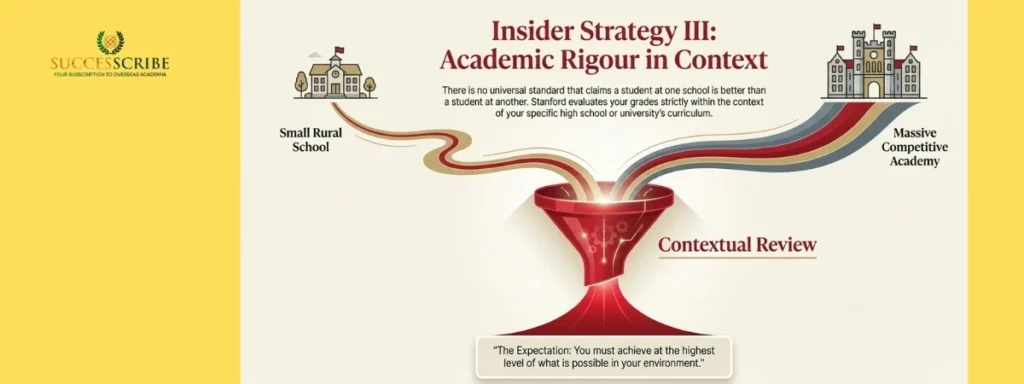
Here is a crucial distinction that separates strategic applicants from naive ones: at Stanford, your GPA is evaluated in context. A 3.95 from a student who took every AP and IB course their school offered is more impressive than a 4.0 from someone who deliberately avoided rigorous courses to protect their average. The academic component of profile building for Stanford is not about achieving a perfect GPA in easy courses – it is about demonstrating that you can thrive under the most rigorous conditions your school offers.
The goal is simple to state and hard to execute: maximum available rigor + near-perfect grades.
| Grade | Recommended Courses | Target Unweighted GPA |
| 9th Grade | Honors English, Algebra II/Pre-Calculus (Honors), Biology or Chemistry (Honors), World History, Foreign Language (Level 2 – 3) | 4.0 |
| 10th Grade | Honors English, AP World History or APUSH, AP Science (Chemistry or Physics), Pre-Calculus/Calculus (Honors), Foreign Language (Level 3 – 4) | 4.0 |
| 11th Grade | AP English Language, AP US History, AP Calculus BC, AP Physics C or AP Chemistry, AP Foreign Language | 3.9 – 4.0 |
| 12th Grade | AP English Literature, AP Economics or Government, Advanced Math or Computer Science, Senior Capstone or Research Course | 3.9 – 4.0 |
Across all four years, aim for 8 to 12 AP exams with scores of 4 or 5. Students admitted to Stanford average around 8 passed AP exams, predominantly with 5s in their core subject areas. If your school offers the IB Diploma Programme, pursue it – especially Higher Level courses in your areas of strength. Admissions officers treat IB with equal respect to AP.
One critical note: a single bad semester – especially in Grade 9 or 10 – is not fatal if the rest of your record shows a clear upward trajectory and genuine growth. Stanford does read grade trends.
Standardized Testing
When it comes to profile building for Stanford, your standardized test scores are best understood as a threshold factor – they need to be strong enough to confirm your academic readiness, but they will never be the reason you get admitted.
Stanford is test-optional through at least the Class of 2030. However, context matters enormously here. In the 2023–24 cycle, approximately 69% of admitted students submitted test scores – and those who submitted scored in the very top percentiles.
| Test | 25th Percentile (Admitted) | 75th Percentile (Admitted) | Your Target |
| SAT Total | 1500 | 1570 | 1550+ |
| SAT Math | 770 | 800 | 780–800 |
| SAT Evidence-Based Reading & Writing | 730 | 770 | 750+ |
| ACT Composite | 34 | 36 | 35–36 |
| ACT Math | 34 | 36 | 35–36 |
| AP Exams (Core Subjects) | 4 | 5 | 5 in your strongest areas |
The practical rule: if your score falls within or above the middle 50%, submit it. If it falls below 1500 SAT or 34 ACT, test-optional may be the wiser path – but only if your application is extraordinarily strong in other dimensions. Begin serious test prep in Grade 10, take your first official attempt in the fall of Grade 11, and plan for no more than 2–3 attempts total.
The Extracurricular Strategy: Build a Spike, Not a Resume
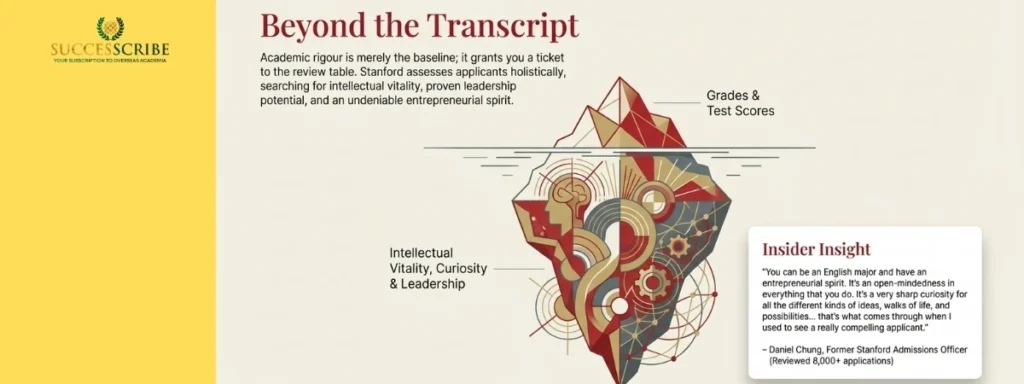
Stanford admissions officers have stated publicly and repeatedly that they are not looking for students who have joined 20 clubs. They are looking for students who have gone deep – who have pursued something with such genuine passion and dedication that they have become genuinely exceptional at it.
This is often called the “spike” strategy. Rather than spreading yourself across many activities at a surface level, you identify one or two domains where you can build real expertise, achievement, and impact – and then you develop complementary activities that reinforce and enrich that central narrative.
How Activities Are Evaluated
| Tier | What It Represents | Concrete Examples |
| Tier 1 – National/International Recognition | The rarest, most powerful entries – these move applications to the top of the pile | USAMO qualifier, Regeneron STS finalist, Published peer-reviewed research, USABO gold medalist, National speech & debate champion, Founded nonprofit with verified $50K+ raised |
| Tier 2 – Regional Recognition or Significant Leadership | Strong and impressive; won’t carry an application alone but are highly valued | State science fair winner, Eagle Scout (Eagle rank), Founded school organization with 100+ active members, State-level athletic competitor, Regional debate champion |
| Tier 3 –Active Contribution with Responsibility | Solid, shows commitment and some initiative | Varsity athlete (non-captain), Orchestra or band (principal chair), School newspaper or literary magazine editor, Meaningful part-time employment (15+ hrs/week) |
| Tier 4 – General Participation | Rarely moves the needle on its own | Club member without leadership, Generic volunteer hours, Brief one-off service activities |
A compelling Stanford activity list typically contains 1-2 Tier 1 achievements, 2-3 Tier 2 activities, and 3-4 Tier 3 activities – totaling around 8-10 entries, all purposefully chosen.
The Narrative Coherence Principle
The most overlooked skill in profile building for Stanford is the ability to make your activities, interests, and essays tell a single, coherent story – because a scattered application leaves no lasting impression, while a focused one is impossible to forget.
Consider two contrasting applicants:
- Applicant A lists: robotics club, community service, tennis (JV), Spanish club, yearbook, math team, drama, student council, Key Club, and environmental club. These are 10 activities, but they form no clear picture.
- Applicant B lists: Founded a nonprofit that teaches computer science to underserved middle schoolers (500+ students taught), USACO Gold division competitor, Research assistant at a university AI lab (co-authored paper submitted to ICLR), School CS club president (grew from 12 to 80 members), and part-time coding instructor. This is 5 activities – and they paint an unmistakable, memorable portrait.
Applicant B is not just impressive. Applicant B is specific. That specificity is what Stanford actually wants.
Research and Intellectual Pursuits: Thinking Like a Stanford Student
Stanford is home to over 18 Nobel Laureate faculty members, the Stanford AI Lab, the d.school, the Hoover Institution, and the Freeman Spogli Institute. It produces more venture-backed startup founders than any other university in the world. Its culture is defined by applied intellectual curiosity – not just learning knowledge, but generating it.
Demonstrating that you already think this way – that you pursue questions beyond what class requires – is one of the most powerful things you can do for your application.
Pathways to Research Experience
Incorporating genuine research experience into your profile building for Stanford is one of the most powerful ways to demonstrate intellectual vitality – the quality Stanford’s admissions officers describe as the trait they most consistently find in their admitted students.
| Pathway | How to Access it | Best Grade to Start | Profile Impact |
| Cold-email university professors | Write a concise, specific research interest statement; email 15 – 20 professors in your field | Grade 10 – 11 | Very High – especially if you produce an output |
| Research Science Institute (RSI) | Competitive application in Grade 11; fully funded; students work with MIT and other researchers for 6 weeks | Apply in Grade 11 | Tier 1 – among the most prestigious programs for high schoolers |
| MIT PRIMES | Remote math/CS research with MIT mentors; apply in October–November | Grade 10–11 | Tier in Mathematics |
| PRIMES-USA | Remote version of MIT PRIMES for students outside New England | Grade 10 – 11 | Tier 1 in mathematics |
| Self-directed project + publication | Design an original study; submit findings to high school research journals (JSHS, Curieux Academic Journal, Journal of Student Research) | Grade 10- 12 | Very High if accepted/published |
| Hospital or clinical volunteering + shadowing | Through school, family, or direct outreach to local hospitals | Grade 9 – 10 | High – foundational for pre-med profiles |
| Online innovation programs (e.g., TKS, Veritas AI) | Apply online; structured cohorts with real-world project deliverables | Grade 9 – 11 | Moderate – High |
Even without formal lab access, a carefully structured independent research project – with a clear hypothesis, methodology, data collection, and findings – demonstrates the intellectual habits Stanford most values. The thinking is what matters, not the institution on the letterhead.
Competitions Worth Pursuing
| Competition | Field | Prestige | When to Apply |
| Regeneron Science Talent Search (STS) | STEM Research | Tier 1 – National | September – November, Grade 12 |
| USAMO / USAJMO | Mathematics | Tier 1 – National | Qualify through AMC 10/12 – AIME |
| USA Biology Olympiad (USABO) | Biology | Tier 1 – National | January – April, Grades 9–12 |
| USA Computing Olympiad (USACO) | Computer Science | Tier 1 – National | Year-round, Grades 9 – 12 |
| Regeneron ISEF | STEM Research | Tier 1 – International | Win state/regional fair first |
| National Speech & Debate Tournament | Speech/Debate | Tier 1 – National | Qualify through regional circuit |
| Scholastic Art & Writing Awards | Creative Writing/Art | Tier 2 – National | September – December |
| AMC 10/12 → AIME → USAMO pathway | Mathematics | Tier 1 pathway | November, Annualy |
| Conrad Challenge | Innovation/Entrepreneurship | Tier 2 – National | October – April |
Leadership and Community Impact: Stanford Wants World-Builders
Stanford’s institutional mission is “the advancement of knowledge and the welfare of society.” This is not decorative language – it is reflected in who they admit. Stanford consistently chooses students who have identified problems and built solutions, not simply students who have achieved high scores.
In practical terms: leadership at Stanford is not about titles. You do not need to be student body president. What you need is evidence that you recognized something that needed to change, took initiative, and created measurable impact.
| Grade Level | Leadership Priority | Specific Action Steps |
| Grade 9 | Explore and discover – find your domain | Attend 4–5 club meetings or tryouts; identify 2–3 areas of genuine interest; take initiative in at least one (volunteer, contribute, stay consistent) |
| Grade 10 | Step into responsibility within existing structures | Pursue a role with accountability – team captain, section leader, event organizer, club officer; demonstrate reliability and impact |
| Grade 11 | Launch something original or achieve recognized excellence | Start a nonprofit, research project, publication, or business; reach state or national level in a competition; take on a leadership role that didn’t exist before you created it |
| Grade 12 | Demonstrate sustained impact and mentor the next generation | Document outcomes; train your successor; expand your initiative; use this as essay material to show growth, reflection, and vision |
Stanford’s Application: Essays and Personal Branding
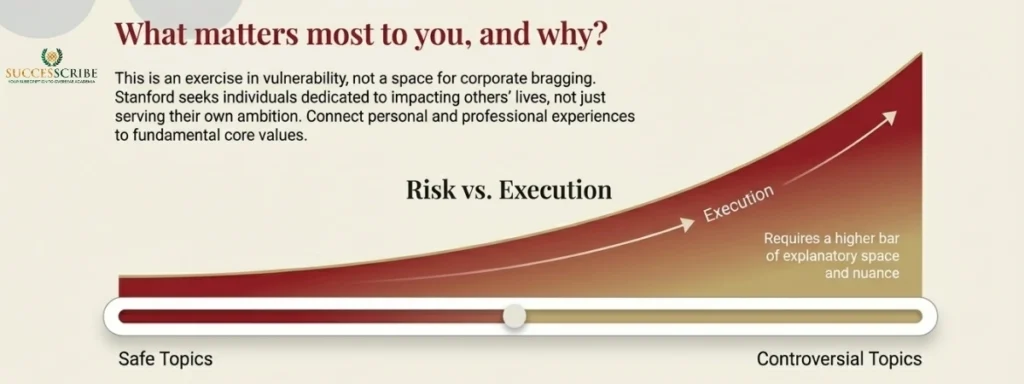
Stanford uses the Common Application supplemented by Stanford-specific short essays and short answers. These are not minor components – Stanford’s essays are among the most carefully evaluated in all of college admissions because they give insight into personality, intellectual depth, and fit that transcripts and scores cannot.
| Component | Word/Character Limit | What Admissions Is Actually Evaluating |
| Common App Personal Statement | 650 words | Voice, self-awareness, intellectual depth, narrative ability |
| Stanford Essay: Tell us about yourself (Roommate prompt) | 250 words | Personality, humor, authenticity, what you’ll add to community life |
| Stanford Essay: What is meaningful to you and why? | 250 words | Genuine intrinsic passion – not what impresses others, but what drives you |
| Stanford Essay: How will Stanford specifically contribute to your intellectual growth? | 250 words | Research on Stanford – professors, courses, programs, labs, student groups |
| Short Answer: Extracurricular activity description | 150 characters | Precise, vivid articulation of your most meaningful activity |
| Additional short answers (intellectual interest, etc.) | 50–250 words each | Specificity, depth, intellectual personality |
Letters of Recommendation: Cultivate Relationships, Not References
A dimension of profile building for Stanford that students chronically underinvest in is the recommendation letter – because a truly specific, enthusiastic letter from a teacher who knows your mind deeply can introduce a version of you that your transcript and activity list simply cannot convey on their own. Stanford requires 2 teacher recommendations and 1 counselor recommendation, with an optional third letter from a mentor, coach, or research supervisor.
| Recommendation Type | Ideal Recommender Profile | What to Provide Them | When to Ask |
| Teacher Rec #1 | Teacher in your intended field of study who has seen your intellectual curiosity firsthand – ideally in a class where you went beyond the curriculum | A detailed “brag sheet” with specific moments from their class, your academic goals, and what you hope they’ll highlight | May of Grade 11 |
| Teacher Rec #2 | Teacher from a contrasting subject who can speak to your character, work ethic, and how you engage with difficult material | Same brag sheet plus a note on the contrast you want covered – showing you’re well-rounded | May of Grade 11 |
| Counselor Rec | Your school counselor who can contextualize your school environment and speak to your growth across all four years | Meet at minimum twice in Grade 11; share your story, goals, and what makes your school context unique | Begin relationship in Grade 10 |
| Optional 3rd Letter | Research supervisor, nonprofit mentor, coach, or employer who has seen you operate in a high-stakes or real-world setting | A specific briefing on what aspects of your work and character you want highlighted – things teachers cannot see | Grade 11–12 |
The most important advice on recommendations: do not ask for a letter, ask for a strong one. When you approach a teacher, say explicitly: “I’m applying to highly selective universities, and I would need a detailed, enthusiastic letter to be competitive. Do you feel you know me and my work well enough to write that kind of letter?” This gives them the opportunity to gracefully decline – and prevents vague, lukewarm letters that can actually hurt your application.
Summer Programs: Converting Free Time Into Competitive Advantage
One important clarification Stanford itself has made: attending a Stanford summer program does not improve your admissions chances. Admissions officers are explicitly instructed not to give preference to pre-collegiate program alumni. What matters is what you produce and learn during any summer program – the skills, research output, and intellectual growth that then inform your application. Strategic use of summers is one of the highest-leverage opportunities in profile building for Stanford, because while the academic year is largely structured for you, summers are where you define yourself entirely on your own initiative.
| Program | Field | Eligibility | Selectivity | Cost |
| Stanford Pre-Collegiate Studies | STEM, Humanities, Social Science | Grades 8–11 | Moderate | $5,000–$14,000 |
| Research Science Institute (RSI) at MIT | STEM Research | Rising Grade 12 only | Extremely High (Tier 1) | Fully funded – FREE |
| MIT PRIMES / PRIMES-USA | Mathematics, CS | Grades 9–11 | Extremely High (Tier 1) | FREE |
| TASP (Telluride Association Summer Program) | Humanities, Social Sciences | Rising Grade 12 | Tier 1 – very selective | FREE |
| COSMOS (UC System) | STEM Clusters | Grades 8–12 | Moderate-High | $4,000 – $5,500 |
| Anson L. Clark Scholars Program | Research | Rising Grade 12 | Very High | FREE |
| GHP (Governor’s Honors Program) | State-based; broad fields | Grades 9 – 11 | High (state-level) | FREE |
| Local University Research Assistantship | Your chosen field | Grades 10–12 | Variable | FREE–$500 |
| Self-funded entrepreneurship or startup | Business, social enterprise | Any grade | Self-directed | Variable |
The Grade-by-Grade Preparation Roadmap
| Timeframe | Academic Priorities | Extracurricular Priorities | Testing & Application |
| Grade 9 | Build strong GPA from day one; establish disciplined study habits; take Honors courses where available | Explore 3–5 activities; find your passion domain; attend competitions to gauge your level | Take AMC 8/10; explore PSAT prep; no major test pressure yet |
| Grade 10 | Add 1–3 AP courses; maintain 4.0; begin researching areas of intellectual interest | Step into leadership within 1-`2 activities; cold-email professors; apply to selective summer programs | Take PSAT/NMSQT in October; begin SAT prep; take AMC 10; apply to RSI, PRIMES for summer |
| Grade 11 | Maximum rigor – take 3 – 5 APs; aim for 5s; begin building college list in spring | Launch your signature project or reach state/national level; ask 2 teachers for recommendation letters in May | SAT/ACT in fall and spring; aim to finalize score by June; AP exams in May; apply to RSI, TASP, COSMOS |
| Summer Before Grade 12 | Deep dive into research, entrepreneurship, or creative output; start essay brainstorming | Pursue substantive summer program or research; generate a real deliverable (paper, product, event, publication) | Retake SAT/ACT if needed; draft all Common App essays by late August |
| Grade 12 – Fall | Maintain strong grades in senior courses – Stanford does verify | Finalize and document all achievements; mentor underclassmen; sustain your leadership roles | Stanford REA deadline: November 1; Regular Decision deadline: January 2; submit all materials early |
Critical Mistakes That Cost Stanford Applicants Their Spot
Even students with near-perfect profiles make strategic errors that cost them admission. These are the most damaging:
| Mistake | Why It Damages Your Application | The Correct Approach |
| Activity list padded with 18–20 low-impact entries | Signals scattered focus and strategic resume-building rather than genuine passion | Curate 8–10 meaningful activities with real depth; quality is the signal |
| Writing “Why Stanford” about Stanford in general | Shows you haven’t researched the school beyond its brand; could have been written for any elite university | Name specific professors, labs, courses, and student programs unique to Stanford |
| Leaving the Additional Information section empty | Wastes a prime opportunity to add context, explain gaps, or introduce a dimension that didn’t fit elsewhere | Use it to explain a grade drop, add context for an unusual path, or briefly describe a passion that had no other home |
| Applying REA without genuine first-choice commitment | Your essays will reflect the absence of authentic Stanford connection | Only apply REA if Stanford is clearly your first choice; your essays must demonstrate specific, informed fit |
| Treating academic stats as the application | Stanford rejects hundreds of perfect-GPA, perfect-SAT applicants every cycle | Stats are the floor – the human being above that floor is what gets admitted |
| Starting essays in October of Grade 12 | Rushed essays lack authenticity, depth, and the benefit of multiple revision cycles | Begin brainstorming in spring of Grade 11; have complete first drafts by August of Grade 12 |
| Requesting recommendation letters in September of senior year | Teachers need time; rushed letters are generic letters | Ask in May of Grade 11, allowing full summer and early fall for writing |
| Claiming impact without evidence | Vague claims of leadership and growth are indistinguishable from other applicants | Quantify everything: number of students reached, funds raised, events organized, members gained |
Conclusion
Ultimately, the most important insight about profile building for Stanford is that the students who succeed are not the ones who optimized every checkbox – they are the ones who became so genuinely absorbed in something meaningful that their application was simply the natural documentation of who they had already become. As you build your profile over four years, remember Stanford’s founding vision: to cultivate minds capable of both deep learning and direct usefulness in the world.
The university seeks students who embody this synthesis – those who will not only excel in seminars but also build companies, lead nonprofits, conduct breakthrough research, and exercise influence on behalf of humanity. Stanford wants students who will “spark lively discussions” and “continue conversations at dinner tables”. Build a profile that shows you’re ready to do exactly that – and you’ll have crafted an application that Stanford cannot afford to pass up.
FAQs
How important is profile building for getting admission into Stanford?
Profile building is extremely important for admission into Stanford University because the university follows a holistic admission process. While academic excellence is required, Stanford evaluates applicants based on leadership, intellectual curiosity, innovation, community impact, and extracurricular achievements. A strong profile helps applicants stand out among thousands of highly qualified candidates.
What GPA is required to get into Stanford?
Most students admitted to Stanford University have a GPA close to 3.9 – 4.0 on a 4.0 scale. Additionally, successful applicants typically take the most challenging courses available at their schools, such as AP, IB Higher Level, or advanced honors classes. However, grades alone are not enough—Stanford also evaluates the overall strength of a student’s profile.
I got a B in one class in Grade 9. Is my Stanford chance over?
A single B – especially in Grade 9 – is not disqualifying. What matters is the trajectory of your record and what surrounds that grade. If the rest of your transcript is strong, your rigor is evident, and your other application components are compelling, one B does not define your application. What you want to avoid is a pattern of inconsistency or a downward trend in Grade 11 or 12, when colleges are watching most carefully.
How many extracurricular activities should I list on my Stanford application?
The Common Application provides space for up to 10 activities. You do not need to fill all 10 – 7 or 8 strong, well-described entries are more powerful than 10 padded ones. Stanford’s admissions officers have said directly that they are far more impressed by students with 5 deeply meaningful activities than students with 20 superficial ones. Depth signals genuine passion; breadth alone signals résumé-building.
What is the acceptance rate at Stanford University?
Stanford University is one of the most selective universities in the world. In recent admission cycles, the acceptance rate has been around 3 – 4%, meaning only about 3 to 4 students are admitted out of every 100 applicants. This makes profile strength and differentiation extremely important.
Related Post
Profile Building for Harvard
Profile Building for Oxford
How to study abroad for free
Dental hygienist course in USA