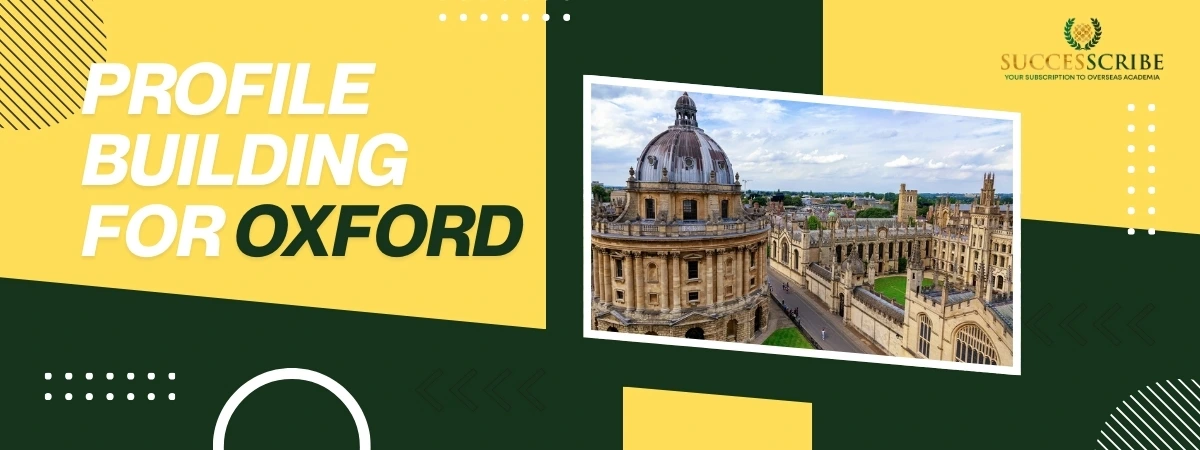
For years, the formula for elite university admission was a straightforward pursuit of numerical perfection: secure the highest GPA or A-Level results, and the gates to the Ivy League or Oxbridge would swing open. Today, however, we are operating in the era of the “Perfect Grade” Paradox. While academic excellence remains the non-negotiable floor of any application, high grades alone have ceased to be a guarantee of admission to institutions like Oxford, Cambridge, Harvard, or Yale. In a landscape where thousands of applicants boast “perfect” scores, a strategic academic profile – one built on the pillars of depth, curiosity, and consistency – has become the real differentiator. In this hyper-competitive landscape, Profile Building for Oxford has shifted from a simple quest for top marks to a strategic demonstration of intellectual vitality Admissions committees are no longer just counting As; they are performing a “holistic review” to find students who demonstrate an undeniable intellectual vitality and a sustained commitment to their chosen field.
Key Highlights: Profile Building for Oxford
- Profile Building for University of Oxford: What Oxford Truly Looks For
- Academic Excellence – The Non-Negotiable Foundation
- The 2026 Admissions Test Revolution (UAT-UK)
- Research Experience & Independent Projects
- Extracurricular Activities – Depth Over Breadth
- Year-by-Year Profile Building Timeline for Oxford University
- Conclusion
- FAQs
Profile Building for Oxford: What Oxford Truly Looks For
Before you can build a profile for Oxford, you must understand what Oxford is actually looking for. Unlike many universities that use a holistic but somewhat formulaic approach, Oxford’s admissions process centres on one central question: does this student have the intellectual drive and ability to thrive in a tutorial-based learning environment?
Oxford’s tutorial system means that most weeks, you will sit in a room with one or two other students and a leading academic expert in your field, defend your written work, and engage in rigorous intellectual debate. This is not a system that rewards passive learners. It rewards students who read beyond the syllabus, form their own opinions, and can articulate and defend complex ideas under pressure.
This philosophy shapes every element of what Oxford looks for – the personal statement must reflect genuine intellectual engagement, the admissions tests assess reasoning and not just rote knowledge, and the interview simulates a tutorial. Understanding this helps you build a profile that is authentically aligned with what Oxford values, rather than one manufactured to tick boxes.
Oxford’s admission philosophy is simple but demanding
Genuine Profile Building for Oxford must begin with a deep understanding of how the tutorial system shapes what tutors actually value in applicants
| Criteria | Weightage in Decision | What It Means |
| Academic Excellence | Very High | Top grades in rigorous subjects |
| Subject Depth | Very High | Super-curricular engagement |
| Critical Thinking | High | Analytical reasoning ability |
| Independent Thought | High | Ability to defend ideas |
| Interview Performance | Decisive | Tutorial-style intellectual discussion |
Academic Excellence – The Non-Negotiable Foundation
Academic achievement is the cornerstone of any Oxford application. There is no meaningful pathway to Oxford without meeting extremely high academic standards, and in many cases, exceeding them. Before any meaningful Profile Building university of oxford can occur, students must secure the foundational grades that clear the first hurdle.
UK Applicants (A-Levels)
For UK students, Oxford typically requires A*A*A to AAA at A-Level depending on the course. However, in practice, the majority of successful applicants hold three or four A*s. For many STEM courses, including Mathematics, Physics, Computer Science, and Biochemistry, a typical offer might be A*A*A, with A* in specific required subjects.
International Applicants
For international students, Oxford evaluates qualifications based on country-specific equivalencies. The following table outlines the general benchmarks for common international qualifications:
| Qualification | Typical Requirement for Oxford |
| International Baccalaureate (IB) | 38 – 40+ points overall, with 766 or higher at Higher Level |
| US High School (SAT/ACT + GPA) | GPA 3.9 – 4.0 unweighted; SAT 1500+; ACT 34+ |
| Indian CBSE/ISC | 95%+ overall; strong performance in relevant subjects |
| A-Levels (International) | A*A*A to A*A*A* depending on course |
| French Baccalaureate | 17–18/20 overall |
| German Abitur | 1.0 to 1.3 (highest grades) |
| Australian Year 12 (ATAR) | 99.00+ ATAR |
It is important to note that meeting these academic benchmarks does not guarantee an interview, let alone an offer. They are the entry threshold, not the finish line.
Subject-Specific Grade Profiles
The grade “arms race” has intensified in STEM and Social Sciences.
| Course Sector | Minimum Offer | Competitive Profile (Success Data) | Crucial Subject Notes |
| Computer Science | AAA | 3-4 A*s | Further Maths is mandatory for 90%+ of offers. |
| Medicine | A*AA | 3+ A*s | Chemistry + (Bio/Physics/Maths). 98% have 3+ As. |
| PPE / Economics | AAA / A*AA | AAA | Maths is essential; Grade 8/9 in GCSE Maths is the norm. |
| Law | AAA | A*AA | High emphasis on essay-based subjects (History/English). |
| Physics / Engineering | AAA | 3-4 A*s | A* usually required in Maths, Physics, or Further Maths. |
Subject Choice Matters Enormously
Oxford is highly specific about subject requirements. If you are applying for Chemistry, you will almost certainly need A-Level Chemistry and Mathematics as a minimum. If you are applying for PPE, they expect strong performance in essay-based subjects like History, English, or Economics. Choosing the right subjects early – ideally by Year 10 or 11 – is a strategic decision with long-lasting consequences.
A common mistake international students make is choosing subjects based on what their school offers or what seems impressive broadly, rather than what aligns with their intended Oxford course. Always cross-reference Oxford’s course-specific entry requirements and recommended subjects before finalising your subject choices.
The 2026 Admissions Test Revolution (UAT-UK)
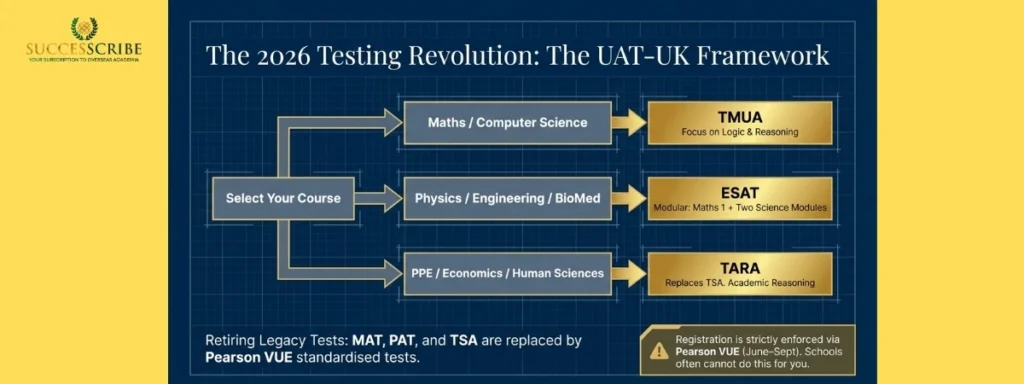
The biggest change in a decade occurred in 2025/2026: the retirement of many “homegrown” Oxford tests (like the MAT, PAT, and TSA) in favor of the UAT-UK (Undergraduate Admissions Test UK) framework, administered via Pearson VUE.
The New Test Map
At the core of Profile Building for Oxford lies uncompromising academic excellence, as high grades remain the essential foundation of any competitive application. If you are applying in 2026, you must register for one of the following “standardized” reasoning tests:
- TMUA (Test of Mathematics for University Admission):
- Required for: Computer Science, Mathematics and joint schools.
- Format: Two 75-minute papers focusing on mathematical reasoning and logic.
- ESAT (Engineering and Science Admissions Test):
- Required for: Engineering, Physics, and Biomedical Sciences.
- Format: Modular computer-based test (Maths 1 is compulsory, plus 2 modules from Bio, Chem, Phys, or Maths 2).
- TARA (Test of Academic Reasoning for Admissions):
Required for: PPE, Economics & Management, Psychology, and Human Sciences.
Note: This has effectively replaced the TSA (Thinking Skills Assessment) as the primary critical thinking metric.
- Legacy Survivors: The UCAT (Medicine) and LNAT (Law) remain unchanged.
Strategic Note: In the 2026 cycle, these tests are sat in October. You must self-register through the Pearson VUE portal – your school cannot always do this for you. Oxford uses these scores as the primary “filter” to reduce 20,000+ applicants to a shortlist of 3,000.
Research Experience & Independent Projects
One of the most powerful components of Profile Building for Oxford is engaging in structured independent research that bridges school-level theory with university-level inquiry. The hallmark of an Oxford applicant is the ability to bridge the gap between A-level theory and university-level inquiry. This is best achieved through structured independent projects.
The “Gold Standard”: Formal Qualifications
While Oxford does not require these, they provide a recognized framework to prove you can handle a 5,000-word academic burden.
- EPQ (Extended Project Qualification): For UK students, an A* in an EPQ focused on your degree subject is the strongest evidence of “Oxford readiness.” In 2026, tutors look for EPQs that involve primary data collection or novel synthesis rather than simple literature reviews.
- IPQ (International Project Qualification): The global equivalent (offered by OxfordAQA and Cambridge International). It is highly regarded as it mirrors the first-year undergraduate dissertation model.
- The “Internal” Research Paper: If your school doesn’t offer the EPQ/IPQ, producing a high-level 2,000-word research paper to be hosted on a school blog or submitted to a journal (like the Young Scientists Journal) is an excellent alternative.
Research Archetypes by Discipline
High-impact Profile Building for Oxford requires tailoring your research projects to reflect the methodological expectations of your chosen discipline. A “Research Project” looks different depending on whether you are a scientist or a classicist.
| Discipline | Research Format | Evidence to Include |
| STEM | Computational modeling or meta-analysis of existing datasets (e.g., using Python to analyze NASA Kepler data). | Link to a GitHub repository or a lab report with a “Limitations” section. |
| Humanities | Archival research or Comparative Analysis (e.g., comparing 18th-century French satirical pamphlets to modern digital memes). | Demonstration of “Source Criticism” – questioning the reliability of your evidence. |
| Social Sciences | Quantitative Surveys or Economic Modeling (e.g., assessing the impact of local ULEZ zones on small business revenue). | Statistical significance ($p$-values) and methodology justification. |
Showcasing “The Struggle”
UCAS Personal Statement (specifically Section 3), Oxford tutors aren’t just looking for your results; they want to see your academic resilience.
The “Pivot” Narrative:
A common trait in successful 2025/26 profiles was the “Pivot.” Instead of a perfect project, the student describes a hurdle:
“Initially, my research into [Topic] suggested X. However, upon encountering [Source/Data], I realized my methodology was biased toward Y. I pivoted my thesis to account for this variable, which led to a more nuanced conclusion.”
Leveraging Digital Research Tools
To make your project look ready, you should mention your use of advanced research tools. This proves you are digitally literate in an academic context:
- Zotero/Mendeley: For reference management and bibliography building.
- R or Python (SciPy/Pandas): For STEM and Social Science data visualization.
- JSTOR/Google Scholar: Moving beyond Wikipedia and using high-level peer-reviewed databases.
National Competitions as Research Proxies
If you don’t have time for a full EPQ, winning or being “Highly Commended” in a prestigious essay competition acts as a research “stamp of approval.”
- The John Locke Institute Essay Prize: High prestige for PPE, Law, and History.
- The Marshall Society Essay Competition: The gold standard for Economics.
- The British Biology/Physics Olympiad (Open Competition): For demonstrating research-level problem-solving in STEM.
Extracurricular Activities – Depth Over Breadth
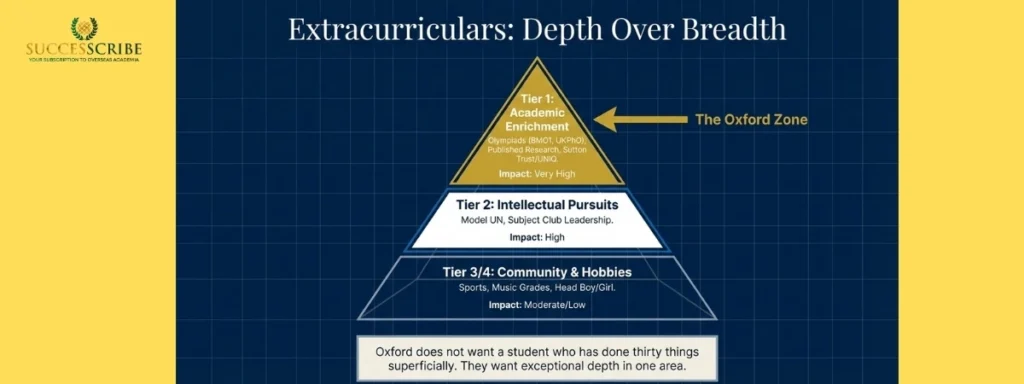
Oxford does not want a student who has done thirty different activities superficially. They want a student who has pursued one or two areas with exceptional depth and genuine passion. This distinction is critical and often misunderstood by students and parents who have been conditioned to “collect” activities for American university applications. Unlike American-style applications, Profile Building for Oxford prioritises depth in academically aligned activities over superficial breadth.
For Oxford, extracurricular activities serve one primary purpose: to demonstrate that your intellectual curiosity extends beyond the classroom and that you are the kind of person who pursues ideas independently, for their own sake.
The following framework organises extracurricular activities into tiers based on how they are typically perceived by Oxford admissions:
| Tier | Type of Activity | Examples | Impact on Application |
| Tier 1 (Highest) | Academic enrichment directly related to your course | Subject Olympiads (Gold/Silver), published research, national academic competitions, prestigious summer schools (e.g., Sutton Trust, UNIQ, Oxford Masterclasses) | Very High – directly signals subject passion and ability |
| Tier 2 | Intellectual pursuits with transferable value | Running a subject-specific club, writing for academic journals, independent research projects, participating in Model UN, organising TEDx events | High – shows initiative and intellectual depth |
| Tier 3 | Leadership and community | School head boy/girl, founding a charity, significant social impact project | Moderate – valued but secondary to academic engagement |
| Tier 4 | Sports, arts, and general activities | Sports teams, music grades, debating | Low-Moderate – positive but not differentiating for Oxford |
The key takeaway is that a student who won a Gold medal at the British Mathematical Olympiad and independently studied real analysis from a university textbook has a far stronger profile for Oxford Mathematics than a student who played three sports, was school captain, volunteered abroad, and studied no mathematics beyond the syllabus.
Academic Olympiads and Competitions Worth Pursuing
Participation in subject Olympiads is one of the most powerful ways to signal academic excellence in your field. Key competitions relevant for Oxford applicants include the British Mathematical Olympiad (BMO1 and BMO2), the UK Physics Olympiad (UKPHO), the Chemistry Olympiad (RSC), the Biology Olympiad (BBO), the UK Linguistics Olympiad (UKLO), the History Olympiad, and the UK Economics Competition. International students should pursue their country’s equivalent national Olympiads, which Oxford admissions tutors are familiar with.
Year-by-Year Profile Building Timeline for Oxford University
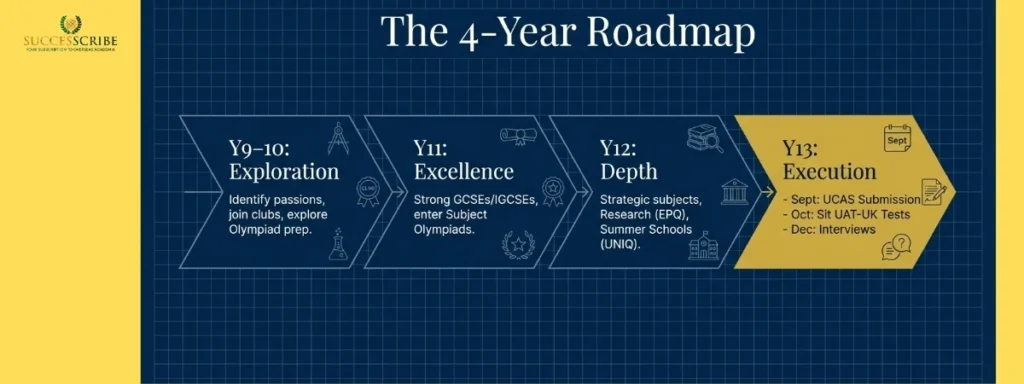
A structured long-term strategy is essential for effective Profile Building for Oxford, ideally beginning as early as Year 9 or Year 10. One of the most valuable things a prospective Oxford applicant can do is begin building their profile systematically from early secondary school. The following timeline provides a structured roadmap:
| Year/Stage | Key Focus Areas | Specific Actions |
| Year 9 – 10 | Foundation and exploration | Identify subject passions; begin reading beyond the syllabus; join subject clubs; explore Olympiad preparation |
| Year 11 | Academic excellence and early competition | Achieve strong GCSEs (9s in relevant subjects); enter subject Olympiads; attend open lectures or online university courses |
| Year 12 (First Half) | Depth and super-curricular engagement | Choose A-Level or IB subjects strategically; pursue research projects; apply for summer programmes (UNIQ, Sutton Trust, Oxbridge application programmes); begin personal statement drafting |
| Year 12 (Second Half) | Application preparation | Finalize personal statement; begin admissions test preparation; research colleges; arrange mock interviews; request reference from teacher |
| Year 13 (September – October) | Submission and testing | Submit UCAS application by 15 October deadline (Oxford’s early deadline); sit admissions tests in October/November |
| Year 13 (November – December) | Interview preparation and attendance | Intensive interview practice; attend Oxford interviews in December |
| January–March | Offer and decision | Receive offer or rejection; respond to offer conditions; prepare for A-Level or IB examinations |
| Gap Year (if applicable) | Strengthening weak areas | Pursue research, work experience, or further study; some students retake exams or gain significant subject-relevant experience |
Common Mistakes That Derail Oxford Applications
Applying to the University of Oxford is not just about being intelligent – it is about being strategically prepared. Every year, thousands of academically strong students are rejected because of avoidable mistakes. Avoiding strategic errors is just as important as building strengths when it comes to Profile Building for Oxford.
| Application Stage | Common Mistake (The “Pitfall”) | Why it Derails You | The “Oxford Standard” Fix |
| Personal Statement | The “Well-Rounded” Trap: Listing too many extracurriculars (DofE, sports, music). | Oxford tutors admit based on academic potential, not hobbies. 2026 data shows successful candidates spend 80%+ of their statement on subject-specific work. | Focus on Super-Curriculars. Link every activity back to a specific academic concept or problem. |
| Personal Statement | The Cliché Opening: “Since I was a child…” or “I have always been passionate about…” | In the new 3-question UCAS format, these phrases waste valuable characters and signal a lack of original thought. | Start with a specific academic observation. “I was struck by the paradox of X in Y’s theory…” |
| Admissions Tests | Ignoring the UAT-UK Format: Preparing using only old MAT/PAT/TSA papers. | The 2026 TMUA, ESAT, and TARA have different timings, modular structures, and a heavier focus on reasoning over syllabus knowledge. | Use the official Pearson VUE practice environment. Practice the specific modular timing of the ESAT/TMUA. |
| Admissions Tests | Missed Registration: Assuming your school will handle the Pearson VUE booking. | For the 2026 cycle, students must often self-register for tests like the UCAT or LNAT, and the UAT-UK window is strictly enforced. | Set a calendar alert for June 18th (Registration opens) and September 19th (Final Deadline). |
| Online Interview | “Playing it Cool”: Appearing detached or overly polished/rehearsed. | Tutors are looking for “teachability.” If you act like you have all the answers, you aren’t demonstrating how you learn in a tutorial. | Verbalize your “working out.” It is better to be visibly struggling but logically thinking than silent and correct. |
| Online Interview | Passive Listening: Not asking for clarification when a tutor gives a hint. | In a 2026 virtual setting, silence is often misinterpreted as being stuck. Tutors use hints as a “litmus test” for your agility. | If stuck, say: “I’m not sure how this applies to X, but if we assume Y, then…” Engage with the hint immediately. |
| Research Project | The “Wikipedia” Depth: Choosing a research topic that is too broad (e.g., “The History of AI”). | This suggests you haven’t engaged with university-level literature or primary sources. | Niche down. Change “History of AI” to “The impact of Transformer architectures on 2024 linguistic translation accuracy.” |
| All Stages | AI-Generated Genericness: Using LLMs to write the Personal Statement sections. | Oxford’s 2026 plagiarism and “AI-detection” protocols are highly sensitive to the “predictable” structure of AI writing. | Use AI for brainstorming and structure, but write the final prose yourself. Tutors want your unique voice, not a filtered average. |
Strategic Recommendation
The single biggest mistake in the current cycle is Underestimating the TARA (Test of Academic Reasoning for Admissions). Because it is a “new” test for many humanities and social science applicants, students often treat it like a general IQ test.
Fact: Successful 2025/26 candidates for PPE and Economics treated the TARA as seriously as a final A-level exam, dedicating at least 40-60 hours of specific logical reasoning practice.
Conclusion
Building a competitive Oxford profile is not a short-term project – it is a years-long intellectual journey that, when undertaken authentically, produces not just a strong university application but a genuinely exceptional student and thinker. Ultimately, Profile Building for Oxford is not about manufacturing perfection – it is about cultivating genuine intellectual excellence over time. The students who succeed at Oxford are rarely those who have followed a formula. They are the students who fell genuinely in love with their subject, who read because they couldn’t stop themselves, who asked questions their teachers couldn’t answer, and who arrived at their interviews not with rehearsed answers but with real ideas to defend and explore.
Begin early. Be strategic, but above all, be genuine. Oxford can – and does – recognise the difference between a manufactured profile and a real intellectual passion. Your goal is not to imitate what an Oxford applicant looks like. Your goal is to become one.
FAQs
How competitive is admission to Oxford in 2026?
Oxford remains one of the most competitive universities globally. On average:
1. Undergraduate acceptance rates range between 14–17% overall
2. For competitive courses like Medicine, PPE, Law, and Computer Science, acceptance rates may fall between 8–15%
3. Around 40 – 45% of applicants are shortlisted for interviews
Competition varies significantly by course.
What happened to the MAT, PAT, and TSA?
As of the 2026 entry cycle, Oxford has retired almost all of its “legacy” in-house tests. They have transitioned to the UAT-UK framework, managed by Pearson VUE. This means you will sit the TMUA (Maths/CS), ESAT (Engineering/Science), or TARA (Humanities/Social Sciences). These are now standardized across several top-tier universities, including Cambridge and Imperial.
What is the minimum GPA or grade requirement to apply to Oxford University?
There is no official “minimum” GPA, but Oxford expects applicants to be performing at the very top of their academic cohort. For US students, an unweighted GPA of 3.9–4.0 is typically expected alongside an SAT score of 1500+ or ACT of 34+. For UK students, offers typically range from AAA to A*A*A at A-Level depending on the course. For IB students, a score of 38–40+ points with 766 at Higher Level is the general benchmark. Meeting these thresholds is the entry point – not the guarantee of admission.
How early should I start building my profile for Oxford?
Ideally, you should begin in Year 9 or Year 10 (ages 13 – 15). This gives you sufficient time to explore subject passions, build academic depth, participate in Olympiads and competitions, pursue super-curricular reading, and develop a strong relationship with a potential referee. Students who begin in Year 12 can still build competitive profiles, but they face a significantly compressed timeline and must be exceptionally focused and strategic.
Can I use AI to help write my Oxford Personal Statement?
Oxford and UCAS use sophisticated plagiarism and “AI-fingerprinting” software. While you can use AI to brainstorm structures or check grammar, the “Three Question” format for 2026 is designed to elicit specific, personal academic reflections. If your statement sounds “generic” or follows predictable AI patterns, it will be flagged, which is often an automatic grounds for rejection.
Suggested Post
Munich Business School
Karlsruhe Institute of Technology
Humboldt University of Berlin
IELTS score for German universities