Securing a seat at the Massachusetts Institute of Technology (MIT) is less about “applying to a college” and more about “joining a mission.” MIT’s acceptance rate continues to hover around a razor-thin 4.0% to 4.5%. To stand out in a pool where almost every applicant has a near-perfect GPA and SAT score, your profile must move beyond academic excellence into the realm of high-impact contribution. MIT’s admissions process is holistic and looks for students who demonstrate exceptional intellectual curiosity, deep problem-solving ability, hands-on innovation, and a commitment to using technology to improve the world.
This is where profile building for MIT becomes critical. Students who successfully gain admission typically spend several years developing research experience, technical projects, competition achievements, leadership roles, and meaningful initiatives.
Key Highlights: Profile Building for MIT
- The Eight Core Traits of the MIT “Match”
- Admission Statistics: The Competitive Landscape
- Academic Infrastructure: Building the Intellectual Foundation
- The “Spike” Strategy: Olympiads and Global Competitions
- Research, Engineering, and Innovation Projects
- The Coding and AI Portfolio
- Leadership, Entrepreneurship, and Community Impact
- Narrative Excellence: Essays, LORs, and Interviews
- Sample MIT-Level Student Profile (Case Study)
- The Four-Year MIT Profile Building Timeline
- Conclusion
- FAQs
The Eight Core Traits of the MIT “Match”
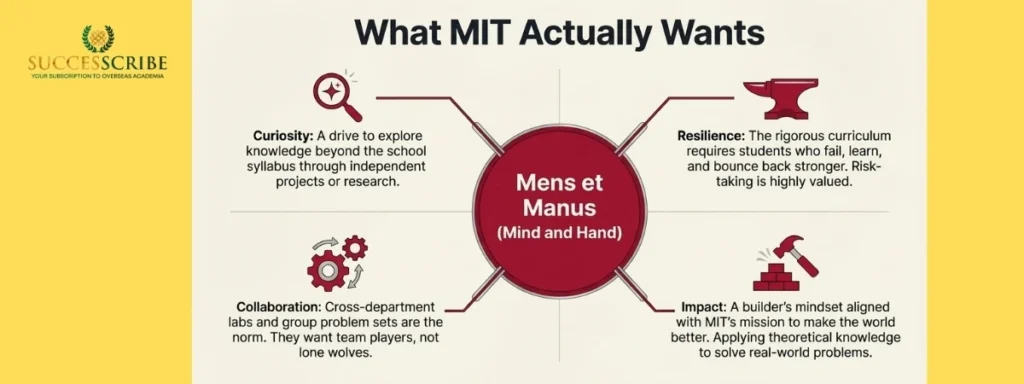
While many focus solely on grades, the most critical aspect of Profile Building for MIT involves demonstrating a collaborative spirit and a willingness to take risks. To secure a seat, a candidate must calibrate their profile against these eight traits:
- Alignment with Mission: Using talent for global or local benefit. So What? It proves you view your intelligence as a tool for service, not just self-advancement.
- Collaborative Spirit: Thriving in group problem-solving. So What? Most MIT “p-sets” (problem sets) are designed to be impossible alone; “lone wolves” fail the community check.
- Initiative: Seizing abundant resources independently. So What? MIT provides the seed money and labs, but only for those who don’t wait for permission.
- Risk-taking: A willingness to fail in pursuit of innovation. So What? Resilience is born from failure; MIT wants students who push boundaries.
- Hands-on Creativity: Applying theory to “messy” real-world builds. So What? It bridges the gap between abstract thinking and tangible results.
- Intensity and Curiosity: Deep, heart-led dedication to specific passions. So What? MIT values the “Spike” – quality over administrative volume.
- Prioritizing Balance: Finding energy and rest outside of academics. So What? This is a resilience check; it ensures you won’t burn out in the Cambridge pressure cooker.
- Community Character: Uplifting others as a trailblazer. So What? MIT is a community that takes care of its own; they want students who expand the potential of those around them.
While these traits represent the “soft” side of admissions, they are the primary lens through which MIT filters the high-octane data of your academic profile.
Admission Statistics: The Competitive Landscape
Strategic benchmarking against real-time data is the only way to set realistic goals. For the Indian applicant, the landscape is uniquely challenging. Unlike the JEE-based system, which relies on a single-rank performance, MIT uses a holistic “Match” process where you compete in a global pool with no regional quotas.
| Category | MIT Admissions Data Audit (Class of 2029 Cycle) |
| Overall Acceptance Rate | 4.6% (1,334 admits out of 29,281 applicants) |
| International Acceptance Rate | 2% |
| SAT Composite Range | 1520 – 1580 |
| SAT Math Target | 800 (A mandatory strategic target for STEM) |
| ACT Composite Range | 34 – 36 |
| Total Indian Student Enrollment | 261 (Total across all UG and PG programs) |
Financial Architecture and Cost of Attendance
The total cost of attendance (tuition, housing, and expenses) is $89,340 (approx. ₹80.6 Lakhs). However, MIT is need-blind for all students, including international students.
- Zero Parent Contribution: Families earning under $100,000 typically pay $0.
- Tuition – Free: Families earning under $200,000 are generally tuition-free.
These figures underscore that while financial barriers are mitigated by the Institute, the academic barrier requires an undeniable “Spike” to survive the initial screening.
Academic Infrastructure: Building the Intellectual Foundation
Academic excellence is the “baseline” or “first level of screening.” For Indian students (CBSE/ISC/State Boards), an 800 in SAT Math is effectively a prerequisite for STEM candidates; it is the strategic indicator of readiness for MIT’s fast-paced curriculum. Excellence in national boards is expected at 90 – 95%+ consistency, with Physics, Chemistry, and Math (PCM) scores ideally reaching 96 – 98%.
| Target STEM Mastery Subjects | Expected Performance Levels (AP/IB/National) |
| Calculus | AP Calculus BC (5), IB HL (7), or 95%+ in National Boards |
| Physics | AP Physics C (5) or equivalent Board rigor |
| Chemistry | Mastery of advanced concepts; high scores in competitive exams |
| Biology | Foundation for interdisciplinary research (Bio-Engineering) |
| Computer Science | Evidence of advanced logic and programming (IOI-level prep) |
Mastery in the classroom proves survival; however, competitive survival requires transitioning from classroom mastery to world-class external validation.
The “Spike” Strategy: Olympiads and Global Competitions
Global competitions play a major role since Profile Building for MIT often includes achievements in Olympiads, science fairs, and other international academic contests. To stand out, you must avoid “administrative volume” – listing 20 superficial activities. Instead, you need a “Spike”: world-class excellence in one area. While MIT is a STEM powerhouse, a Spike does not have to be STEM-related. World-class achievement in the arts, humanities, or music provides the interdisciplinary balance MIT highly values.
High-Impact Validation
- Math/Science Olympiads: IMO, IPhO, IChO, or IOI ranks are the gold standard for proving global competitiveness.
- Science Fairs: Success at Intel ISEF or the IRIS National Science Fair demonstrates original research capabilities.
- Non-STEM Spikes: National-level music performance, professional-grade writing, or significant social advocacy.
The goal is to prove you are a trailblazer who has exhausted the resources of your local environment and required a global stage. This leads naturally from structured competitions to self-directed innovation.
Research, Engineering, and Innovation Projects
Hands-on projects demonstrate the “Manus” (Hand) element of the MIT motto. MIT looks for a “builder’s mindset” – the ability to take action on theoretical knowledge. Documenting your failures is just as important as your successes because authentic Profile Building for MIT highlights your ability to iterate and solve ‘messy’ real-world problems.
Portfolio Distinctions (SlideRoom Submissions)
- The Maker Portfolio: For students who “do.” This is for hands-on projects, engineering builds, or coding apps. You must show finished work you are proud of, documenting the “how” as much as the “what.”
- The Research Portfolio: For students conducting original inquiry. This requires a formal technical abstract and an evaluation from a mentor or lab supervisor who can speak to your independence and contribution.
Successful applicants use technology to solve real-world problems. Whether it is a low-cost medical device for a local clinic or a new algorithm for resource distribution, the impact must be tangible.
What Makes a “Winning” Project?
It isn’t about the budget; it’s about the complexity, iteration, and documentation.
- Complexity: Did you build a simple “off-the-shelf” drone, or did you write a custom PID controller for a drone that maps reforestation zones?
- Iteration: MIT loves to see where you failed. Document Version 1.0 (the one that caught fire) just as much as Version 4.0 (the one that worked).
- Impact: Did your project help someone? A low-cost water filtration system for a local village carries more weight than a shiny, useless gadget.
The Coding and AI Portfolio
Technical literacy and open-source contributions are highly valued. MIT wants to see that you can collaborate in the digital realm as effectively as in a physical lab. Shipping functional code to GitHub proves that your technical Profile Building for MIT is rooted in practical application rather than just theoretical knowledge.
Technical Evidence Requirements
A strong technical profile must move beyond “learning to code” and move toward “shipping code.”
- GitHub/Open Source: Active contributions with measurable impact (Stars, Forks, merged PRs).
- Hackathons: Participation in high-stakes coding marathons.
- Kaggle/AI: Success in data science competitions or creating functional AI tools.
Required Documentation Points:
- Lines of code written for core modules.
- Number of active users or downloads.
- Specific technical problems solved by your tool.
- Collaboration evidence – showing you can work on someone else’s codebase.
Leadership, Entrepreneurship, and Community Impact
MIT seeks “trailblazers” who take responsibility for their communities. We distinguish between “Title-based Leadership” (being President of a stagnant club) and “Impact-based Initiative” (founding a project that solves a community problem).
Entrepreneurial ventures are viewed as evidence of risk-taking and resilience. Founding a startup or a non-profit proves you can lead a team through the “messy” stages of growth and persist despite setbacks.
Narrative Excellence: Essays, LORs, and Interviews
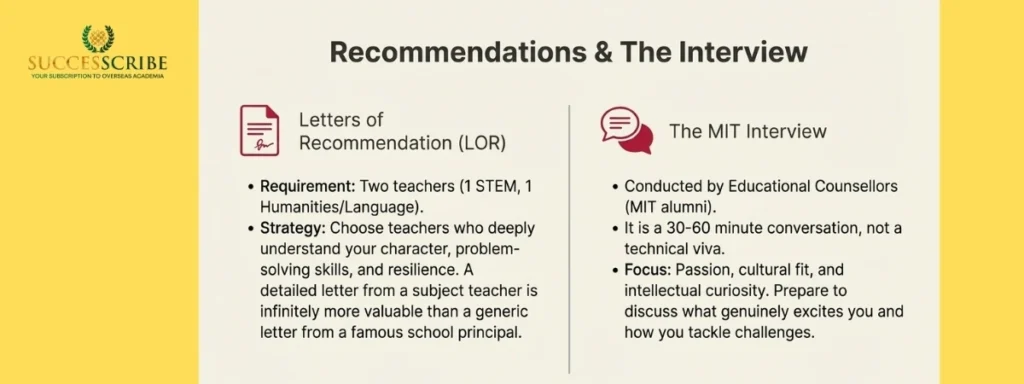
Once the “Hard Factors” (scores) are established, the “Soft Factors” differentiate the candidate. Authenticity is non-negotiable; avoid over-polished or AI-generated templates.
Your essays should provide the emotional soul of your application, ensuring that the strategic Profile Building for MIT you’ve done feels like a natural extension of your character.
MIT Short-Answer Strategy (100 – 200 words)
- The “Pleasure” Essay: This is not a list of hobbies. It is a balance and resilience check. MIT wants to know how you find energy and rest to sustain your intensity.
- The “Challenge” Essay: Focus on an unexpected obstacle. Reflect on what you learned about yourself during the struggle.
- The “Collaboration” Essay: Describe working across differences to tackle a challenge.
| Recommender | Focus Area |
| STEM Teacher | Thinking style, problem-solving under pressure, and intellectual grit. |
| Humanities/Language Teacher | Character, contribution to the community, and interdisciplinary curiosity. |
The Interview
The conversation with an Educational Counselor (EC) is a reflective exchange on “fit.” Be ready to discuss your “why” with the same precision as your “how.”
The MIT Alumni Interview: Turning Conversation Into Confirmation
MIT interviews are conducted by volunteer alumni in your region and are considered ‘informational’ rather than evaluative. However, alumni consistently report that interview performance can provide a meaningful positive signal – particularly for borderline cases. The interview cannot hurt you, but it can help you.
Common MIT Interview Questions and Strong Responses
| Interview Question | Weak Response Pattern | Strong Response Pattern |
| Tell me about yourself | Recites resume chronologically | Tells a coherent story with a clear intellectual identity and specific pivot moments |
| What project are you most proud of? | Names an award or recognition | Describes the problem, the failures, what they learned, and why it still matters to them |
| Why MIT specifically? | Generic answer about ‘best STEM school’ | References specific lab, professor, course, or tradition; explains personal connection |
| What would you do if you weren’t going to college? | Scrambles for an answer | Has a genuine response reflecting self-knowledge and intellectual independence |
| What’s something you’re curious about that you haven’t studied yet? | Names a broad topic like ‘quantum computing’ | Asks a specific question and explains what they’ve already done to begin exploring it |
| What’s your biggest failure? | Minimizes the failure or blames others | Owns it fully, describes what they changed, shows evidence of the lesson applied |
Sample MIT-Level Student Profile (Case Study)
Below is an example of a competitive MIT applicant profile.
- Academics: 97% CBSE average; SAT 1580 (800 Math Strategic Target).
- Spike: International Physics Olympiad (IPhO) Silver Medalist.
- Innovation (Manus): Developed a “messy” prototype for a low-cost solar-powered water filtration sensor currently piloted in a rural village.
- Leadership: Founded a regional “Math Circle” to mentor 50+ students, focusing on under-resourced schools (Community Impact).
- Narrative Balance: Plays the Sitar for meditation and mental rest (The Pleasure Essay).
The Four-Year MIT Profile Building Timeline
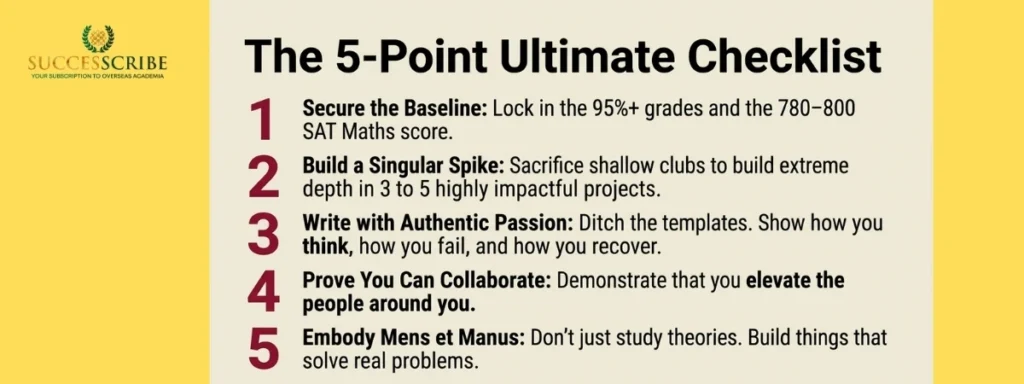
Building a competitive MIT profile is not something you start in Grade 12. Every MIT alumnus who reflects honestly on the process describes it as a multi-year effort. Starting as early as Grade 9 allows for a low-stress approach to Profile Building for MIT, giving you the years needed to develop deep, heart-led dedication to your passions. The following timeline synthesizes the actual paths of MIT alumni from diverse backgrounds.
| Grade | Academic Priority | Research/Competitions | Community & Activities | MIT-Specific Steps |
| Grade 9 | Max rigor in math & science; target all A’s; start SAT/ACT prep | Begin AMC 10; explore science fair; identify a research interest area | Join robotics, coding, or science clubs; identify your ‘spike’ | Explore MIT OpenCourseWare; watch MIT lectures on YouTube |
| Grade 10 | AP courses in STEM; aim for 5s; take PSAT seriously | AIME preparation; regional science fair; cold email 5 professors | Deepen one activity to leadership level; start a project or club | Apply to MIT summer programs; study MIT’s research groups |
| Grade 11 | Heaviest AP load; nail SAT/ACT (target score); rigorous sciences | USAMO/USAJMO/USACO attempt; ISEF-level project; university lab research | Measurable leadership impact in primary activity; community initiative | Apply to RSI and MIT PRIMES; visit campus if possible |
| Grade 12 | Maintain GPA; take college-level courses if possible | Finalize any competitions; publish/submit research if ready | Legacy-level impact in extracurriculars; recruit successors | Write essays in summer; submit EA (Nov 1); prepare for interviews |
Conclusion
Across dozens of MIT alumni interviews, blog posts, Reddit AMAs, and first-person accounts reviewed for this guide, one message emerges with overwhelming consistency: the students who got into MIT were not the ones who built a profile to get into MIT. They were the ones who were genuinely obsessed with something, who built real things, asked real questions, and happened to document it all. The profile building for MIT strategies in this guide is not about manufacturing a persona. They are about creating the structures, habits, and opportunities that allow your genuine intellectual identity to become visible to MIT admissions readers.
The best application is one where every section – the transcript, the activities, the essays, the recommendations – tells the same coherent story about who you are and what you care about. The journey to MIT is an exercise in “Mind and Hand.” Your goal in profile building is not to prove you are the smartest person in the room, but to prove you are the person who will use your intelligence to uplift everyone else in that room. MIT is a Match process. By aligning your academic depth with genuine innovation and a collaborative spirit, you demonstrate that you are a trailblazer ready for the intensity of the world’s premier research institution.
FAQs
How early should students start profile building for MIT?
Ideally, students should start profile building for MIT from Grade 9 or even earlier. Early preparation allows students to explore different academic interests, participate in Olympiads, build technical projects, and develop leadership initiatives over time. Since MIT values depth and long-term commitment rather than short-term achievements, starting early helps students develop a genuine intellectual “spike.”
Is a 1600 SAT or a perfect GPA enough to get into MIT?
No. While high scores are a “baseline” (the first level of screening), they are not a guarantee. With an acceptance rate under 5%, MIT rejects thousands of students with perfect stats every year. Your academic data proves you can survive the workload; your “Spike” and alignment with the Eight Core Traits (like Initiative and Risk-taking) are what actually get you admitted.
What kind of students does MIT look for during the admissions process?
The Massachusetts Institute of Technology (MIT) looks for students who demonstrate exceptional curiosity, problem-solving ability, creativity, and a strong desire to improve the world using science and technology. Beyond academics, MIT values collaboration, resilience, risk-taking, community impact, and hands-on innovation.
MIT is a STEM school – should I include my passion for arts or music?
Absolutely. This falls under Prioritizing Balance. MIT explicitly looks for “interdisciplinary balance.” Whether you play the Sitar, write poetry, or practice archery, these “Pleasure” activities show admissions officers that you have the resilience and mental outlets necessary to handle the high-pressure environment of Cambridge.
What GPA or academic performance is expected for MIT applicants?
Students admitted to MIT typically demonstrate excellent academic performance throughout high school. For Indian students, this often means 90–95% or higher in national board exams, with particularly strong performance in mathematics and science subjects.
Related Post
Profile Building for Stanford
Profile Building for Harvard
Profile Building for Oxford
Engineering management courses in USA