
For students aiming to join the London School of Economics and Political Science (LSE), the application process is far more than just filling out a form. It is a precise exercise in demonstrating “academic potential” and “logical reasoning.” As the only G5 super-elite university that does not conduct interviews for most undergraduate courses, LSE admissions tutors rely solely on your UCAS application to form their impression of you. Your Personal Statement, academic grades, and reference letter must function like a rigorous social science research project: logically coherent, evidence-based, and with every element interconnected. Students planning their UK applications should understand that Profile Building for LSE requires a strong academic narrative supported by intellectual curiosity and subject-specific engagement.
Key Highlights: Profile Building for LSE
- The LSE Philosophy: Academic Merit Above All
- Academic Excellence: The Foundation of the LSE Application
- Strategic Subject Selection (Undergraduate)
- Postgraduate Profile Building (Masters & PhD)
- The Super-Curricular Pillar: Developing Intellectual Curiosity
- Research Projects and Independent Study: Thinking Like a Social Scientist
- Competitive Excellence: Economics & Social Science Competitions
- Strategic Internships: Policy, Research, and Think Tanks
- Leadership and Social Impact: The “Human” Element
- Reading Habits: Curating an LSE-Level Bibliography
- Mastering the Admissions Tests: TMUA, LNAT, and UGAA
- Letters of Recommendation: Your Advocates Matter
- The Personal Statement: LSE’s “Deciding Factor”
- The LSE Summer School (Pre-University Entry)
- Strategic Timeline: Grade 9 to Grade 12
- Avoiding the “Standard Rejection”: Common Mistakes
- Conclusion
- FAQs
The LSE Philosophy: Academic Merit Above All
Unlike many US Ivy League schools that prioritize well-roundedness (sports, music, leadership), LSE is famously academically focused. They are looking for “specialists” – students who have a deep, almost obsessive interest in their chosen social science. At the core of admissions lies the belief that Profile Building for LSE must revolve around academic excellence rather than a large number of extracurricular activities.
| Pillar | Weightage (Estimated) | Focus Area |
| Academic Excellence | 80% | Predicted grades, subject choices, and rigor. |
| Personal Statement | 10% | Evidence of “Super-curricular” engagement. |
| Teacher Reference | 10% | Validation of your intellectual curiosity. |
| Admissions Tests | Variable | Mandatory for Law (LNAT) and Economics (TMUA). |
Admissions selectors operate on an 80/20 Rule: at least 80% of your profile must be dedicated to academic and “super-curricular” engagement. LSE is not looking for a student who “wants to study” a subject; they are looking for an applicant who is already functioning as a social scientist. The profile must demonstrate that you have moved beyond passive consumption of a school syllabus to active, critical reflection on the complex systems that govern global society.
Academic Excellence: The Foundation of the LSE Application
Academic metrics are non-negotiable. LSE does not recognize UCAS Tariff points; it evaluates only the specific grades achieved in rigorous qualifications. For most successful applicants, Profile Building for LSE begins with maintaining consistently high academic grades in rigorous subjects.
Standard Entry Requirements
| Qualification | Minimum Requirement Range | Competitive Reality (High-Demand) |
| A-Levels | AAB – A*AA | AAA* |
| IB Diploma | 37 (666 HL) – 38 (766 HL) | 40+ (776 HL) |
| GCSEs | Grade 6 in English and Maths | Multiple Grades 8/9 |
| Advanced Highers | AAB – A1AA | A1A1A |
For quantitative degrees such as Economics, Finance, or Data Science, A* Mathematics is mandatory. For courses like Law or International History, selectors scrutinize your ability to handle heavy analytical writing. Mere compliance with the minimum is insufficient for courses like Economics, which carries a staggering 4.9% acceptance rate.
Strategic Subject Selection (Undergraduate)
A critical part of Profile Building for LSE is choosing academically demanding subjects that align with the degree you intend to pursue. LSE values “traditional” academic subjects. If you are applying for 2026/27 entry, your A-Level (or IB/CBSE/ISC) choices must demonstrate quantitative and analytical depth.
- The “Broad Mix” Rule: LSE prefers at least two traditional subjects (e.g., History, Economics, Government, Mathematics).
- The Mathematics Requirement: For Economics, Finance, and Management, A in Mathematics* is non-negotiable. For the most competitive quantitative courses, Further Mathematics is highly recommended.
- Avoid “Soft” Subjects: Avoid combining subjects like Media Studies, Art, or Business Studies if you are applying for a pure Economics or Law degree.
Postgraduate Profile Building (Masters & PhD)
For graduate applicants, Profile Building for LSE focuses heavily on research capability, academic writing, and a strong alignment with the chosen program.
Graduate Profile Checklist
| Component | What LSE Looks For |
| GPA/Grades | 1st Class Honours (UK) or 3.6/4.0 GPA (US) / 75%+ (India). |
| GRE/GMAT | Highly recommended for all quantitative finance/econ roles, even if “optional.” Aim for 163+ in Quant. |
| Statement of Academic Purpose | 1,000 – 1,500 words. Must be a “mini research proposal” in tone. |
| Work Experience | Crucial for “Executive” programs; less so for pure “MSc” programs. |
The Super-Curricular Pillar: Developing Intellectual Curiosity
LSE explicitly prioritizes “Super-Curricular” activities – academic engagement beyond the classroom – over general extracurriculars. The School’s pedagogy is centered on learning through reading and discussing those ideas in academic essays. Your profile must mirror this.
- LSE iQ Podcast & Research for the World: These are not just for listening; they are for critiquing.
- Specialized Journals: Engaging with Economica (published for the Department of Economics) signals high-level scholarly intent.
- Reflective Engagement: LSE is indifferent to a “reading list.” They value reflection. Do not simply state you read a text; critique its central thesis, analyze its methodology, and contrast it with opposing theories.
Research Projects and Independent Study: Thinking Like a Social Scientist
As a research-intensive institution where 56% of output is graded as 4-star “world-leading,” LSE seeks students who can replicate this rigor. An Extended Project Qualification (EPQ) or independent research paper is a vital signal of “fit.”
Use LSE’s research centers as a roadmap for your own inquiries:
- STICERD: Explore the history of economic thought.
- CEP (Centre for Economic Performance): Investigate productivity and human wellbeing.
- CASE (Centre for Analysis of Social Exclusion): Analyze inequality and social policy.
Framing a research project around “Global Challenges” like national productivity or climate economics proves you can contribute to the School’s lasting impact.
Competitive Excellence: Economics & Social Science Competitions
High-stakes competitions validate your ability to perform under global pressure. LSE values essay-based contests because they provide objective evidence of sophisticated social science thinking. Participating in global essay competitions can significantly strengthen Profile Building for LSE by showcasing analytical thinking and argumentation skills.
| Competition Name | Subject Area | Strategic Value |
| John Locke Essay Competition | Philosophy/Economics | Validates argumentative depth and high-level prose. |
| Marshall Society | Economics | Signals engagement with Cambridge-level economic thought. |
| RES Essay Competition | Economics | Evidence of engagement with contemporary economic themes. |
Strategic Internships: Policy, Research, and Think Tanks
LSE values practical engagement, but only if it is intellectually relevant. A week at a high-street bank is “fluff” compared to a role that offers insight into policy-formulation. Selectors look for students who can best reflect on experiences, not necessarily those who had the most expensive opportunities. Relevant internships in policy organizations or research institutions can add strong real-world exposure to Profile Building for LSE.
Seek placements in:
- Think Tanks & NGOs: Focused on social policy or economic development.
- Governmental Departments: Understanding the machinery of the state.
- Research Assistantships: Assisting in data collection or literature reviews.
The “So What?” is critical: How did this experience evolve your understanding of the academic modules you are applying to study?
Leadership and Social Impact: The “Human” Element
LSE is committed to Equity, Diversity, and Inclusion. Leadership roles in student government or community social impact projects should be presented as evidence of your desire to tackle global inequality. Keep this to a maximum of 20% of your profile. It is a secondary support to your academic identity, not a replacement for it.
Reading Habits: Curating an LSE-Level Bibliography
A bibliography for LSE must be curated with surgical precision. Avoid generalist texts; focus on foundational and contemporary scholarly works. Developing advanced reading habits is a vital aspect of Profile Building for LSE, as the university values students who actively engage with scholarly literature.
| Category | Recommended Authors/Works |
| Economics | Keynes, Hayek, Amartya Sen |
| Climate Economics | Professor Lord Nicholas Stern |
| Human Wellbeing | Professor Lord Richard Layard (Happiness) |
| Social Theory | Research outputs from CASE or STICERD |
Active Reading Guide: Take notes on the why behind the author’s conclusions. This forms the backbone of your Personal Statement, which must read like a mock academic essay rather than a biography.
Recommended Books for LSE Aspirants
| Book | Author | Topic |
| Capital in the Twenty-First Century | Thomas Piketty | Economic inequality |
| Freakonomics | Steven Levitt | Economic thinking |
| The Undercover Economist | Tim Harford | Everyday economics |
| Why Nations Fail | Daron Acemoglu | Political economy |
| Thinking Fast and Slow | Daniel Kahneman | Behavioral economics |
Mastering the Admissions Tests: TMUA, LNAT, and UGAA
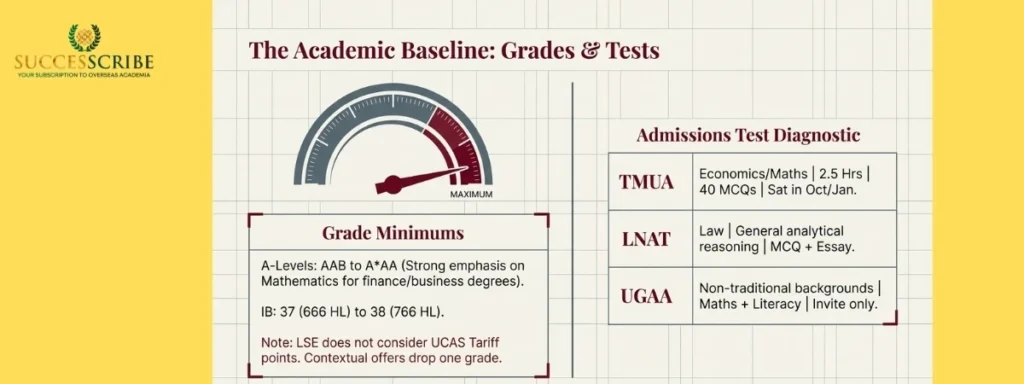
Admissions tests are the ultimate “tie-breakers” for over-qualified applicant pools. Preparing strategically for admissions tests is an essential stage of Profile Building for LSE, particularly for competitive programs like Economics and Law.
| Test Type | Core Skill Evaluated | Critical Strategy |
| TMUA | Mathematical Logic | Two periods: Oct & Jan. Cambridge applicants must take October. |
| LNAT | Analytical Reasoning | Focus on the essay section to show LSE-level critical writing. |
| UGAA | Maths & Literacy | Mandatory for non-traditional backgrounds (Shortlisted only). |
The TMUA (Test of Mathematics for University Admission)
This is mandatory for Economics and Econometrics. It is also highly recommended for the “Mathematics with” suite, including Data Science, Actuarial Science, and Financial Mathematics. It tests mathematical reasoning, not just calculation.
- Goal: You need to be in the top 20th percentile.
- Focus: Logic and mathematical reasoning rather than just calculation.
The LNAT (National Admissions Test for Law)
Used to assess the reasoning and essay-writing skills of prospective Law students.
- Section A (Multiple Choice): Tests your ability to read between the lines.
- Section B (Essay): LSE looks at this very closely. They want to see if you can argue a point without being emotional.
UGAA (Undergraduate Admissions Assessment)
Perhaps the most unique tool in LSE’s arsenal, the UGAA is a tool for equity. It is used specifically for “hidden gems” – applicants with non-traditional or unrecognized qualifications – to prove their potential through literacy and math assessments. It ensures that LSE’s “cosmopolitan” standard remains open to the best talent, regardless of their educational background.
Letters of Recommendation: Your Advocates Matter
Letters of recommendation (LORs) are your referees’ opportunity to confirm, in their own credible voice, what your application claims about you. A lukewarm letter from a famous professor is far less valuable than a specific, enthusiastic letter from a faculty member who knows your work deeply and can speak to your intellectual potential with conviction and evidence.
| Reference Type | Ideal Source | What to Ask Them to Cover | Priority |
| Academic Referee 1 | Dissertation supervisor / Thesis advisor | Research ability, intellectual curiosity | Highest |
| Academic Referee 2 | Senior faculty, class professor | Academic performance, critical thinking | High |
| Professional Referee | Internship manager, employer | Work ethic, problem-solving, impact | High |
| Research Referee | Research PI / Lab supervisor | Analytical skills, contribution | Contextual |
The Personal Statement: LSE’s “Deciding Factor”
Because LSE does not interview, the Personal Statement (PS) is a simulation of LSE pedagogy. It is a 4,000 – character scholarly argument for your admission.

Application Level Comparison
| Feature | Undergraduate (UCAS) | Graduate (SoAP) |
| Level | Bachelor’s (BSc/BA) | Master’s/PhD (MSc/PhD) |
| Focus | 80% Academic Interest | Academic & Professional Trajectory |
| Word Count | 4,000 Characters | 1,000 – 1,500 Words |
The “Fit” Mandate: You must research your specific course. If you apply for International History but write about Ancient History (which LSE does not offer), you will be rejected. Similarly, focus on Social Anthropology rather than Biological Anthropology.
The LSE Summer School (Pre-University Entry)
The LSE Summer School is not just a “experience” – it is a trial run of life at the School. For 2026, the program is divided into three intensive 3-week sessions.
| Feature | 2026 Requirement / Details |
| Target Audience | University students & High School “Offer Holders” (Year 13) |
| 2026 Sessions | Session 1 (June), Session 2 (July), Session 3 (August) |
| Estimated Cost | £3,350 (Tuition) + £1,500+ (Housing) |
| Profile Value | Provides 7.5 ECTS credits and direct exposure to LSE faculty. |
Strategic Timeline: Grade 9 to Grade 12
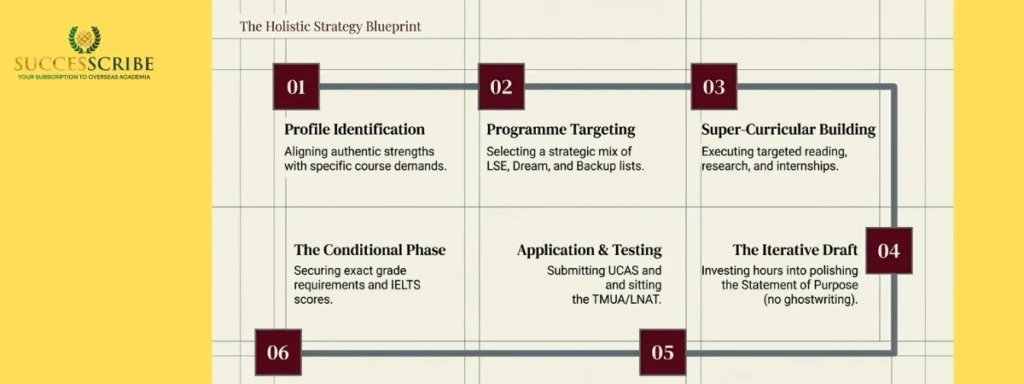
Starting early can significantly improve Profile Building for LSE.
| Year | Phase | Critical Milestone |
| Grade 9-10 | Foundation | Selection of A-Level/IB subjects; focus on Higher Level Mathematics. |
| Grade 11 | Execution | Manufacturing skills; securing policy internships and essay competitions. |
| Grade 12 | Application | Sitting TMUA/LNAT (Oct/Jan); drafting AI-free Personal Statements. |
Students who start early have more opportunities to develop a strong academic narrative.
Avoiding the “Standard Rejection”: Common Mistakes
Even A* students fail by falling into these “Fatal Errors”:
- The “Dream” Opening: LSE warns against wasting space on: “I have always dreamed of coming to LSE since I was young.” This is emotional fluff.
- The “Football” Pitfall: Do not spend more time talking about being “captain of the school football team” than about your subject. LSE seeks scholars, not athletes.
- AI Usage: LSE utilizes sophisticated detection; an AI-assisted statement is a disqualifying breach of academic integrity.
- University Naming: Mentioning “LSE” in a UCAS statement alienates your other four choices.
Conclusion
Admission to LSE is a marathon of intellectual preparation. You must prove you can read, think, and write with the rigor of an LSE undergraduate. Frame your application as a contribution to the School’s 130-year legacy of solving global challenges. Proving your “fit” is the only path to the 6.5%. Ultimately, successful applicants understand that Profile Building for LSE is about demonstrating genuine intellectual engagement with social sciences rather than simply listing achievements.
FAQs
How has the Personal Statement changed for LSE applicants?
UCAS has transitioned to a multi-question format. However, LSE’s core requirement remains the same: at least 80% of your responses must focus on academic engagement. You must provide evidence of critical reflection on books, lectures, or research rather than just listing activities.
Is the TMUA mandatory for all Economics applicants?
Yes. For 2026 entry, the TMUA (Test of Mathematics for University Admission) is mandatory for BSc Economics and BSc Econometrics and Mathematical Economics. It is also highly recommended for other quantitative courses in the Mathematics and Statistics departments.
Can I apply to two different courses at LSE to increase my chances?
You can, but it is rarely advisable. You only submit one personal statement for all LSE choices. Unless the courses are extremely similar (e.g., Social Policy and Sociology), it is difficult to show enough depth for both. Note: LSE will only make you one offer per cycle.
Does attending the LSE Summer School guarantee an interview or an offer?
No. LSE does not conduct interviews for undergraduate or most postgraduate courses, and Summer School does not grant preferential treatment. However, it significantly strengthens your profile by providing university-level evidence of your academic ability and “fit” for the LSE style of learning.
What are “Non-Preferred” subjects, and will they hurt my profile for LSE?
LSE prefers traditional academic subjects (History, Economics, Maths, etc.). “Non-preferred” subjects include Business Studies, Accounting, and Media Studies. Having one is usually fine, but you must have at least two traditional subjects to be considered competitive.
Related Post
Profile Building for MIT
Profile Building for Stanford
Profile Building for Harvard
Profile Building for Oxford