
Gaining admission to Imperial College London is a goal shared by thousands of ambitious students across the world. Located in the heart of London and widely recognized as one of the most prestigious STEM universities globally, Imperial has built a reputation for producing innovators, Nobel laureates, entrepreneurs, and scientists who contribute significantly to global technological progress.
Imperial consistently ranks among the top universities in the world for science, engineering, medicine, and technology. It is also a member of the UK’s elite Russell Group, a network of research-intensive universities known for academic excellence. Every year, Imperial receives applications from some of the most academically talented students worldwide. As a result, the admissions process is extremely competitive, particularly for international applicants.
A strong profile demonstrates that a student has gone beyond textbooks to explore their chosen field. Whether it is developing a machine learning project, participating in physics competitions, conducting independent research, or completing an engineering prototype, these activities signal that a student is genuinely excited about their subject.
Key Highlights: Profile Building for Imperial College London
- Understanding the Admission Philosophy of Imperial College London
- Academic Excellence: The Foundation of an Imperial Application
- Supercurricular vs Extracurricular Activities
- Super-Curricular Depth: The “X-Factor”
- Admissions Tests: The High-Stakes Gateway
- Academic Projects That Strengthen an Imperial Application
- Olympiads and Academic Competitions
- Imperial’s Own Pre-University Programs
- Building a Powerful Personal Statement
- The Interview: Demonstrating “Teachability”
- Post-Graduate (PG) Profile Building
- A Four-Year Roadmap for Building a Strong Imperial Profile
- Common Mistakes Students Make
- Example of a Strong Imperial Applicant Profile
- Conclusion
- FAQs
Understanding the Admission Philosophy of Imperial College London
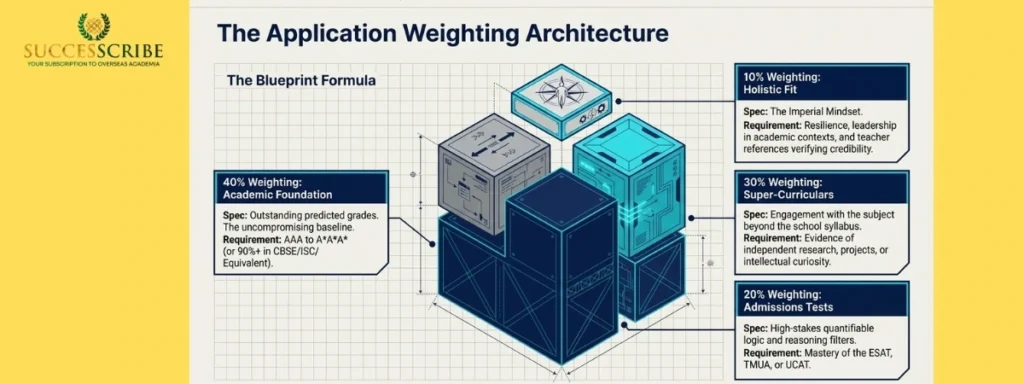
To build a strong profile, students must first understand how Imperial evaluates applicants.
Unlike many universities that emphasize a broad range of extracurricular achievements, Imperial focuses heavily on academic potential and subject mastery. The university wants students who have demonstrated a genuine interest in exploring their chosen field beyond the school curriculum.
The admissions team typically evaluates applications based on several key factors.
| Admission Factor | Importance | What Imperial Looks For |
| Academic Excellence | Very High | Outstanding predicted grades |
| Subject Passion | Very High | Evidence of intellectual curiosity |
| Supercurricular Activities | High | Academic exploration outside school |
| Research or Projects | High | Independent thinking |
| Personal Statement | High | Clear motivation and subject understanding |
| Teacher Reference | Medium | Academic credibility and character |
Imperial’s “Ideal Applicant” Matrix
| Pillar | What They Seek | Weighting |
| Academic Foundation | Predicted AAA – AAA (or 90%+ in CBSE/ISC/Equivalent). | 40% |
| Super-curriculars | Engagement with the subject beyond the school syllabus. | 30% |
| Admissions Tests | Mastery of the ESAT, TMUA, or GMAT (for PG). | 20% |
| Holistic Fit | Leadership, resilience, and “The Imperial Mindset.” | 10% |
Academic Excellence: The Foundation of an Imperial Application
Imperial’s Faculty of Engineering and Faculty of Natural Sciences are uncompromising. For 2026, the Standard Offer is often the Minimum Entry Requirement.
High School Selection (Undergraduate)
- Mathematics is King: For almost any ICL course (including Medicine and Business), a Grade 9 (GCSE) or A* (A-Level/IB) in Mathematics is non-negotiable.
- The “Double Math” Edge: For Computing and Physics, taking Further Mathematics is no longer “recommended” – it is effectively essential for the most competitive applicants.
- Breadth vs. Depth: Imperial prefers a 4th A-Level in a contrasting science (e.g., Biology for a Physics applicant) rather than a non-science subject, unless that subject is a language or Economics.
Undergraduate Academic Benchmarks
| Curriculum | Competitive Requirement |
| A-Levels | A*A*A or A*A*A* (Specifically in Math/Physics/Chem) |
| IB Diploma | 40–42 points with 7, 7, 6 in Higher Level subjects |
| CBSE/ISC (India) | 95% overall with 98% in Mathematics |
| AP (USA) | Five Grade 5s in relevant STEM subjects |
Supercurricular vs Extracurricular Activities
One of the most misunderstood aspects of UK university admissions is the difference between extracurricular and supercurricular activities.
| Type | Meaning | Example |
| Extracurricular | Activities unrelated to academics | Sports, music, drama |
| Supercurricular | Activities related to your academic subject | Research, projects, competitions |
Extracurricular activities can still be valuable because they demonstrate leadership, teamwork, and time management. However, they usually play a secondary role in the admissions process for highly academic universities.
Supercurricular activities, on the other hand, demonstrate intellectual curiosity.
For example:
- A student interested in Artificial Intelligence might:
- Build machine learning models
- Study neural networks independently
- Participate in hackathons
- Complete online courses in deep learning
These experiences demonstrate that the student is not simply interested in obtaining a degree – they are genuinely curious about the subject.
Super-Curricular Depth: The “X-Factor”
The Personal Statement is no longer a narrative essay; it is a structured evidence sheet. To fill it, you need “Super-curriculars” – activities that take your school subjects into the real world.
- The “Chain of Inquiry” Model
Instead of doing five random things, do one thing deeply.
- Observation: You read an article about Solid State Batteries.
- Investigation: You take a specialized MOOC (e.g., Battery Management Systems via Coursera).
- Application: You use MATLAB or Python to simulate battery degradation cycles.
- Contribution: You write a 500-word summary of your findings and post it on a technical blog or LinkedIn.
- Competitive Mathematics & Olympiads
For Imperial, participation in the UKMT Senior Maths Challenge, British Physics Olympiad (BPhO), or international equivalents (IMO, IPhO) acts as a high-signal indicator. Even a “Bronze” or “Silver” award is worth mentioning, as it shows you can handle “unstructured” problems that don’t appear in standard textbooks.
Admissions Tests: The High-Stakes Gateway
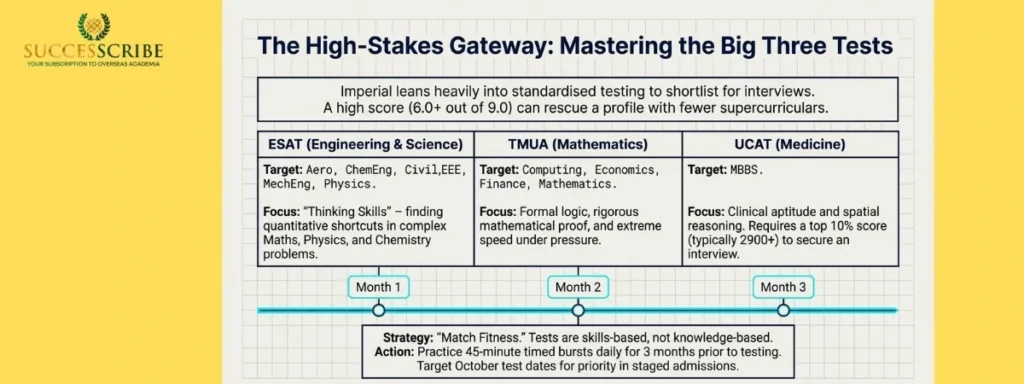
Imperial has leaned heavily into the ESAT and TMUA. A high score here can override a slightly weaker personal statement.
The “Big Three” Exams
| Test | Full Name | Used For (Imperial Courses) |
| ESAT | Engineering and Science Admissions Test | Aeronautics, Chemical Engineering, Civil Engineering, EEE, Mechanical Engineering, Physics, etc. |
| TMUA | Test of Mathematics for University Admission | Computing, Economics, Finance, Mathematics, some Business courses. |
| UCAT | University Clinical Aptitude Test | Medicine (MBBS) |
- ESAT (Engineering and Science Admissions Test): Covers Mathematics, Physics, and Chemistry. It tests “Thinking Skills” – the ability to find shortcuts in complex problems.
- TMUA (Test of Mathematics for University Admission): Used for Computer Science and Economics. It focuses on formal logic and mathematical proof.
- UCAT (University Clinical Aptitude Test): For Medicine, A score in the top 10% (typically 2900+) is usually required for an Imperial interview.
Treat these like a sport. You need “match fitness.” Practice 45-minute timed bursts every day for three months leading up to the October/January test dates.
How to Prepare:
- Start Early: These tests are skills-based, not knowledge-based. You cannot cram for them a week before.
- Practice, Practice, Practice: Use official practice papers. The speed required for TMUA and the scientific reasoning for ESAT require dedicated practice.
- Strategy: Aim to take the first round of tests (in October). This ensures your scores are available for consideration, especially if you are applying to competitive departments with “staged admissions” where early applications are prioritized.
Academic Projects That Strengthen an Imperial Application
One of the most effective strategies for Profile Building for Imperial College London is completing independent academic projects.
Projects allow students to apply theoretical knowledge in practical ways and demonstrate initiative.
Here are some examples of strong projects depending on the intended field of study.
| Field | Example Project |
| Computer Science | AI chatbot using natural language processing |
| Mechanical Engineering | Building a robotic arm |
| Physics | Simulation of gravitational waves |
| Mathematics | Research on number theory patterns |
| Biotechnology | DNA analysis project |
Olympiads and Academic Competitions
Academic competitions are another powerful way to demonstrate subject mastery.
Many successful Imperial applicants have participated in Olympiads or high-level academic competitions, which test problem-solving skills beyond the standard school curriculum.
| Competition | Field | Value for Imperial |
| International Mathematical Olympiad | Mathematics | Elite problem solving |
| International Physics Olympiad | Physics | Advanced theoretical thinking |
| UKMT Mathematics Challenge | Mathematics | Globally respected competition |
| Google Science Fair | STEM | Innovation and research |
Imperial’s Own Pre-University Programs
For students aged 16-17, the Imperial Global Summer School is a direct pathway to building a relevant profile.
- The Experience: You attend university-style lectures, work in labs, and participate in the “Innovation Challenge” – solving real-world problems in teams.
- The Advantage: This gives you direct exposure to Imperial’s teaching style and provides undeniable material for your personal statement (e.g., “During the Innovation Challenge at the Imperial Global Summer School, my team and I tackled the issue of…”). It also demonstrates a sustained and proven interest in the institution itself.
Building a Powerful Personal Statement
The Personal Statement submitted through the UCAS Application System plays a crucial role in Imperial admissions. Unlike American universities that require multiple essays, UK universities rely heavily on a single personal statement that explains why a student wants to study their chosen subject.
The personal statement should focus on academic motivation rather than personal storytelling.
| Weak Personal Statement | Strong Personal Statement |
| Lists achievements | Explains intellectual development |
| Generic statements | Specific academic insights |
| No reflection | Demonstrates curiosity |
The Interview: Demonstrating “Teachability”
If you are invited to an interview (common for Engineering, Medicine, and Computing), you have already passed the academic hurdle. Now, they are checking your communication and trainability.
Typical Interview Structure
- The Icebreaker (5 mins): Discussion on a recent news item in your field (e.g., “The impact of the 2025 AI Accord on software safety”).
- The Technical Problem (15-20 mins): The interviewer will give you a problem you cannot solve immediately.
- Goal: See how you react to hints.
- Advice: Never stay silent. Say, “I am considering using the Principle of Conservation of Energy here, but I am unsure how to account for friction…”
- The “Why Imperial?” (5 mins): Mention specific ICL facilities like the Dyson School of Design Engineering or the Data Science Institute.
Post-Graduate (PG) Profile Building
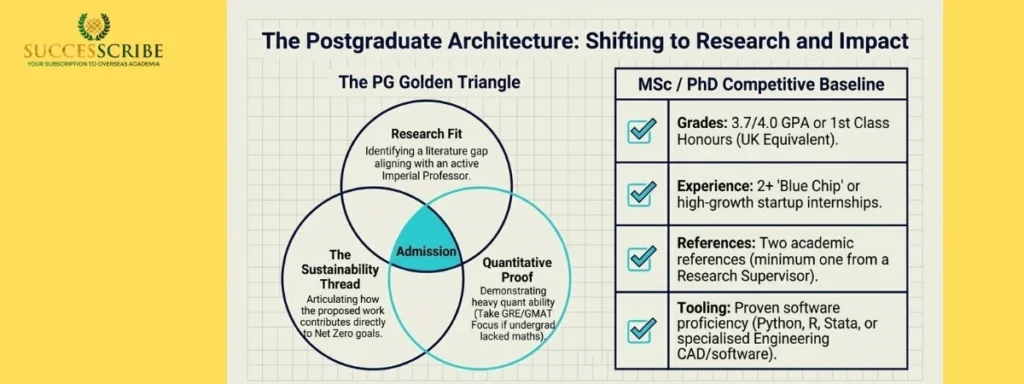
For Masters (MSc/MRes) and PhD applicants, the requirements shift toward Research Fit and Professional Impact.
The “Golden Triangle” of PG Applications
- Research Proposal/Statement of Purpose: Identify a gap in current literature that aligns with an Imperial Professor’s work.
- Quantitative Proof: Imperial’s Business School and Engineering faculty are heavily quantitative. If your undergrad wasn’t math-heavy, take a GRE or GMAT Focus Edition.
- The “Sustainability” Thread: Imperial expects all PG applicants to articulate how their work contributes to the “Net Zero” or “Sustainable Development” goals.
PG Competitive Profile Checklist
| Factor | Requirement |
| GPA | 3.7/4.0 or 1st Class Honours (UK Equivalent). |
| Internships | At least 2 “Blue Chip” or high-growth startup internships. |
| References | Two academic references; at least one must be from a Research Supervisor. |
| Software | Proficiency in Python, R, Stata, or specialized Engineering software. |
A Four-Year Roadmap for Building a Strong Imperial Profile
Students who start early have a significant advantage.
| Grade | Focus |
| Grade 9 | Explore interests and read widely |
| Grade 10 | Start small academic projects |
| Grade 11 | Participate in competitions and research |
| Grade 12 | Prepare applications and personal statement |
Early planning allows students to develop a coherent academic narrative, which is highly valued in UK admissions.
Common Mistakes Students Make
Many talented students fail to secure admission simply because they misunderstand the admissions process. Common Mistakes Students Make
- Participating in too many unrelated activities
- Focusing only on grades without academic exploration
- Writing generic personal statements
- Ignoring supercurricular development
- Successful applicants typically show clear intellectual direction.
Example of a Strong Imperial Applicant Profile
To illustrate what a competitive profile might look like, consider the following example.
| Component | Example |
| Academic Grades | 97% CBSE |
| Major Project | AI model predicting stock trends |
| Competition | National coding championship finalist |
| Internship | AI startup internship |
| Personal Statement | Focus on computational problem solving |
This profile demonstrates academic excellence, technical skills, and intellectual curiosity.
Conclusion
Throughout this guide on Profile Building for Imperial College London, one central theme becomes clear: successful applicants are not just high achievers in school – they are deeply engaged learners who actively explore their chosen field beyond the classroom. While strong academic performance remains the essential foundation of any competitive application, what truly distinguishes successful candidates is their ability to demonstrate academic depth, independent thinking, and genuine enthusiasm for their subject.
FAQs
Can I apply for two different courses at Imperial?
You can use two of your five UCAS choices for Imperial, but be careful.
The Limitation: You only have one personal statement. If you apply for Mechanical Engineering and Biotechnology, your statement will likely be too diluted to impress either department.
The Exception: It is common to apply for a standard 3-year BEng and the 4-year MEng version of the same course as separate choices.
Does Imperial offer “Contextual Offers” for 2026?
Yes. If you meet certain criteria (e.g., attending a state school with lower progression rates or living in a specific area), you may be eligible for a guaranteed interview or a reduced grade offer (e.g., AAA instead of A*A*A).
Imperial has introduced an August Reconsideration Pool for students who missed their offer but achieved exceptional final results and meet contextual criteria.
How do the ESAT and TMUA scores actually impact my offer for Imperial College London?
Scores are reported on a scale of 1.0 to 9.0.
The Filter: Imperial uses these scores to shortlist for interviews. There is no “pass mark,” but a score above 6.0 is generally considered very competitive for most departments.
Holistic View: A slightly lower score won’t automatically disqualify you if your personal statement and predicted grades are world-class, but a high score can “rescue” a profile that has fewer extracurriculars.
Why is profile building important for Imperial College London?
Profile building is essential for admission to Imperial College London because the university looks for students who demonstrate academic excellence along with strong subject interest. A well-developed profile shows intellectual curiosity through projects, research, competitions, and subject-related activities.
When should students start profile building for Imperial College London?
Students should ideally begin profile building from Grade 9 or Grade 10. Starting early gives them enough time to explore their interests, work on meaningful projects, and develop a strong academic profile.
Related Post
Profile Building for LSE
Profile Building for MIT
Profile Building for Stanford
Profile Building for Harvard