Getting into Harvard in 2026 isn’t just about being “smart.” Profile Building for Harvard has evolved from a quest for academic perfection into a demonstration of systemic impact and world-class leadership. With Harvard’s acceptance rate hovering around 3.1% to 3.3% for the Class of 2030, a perfect GPA is merely the price of admission. To get a “Yes,” you must prove you are a high-impact leader who will shift the needle of human history.
Key Highlights: Profile Building for Harvard
- The Harvard “1-6” Internal Rating System
- Defining “Intellectual Vitality” in the AI Era
- The 4-Year Strategic Roadmap
- Extracurriculars: Quality of Impact (QoI)
- The “Personal Profile” and the Essay Landscape
- Testing and Academics Strategy
- The Final Piece: Letters of Recommendation (LORs)
- Conclusion
- FAQs
The Harvard “1-6” Internal Rating System
Harvard admissions officers do not just “read” your file; they score it. Understanding the internal rating framework is essential for effective Profile Building for Harvard, because every application is scored across academics, extracurricular impact, and personal character. Based on data released during litigation and updated for the 2025-2026 cycle, every applicant is ranked from 1 (World-Class) to 6 (Below Average) across four key dimensions. To get in, you generally need at least one “1” or two “2s.”
| Category | Rating 1 (Top 1%) | Rating 2 (Exceptional) | Rating 3 (Strong) |
| Academic | Original published research; International Olympiad Gold. | Near-perfect GPA; Top 1-2% of class; 1580+ SAT. | 3.9+ GPA; 1520+ SAT; honors courses. |
| Extracurricular | National/International recognition (e.g., Olympic athlete, Forbes 30u30). | State-level leadership; Significant founder role. | Club President; Varsity athlete; standard involvement. |
| Personal | Truly extraordinary character; transformative life story. | Strong maturity; high resilience; glowing letters. | Respectful, hardworking, “nice” person. |
Defining “Intellectual Vitality” in the AI Era

As generative AI standardizes traditional output, Profile Building for Harvard now hinges on ‘Cognitive Agency’ – the rare ability to leverage emerging technology for original, self-directed discovery. With AI capable of generating standard essays, passing the Bar exam, and solving complex AP Calculus problems, Harvard admissions officers no longer find “high grades” or “polished writing” impressive on their own.
To achieve a Rating 1 in the Academic/IV category today, you must demonstrate Cognitive Agency – the ability to direct technology and traditional resources toward original, complex discovery.
The Three Pillars
Harvard evaluates your intellectual hunger through three specific lenses. If your profile only hits one, you are “strong”; if you hit all three, you are “vital.”
| Pillar | Focus | 2026 Evidence |
| Pillar 1: Self-Directed Inquiry | Learning beyond the curriculum. | Auditing graduate-level Coursera/edX tracks; pursuing niche certifications (e.g., Quantum Computing or Ethnomusicology). |
| Pillar 2: Technical Synergy | Using AI/Tech as a “Co-Pilot,” not a “Ghostwriter.” | Building custom LLMs for local data; using CRISPR kits for home-lab biology; Advanced data visualization of social trends. |
| Pillar 3: Discourse & Dissent | Engaging with conflicting ideas. | Participating in high-level philosophy salons; writing Op-Eds that challenge the “status quo”; leading non-partisan debate forums. |
Moving from “Consumer” to “Producer”
In the “AI Era,” the greatest risk to a Harvard applicant is looking like a passive consumer of information. Intellectual Vitality is proven when you produce something that did not exist before. The strongest candidates treat Profile Building for Harvard as a creation journey, not a participation checklist.
- The “Rabbit Hole” Project: Harvard loves to see a student who found a tiny niche and went 10 miles deep.
Example: Instead of “Biology Club,” you spent 18 months investigating why a specific local lichen species is dying, eventually corresponding with a professor at Oxford to verify your findings.
- The Interdisciplinary Bridge: 2026 is the year of the Polymath. Harvard is actively looking for “The Poet who Codes” or “The Physicist who paints Renaissance-style frescoes.” This shows a brain that can synthesize disparate data points—something AI still struggles to do authentically.
Proof of Work: “The Digital Footprint”
Harvard admissions officers frequently “Google” or check the digital portfolios of top-tier candidates. Your IV must be verifiable.
- Substack/Medium Publications: A consistent, long-form blog where you analyze complex topics (e.g., “The Ethics of Neuralink in Pediatric Care”).
- Open Source Contribution: For STEM applicants, a GitHub repository with active “commits” shows you are building tools for the community, not just doing homework.
- The “Failure Log”: Ironically, Harvard’s 2026 supplemental prompts often hint at intellectual risk. A student who tried to build a fusion reactor in their garage and failed, but can explain the physics of why it failed, has more IV than a student who got a 100% on a pre-packaged lab report.
Quantifying IV for the “Class of 2030”
To make your Intellectual Vitality “scannable” for a busy admissions officer, use the Impact-Scale-Depth (ISD) method in your descriptions:
- Ineffective (2022 style): “I am very interested in History and read many books about the Cold War.”
- Vital (2026 style): “Curated a digital archive of 50+ oral histories from Cold War defectors; utilized AI-transcription and sentiment analysis to map psychological trauma; findings cited in the National High School History Journal.”
The 4-Year Strategic Roadmap
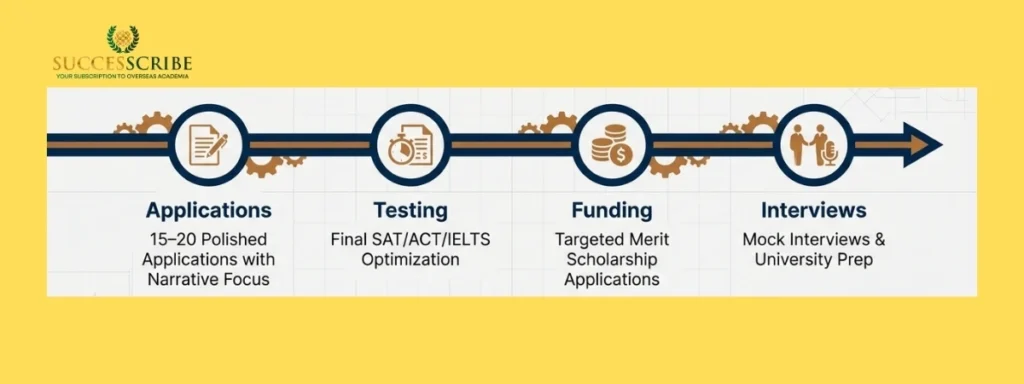
Profile Building for Harvard is a four-year marathon that transforms exploration into specialization, specialization into impact, and impact into narrative clarity. Harvard’s admissions committee looks for “longitudinal commitment” – proof that your passions didn’t just appear in your junior year to impress them. The goal of this roadmap is to move you from Exploration (9th) to Specialization (10th) to Impact (11th) and finally to Synthesis (12th).
1. The “Macro” View: Year-by-Year Strategic Focus
To stand out in the 2026 pool, your four-year journey should look like an inverted pyramid: starting broad and narrowing down into a razor-sharp “Spike.”
| Year | Theme | Academic Objective | Extracurricular Strategy |
| 9th Grade | The Explorer | Establish a 4.0 GPA “Floor.” | Join 5-6 diverse activities; find your “hook.” |
| 10th Grade | The Specialist | Maximize course rigor (AP/IB). | Quit 3 minor clubs; take 1 leadership role. |
| 11th Grade | The Architect | Standardized Testing (1550+). | Launch a “Legacy Project” or original research. |
| 12th Grade | The Storyteller | Maintain “Senioritis” immunity. | Synthesize your journey into the Common App. |
2. The “Micro” Roadmap: A Deep Dive into the 48-Month Plan
Phase I: The Foundation (9th Grade)
This year is about proving you can handle the heat while finding what makes you tick.
- Academic: Enroll in the most advanced math and language tracks available.
- The “Pilot” Project: Start one small-scale independent project (e.g., a niche blog, a coding repository, or a local volunteer initiative).
- Summer Strategy: Attend a local university enrichment program or a specialized skills camp (Coding, Debate, or Arts).
Phase II: The “Spike” Identification (10th Grade)
By 10th grade, Harvard expects you to stop “sampling” and start “investing.”
- Pruning the Tree: If an activity doesn’t contribute to your future “Spike,” drop it. Quality of hours beats quantity of clubs.
- Competition Entry: Start entering regional competitions (Science fairs, Writing contests, Math Olympiads).
- Summer Strategy: Look for “Tier 2” summer programs (e.g., Yale Young Global Scholars or state-level leadership summits).
Phase III: The Impact Year (11th Grade)
This is the most critical year. In 2026, “Impact” is defined as Systemic Change.
- Testing: Secure your SAT/ACT score by December.
- The Legacy Project: This is an activity that would continue even after you graduate. (e.g., founding a non-profit that has a board of directors, or publishing a paper in a peer-reviewed journal).
- Summer Strategy: This is the “Golden Window.” Aim for Rating 1 programs like RSI, TASP, or prestigious internships at Fortune 500 companies or top-tier research labs.
Phase IV: The Narrative Synthesis (12th Grade)
The first half of your senior year is about “Packaging.”
- LOR Strategy: Secure letters from teachers who can speak to your Intellectual Vitality, not just your grades.
- The Common App: Your main essay should not be a resume – it should be a window into your soul. Use the “Supplementary Essays” to prove your fit for Harvard’s specific culture.
3. The “Impact Scorecard” (Self-Assessment)
Use this table to evaluate your roadmap at the end of each year. Harvard isn’t looking for “Participants”; they are looking for “Catalysts.”
| Level of Activity | Description | Harvard Internal Rating (Est.) |
| Member | You showed up to meetings and helped out. | 4 (Low) |
| Officer | You managed a budget or a small team. | 3 (Average) |
| Catalyst | You created a new initiative that solved a problem. | 2 (Strong) |
| Disruptor | You changed the way an organization or community operates on a large scale. | 1 (Exceptional) |
Successful Profile Building for Harvard demands a multi-year longitudinal strategy, transitioning a student from broad intellectual exploration in the ninth grade to a razor-sharp ‘specialized spike’ by senior year.
Extracurriculars: Quality of Impact (QoI)
Harvard has moved beyond “checking boxes.” In a world where AI can automate club management and basic tasks, the Admissions Committee now focuses on Quality of Impact (QoI). They aren’t looking for how much you did, but how much you changed.
QoI is the measure of your “footprint.” Harvard evaluates this through three specific lenses: Magnitude, Sustainability, and Reach.
The 2026 Impact Rubric
Harvard uses an internal “Tier” system (often cited as the 1 – 4 Tier scale) to categorize the significance of your activities.
| Tier | Level of Impact | Examples | Admissions Value |
| Tier 1 | National/International | Winning a top-level Olympiad (IMO/ISEF); Publishing original research in a Tier-1 journal; Founding a startup with $50k+ revenue/funding. | Rare (Rating 1): Almost guarantees an “Academic” or “EC” score of 1. |
| Tier 2 | State/Regional | All-State First Chair in Orchestra; Student Body President of a 2,000+ student school; Founding a city-wide youth advocacy council. | Exceptional (Rating 2): Very strong; puts you in the top 5% of the pool. |
| Tier 3 | School/Local | Club President; Varsity Captain; Regular volunteer at a local hospital. | Strong (Rating 3): Standard for a high-achiever; needs a “Spike” to stand out. |
| Tier 4 | General Participation | Member of 4 clubs; casual hobbyist; summer camp attendee. | Low: Often viewed as “resume padding” in the 2026 cycle. |
Strategic summer planning is a powerful accelerator in advanced Profile Building for Harvard.
Quantifying Your “Legacy”
To get a Rating 1 or 2, you must present your impact using Hard Metrics. In 2026, vague descriptions like “helped students” are ignored. Harvard wants to see the Delta (the change you created).
The “Harvard Description” Formula:
[Action Verb] + [Quantitative Data] + [Specific Outcome] + [Sustainability]
- Before (Weak): “I was the leader of the Recycling Club and we helped the school go green.”
- After (Strong and Impactful): “Spearheaded a school-wide zero-waste initiative; reduced landfill contributions by 40% (3 tons/year) by negotiating a contract with a local composting firm; secured $5,000 in recurring grants to ensure the program continues after my graduation.”
Social Impact Shift
Following the 2023 SCOTUS ruling, Harvard’s 2026 evaluation places higher weight on Identity-Linked Impact. They want to see how your personal background drives your service.
| Impact Type | 2026 Strategic Focus | How to Prove It |
| Community Bridging | Solving a problem for an underrepresented group. | “Developed a multilingual AI-tutor that helped 200 ESL students improve literacy scores by 15%.” |
| Intellectual Service | Teaching complex skills to others. | “Founded a ‘Girls Who Code’ chapter in a rural district; 12 members went on to win regional hackathons.” |
| Civic Agency | Changing local or state policy. | “Lobbied the City Council to install LED streetlights in high-crime zones; 10% decrease in local accidents.” |
The “Anti-AI” Verification
Because AI can now “hallucinate” or embellish resumes, Harvard in 2026 often looks for Proof of Work.
- Media Coverage: Being featured in a local or national newspaper for your work.
- Endorsements: A supplemental Letter of Recommendation from a non-teacher (e.g., a Mayor, a CEO, or a Research Supervisor) who can verify your QoI.
- Digital Artifacts: A link to a portfolio, a GitHub repository, or a published white paper that serves as a “receipt” for your impact.
High-Impact Summer Programs (The “Golden Ticket” List)
While no program guarantees admission, these are historically “feeders” for Harvard due to their low acceptance rates (<5%):
- RSI (Research Science Institute): The gold standard for STEM.
- TASP/Telluride: The gold standard for Humanities.
- SSP (Summer Science Program): Elite astrophysics/biochemistry.
- Bank of America Student Leaders: High-impact community service.
The “Personal Profile” and the Essay Landscape
Since the 2023 Supreme Court ruling on Affirmative Action, Harvard’s supplemental essays have shifted toward lived experience. In 2026, the prompt focuses on “how your unique background will contribute to the Harvard community.” Essays are where Profile Building for Harvard transforms from data into identity.
The “Spike” Analysis
| Type of Spike | Profile Requirements | Success Figure (Estimated) |
| The STEM Innovator | 1+ Major Publication; USAMO/USACO Platinum; Patent holder. | 18% of the incoming class. |
| The Social Justice Advocate | Lobbying experience; NGO founder; 500+ hours of targeted impact. | 15% of the incoming class. |
| The Creative Visionary | Scholastic Art/Writing Gold Key; National-level portfolio; Published author. | 10% of the incoming class. |
| The Institutional Leader | Student Body President of a large school; Varsity Captain; Intern at a Fortune 500. | 20% of the incoming class. |
Testing and Academics Strategy
The “Test-Optional” era has officially ended for Harvard. After analyzing data from the early 2020s, Harvard (along with several other Ivy League peers) reinstated mandatory standardized testing, citing it as the most effective predictor of academic success when paired with high school GPA. For the Class of 2030, academics are no longer a “competitive advantage” – they are a threshold. If you don’t meet the threshold, your extracurriculars are rarely even read. If you do meet it, you are simply “invited to the conversation.”
The 2026 Academic “Floor”
In competitive Profile Building for Harvard, standardized testing is the entry ticket – not the differentiator. To receive a Rating 1 or 2 in Academics, you must demonstrate mastery of the most rigorous curriculum available to you. Harvard’s AI-driven transcript readers now flag “course-dodging” (taking an easier class to protect a 4.0 GPA).
| Metric | The “Floor” (Minimum) | The “Harvard Target” (Competitive) |
| Unweighted GPA | 3.90 | 3.98 – 4.00 |
| Class Rank | Top 5% | Top 1% (Valedictorian/Salutatorian) |
| AP/IB Rigor | 6–8 Advanced Courses | 10 – 14 Advanced Courses (context-dependent) |
| SAT Score | 1500 | 1570+ (with 790+ in Math for STEM) |
| ACT Score | 33 | 35 – 36 |
Standardized Testing Strategy (SAT/ACT)
The SAT has fully transitioned to the Digital Adaptive format. Harvard looks closely at your “Sectional Consistency.”
- The 800-Math Standard: For any STEM-related major (CS, Engineering, Economics, Physics), an 800 in Math is nearly expected. A 750 or below in Math for a Physics applicant is a significant “Red Flag.”
- Superscoring: Harvard continues to “Superscore” (taking your best sections from different sittings), but they discourage taking the test more than 3 times.
- AP Exam Scores: In 2026, “reporting” your 4s and 5s is mandatory for a competitive profile. A string of 3s on AP exams despite having an “A” in the class suggests grade inflation, which can hurt your Academic Rating.
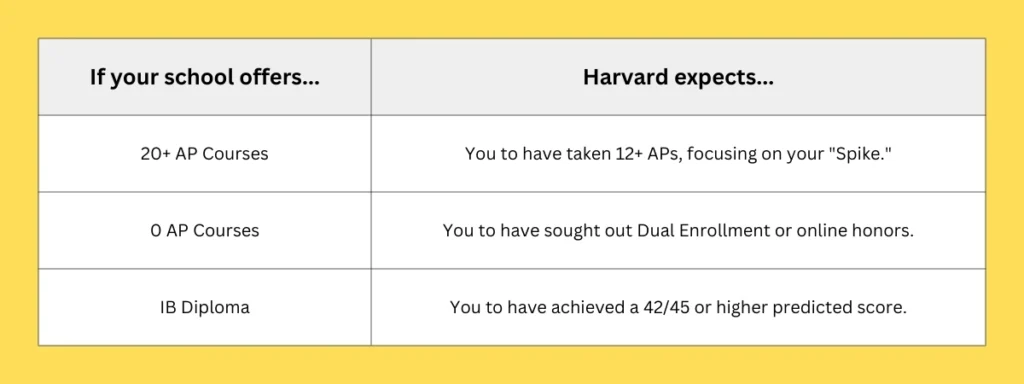
The “Contextual Excellence” Metric
Harvard uses a proprietary tool (often compared to the College Board’s “Environmental Context Dashboard”) to see your stats in the context of your school’s resources.
| If your school offers… | Harvard expects… |
| 20+ AP Courses | You to have taken 12+ APs, focusing on your “Spike.” |
| 0 AP Courses | You to have sought out Dual Enrollment or online honors. |
| IB Diploma | You to have achieved a 42/45 or higher predicted score. |
Beyond the Numbers: The “Academic Spike”
A 4.0 GPA is a “flat” stat. To make it “pointy,” you need Validation Beyond the Classroom.
- AIME/AMC: For math-heavy profiles, reaching the AIME (American Invitational Mathematics Examination) is a massive boost.
- Writing Competitions: For humanities, a “Gold Key” from Scholastic or a win in the John Locke Institute essay competition acts as external proof of your GPA’s validity.
- Dual Enrollment: Taking “Multivariable Calculus” or “Organic Chemistry” at a local community college because you exhausted your high school’s curriculum is the ultimate sign of Intellectual Vitality.
Strategic Advice
Stop the “AP Arms Race”: Do not take AP Art History if you are a pre-med student just to have “one more AP.” Instead, take the core 8-10 APs and spend that extra time on a Research Project or a Clinical Internship. In 2026, Harvard prefers “Rigor with Purpose” over “Rigor for the sake of Rigor.”
The Final Piece: Letters of Recommendation (LORs)
In the 2026 “Holistic Plus” model, LORs are the only way Harvard can verify your character. A “1” rated LOR doesn’t say “This student got an A.” It says, “This student is the most brilliant mind I have encountered in 25 years of teaching.”
Strategy: Meet with your teachers in the spring of 11th grade. Provide them with a “Brag Sheet” that highlights your Intellectual Vitality projects. Remind them of specific moments where you challenged a concept or helped a peer.
Conclusion
Harvard isn’t looking for the best student in your high school; they are looking for the best student for their global community. Your profile must tell a story of someone who has already changed their corner of the world and needs Harvard’s resources to change the rest of it. Ultimately, Profile Building for Harvard is the art of narrative synthesis – presenting a verifiable history of someone who has already mastered their environment and is poised to scale that influence globally.
FAQs
Is Harvard only for perfect students?
No. It is for exceptional students with impact and authenticity.
What is the “Intellectual Vitality” (IV) requirement I keep hearing about?
Intellectual Vitality is an internal Harvard metric that measures your hunger for learning. In the AI era, Harvard looks for students who don’t just “do the homework” but pursue knowledge independently.
Pro-Tip: Evidence of IV includes original research, self-taught coding languages, or deep-dive philosophical inquiries documented in your portfolio.
Which is better for Profile Building for Harvard: 15 AP classes or a major Research Project?
In 2026, the Research Project wins. Once you have taken the “Core” APs (usually 8-10), the marginal utility of the 11th or 12th AP is low. Harvard prefers you use that time to create a “Legacy Project” or original work that demonstrates Quality of Impact (QoI).
Can I get into Harvard if I have a 3.8 GPA but a world-class “Spike”?
It is possible, but difficult. Harvard rarely admits students with a “3” Academic Rating unless they have a “1” in another category (like being an Olympic athlete or a world-renowned activist). If your GPA is lower due to a specific hardship, use the “Additional Information” section to explain the context.
Suggested Post
How to study abroad for free
Massachusetts Institute of Technology
Harvard University fees in Indian rupees
University of California, Los Angeles