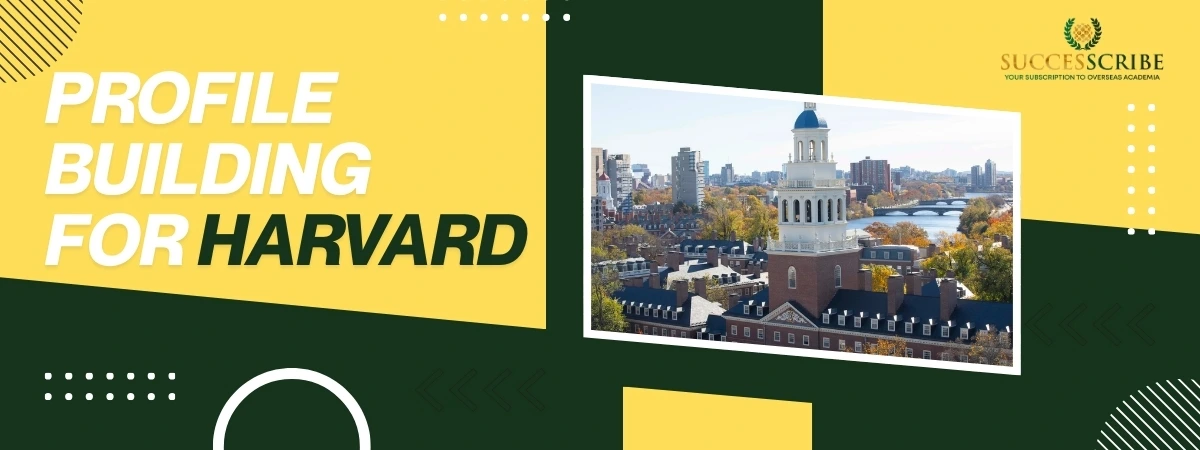
In the 2026 admissions cycle, “Profile Building” is no longer an optional enhancement; it is a deliberate, multi-year strategic journey. In a landscape where high GPAs and test scores have become commoditized – representing the baseline for entry rather than the differentiator – your profile is your “Human Brand.” It is the qualitative evidence that moves you from a set of statistics to a compelling individual who will contribute to the vibrant ecosystem of a top-tier American university. Profile Building Bachelors in USA has become a decisive factor in the 2026 admissions cycle, where universities evaluate students beyond grades to understand their intellectual curiosity, leadership potential, and real-world impact.
Key Highlights: Profile building Bachelors in USA
- Why Marks Alone No Longer Secure Top U.S. Universities
- How American Universities Review Applicants Holistically
- Academic Rigor & Curriculum Choices That Impress U.S. Universities
- How to Use Test Scores as a Competitive Advantage
- Extracurricular Activities (ECAs): Depth Over Breadth
- Professionalism in High School: Internships and Research
- How Strong LORs Strengthen U.S. Bachelor’s Applications
- Writing Essays That USA Admissions Officers Remember
- Timeline for Building a Winning U.S. Bachelor’s Profile
- Ivy League vs Public Universities: Profile Expectations Compared
- Errors That Can Weaken Your U.S. Bachelor’s Application
- Special Considerations for International Students
- Conclusion
- FAQs
Want to Study in Europe?
Start your journey with Successcribe’s free expert guidance
Book a Free Session NowWhy Marks Alone No Longer Secure Top U.S. Universities
We are currently witnessing the diminishing marginal utility of high marks alone. While academic achievement remains the cornerstone of any application, the 2026 reality is characterized by “academic parity” among thousands of applicants. Securing a spot at a “promising” or “top” university requires shifting focus from mere achievement to Intellectual Exploration and Personal Growth.
- Academic Achievement vs. Intellectual Exploration: Grades show diligence; exploration shows the ability to apply knowledge. Universities today prioritize students who seek research opportunities and independent studies that demonstrate curiosity.
- The Narrative over the Number: A strong profile paints a narrative of your interests. While grades can get you into “any” university, only a strategic profile secures admission to elite institutions and unlocks significant merit-based scholarship opportunities.
In the modern admissions landscape, Profile Building for Bachelors in USA outweighs grades alone, as universities seek students who demonstrate exploration, initiative, and purpose beyond academic numbers.
How American Universities Review Applicants Holistically
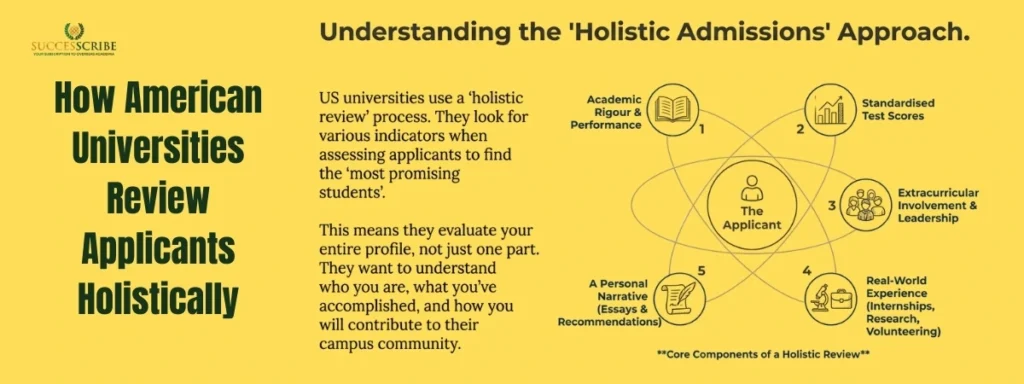
U.S. admissions committees employ a “Holistic Evaluation” framework, a mindset that views the applicant as a whole person. They are not simply looking for students; they are looking for community members.
The Pillars of Holistic Review:
- Academic Rigor: The difficulty of your curriculum relative to your environment.
- Standardized Test Scores: Quantitative validation of college readiness.
- Extracurricular Activities (ECAs): Evidence of passion, commitment, and time management.
- Leadership and Social Impact: Proof of initiative and the ability to drive change.
- Personal Narrative: The “why” behind your journey, articulated through essays and third-party validation.
| Profile Category | Key Components | Success Criteria | Timeline(Advised) | Impact on Admission | Consultant Recommendations |
| Academic Foundation | GPA, 10th-12th grade marks, AP/IB coursework | GPA 3.0 – 4.0; consistent high marks; rigour through Advanced Placement (AP) or International Baccalaureate (IB) courses | Grade 9 or 10 onwards | Foundational cornerstone; demonstrates readiness for college-level study | Add AP courses related to your future degree to show dedication; maintain a virtuous academic record to showcase diligence. |
| Personal Branding & Documentation | Statement of Purpose (SOP), Letters of Recommendation (LOR), Personal Essays | Authentic, engaging narrative; unique story; strong vocabulary; no grammatical errors | August/September of application year | Allows applicant to shine beyond grades; critical document for evaluation | Be yourself and share your unique story; avoid generic statements; seek feedback from mentors for clarity. |
| Extracurricular Activities | Clubs, sports, music, art, student council, hobby development | Depth over breadth; quality over quantity; long-term commitment and meaningful impact | Start early (Grade 9 or 10) | Differentiates candidate; showcases well-roundedness and time management | Quality beats quantity; focus on activities you are genuinely passionate about where you can make a meaningful impact. |
| Leadership Roles | Club president, captaincy, project lead, organising events | Demonstrated initiative, responsibility, and ability to motivate others | High school years | Indicates proactive individual likely to contribute to the campus community | Take on leadership roles in existing clubs or create your own initiatives to show you are a take-charge person. |
| Standardized Testing | SAT, ACT, AP exams | Average scores of target universities or higher; high scores can compensate for lower grades | High school (Grade 11/12) | Critical for measuring college readiness; improves scholarship opportunities | Research average scores of target universities and aim to exceed them; prep diligently to boost the overall profile. |
| Community Service | Volunteering, NGO work, social initiatives | Volunteering, NGO work, social initiatives | Ongoing throughout high school | Reflects positively on character and compassionate nature | Document work highlighting specific achievements; reflect on how it shaped your perspective. |
| Professional Experience | Internships, part-time jobs, work experience | Experience relevant to the intended major; hands-on practice | Undergraduate or senior high school | Shows maturity, responsibility, and professional interest; provides a competitive edge | Intern at a space that challenges you and relates to your field of study to gauge interest. |
| English Proficiency | IELTS, TOEFL, PTE, Duolingo English Test | High scores to boost application and meet university-specific requirements | Grade 11 or 12 | Mandatory requirement for international students; ensures student can handle medium of instruction | Engage in reading books and watching English media to improve fluency; take practice tests for high scores. |
Academic Rigor & Curriculum Choices That Impress U.S. Universities
A strong GPA supported by academic rigor forms the backbone of Profile Building Bachelors in USA, proving a student’s readiness for college-level challenges. Academic rigor is the primary litmus test for college readiness. In 2026, admissions officers look for students who have maxed out the opportunities available to them.
Curriculum Comparison & Strategic Value
| Curriculum | Strategic Advice & Admission Impact |
| IB (International Baccalaureate) | Highly regarded for its breadth and the “Extended Essay,” which mirrors college-level research. |
| Advanced Placement (AP) | Proves the ability to handle university-level rigor. Note: US students often start APs in 9th Grade; starting early provides a distinct competitive edge. |
| CBSE / ISC | Valued for foundational depth; requires consistent high performance (Class 9–12) to prove stability. |
| A-Levels | Recognized for deep specialization; best for students with a clear major-specific focus. |
GPA Expectations and Consistency
- The 3.0 – 4.0 Range: Most competitive universities expect a GPA within this bracket.
- Grade Trends: Committees look for “Consistent Grades” from Class 9–12. A rising trend can salvage a weak start, but a late-stage dip is a major red flag.
- The AP Advantage: Beyond college credits, AP courses serve as a signal to committees that you are ready for high-level study.
How to Use Test Scores as a Competitive Advantage
In a “Test-Optional” world, submitting a high score is a powerful Unique Selling Point (USP). It acts as a voluntary signal of academic rigor, especially for students coming from schools with high grade inflation.
| Test Type | Purpose | High-Impact Range |
| SAT | Scholastic Aptitude | 1450 – 1600 |
| ACT | Academic Achievement | 32 – 36 |
| IELTS / TOEFL | English Proficiency | 7.5+ / 105+ |
For competitive majors like Engineering or CS, a high SAT/ACT score is nearly mandatory to compensate for lower grades or to secure merit-based scholarships.
Extracurricular Activities (ECAs): Depth Over Breadth
“Quality beats quantity every time.” Admissions committees are wary of “bucket-filling” – the practice of listing ten shallow activities. They prefer a “Spike” – an extraordinary talent or commitment in one or two areas.
Meaningful extracurricular involvement strengthens Profile Building Bachelors in USA by showcasing passion, time management, and sustained commitment.
High-Impact ECA Categories
- Leadership Roles: Moving beyond titles to “taking charge.” Whether it’s student council or founding a club, impact must be measurable.
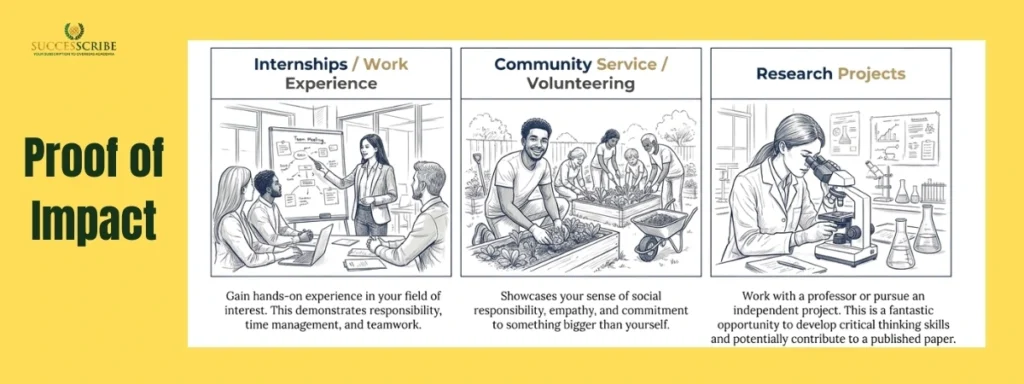
- Community Service: Long-term commitment to social impact (e.g., sustainable energy projects) is far superior to one-off volunteering events.
- Passion Projects: Startups, independent coding projects, or blogs that show you are self-directed.
- Olympiads & Competitions: National or international recognition provides objective proof of excellence
Extracurricular Strength Mapping
| Activity Type | Character Traits Demonstrated | Strategic Value |
| Competitive Sports | Resilience, Teamwork | High (if leadership is shown) |
| Independent Research | Intellectual Curiosity | Very High (for STEM/Ivy targets) |
| Social Entrepreneurship | Initiative, Problem Solving | Maximum (shows “Human Brand”) |
| Olympiads | Subject Mastery | High (for technical rigor) |
Professionalism in High School: Internships and Research
Real-world experience is the ultimate “gap-closer.” It proves that you can translate theoretical knowledge into professional impact.
- Professional Internships: Internships at top-tier firms or startups demonstrate responsibility.
- Research & Publication: Writing research papers on surging technologies (AI, Blockchain) and publishing them in peer-reviewed journals marks you as a scholar.
- Technical Workshops: Participation in seminars conducted by prestigious bodies like IEEE or IETE, or programs at IITs/NITs, adds institutional weight to your profile.
How Strong LORs Strengthen U.S. Bachelor’s Applications
The LOR is a third-party validation of your character. It provides the “integrity” check for your application.
- Who Should Write Them: Ideally, a Counselor, Principal, and two Subject Teachers who have observed your growth over time.
- The Expectation: Universities want specific examples of your leadership and academic advancements, not generic praise.
- Integrity: Ensure your LORs provide a unique perspective that complements your SOP without repeating it verbatim.
Writing Essays That USA Admissions Officers Remember
In an era of AI-generated content, authenticity is the only currency that matters. Your SOP is where you “paint a narrative” of your life.
- Personal Statement: Focus on your unique story, challenges overcome, and your voice.
- Supplemental Essays: These must demonstrate a deep “connection to the university” – how you will use their specific resources to achieve your goals.
- The Professional Tone: Use a strong vocabulary and flawless grammar to convey maturity, but ensure the narrative remains grounded in your actual experiences.
Timeline for Building a Winning U.S. Bachelor’s Profile
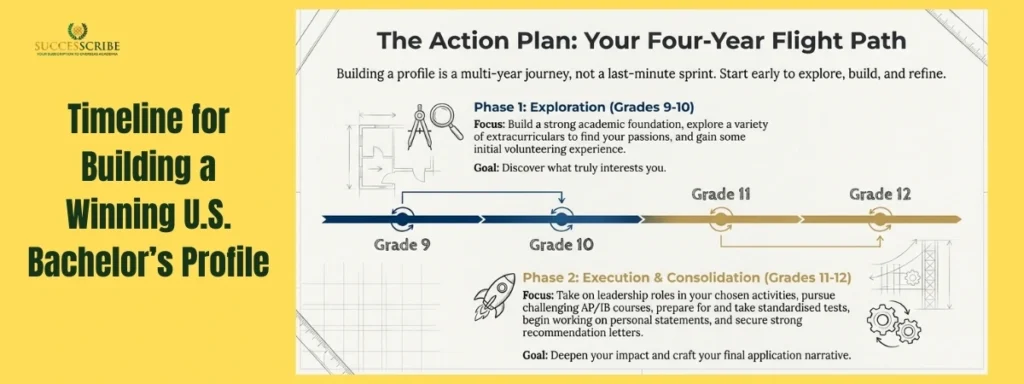
A winning profile requires an early start. Class 9 is the ideal baseline to allow for the exploration phase. Early planning ensures effective Profile Building for Bachelors in USA, enabling students to grow gradually rather than rushing achievements.
| Grade | Strategic Focus |
| Class 9 | Exploration: Develop hobbies, begin AP exploration, and maintain a baseline GPA. |
| Class 10 | Foundation: Secure high board marks; identify intended majors; start skill certifications (Coursera/edX). |
| Class 11 | Execution: Take leadership roles; standardized test prep; summer school; research projects. |
| Class 12 | Finalization: High-level internships; finalize portfolio/essays; early application submission. |
Ivy League vs Public Universities: Profile Expectations Compared
Profile requirements shift drastically based on the selectivity and type of the institution.
| Feature | Ivy League / Elite Private | Large Public Universities (e.g., Purdue, UC) |
| Acceptance Rate | Extremely low (<10%). | Higher, but major-dependent. |
| Profile Style | Seeks a “Spike” (extraordinary talent). | Seeks “Well-Rounded” excellence. |
| STEM Strategy | Focus on Research, IEEE/IETE workshops, Olympiads. | High GPA/SAT + relevant internships. |
| Non-STEM Strategy | Social impact, creative portfolios, leadership. | Diverse ECAs + strong communication skills. |
Errors That Can Weaken Your U.S. Bachelor’s Application
Avoiding academic, extracurricular, and application errors is essential to protect the credibility of Profile Building for Bachelors in USA.
1. Academic Mistakes
- Focusing solely on GPA while ignoring course rigor – A 4.0 GPA in easy courses is less impressive than a 3.8 GPA in the most challenging courses available
- Dropping difficult courses senior year – Admission officers notice and question your commitment
- Neglecting standardized test preparation – Even at test-optional schools, strong scores help
- Ignoring demonstrated interest – Some universities track campus visits, email engagement, and interview attendance
2. Extracurricular Mistakes
- Resume padding – Listing activities with minimal involvement is obvious and counterproductive
- Starting activities only in junior or senior year – Sustained commitment matters more than last-minute additions
- Only doing activities that “look good” – Passion and genuine interest are apparent in applications
- Neglecting summer experiences – Three summers represent over 20% of your high school years.
3. Application Mistakes
- Applying only to highly selective universities – Build a balanced list with safety, match, and reach schools
- Generic essays – Recycling the same essay for multiple “Why this university” prompts is noticeable
- Submitting applications on deadlines – Technical issues can prevent submission; aim for 2-3 days early
- Not reviewing applications – Typos and errors suggest carelessness.
Special Considerations for International Students
International applicants must approach Profile Building Bachelors in USA strategically by balancing academics, cultural awareness, and global exposure.
1. Demonstrating English Proficiency
Most universities require TOEFL or IELTS scores from international students. Minimum competitive scores:
- TOEFL iBT: 100+ (top universities), 80-90 (most universities)
- IELTS: 7.0+ (top universities), 6.5 (most universities)
- Duolingo English Test: 120+ (increasingly accepted)
Some universities waive this requirement for students from English-speaking countries or those who’ve studied in English-medium schools for 3+ years.
2. Demonstrating Cultural Engagement
International students should showcase understanding of both their home culture and interest in American higher education:
- Explain how your background provides unique perspectives
- Demonstrate knowledge of the American university system
- Show how you’ll contribute to campus diversity
- Highlight cross-cultural experiences and adaptability
3. Visa and Documentation
F-1 student visa requires acceptance from a SEVP-certified institution and proof of financial resources to cover all expenses. Processing can take 8-12 weeks, so plan accordingly.
4. Building Your Digital Presence
In 2026, 47% of admission officers report reviewing applicants’ online presence.
Professional Online Profiles
- LinkedIn profile highlighting academic and extracurricular achievements
- Personal website or portfolio (especially for arts, computer science, journalism)
- GitHub account (for computer science students)
- Published writing or research (Google Scholar profile)
Social Media Caution
- Make profiles private or ensure all content is appropriate
- Avoid controversial political or offensive content
- Remember that deleted content may still be accessible
Conclusion
A winning profile for the 2026 cycle is an authentic story of growth and impact. It is not a checklist of prestigious titles but a demonstration of how you use your unique talents to solve problems and explore your interests. By starting early, focusing on quality over quantity, and maintaining academic rigor, you can craft a narrative that elite institutions simply cannot ignore. Your journey to a world-class education begins with the strategic step you take today. Successful Profile Building Bachelors in USA is not about perfection but about purpose, impact, and authenticity demonstrated consistently over time.
FAQs
What does profile building mean for a Bachelor’s degree in the USA?
Profile building refers to the overall development of a student’s academic record, extracurricular activities, leadership roles, internships, projects, essays, and personal achievements to strengthen their undergraduate application for US universities. It goes far beyond marks and focuses on who the student is as an individual.
When should students start profile building for Bachelor’s in the USA?
Ideally, profile building should start from Class 9 or Grade 9. Early planning allows students to:
1. Explore interests
2. Build long-term extracurricular involvement
3. Take leadership roles
4. Develop impactful projects
However, even students in Class 11 or 12 can still improve their profiles with proper strategy.
What type of extracurricular activities are valued by US universities?
US universities value quality over quantity. High-impact activities include:
1. Leadership roles (club president, founder)
2. National or international competitions
3. Sports at competitive levels
4. Long-term volunteering or social impact projects
5. Passion-driven personal initiatives
Consistency and impact matter more than certificates.
Is volunteering compulsory for US college admissions?
Volunteering is not compulsory, but it is highly valued if it shows:
1. Genuine commitment
2. Long-term involvement
3. Social responsibility and leadership
Admissions officers can easily identify forced or short-term volunteering.
How does profile building differ for STEM and non-STEM majors?
Profile building depends on the chosen major:
1. STEM students should focus on research, competitions, projects, and technical skills
2. Non-STEM students should highlight creativity, writing, debates, leadership, and social initiatives
Profiles must align with the intended field of study.
Related Post
Highly demanded jobs in Germany
Exams required to study in USA
Executive MBA in USA
Dental hygienist course in USA