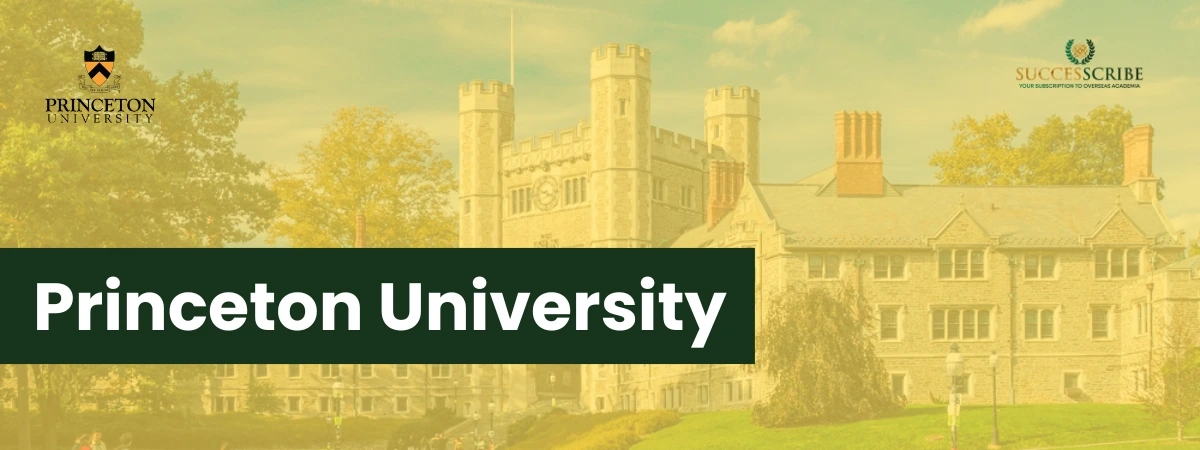
Princeton University is one of the world’s most prestigious and selective institutions of higher education. Located in Princeton, New Jersey, USA, the university is a proud member of the Ivy League, a group of eight elite private universities in the United States known for academic excellence, global reputation, and highly competitive admissions. Founded in 1746, Princeton University is the fourth-oldest university in the United States and has consistently ranked among the top 10 universities globally. The university is especially renowned for its strength in undergraduate education, world-class research output, distinguished faculty, and an unmatched commitment to financial aid and accessibility.
Key Highlights: Princeton University
- History of Princeton University
- Ranking and Reputation of Princeton University
- Admission Acceptance Rate & Selectivity at Princeton University
- Admission Requirements at Princeton University
- Faculties, Schools, and Academic Departments: Princeton University
- Top Courses and Highly Ranked Programs at Princeton University
- Cost of Studying at Princeton University
- Scholarships & Financial Aid for International Students at Princeton University
- Notable Alumni of Princeton University
- Career Outcomes & Employment Statistics: Princeton University
- Conclusion
- FAQs
Want to Study in Europe?
Start your journey with Successcribe’s free expert guidance
Book a Free Session NowHistory of Princeton University
Princeton University has a rich and influential history spanning nearly 280 years, deeply intertwined with the intellectual, political, and scientific development of the United States.
Founding and Early Years
Princeton University was founded in 1746 as the College of New Jersey in Elizabeth, New Jersey. The institution was established to train ministers but quickly evolved into a center for liberal education and leadership.
In 1756, the college moved to Princeton, New Jersey, where Nassau Hall – one of the oldest academic buildings in the U.S – became its iconic centerpiece. For a brief period in 1783, Nassau Hall even served as the capital of the United States, making Princeton the only university to have housed the U.S. government.
Transition to Princeton University
In 1896, the institution officially adopted the name Princeton University, reflecting its expanded mission in teaching, research, and global scholarship.
| Year | Milestone |
| 1746 | Founded as the College of New Jersey |
| 1756 | Relocated to Princeton, NJ |
| 1783 | Served as U.S. capital |
| 1896 | Renamed Princeton University |
| 1969 | Became coeducational |
| 2001 | Introduced the no-loan financial aid policy |
Over the centuries, Princeton has educated U.S. Presidents, Supreme Court Justices, Nobel Laureates, economists, scientists, and global leaders, cementing its status as a cornerstone of global higher education.
Ranking and Reputation of Princeton University
Princeton University enjoys an extraordinary global reputation as one of the most academically rigorous and intellectually influential universities in the world. Its consistent top-tier rankings across national, global, and subject-specific league tables reflect not only academic excellence but also teaching quality, research impact, faculty distinction, and graduate outcomes.
Unlike many large research universities, Princeton is especially praised for combining elite research output with an unmatched undergraduate teaching focus, a rare balance that significantly enhances its academic standing.
Global University Rankings
Princeton University continues to rank among the top 20 universities worldwide, according to the most respected international ranking bodies.
| Ranking Organization | 2025–26 Position | Evaluation Focus |
| QS World University Rankings 2025 | Top 20 globally | Academic reputation, employer reputation, research impact |
| Times Higher Education (THE) World Rankings 2025 | Top 10 globally | Teaching, research quality, citations, international outlook |
| U.S. News Global Universities Ranking | Top 10 worldwide | Global research reputation and publications |
| U.S. News National Universities (USA) | #1 in the United States | Undergraduate teaching, faculty resources, outcomes |
Princeton has held the #1 position among U.S. national universities for more than a decade, a distinction unmatched by most Ivy League peers.
Subject-wise Rankings and Academic Strengths
Princeton University is internationally recognized for exceptional performance across multiple academic disciplines, particularly in fields that emphasize analytical thinking, theory, and research excellence.
Highly Ranked Subjects (Global)
| Discipline | Global Standing |
| Economics | Top 3 worldwide |
| Mathematics | Top 5 worldwide |
| Physics | Top 5 worldwide |
| Public Policy & International Affairs | Top 10 |
| Computer Science | Top 20 |
| Engineering | Top 20 |
| History & Philosophy | Top 10 |
Princeton’s Economics Department is often regarded as the best in the world, producing Nobel Prize winners and influential policy advisors. Similarly, its Mathematics and Physics departments are globally dominant, particularly in theoretical research.
Reputation Among Employers
According to global employer surveys:
- Princeton graduates are among the top 10 most employable graduates worldwide
- Alumni are highly sought after in finance, consulting, technology, academia, and public policy
Admission Acceptance Rate & Selectivity at Princeton University
Princeton University is globally recognized as one of the most selective universities in the world, with an admissions process designed to identify students who demonstrate exceptional academic ability, intellectual depth, leadership potential, and personal integrity.
Every year, tens of thousands of highly qualified applicants from across the globe compete for a very limited number of seats, making admission to Princeton not only prestigious but extraordinarily competitive.
Overall Acceptance Rate (Latest Data)
For the Class of 2029 (Fall 2025 intake), Princeton University received more than 39,000 applications for undergraduate admission. Out of these, fewer than 1,700 students were offered admission.
| Admission Cycle | Total Applicants | Students Admitted | Acceptance rate |
| Class of 2027 | 38,000 | 1,600 | 4.2% |
| Class of 2028 | 39,200 | 1,700 | 4.3% |
| Class of 2029 (Est.) | 39,500+ | 1,700+ | 4.3% |
This means that more than 95% of applicants are rejected, highlighting the extreme selectivity of Princeton University.
Acceptance Rate by Application Type
Princeton offers Single-Choice Early Action (SCEA), which allows students to apply early without committing.
| Application Round | Acceptance Rate |
| Single-Choice Early Action | 7 – 8% |
| Regular Decision | 3 – 4% |
| Overall | 4.3% |
While early applicants face slightly higher acceptance rates, Princeton emphasizes that academic standards remain equally rigorous across both rounds.
Selectivity for International Students
Admission for international applicants is even more competitive, as Princeton seeks to maintain a globally diverse yet academically elite student body.
| Category | Acceptance Rate |
| U.S. Domestic Applicants | 4.5% |
| International Applicants | 3–4% |
International students typically represent 12–14% of the undergraduate population, drawn from over 120 countries.
Why Princeton Is Highly Selective
Princeton evaluates applicants using a holistic admissions process, considering:
- Academic excellence
- Intellectual curiosity
- Leadership potential
- Community impact
- Personal character
Unlike many universities, Princeton places exceptional emphasis on academic rigor and scholarly depth, especially in mathematics, sciences, and humanities.
Apply to Top European Universities
Make your application simple and stress-free with Successcribe
Get Expert Help NowAdmission Requirements at Princeton University
Princeton University follows one of the most rigorous and holistic admissions processes in global higher education. The university seeks students who demonstrate exceptional academic ability, intellectual curiosity, leadership potential, and personal integrity. Admission decisions are made after a comprehensive evaluation of each applicant’s academic achievements, personal background, and future potential.
Princeton is need-blind for both domestic and international students, meaning financial circumstances do not influence admission decisions.
Undergraduate (Bachelor’s) Admission Requirements
Princeton University offers a limited number of undergraduate places each year, making its Bachelor’s admissions process extremely competitive.
Academic Qualifications
Applicants are expected to have an outstanding high school academic record, typically ranking among the top 5–10% of their graduating class.
High School Coursework:
Princeton does not have strict course requirements but strongly recommends:
- 4 years of English
- 4 years of Mathematics (through calculus for engineering applicants)
- 4 years of a single foreign language
- At least 2 years of laboratory science (physics and chemistry for engineering)
- 2 years of history
Preferred academic background includes:
- Advanced coursework in Mathematics, Science, Humanities, and Social Sciences
- AP, IB, A-Levels, or equivalent national curriculum
- Consistent academic excellence across Grades 9–12
Standardized Test Requirements
Princeton University has reinstated standardized testing requirements.
| Test | Requirement | Competitive Range |
| SAT | Required | 1500–1580 |
| ACT | Required | 34–36 |
More than 85% of admitted students score above the 95th percentile, reflecting Princeton’s strong academic expectations.
English Language Proficiency (International Students)
All non-native English speakers must demonstrate English proficiency.
| Test | Minimum Score | Recommended Score |
| IELTS Academic | 7.5 | 8.0 |
| TOEFL iBT | 100 | 105+ |
| PTE Academic | 70 | 75+ |
Students studying in English-medium schools may be exempt, subject to admission review.
Required Application Components (Bachelor’s)
| Component | Details |
| Application Platform | Common Application |
| Personal Essay | Required |
| Princeton Supplemental Essays | Required |
| Letters of Recommendation | 2 teachers + 1 counselor |
| School Report | Mandatory |
| Extracurricular Activities | Strongly evaluated |
| Interview | Optional (subject to availability) |
Princeton places special emphasis on depth of extracurricular involvement, leadership roles, and community contribution rather than the number of activities.
Master’s Degree Admission Requirements
Princeton’s Graduate School encompasses 46 degree-granting departments and programs, offering highly selective Master’s programs in specific fields. Unlike many universities, Princeton primarily focuses on doctoral education, with Master’s programs available in architecture, engineering, finance, public affairs, and public policy. The Graduate School awards over 600 advanced degrees annually.
Important Note: Princeton does not offer an MBA program. Master’s programs are limited to specific professional and research-focused fields.
Master’s Programs Offered
Princeton offers Master’s degrees in the following areas:
Master of Arts (M.A.):
- Near Eastern Studies
- Various humanities and social sciences departments (terminal or en route to Ph.D.)
Master of Architecture (M.Arch):
- Architecture (professional degree)
Master of Engineering (M.Eng):
- Chemical and Biological Engineering
- Civil and Environmental Engineering
- Electrical and Computer Engineering
- Mechanical and Aerospace Engineering
Master of Science in Engineering (M.S.E.):
- Computer Science
- Operations Research and Financial Engineering
Master in Public Affairs (M.P.A.):
- Princeton School of Public and International Affairs
- Two-year professional program
Master in Public Policy (M.P.P.):
- Princeton School of Public and International Affairs
- One-year accelerated program
Master in Finance (M.Fin.):
- Bendheim Center for Finance
- Two-year quantitative finance program
General Admission Requirements for Master’s Programs
Education Background
| Requirement | Details |
| Bachelor’s Degree | Required from accredited institution (or international equivalent) |
| Minimum Duration | At least 3-4 years of full-time study |
| Minimum GPA | 3.0 on 4.0 scale (competitive applicants: 3.5+) |
| Field of Study | Relevant undergraduate major preferred but not always required |
Standardized Testing Requirements
| Program Type | GRE Requirement |
| Most Master’s Programs | Required |
| Computer Science MSE | Required (General Test) |
| Engineering Programs | Required (General Test) |
| Public Affairs/Policy | Required (General Test) |
| Finance | Required (General Test) |
| Some Ph.D. Programs | Optional or required (varies by department) |
Recommended competitive score: 298+ combined (some programs: 310+)
English Language Proficiency
Required for:
- All applicants whose primary language is not English
- Applicants who did not complete undergraduate education in English
Exemptions:
- Applicants who completed full undergraduate education where English is the language of instruction
- Applicants with at least 2 years of full-time graduate study in English
| Test | Minimum Overall Score | Speaking Section Requirement |
| IELTS Academic | 7.0+ | 7.0+ in speaking |
| TOEFL iBT | 100+ (competitive: 105+) | 28 (for Computer Science MSE) |
Application Components for Master’s Programs
| Component | Details | Notes |
| Online Application | Via Graduate School portal | One application per year to one program only |
| Application Fee | $75 | Fee waivers available based on financial need |
| Transcripts | Official transcripts from all post-secondary institutions | Upload unofficial copies; official required if admitted |
| Statement of Purpose | 1,000-2,000 words | Explain research interests, career goals, fit with program |
| Personal Statement | Varies by program | Some programs require separate diversity statement |
| Three Letters of Recommendation | Academic or professional recommenders | At least two should be from professors who know your work |
| Resume/CV | Current and comprehensive | Include research, publications, work experience |
| GRE Scores | Official scores | Self-reporting acceptable initially |
| Writing Sample | Required for some programs | 10-25 pages of academic writing |
| English Proficiency Test | TOEFL/IELTS/DET (if applicable) | Official scores required |
Faculties, Schools, and Academic Departments: Princeton University
Princeton University is distinct for its “one faculty” model: the same professors who conduct groundbreaking research also teach undergraduate courses. This ensures that even freshmen have access to Nobel laureates and world-class experts. Princeton’s academic landscape is organized into four main divisions encompassing 37 undergraduate concentrations and 47 graduate departments.
The Four Academic Divisions
Most academic life at Princeton flows through these four pillars. While students focus on a specific major (concentration), the liberal arts curriculum encourages cross-divisional exploration.
| Division | Primary Focus | Notable Departments |
| Humanities | Cultural, historical, and philosophical inquiry. | Philosophy, Classics, Comparative Literature, Art & Archaeology. |
| Social Sciences | Human behavior and societal structures. | Economics, Politics, Sociology, Anthropology. |
| Natural Sciences | The physical and biological world. | Physics, Molecular Biology, Astrophysical Sciences, Chemistry. |
| Engineering & Applied Science | Innovation and practical problem-solving. | Computer Science, Bioengineering, Electrical & Computer Engineering. |
Professional Schools & Specialized Institutes
Unlike its peers, Princeton does not have a Law, Medical, or Business school. Instead, it focuses on specialized professional training in areas that align with its “Service to Humanity” mission.
- School of Engineering and Applied Science (SEAS): Known for a uniquely interdisciplinary approach, it offers the B.S.E. degree. In 2025, it has expanded its focus on Quantum Science and AI Safety.
- Princeton School of Public and International Affairs (SPIA): A global leader in policy education. Undergraduates and graduates here focus on solving complex domestic and international challenges.
- School of Architecture: Consistently ranked among the world’s best, it offers a rigorous four-year A.B. program and professional graduate degrees.
- The Graduate School: Oversees all doctoral and master’s programs, ensuring a standardized high bar for academic rigor across all disciplines.
Academic Environment at Princeton
What distinguishes Princeton academically is:
- A 5:1 student–faculty ratio
- Strong culture of independent research
- Faculty-led mentorship from the first year
- Integration of teaching and research
Princeton’s academic structure encourages intellectual depth rather than breadth, ensuring students develop expertise while benefiting from interdisciplinary exposure.
Top Courses and Highly Ranked Programs at Princeton University

Princeton University is internationally renowned for offering academically rigorous and research-intensive programs across the humanities, social sciences, natural sciences, engineering, and public policy. The university’s curriculum emphasizes theoretical depth, critical thinking, and original research, making its programs among the most respected in the world.
Princeton consistently ranks at the top globally in several disciplines, particularly in fields that require strong analytical, quantitative, and conceptual foundations.
The Core Powerhouses: Top 5 Majors
While Princeton offers 37 concentrations, the following five are the most sought-after, attracting over 50% of the student body.
| Program | National Rank (2025) | Key Attribute |
| Computer Science | #6 | Focuses heavily on AI, Robotics, and Theory. |
| Economics | #1 | Includes the world-renowned Bendheim Center for Finance. |
| Public Policy (SPIA) | #1 | Quantitative approach to global social and political issues. |
| Operations Research | #2 | A blend of math, engineering, and financial modeling. |
| History | #9 | Renowned for archival research and global perspectives. |
Highly Ranked Specialized Programs
Beyond the popular majors, Princeton holds several “World #1” or “National Top 3” spots in specialized disciplines.
- Mathematics: Consistently ranked #1 in the world by the Shanghai (ARWU) rankings. The department is a global hub for Fields Medalists.
- Physics: Ranked #10 globally (QS 2025), it is famous for its work in Quantum Science and Plasma Physics.
- Philosophy: Often ranked as the #1 or #2 department in the U.S., focusing on ethics and political philosophy.
- Bioengineering: A rapidly growing field at Princeton, benefiting from the new state-of-the-art facilities in the School of Engineering.
Cost of Studying at Princeton University
Princeton University is widely recognized for having one of the most transparent and generous financial models in higher education. While the “sticker price” of an Ivy League education is substantial, Princeton’s need-blind admission and no-loan financial aid policies ensure that the actual cost for most students is significantly lower than the listed price.
For the 2025-2026 academic year, the university has released a standard budget that accounts for tuition, housing, dining, and estimated personal expenses.
Estimated Undergraduate Budget
The following table breaks down the direct and indirect costs for a typical first-year or sophomore student.
| Expense Category | Annual Estimated Cost (USD) |
| Tuition | $65,210 |
| Housing | $12,450 |
| Food (Meal Plan) | $8,720 |
| Required Fees | $300 |
| Books & Personal Expenses | $4,050 |
| Total Estimated Budget | $90,730 |
For the 2026-2027 cycle, the total estimated cost is projected to rise to approximately $94,624 due to inflationary adjustments in tuition and housing.
Graduate Student Costs
Graduate costs vary depending on the degree type and enrollment status. For Ph.D. candidates, Princeton typically provides a full funding guarantee that covers 100% of tuition and provides a living stipend.
- Regular Graduate Tuition: $65,210
- Student Health Plan (SHP) Fee: $3,800
- Total Graduate Tuition & Health: $69,010
- Estimated 12-Month Living Expenses: $38,610
Scholarships & Financial Aid for International Students at Princeton University
Princeton University’s financial aid program is widely recognized as one of the most generous and accessible in the world – especially for international students. Unlike many universities that are need-aware for foreign applicants, Princeton is fully need-blind for all applicants (including international students) and meets 100% of demonstrated financial need with grant aid, meaning students do not have to repay the support they receive.
This combination of need-blind admissions and full need-met aid makes Princeton exceptionally welcoming and supportive for talented students from all income levels and nationalities.
The “Need-Blind” Advantage
Most U.S. universities are “need-aware” for international students, meaning they may reject a qualified applicant if that applicant requires too much financial aid. At Princeton, international students are treated exactly like U.S. domestic students.
- Admission Factor: Financial need is never considered during the application review.
- Grant vs. Loan: Princeton does not include loans in its aid packages. International students receive grants, which are essentially “free money” that does not need to be repaid.
- Coverage: Aid can cover not just tuition, but also room, board, books, and personal expenses.
Updated Income Thresholds
The university recently increased its financial aid budget to $327 million to accommodate broader eligibility. Below is the breakdown of what an international family can expect to pay based on their annual income (calculated in USD).
| Annual Family Income (USD) | Estimated Student Contribution | Typical Aid Coverage |
| $0 – $100,000 | $0 | Full Tuition, Room, & Board |
| $100,000 – $150,000 | $0 | Full Tuition & most of Room/Board |
| $150,000 – $250,000 | Varies | 100% Tuition Coverage |
| $250,000+ | Based on Need | Partial Tuition Grants (if applicable) |
Application Requirements for International Students
To be considered for financial aid, international applicants must complete the Princeton Financial Aid Application (PFAA). Princeton does not use the CSS Profile or the FAFSA (which is for U.S. citizens only).
Required Documents:
- PFAA: Completed via the Princeton Applicant Portal after submitting your admission application.
- Income Documentation: Signed copies of your parents’ 2023 national tax returns (translated into English).
- Non-Custodial Parent Form: Required if your parents are divorced or separated.
- Currency Conversion: You must report all figures in your local currency; the financial aid office will handle the conversion based on current exchange rates.
Graduate Student Funding
While undergraduate aid is based on family need, Ph.D. funding at Princeton is merit-based and guaranteed for all students, including international.
- Ph.D. Candidates: 100% of tuition is covered, and a living stipend (approx. $45,000–$50,000) is provided for the duration of the program (usually 5 years).
- Master’s Candidates: Funding varies. However, the School of Public and International Affairs (SPIA) famously provides full tuition and stipends to nearly all its Master’s students to ensure they can enter public service without debt.
Notable Alumni of Princeton University
Princeton University has produced an extraordinary network of alumni who have shaped global politics, science, economics, literature, technology, and public life. With over 95,000 alumni worldwide, Princeton graduates are known for their intellectual depth, leadership, and long-term impact. The university consistently ranks among the top institutions globally for influential alumni per capita.
Political and Public Leaders
Princeton has been a training ground for the architects of modern governance and law.
- James Madison (Class of 1771): The 4th U.S. President and the “Father of the Constitution.”
- Woodrow Wilson (Class of 1879): The 28th U.S. President and Nobel Peace Prize winner; he also served as the President of Princeton.
- Michelle Obama (’85): Former First Lady of the United States, lawyer, and bestselling author.
- Sonia Sotomayor (’76): The first Hispanic Justice of the U.S. Supreme Court. She is joined on the bench by fellow Tigers Samuel Alito (’72) and Elena Kagan (’81).
- John F. Kennedy (Attended): While he later transferred to Harvard due to illness, JFK began his collegiate career in the Princeton Class of 1939.
Tech Titans and Business Visionaries
Princeton’s focus on engineering and independent thinking has produced some of the wealthiest and most disruptive individuals in commerce.
| Alumnus | Class Year | Notable Achievement |
| Jeff Bezos | 1986 | Founder of Amazon and Blue Origin; consistently among the world’s richest individuals. |
| Eric Schmidt | 1976 | Former CEO of Google and Executive Chairman of Alphabet Inc. |
| Meg Whitman | 1977 | Former CEO of eBay and Hewlett-Packard; current U.S. Ambassador to Kenya. |
| MacKenzie Scott | 1992 | Bestselling novelist and one of the world’s leading philanthropists. |
| Joseph Lubin | 1987 | Co-founder of Ethereum and founder of ConsenSys (Blockchain pioneer). |
Career Outcomes & Employment Statistics: Princeton University

Princeton University consistently delivers exceptional career outcomes, reflecting its rigorous academics, strong alumni network, and deep employer trust across industries. Graduates from Princeton are among the most employable in the world, with high placement rates, competitive salaries, and strong representation in leadership, research, and public service roles.
Overall Employment & Graduate School Outcomes
Princeton’s Office of Career Development publishes outcomes based on surveys of graduating students (typically within 6 months of graduation). The results show near-universal success across undergraduate and graduate programs.
| Indicator | Data |
| Overall placement rate (employment + grad school) | 97–98% |
| Graduates employed within 6 months | 62% |
| Graduates pursuing further study | 35% |
| Still seeking / other plans | 2–3% |
| Median starting salary (overall) | USD 85,000–90,000 |
| Median starting salary (STEM & Economics) | USD 95,000–110,000 |
Princeton consistently ranks in the top 10 globally for graduate employability and employer reputation.
Salary Outcomes by Discipline
Princeton graduates consistently command some of the highest starting salaries in the United States. The following table highlights the Median Starting Salary for various concentrations.
| Major/Concentration | Median Starting Salary (USD) | Common Top Employers |
| Computer Science | $128,000 | Google, NVIDIA, OpenAI, Meta |
| Economics / Finance | $92,500 | Goldman Sachs, JP Morgan, Citadel |
| Engineering (B.S.E.) | $98,000 | Tesla, SpaceX, Boeing |
| Public & Int. Affairs | $68,000 | U.S. State Dept, World Bank, McKinsey |
| Natural Sciences | $74,500 | Pfizer, Moderna, NIH |
| Humanities | $62,000 | NY Times, Sotheby’s, Law Firms (Paralegal) |
Graduate School Pipeline
Princeton is a premier feeder for top-tier graduate programs. Approximately 1 in 5 students go directly into advanced study.
- Law Schools: Princeton is a top feeder for Yale Law, Harvard Law, and Stanford Law.
- Medical Schools: The acceptance rate for Princeton applicants to medical school is consistently double the national average, often exceeding 85%.
- Ph.D. Programs: Many students secure prestigious fellowships, such as the Rhodes, Marshall, or Fulbright scholarships, to study at Oxford or Cambridge before pursuing their doctorates.
Conclusion
Princeton University represents academic excellence, global prestige, and lifelong impact. With a history of nearly 300 years, a top 10 global ranking, and an acceptance rate of around 4%, Princeton remains one of the most selective and respected universities in the world for 2026. Its need-blind admissions, 100% demonstrated financial aid coverage, and strong focus on student–faculty interaction (5:1 ratio) make Princeton both elite and accessible. Graduates benefit from 97 – 98% placement rates, median starting salaries of USD 85,000+, and access to one of the world’s most influential alumni networks of 95,000+ leaders, innovators, and changemakers.
FAQs
Where is Princeton University located?
Princeton University is located in Princeton, New Jersey, USA, approximately 1 hour from New York City and 1.5 hours from Philadelphia.
What is Princeton University best known for?
Princeton is best known for its world-class liberal arts education, strong undergraduate focus, research excellence, and leadership in Economics, Public Policy, Computer Science, Engineering, and the Humanities.
What is the acceptance rate at Princeton University?
The acceptance rate is approximately 4%, making Princeton one of the most selective universities in the world.
Does Princeton University accept international students?
Yes. Princeton welcomes students from 150+ countries, with international students making up around 12–13% of the undergraduate population.
What is the cost of studying at Princeton University?
The total annual cost (tuition, housing, meals, and fees) is approximately USD 85,000–90,000 before financial aid.
Related Post
Harvard University fees in Indian rupees
MIT admission requirements for undergraduate
SOP for MS in Computer science in USA
Scholarships for Master’s in the USA