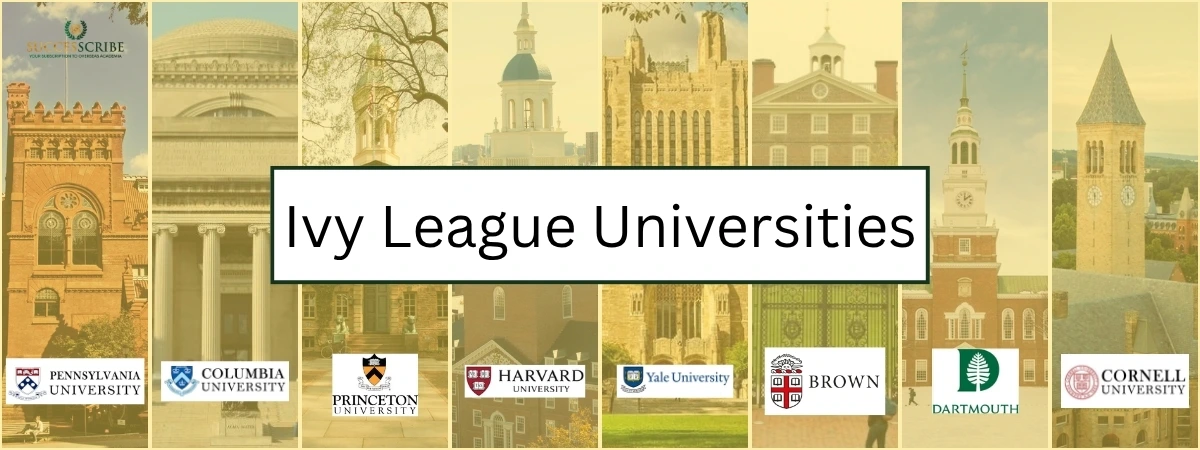
The term “Ivy League Universities” refers to a group of eight prestigious private universities in the United States, known for their academic excellence, elite reputation, and highly competitive admissions process. Originally formed as an athletic conference in 1954, the Ivy League has now become a symbol of academic prestige, global recognition, and career success. Ivy League universities consistently rank among the top 20 universities globally, attracting students from over 150+ countries. These institutions are not just about academics – they are hubs of innovation, research, leadership, and networking.
Key Highlights: Ivy League Universities
- Fast Facts: Ivy League Universities
- Why the Ivy League Still Matters
- The 8 Ivy League Universities
- Ivy League Acceptance Rates
- Cost of Studying at Ivy League Universities
- Prestigious Programs and Graduate Outcomes
- Admission Requirements for Ivy League Universities
- The “Ivy Plus” Mirage: Why Stanford and MIT Don’t Belong
- Strategic Evaluation: Pros and Cons for Indian Families
- Conclusion
- FAQs
Fast Facts: Ivy League Universities

While the “Ivy” brand is a collective hallmark, each institution operates with a distinct institutional DNA. For the strategic Indian applicant, success is not about “getting in” to any Ivy, but about aligning a student’s specific trajectory with the unique cultural architecture of the right campus.
- The Ancient Eight: Brown, Columbia, Cornell, Dartmouth, Harvard, University of Pennsylvania (Penn), Princeton, and Yale.
- Selectivity: Acceptance rates for the Class of 2029 have dipped below 4% at several institutions, with none exceeding 8.5%.
- Financial Might: Harvard University maintains the world’s largest academic endowment at $53.2 billion.
- AAU Membership: All eight are members of the Association of American Universities, an elite alliance that dictates global research standards and attracts the highest tier of faculty funding – a critical metric for Indian families prioritizing research prestige.
- Geographic Concentration: Exclusively located in the U.S. Northeast (the “Ivy Corridor”).
Want to Study in Europe?
Start your journey with Successcribe’s free expert guidance
Book a Free Session NowWhy the Ivy League Still Matters
In today’s fast-changing education landscape – where online degrees, AI learning, and skill-based hiring are growing rapidly – the Ivy League continues to stand strong. Its value in 2026 goes far beyond prestige; it’s about positioning, opportunities, and long-term impact.
1. Global Brand Recognition
An Ivy League degree acts as a powerful global brand.
- Instantly recognized by employers worldwide
- Strong credibility across industries
- Advantage in competitive job markets
Even in India, candidates from Ivy League universities often get priority consideration in top firms.
2. Faster Career Growth & Opportunities
Ivy League universities are directly connected with top global recruiters.
- 90%+ employment rate within 6 months
- Average starting salary: ₹60 lakh – ₹1+ crore/year
- Top Recruiters: Google, Microsoft, Goldman Sachs, Meta, Nvidia etc.
Students often start in high-impact roles, not entry-level positions.
3. Learning That Goes Beyond Academics
Education at Ivy League universities is interactive and practical.
- Critical thinking skills
- Problem-solving ability
- Research exposure
- Real-world application of knowledge
Focus is on “learning how to think,” not just what to study
4. Elite Alumni Network
One of the biggest long-term advantages is the strong alumni network. Includes:
- CEOs
- Entrepreneurs
- Policymakers
- Industry leaders
This network supports you throughout your career
5. Strong Return on Investment (ROI)
Despite high tuition fees, the financial returns are significant.
- High-paying job opportunities
- Fast career progression
- Global work exposure
Many students recover their investment within 3 – 5 years
6. Future-Ready Education
Ivy League universities continuously evolve to stay relevant.
- AI & Technology
- Entrepreneurship
- Interdisciplinary learning
- Global challenges (climate, economy, policy)
Students are prepared for future industries, not just current jobs
7. More Than Prestige – It’s Strategic Positioning
Ivy League matters because it places students in a different league altogether. It offers:
- High-quality exposure
- Competitive environment
Access to global opportunities
It’s not just about the name – it’s about the platform it provides
The 8 Ivy League Universities

All eight Ivy League institutions are private, non-profit universities located in the Northeastern United States. Together, they share several distinguishing characteristics: extraordinary selectivity, massive endowments, world-class faculty, and an outsized proportion of Nobel laureates, heads of state, and business leaders among their alumni.
| University | Founded | Location | QS 2026 Rank |
| Harvard University | 1636 | Cambridge, MA | #5 |
| Yale University | 1701 | New Haven, CT | #21 |
| Princeton University | 1746 | Princeton, NJ | #25 |
| Columbia University | 1754 | New York City, NY | #38 |
| University of Pennsylvania | 1740 | Philadelphia, PA | #15 |
| Brown University | 1764 | Providence, RI | #69 |
| Dartmouth College | 1769 | Hanover, NH | #247 |
| Cornell University | 1865 | Ithaca, NY | #16 |
1. Harvard University (Est. 1636)
Harvard is not only the oldest university in the United States but also one of the most recognized academic institutions in human history. Founded in Cambridge, Massachusetts, just six years after the Massachusetts Bay Colony was established, Harvard has shaped American – and global – intellectual life for nearly four centuries.
In the QS World University Rankings 2026, Harvard holds the 5th position globally. Its endowment of $53.2 billion (2024) is the largest of any private educational institution in the world. Harvard has produced 8 U.S. Presidents, 161 Nobel laureates, and 14 Turing Award winners. Its acceptance rate for the Class of 2029 fell to approximately 3.6%, making it one of the most selective universities on the planet. The university is home to 13 degree-granting schools, including the famous Harvard Business School, Harvard Medical School, Harvard Law School, and Harvard Kennedy School.
2. Yale University (Est. 1701)
Yale, located in New Haven, Connecticut, is the third-oldest university in the United States and consistently ranks among the top 25 universities globally. Its law school and drama school are regarded as the finest in their respective disciplines worldwide. The Yale School of Law has produced five U.S. Supreme Court Justices currently serving on the bench and has the lowest acceptance rate of any law school in the country at approximately 6%.
In QS 2026, Yale ranks at #21 globally. Yale’s endowment reached $40.7 billion in 2024, making it the second-wealthiest Ivy. The acceptance rate for the Class of 2029 was approximately 3.7%. Yale is well known for its residential college system – 14 residential colleges house undergraduate students, creating tight-knit communities within a large university setting.
3. Princeton University (Est. 1746)
Princeton, located in Princeton, New Jersey, occupies a unique position among the Ivies: it has no law school, no medical school, and no business school at the undergraduate level. This focus on the liberal arts and graduate studies in STEM and humanities has made Princeton consistently rank at the top of undergraduate-focused metrics. In the Times Higher Education World University Rankings 2026, Princeton rose to joint third place globally – its best-ever finish.
Princeton’s endowment stands at approximately $34.0 billion, and its spending per student is the highest of any university in the world. The QS 2026 rank is #25. Most notably, Princeton runs a purely grant-based financial aid program – no student admitted to Princeton is required to take out loans to finance their education. The acceptance rate for the Class of 2029 is approximately 4.0%.
4. Columbia University (Est. 1754)
Columbia University in the City of New York was founded as King’s College by royal charter of King George II of Britain in 1754. Located in Morningside Heights, Manhattan, Columbia offers students the unique advantage of studying in the most cosmopolitan city in the world. The Columbia Journalism School, founded in 1912 and the first institution to award the Pulitzer Prize, remains among the most prestigious journalism programs globally.
Columbia’s QS 2026 rank is #38. Its 2024 – 25 tuition and fees were among the highest of the Ivies at $71,845. With an enrollment of approximately 35,000 students (including graduate and professional programs), it is the largest Ivy by population. The Class of 2029 acceptance rate stood at approximately 3.9%.
5. University of Pennsylvania (Est. 1740)
Founded by Benjamin Franklin in 1740, the University of Pennsylvania (Penn) is the oldest research university in the United States. Home to the legendary Wharton School – established in 1881 as the world’s first business school – Penn holds an especially strong reputation in business, finance, and entrepreneurship. Wharton MBA graduates consistently rank among the highest-earning in the world.
Penn’s QS 2026 rank is #15 – the highest of any Ivy League school in the 2026 edition. Its endowment exceeds $21.4 billion. Penn achieved a perfect score in the QS Employment Outcomes indicator. The Class of 2029 acceptance rate was approximately 5.7%.
6. Brown University (Est. 1764)
Brown University, located in Providence, Rhode Island, distinguishes itself through its Open Curriculum – a philosophy introduced in 1969 that allows undergraduate students to design their own course of study without any mandatory requirements, other than the requirements of their chosen concentration. This unusual degree of academic freedom has made Brown particularly attractive to intellectually independent, creative students.
In QS 2026, Brown ranks at #69 globally. Its endowment is approximately $7.9 billion. The university’s Class of 2029 acceptance rate was approximately 5.2%. Brown applied an Early Action acceptance rate of approximately 18% for the Class of 2029, significantly higher than its Regular Decision rate.
7. Dartmouth College (Est. 1769)
Dartmouth, located in Hanover, New Hampshire, is the smallest of the Ivy League schools by enrollment and the only one to retain the name ‘College’ rather than ‘University’ – a proud tradition reflecting its emphasis on undergraduate teaching. Despite this, Dartmouth operates the Tuck School of Business, the Thayer School of Engineering, and the Geisel School of Medicine.
Dartmouth’s QS 2026 rank is #247 – lower than other Ivies – partly because QS places significant weight on research citations and international student ratios, areas where smaller, teaching-focused institutions naturally score lower. The Tuck MBA program consistently ranks among the top 10 in the United States. Dartmouth reinstated SAT/ACT requirements for the Class of 2029, bucking the test-optional trend. The acceptance rate for the Class of 2029 was approximately 6.2%.
8. Cornell University (Est. 1865)
Cornell University in Ithaca, New York, is the youngest of the Ivy League schools and arguably the most unusual: it was founded as a non-sectarian, co-educational institution with a mission to provide ‘an institution where any person can find instruction in any study’ – a radical idea in 1865. Today, Cornell is both a private and statutory institution, operating several colleges on behalf of New York State.
Cornell’s QS 2026 rank is #16 – third among the Ivies – powered by its extensive research output and high employer reputation scores. It consistently earns the highest acceptance rate among the Ivies at approximately 8.0% for the Class of 2029, and with over 25,000 students, it is the second-largest Ivy by enrollment. Cornell’s School of Hotel Administration is the finest hospitality management program in the world.
Ivy League Acceptance Rates
Getting into an Ivy League university is extremely competitive.
| University | Acceptance Rate (Estimated) |
| Harvard University | 3.5% |
| Columbia University | 3.9% |
| Princeton University | 4% |
| Yale University | 4.5% |
| Brown University | 5% |
| University of Pennsylvania | 5.5% |
| Dartmouth College | 6% |
| Cornell University | 7% |
Apply to Top European Universities
Make your application simple and stress-free with Successcribe
Get Expert Help NowCost of Studying at Ivy League Universities
Despite high costs, Ivy League universities offer generous financial aid, making them affordable for many students. The “sticker shock” of the Ivy League is undeniable, with the total cost of attendance (COA) now exceeding $90,000 annually. However, Indian families must view this through the lens of long-term ROI and the massive endowments that subsidize these costs for those who qualify.
| Expense Type | Cost (USD/year) |
| Tuition Fees | $60,000 – $85,000 |
| Living Expenses | $15,000 – $25,000 |
| Total Cost | $75,000 – $110,000 |
Scholarships & Financial Aid
Unlike many universities, Ivy League institutions primarily offer need-based financial aid.
- 50%–65% of students receive financial aid
- Families earning below $75,000/year often pay ZERO tuition
- No repayment required (not loans, mostly grants)
Prestigious Programs and Graduate Outcomes
Each Ivy League school has signature programs that hold global leadership. The table below highlights top programs at each institution, expected starting salaries, and notable alumni, giving prospective applicants a clear picture of where each university excels.
| University | Top Programs | Avg. Starting Salary (USD) | Notable Alumni |
| Harvard University | Law, Medicine, MBA, Public Policy | $90,000–$160,000 | Barack Obama, Mark Zuckerberg, Bill Gates |
| Yale University | Law, Drama, Architecture, Medicine | $80,000–$145,000 | Hillary Clinton, George W. Bush, Jodie Foster |
| Princeton University | Computer Science, Economics, Public Affairs | $85,000–$150,000 | Jeff Bezos, Michelle Obama, Alan Turing |
| Columbia University | Journalism, Engineering, Business, Law | $85,000–$155,000 | Barack Obama (transfer), Warren Buffett |
| Univ. of Pennsylvania | Wharton MBA, Engineering, Nursing | $90,000–$175,000 | Elon Musk, Donald Trump, Warren Buffett |
| Brown University | Open Curriculum, CS, Pre-Med, Economics | $75,000–$135,000 | Emma Watson, John F. Kennedy Jr., Ted Turner |
| Dartmouth College | Tuck MBA, Engineering, Liberal Arts | $80,000–$145,000 | Tim Cook (Tuck MBA), Daniel Webster, Mindy Kaling |
| Cornell University | Hotel Admin, Engineering, Agriculture, CS | $80,000–$145,000 | Bill Nye, Toni Morrison, Ruth Bader Ginsburg |
Attended but did not graduate, or affiliated via graduate school only. Starting salaries are estimates based on 2024 – 25 graduate outcomes data.
Admission Requirements for Ivy League Universities
Getting into an Ivy League university is not just about having high marks – it’s about presenting a well-rounded, exceptional profile. These universities follow a holistic admission process, meaning they evaluate who you are beyond academics.
The Academic Baseline: Rigor & GPA
A high GPA is a prerequisite, but it is the rigor of your coursework that distinguishes you. Admissions officers evaluate your transcript against the most challenging curriculum available at your specific high school.
- GPA Standards: Successful applicants typically hold an unweighted GPA of 3.9 to 4.0.
- Course Selection: You are expected to have completed the “Big Five” core subjects all four years: English, Math, Science, Social Studies, and Foreign Language.
- Advanced Tracks: Mastery of AP, IB (Higher Level), or Dual Enrollment courses is essential. By 2026, schools like Yale and Harvard specifically look for students who haven’t just “collected” APs, but have taken them in a sequence that shows a clear narrative (e.g., AP Physics C and Calculus BC for aspiring engineers).
The Great Testing Reset
As of the 2026-2027 admissions cycle, the “Test-Optional” experiment of the early 2020s has mostly ended. Six of the eight Ivy League schools now require standardized test scores.
Ideal Score Range:
| Exam | Competitive Score |
| SAT | 1450 – 1580 |
| ACT | 32 – 36 |
Extracurriculars: Depth Over Breadth
The “well-rounded” student is often passed over for the “well-angled” student. The Ivy League seeks a “Spike” -a specific area where you have achieved national or international recognition.
The Tier System of Activities:
- Tier 1 (Rare/Elite): Winning a major national competition (e.g., Regeneron ISEF, National Merit Scholar), starting a revenue-generating business, or published research in a peer-reviewed journal.
- Tier 2 (High Leadership): Student Body President, Varsity Team Captain, or founder of a community-wide non-profit with measurable impact (e.g., “raised $20,000 for local clinics”).
- Tier 3 (Standard Leadership): Club President, Eagle Scout, or Editor of the school newspaper.
- Tier 4 (Participation): General membership in clubs, local volunteering, or hobby-based interests.
The 2026 “Human Factor”: Essays and AI
With the rise of AI-assisted writing, Ivy League admissions offices have implemented sophisticated AI-detection protocols and updated their essay prompts to be more “un-Googleable.”
- Personal Statement: Must reflect high Emotional Intelligence (EQ) and specific personal growth. In 2026, “vulnerability” and “intellectual humility” are the most valued traits.
- Institutional Fit: You must answer “Why us?” with surgical precision. Mentioning specific 2026 initiatives – like Brown’s “Operational Sustainability” goals or Cornell’s “AI for Social Good” lab – is crucial to show you have done your homework.
Letters of Recommendation (LoRs)
The Ivy League has shifted toward narrative-based evaluations.
- The Sources: You typically need one counselor recommendation and two from core-subject teachers (Junior or Senior year).
- The Context: Admissions officers are looking for “Superlatives.” A letter that says “Best student in my 20-year career” carries significantly more weight than a list of your grades.
The “Ivy Plus” Mirage: Why Stanford and MIT Don’t Belong

A perennial source of confusion for applicants is the exact membership of the league. Elite institutions like Stanford, MIT, and the University of Chicago are frequently – and incorrectly – assumed to be Ivies due to their low acceptance rates and global rankings.
This confusion is often exacerbated by the “IvyPlus” exchange programs and sustainability working groups, which facilitate collaboration between the official eight and a select group of high-prestige peers. However, the membership remains a closed circle of eight.
| Official Ivy League | Commonly Mistaken “IvyPlus” Peers |
| Brown University | Stanford University |
| Columbia University | Massachusetts Institute of Technology (MIT) |
| Cornell University | University of Chicago |
| Dartmouth College | Duke University |
| Harvard University | California Institute of Technology (Caltech) |
| University of Pennsylvania | Johns Hopkins University |
| Princeton University | Northwestern University |
| Yale University | Georgetown University |
Strategic Evaluation: Pros and Cons for Indian Families
For Indian families, choosing an Ivy League university is not just an academic decision – it’s a long-term investment involving finances, career outcomes, global exposure, and personal growth. While the prestige is undeniable, it’s important to evaluate both sides with clarity and practicality.
| Pros | Cons |
| Unmatched Brand: Resonates in India and globally. | Pressure Cooker: Intense mental health strain. |
| Financial Aid: Often cheaper than private Indian unis for middle-income families. | Selectivity: 96% of qualified applicants are rejected. |
| Network: Access to a $150B+ collective endowment. | Climate: Harsh, long Northeast winters. |
Conclusion
The Ivy League remains the most potent tool for global impact. As these institutions navigate a post-Affirmative Action world, they are refocusing on individualized merit and intellectual curiosity. For the Indian student, an Ivy degree is more than a diploma; it is a catalyst. If you approach this journey not just as a search for prestige, but as a search for “fit,” the gates of the Ancient Eight remain the most transformative destination in higher education. Start early, build your spike, and lead with purpose.
FAQs
What are Ivy League universities?
Ivy League universities are a group of eight prestigious private universities in the United States, known for their academic excellence, global reputation, and selective admissions.
Is it true that some Ivies are “easier” to get into than others?
While “easy” is relative, there is a statistical difference. In 2026, Cornell University typically has the highest acceptance rate (around 7%) due to its larger undergraduate population and diverse range of colleges (like Agriculture and Industrial Labor Relations). In contrast, Harvard and Princeton consistently remain the most selective, often dipping below 4%. However, every school in the league requires a near-perfect profile.
Can I get a merit-based or athletic scholarship at an Ivy League school?
No. This is a common point of confusion. By 2026, the Ivy League Council maintains its strict policy: No merit or athletic scholarships are awarded. All financial assistance is need-based. The trade-off is that their need-based aid is the most generous in the world, often covering 100% of costs for families earning under $100,000
Are “Public Ivies” a better value in 2026?
It depends on your goals and residency. Schools like UC Berkeley, Georgia Tech, and the University of Michigan offer STEM and Engineering programs that often outrank several Ivy League schools at a lower “sticker price.” However, for careers in high finance, international law, or global diplomacy, the Ivy League’s “Permanent Network” still provides a specialized ROI that public universities struggle to match.
Which universities are part of the Ivy League?
The Ivy League includes:
1. Harvard University
2. Yale University
3. Princeton University
4. Columbia University
5. University of Pennsylvania
6. Brown University
7. Dartmouth College
8. Cornell University
Why is it called the “Ivy League”?
The name stems from the 19th-century custom of “planting the ivy” at many colleges during class day ceremonies. It was first used in reference to this group of schools by sportswriters in the 1930s, particularly Stanley Woodward in 1933, before becoming an official athletic conference in 1954
Related Post
Profile Building for University of Cambridge
Profile Building for Stanford
Profile Building for Harvard
Profile Building for Oxford