Studying abroad is no longer a luxury reserved for wealthy families. In 2025–26, more than 1.4 crore international students worldwide are enrolled in foreign universities, and over 56% depend on scholarships, government funding, or tuition-free education. For Indian students, the dream of studying abroad for free is not only possible – it is more achievable than ever before. Understanding How to Study Abroad for Free begins with identifying countries that offer tuition-free education and scholarships that cover living expenses. Countries like Germany, Norway, Finland, the Czech Republic, and France offer zero or almost-zero tuition fees, while fully funded scholarships such as DAAD, Erasmus+, Fulbright, Chevening, MEXT, KGSP, CSC, and Commonwealth cover 100% tuition fees + living expenses + airfare + health insurance.
Key Highlights – How to Study Abroad for Free
- Understanding the Concept of “Studying Abroad for Free”
- Global Trends in Tuition-Free and Low-Cost International Education
- Scholarships and Financial Aid as the Core Mechanism
- Countries Offering Low or No Tuition Fees
- Eligibility & Admission Requirements
- Application Pathways for Low-Cost International Study
- Managing Finances and Student Life Abroad
- Conclusion
- FAQs
Countries Offering Low or No Tuition Fees

Many nations across Europe and beyond have adopted tuition-free or extremely low-cost higher education models for international students. These countries prioritise academic accessibility, public-funded education, and global talent mobility. While tuition fees may be waived or significantly subsidised, students must still account for living expenses, semester contributions, and administrative charges. Understanding How to Study Abroad for Free helps you take advantage of government-funded programs that cover tuition, living expenses, and travel. Below is a refined and comprehensive presentation of the leading countries where students – especially from India – can pursue world-class education at minimal cost.
| Country | Tuition Policy & Average Fees (per semester/year) | Avg. Monthly Expenses (excluding rent, where specified) |
| Germany | Germany is one of the best answers to How to Study Abroad for Free, thanks to its tuition-free public universities. No tuition fees at most public universities for all international students. A semester fee of €250 – €350 is charged for administrative costs. Exception: Baden-Württemberg charges non-EU/EEA students €1,500/semester. | $600 – $900 USD |
| Norway | Free tuition at public universities for all international students, regardless of origin. A small semester fee of NOK 300-600 (INR 3K–5K or USD 35–60) is required. | $700 – $1,000 USD |
| Finland | Free for EU/EEA students. Non-EU/EEA students pay fees, typically €6,000 – €18,000 per year. PhD programs are often fully funded. Free for non-EU students studying in Finnish or Swedish. | €850 (USD 1,000) |
| France | Low tuition at public universities for all students. EU/EEA students pay €170/year for undergraduate. Non-EU students pay approximately €300–€800 per year. Specialized programs and grandes écoles may have higher fees. | €1,000 (USD 1,200) |
| Netherlands | Non-EU/EEA students pay €8,000–€16,000 per year. | €1,100 (USD 1,300) |
| Denmark | Free for EU/EEA students. Non-EU/EEA students pay DKK 45,000 – 120,000 ($6,670-17,800) or INR 7L–15L per year. PhD programs are fully funded. | €1,170 (USD 1,400) |
| Austria | Free for EU/EEA students. Non-EU/EEA students pay €726 per semester. A semester fee of €20–€50 is also charged. | €950 (USD 950) |
| Italy | Public universities charge between €900 – €4,000 per year. | €700 – €1,000 per month |
| Belgium | EU students pay a maximum of €906/year. Non-EU students pay €4,175 per year. | €900 (USD 1,100) |
| Poland | $400 – $4,500 USD per semester. | $400 – $900 USD |
| Greece | Free for EU/EEA students. Non-EU students pay €1,500 per year. | $350 – $800 USD |
| Czech Republic | Free for students who study in the Czech language at public universities. English-taught programs cost €4,000-12,000 or INR 2L–5L per year. | €750 (USD 900) |
| Sweden | Free for EU/EEA students. Non-EU/EEA students pay SEK 80,000 – 145,000 ($8,200-14,870) or INR 7L–17L per year for most courses. PhD programs are fully funded. | €1,000 (USD 1,200) |
| Spain | EU students pay low fees. Non-EU students pay €750 – €2,500 per year at public institutions. | €900 – €1,100 per month (total living costs). |
| Iceland | No tuition fees at four public universities for all students. A registration fee of ISK 75,000 ($600) per year is charged. | $800 – $1,000 USD |
| Argentina | Free at public universities, though international students may pay a small enrollment fee. Private institutions can cost upwards of $5,000/year. | $400 – $900 USD |
| Taiwan | Affordable tuition fees, particularly at top institutions like National Taiwan University (NTU). Around €1,000–€3,000/year Tuition Fees is charged | €400–€800 |
Suggested Post: Top countries for highest MBA salaries
Apply to Top European Universities
Make your application simple and stress-free with Successcribe
Get Expert Help NowUnderstanding the Concept of “Studying Abroad for Free”
The notion of studying abroad for free does not imply that all expenses – tuition fees, living costs, travel, books, health insurance, and visa charges – are universally waived. Instead, it refers to a combination of institutional, national, and third-party funding structures that collectively reduce or eliminate major components of educational expenditure. For anyone wondering How to Study Abroad for Free, focusing on strong academic performance and early application deadlines is crucial.
In contemporary higher education, three principal pathways define this opportunity:
- Tuition-Free Public University Systems
Certain countries – especially in Europe – provide state-funded higher education that does not charge tuition fees, even to non-EU/EEA international students.
- Fully Funded Scholarships and Fellowships
Prestigious national and institutional scholarships cover tuition, living costs, travel, and insurance.
- Low-Cost, Direct Enrollment or Exchange Programs
Students who enroll directly in public institutions or participate in university exchange partnerships avoid high intermediary fees and, in many cases, pay either reduced or home university tuition.
A realistic approach to studying abroad for free generally involves combining at least two of the above elements – for example, tuition-free university education (as in Germany or Norway) paired with a scholarship to cover living expenses.
Scholarships and Financial Aid as the Core Mechanism
Students often ask How to Study Abroad for Free, and the answer lies in combining tuition-free universities with fully funded scholarships. Scholarships constitute the most direct and effective path to studying abroad for free. These financial instruments may cover tuition, living expenses, travel, books, research-related costs, and health insurance. They are offered by governments, universities, and private organizations.
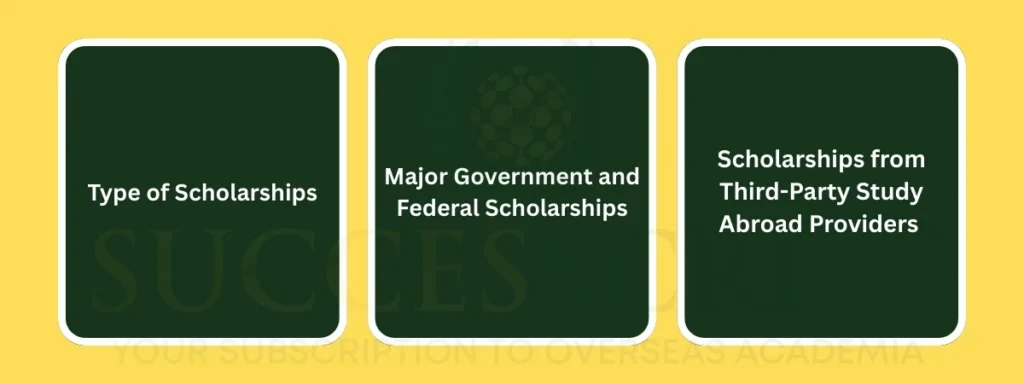
Type of Scholarhips
| Scholarship Category | Description | Typical Coverage |
| Merit-Based Scholarships | Awarded for exceptional academic achievements (e.g., GPA, board marks, GRE/GMAT scores). | Tuition fee waiver, monthly allowances. |
| Needs-Based Scholarships | For students with documented financial need. | Tuition, accommodation, travel. |
| Diversity & Inclusion Scholarships | Encourages participation of underrepresented groups. | Tuition + partial living expenses. |
| Research/Subject-Specific Scholarships | For STEM, critical languages, sustainability, public health, cybersecurity, etc. | Full funding for research and lab fees. |
| Government-Funded Scholarships | Offered by national governments to support education abroad or attract foreign students. | Fully funded packages including stipends. |
Major Government and Federal Scholarships
| Scholarhsip Name | Description & Focus | Target Audience | Estimated Funding / Benefits |
| DAAD (Germany) | Funds undergraduate, graduate, and doctoral-level study in Germany. | International students | Tuition-free + €934/month (INR 85K approx). |
| Erasmus Mundus Joint Masters | Multi-country master’s degree programs. | All nationalities | Full tuition, travel, visa fees, monthly stipend (€1,100). |
| Eiffel Excellence Scholarship (France) | Prestigious French govt. scholarship for master’s & PhD. | International students | €1,181/month (INR 1L). |
| Swedish Institute Scholarships | Fully funded master’s programs in Sweden. | Non-EU/EEA students | Full tuition + SEK 12,000/month stipend. |
| ARES (Belgium) | Programs in priority sectors. | Students from developing nations | Monthly stipend €1,100. |
| OeAD (Austria) | Research and degree scholarships. | International students | €900/month stipend. |
| Danish Government Scholarship | Merit-based for non-EU/EEA students. | Graduate students | Tuition waiver + living grant. |
| Holland Scholarship | First-year support for international students. | Non-EU/EEA students | €5,000–€10,000 for one year. |
| Boren Awards | For critical language study. | U.S. students | Up to $25,000. |
| Gilman International Scholarship | Pell Grant recipients studying abroad. | U.S. undergraduates | Up to $5,000. |
| Fulbright Grant | Research or study in 140+ countries. | Graduate scholars | Tuition + monthly stipend + airfare. |
Scholarships from Third-Party Study Abroad Providers
Many international students reduce their study-abroad expenses by applying for third-party scholarships offered by global study-abroad providers, NGOs, private organizations, and international education agencies. These scholarships are independent of universities and governments, making them accessible to students from all academic backgrounds. What makes these scholarships attractive is that they often cover tuition fees, accommodation, flights, insurance, and living expenses, depending on the provider.
| Scholarship Provider | Scholarship Name | Coverage | Eligibility Highlights |
| CIEE (Council on International Educational Exchange) | CIEE Scholarships & Grants | Up to 100% tuition, travel grants, housing assistance | Enrolled in an approved CIEE program; financial need or academic merit |
| AIFS (American Institute for Foreign Study) | AIFS Study Abroad Scholarships | Up to USD 5,000 | Academic merit, financial need, statement of purpose |
| IES Abroad | IES Abroad Grants & Scholarships | Up to USD 6,500, housing stipends | Minimum GPA 2.75+, accepted into IES program, financial need |
| DAAD (Independent International Applicants) | DAAD Private Scholarships | Monthly stipend up to EUR 934, travel & insurance | Strong academic performance, relevant study plan |
| Fulbright (Non-Degree Programs) | Fulbright Travel Grants | Travel + living costs | U.S.–based students applying for research/study |
| The Global Study Grants | Global Study Award | Up to GBP 10,000 | Demonstrated academic achievement & motivation to study internationally |
| British Council & Partner NGOs | GREAT Scholarships (Third-Party Funded) | Up to GBP 10,000 | Indian students applying for UK universities; program-specific |
Key Advantages of Third-Party Scholarships
- Accept students from any university or country.
- Many do not require perfect academic scores.
- Provide flexible coverage (tuition, travel, housing, or living expenses).
- Ideal for students applying for multiple destinations abroad.
Suggested Post: Letter of recommendation for study abroad
Global Trends in Tuition-Free and Low-Cost International Education
Between 2020 and 2025, several governments strengthened policies to internationalize their higher education sectors. Concurrently, scholarship budgets in Europe, East Asia, and North America expanded to attract global talent, addressing national skill shortages in areas such as data science, engineering, sustainability, health sciences, and critical foreign languages.
1. Rise of State-Subsidized Education
Countries such as Germany, Norway, Iceland, and Argentina continue to maintain tuition-free public university structures. In 2025, Germany reported that over 375,000 international students were enrolled in its universities, many benefiting from tuition-free education.
2. Increased Funding for International Scholarships
Programs like Erasmus Mundus, DAAD, Fulbright, the Eiffel Excellence Scholarship, and the Swedish Institute Scholarship report annual increases in both funding and international student acceptance.
3. Strategic Skill Development Policies
Nations experiencing talent shortages – Germany, Finland, Sweden, and Denmark – use tuition reduction strategies or fully funded PhD programs to attract global students to STEM and research-intensive fields.
Eligibility & Admission Requirements for Study Abroad for Free
Studying abroad – especially in low-cost or tuition-free destinations – requires meeting specific academic, language, and documentation requirements. A clear understanding of the eligibility rules is the first step for students exploring How to Study Abroad for Free, as universities and scholarship bodies expect strong academic performance. Although criteria vary from country to country and university to university.
1. Academic Eligibility Requirements
Eligibility depends mainly on the degree level – Bachelor’s or Master’s.
| Degree Level | Academic Requirements |
| Undergraduate (Bachelor’s) | Completed Class 12th from a recognized board (CBSE, ISC, State Boards, IB, Cambridge).Minimum GPA/Percentage: 65%–75% depending on country & university.Entrance exams may apply (e.g., TestAS for Germany, SAT/ACT for U.S. optional universities).Some countries require Mathematics or specific subjects for STEM courses. |
| Postgraduate (Master’s) | A recognized Bachelor’s degree (3 – 4 years) in a relevant field.Minimum GPA: 2.5–3.0 / 4.0 scale (60%+).Standardized tests: GRE/GMAT (only for selective programs).Some countries require subject-specific prerequisites (e.g., programming for CS degrees). |
English Language Proficiency Requirements
Most English-taught programs require IELTS, TOEFL, or equivalent. Below is the country-wise proficiency requirement table, cleaned and formatted.
| Country | IELTS Requirement | TOEFL iBT Requirement |
| Germany | 6.0 – 6.5 | 80 – 90 |
| Norway | 6.5 – 7.0 | 90 – 100 |
| Finland | 6.0 – 6.5 | 79 – 92 |
| Sweden | 6.5 – 7.0 | 90 – 100 |
| Austria | 6.0 – 6.5 | 80 – 90 |
| Czech Republic | 5.5 – 6.5 | 70 – 90 |
| France | 6.0 – 7.0 | 80 – 100 |
| Belgium | 6.0 – 6.5 | 80 – 90 |
| Denmark | 6.5 – 7.0 | 90 – 100 |
| Netherlands | 6.5 – 7.0 | 90 – 100 |
Additional Language Requirements (for Non-English Programs)
Some countries offer free tuition only in their local language, requiring proficiency certificates.
| Country | Language Requirement | Accepted Tests/Levels |
| Germany | German for tuition-free bachelor’s programs | Goethe C1 |
| Czech Republic | Czech language for free public university programs | B2–C1 level (University-specific tests) |
| Finland | Finnish/Swedish for tuition-free programs for Non-EU | YKI Test (Level 3–4) |
| France | French for many undergraduate programs | DELF B2 / DALF C1 |
| Austria | German language proficiency | ÖSD B2 / C1 |
Required Application Documents
To be eligible for admission, students must prepare a complete set of documents. Here is the polished document checklist:
| Document Type | Details Required |
| Academic Transcripts | Class 10, Class 12, Bachelor’s degree marksheets and certificates |
| Language Score | IELTS/TOEFL/PTE |
| SOP (Statement of Purpose) | Explains academic background, goals & reasons for choosing the program |
| Letters of Recommendation (LORs) | 1–3 recommendations from teachers or professors |
| CV/Resume | Updated with academics, skills, and work experience (if any) |
| Passport | Valid for at least 1–2 years depending on country |
| Portfolio | Required for design, architecture, arts programs |
| Entrance Exam Score | GRE/GMAT/SAT/TestAS (if applicable) |
| Financial Proof for Visa | Bank balance, blocked account, or sponsorship documents |
Admission Process (Step-by-Step)
Here is a polished and structured version of the admission process you shared:
| Step | Process Description |
| 1. Research & Shortlisting | Identify tuition-free/low-cost countries and check eligibility criteria and deadlines. |
| 2. Document Preparation | Prepare transcripts, language scores, SOP, LORs, resume, and portfolio (if needed). |
| 3. Submit University Application | Apply directly or via platforms like Uni-Assist (Germany). |
| 4. Scholarship Applications | Apply for government, university, and private funding options simultaneously. |
| 5. Receive Offer & Prepare Visa | Submit financial proof, health insurance, and university acceptance for visa approval. |
| 6. Pre-Departure Preparation | Book accommodation, travel, and prepare for international relocation. |
Suggested Post: Letter of recommendation for study abroad
Application Pathways for Low-Cost International Study
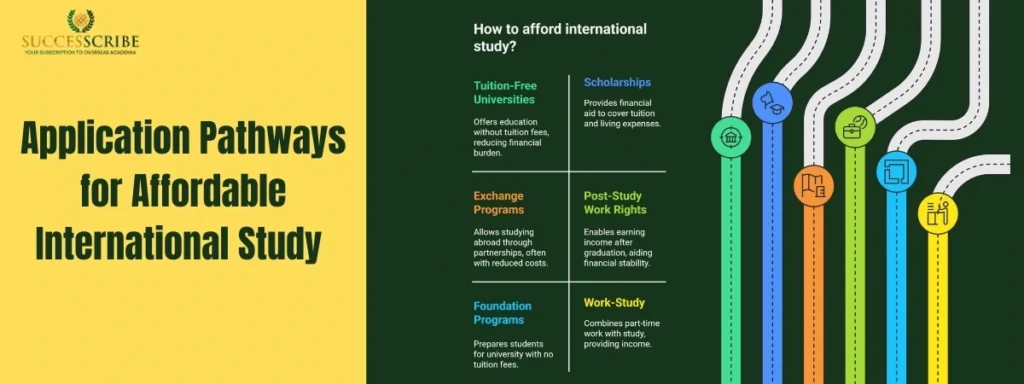
For students seeking a financially sustainable pathway to study abroad, it is essential to understand the various application channels, admission models, funding routes, and cost-reduction strategies that different countries offer. The application process varies significantly depending on destination, level of study, and the structure of the higher-education system.
1. Apply to Tuition-Free or Low-Fee Public Universities
Many European countries – like Germany, Norway, Austria, Finland, and France – offer public universities with zero or very low tuition fees for international students.
Students only need to cover semester contributions (INR 15,000–35,000), which often include transportation and student services.
- Best for: Bachelor’s & Master’s students
- Key Requirement: Strong academic profile + language proficiency (English/German/French depending on the program)
2. Use Fully Funded Scholarship Pathways
Scholarships cover tuition fees and in many cases, even living costs.
Major scholarship categories:
- Government-funded scholarships:
DAAD (Germany), Eiffel Excellence (France), Swedish Institute Scholarship, Chevening (UK), Fulbright (USA).
- University-funded scholarships:
Uppsala Global Scholarship, University of Helsinki Scholarship, ETH Zurich Excellence Scholarship.
- Private/NGO scholarships:
Erasmus+ Mobility Grants, Commonwealth Scholarships, Joint Japan–World Bank Scholarship.
Best for: Students with strong academics, research background, or leadership experience.
3. Enroll Through Exchange & Mobility Programs
Exchange programs allow students to study abroad for 1–2 semesters at heavily discounted or fully waived tuition fees.
Popular mobility programs (2025–26):
- Erasmus+ Mobility Grant (Europe)
- DAAD Exchange Scholarships (Germany)
- U.S.–India Undergraduate Exchange Program
Best for: Students already enrolled in a college in home country.
4. Choose Countries Offering Post-Study Work Rights
Several affordable study destinations – Germany, France, New Zealand, Ireland, Finland, Norway – allow 1–3 years of post-study work, helping students manage living costs and gain international experience.
Best for: Those planning long-term career growth.
5. Apply for No-Tuition Foundation or Pathway Programs
Some European universities offer free or low-fee preparatory programs that lead to admission into bachelor’s or master’s courses.
Examples:
- Studienkolleg (Germany) – often free at public institutions
- Foundation Year at public universities in France, Norway, Czech Republic
Best for: Students who don’t meet direct entry requirements.
6. Work-Study Pathway (Part-Time Jobs While Studying)
Most affordable countries allow part-time work for international students:
- Germany: 20 hours/week
- France: 964 hours/year
- Finland & Norway: 20 hours/week
Part-time earnings help reduce living costs significantly.
Best for: Students who want financial flexibility.
Suggested Post: Average salary after masters in Germany
Managing Finances and Student Life Abroad
Beyond tuition, managing daily living costs is paramount. Strategic budgeting and leveraging student-specific resources can significantly reduce financial strain.
Practical Money-Saving Strategies
- Budgeting: Create a detailed monthly budget and track expenses. Overestimate expenditures to account for unexpected costs.
- Housing: Opt for shared accommodation with roommates or university dormitories to save on rent.
- Food: Cook meals at home and purchase local food at markets rather than eating out frequently, especially at Western-style restaurants.
- Work-Study: In many destinations, students can work part-time (up to 20 hours/week during term time and 40 hours during holidays) to supplement their income.
- Financial Aid Utilization: U.S. students receiving Federal Pell Grants may be able to apply this aid to their study abroad program. Some providers, like SIT Study Abroad, offer matching funds for Pell recipients.
- Student Discounts: Use a student ID to get significant discounts at restaurants, bars, museums, cinemas, and on public transport.
- Free Activities: Take advantage of free cultural activities like visiting museums, exploring historic city centers, and hiking in local parks.
Conclusion
Studying abroad for free is not just a possibility – it is a real and achievable opportunity for students who plan smartly and act early. With tuition-free universities, fully funded scholarships, and affordable study destinations, the world now offers more accessible pathways than ever before. Knowing How to Study Abroad for Free can help students from middle-class families achieve their dream of studying overseas without financial pressure. By choosing the right country, preparing strong applications, meeting language requirements, and applying to multiple scholarships, any student can unlock a world-class education without financial stress. More than saving money, this journey builds global exposure, confidence, and long-term career advantages that stay with you for life.
FAQs
Is it really possible to study abroad for free in 2026?
Yes. Many countries like Germany, Norway, Finland, France, and Austria offer free or highly subsidized education at public universities. With the right scholarships, students can also cover living expenses, making the entire journey nearly cost-free.
What does a “Fully Funded Scholarship” typically cover?
A fully funded scholarship (e.g., Chevening, MEXT, Fulbright) covers 100% of the major costs, including: Tuition fees + Monthly Living Stipend + Airfare + Health Insurance.
What is the difference between tuition-free and fully funded?
Tuition-Free means the university doesn’t charge tuition, but you must still pay for your living costs (rent, food, etc.). Fully Funded means a scholarship covers both tuition and living costs, making the experience truly free.
Which courses have the highest chances of getting a scholarship?
Fields in high global demand, such as:
1. Computer Science & IT
2. Engineering (Mechanical, Electrical, Civil)
3. Data Science & AI
4. Business Analytics
5. Healthcare
6. Renewable Energy
7. Biotechnology
Governments fund these due to skill shortages.
Does studying abroad for free guarantee a job?
No guarantee, but students in countries like Germany, Norway, the UK, Canada, and Australia get strong job opportunities due to post-study work visas and skill shortages.
1. Success depends on:
2. Your field of study
3. Internships
4. Language skills
5. Networking
6. Academic performance
Related Post
which engineering branch is best for future
Best medical courses in the world
Jobs and salary after MBA in UK
Highest paying MBA specialization